www.unicomlearning.com 
Topic: LEADING WITH QUALITY 
Speaker Name: PRASANNA VEE 
Speaker Designation: Founder 
Company: CrawlPal
Agenda www.unicomlearning.com 
• What is Quality? 
• Quality Control Vs. Quality Assurance 
• Defect Prevention Vs. Defect Detection 
• Next Generation Testing 
• The Agile Tester
www.unicomlearning.com 
What is Quality?
Definition of Quality 
• Quality of Customer Experience 
– How well the functionality and end-to-end experience meets or exceeds customer 
expectations under actual usage 
– Do customers feel the product or service is consistently Reliable, Responsive, Compatible, 
Secure, aesthetically pleasing, and easy to use? 
• Quality of Engineering 
– How effectively the architecture, design, code, testing, and integration meet high 
engineering standards and product requirements 
Quality of Customer Experience 
Reliability Performance Compatibility 
Security Completeness Usability 
Aesthetics Market Relevance Availability 
Supportability Manageability … 
Quality of Engineering 
Architectural 
Quality 
Code Quality Design Quality 
Agility Cost Effectiveness Defect Rate 
Integration Maintainability Operational Cost 
Resiliency Testability … 
November 10, 2014 4
Quality of Customer Experience 
 What is Quality? 
“Delighting the customer by fully meeting their needs and expectations” 
 What does Quality Include? 
–Functionality, Performance, Reliability, Availability, Usability/User Experience, Maintainability 
 Why is Quality Critical? 
Ariane 5 example, Disappearing Warehouse, McAfee 5958 example 
 How to accomplish Total Quality? 
“Quality is the result of a carefully constructed cultural environment. It has to 
be the fabric of the organization, not part of the fabric.” -Philip Crosby 
The bottom line: Make customer experience the fabric of your organization. 
 Be a Customer Champion – Customer Empathy competency 
Goal: Making the Quality of the customer experience THE reason for 
purchasing your product/service over competition. 
November 10, 2014 5
Quality of Engineering 
• Product Engineering Quality 
– How effective is each filter at 
finding the right defects at the right 
time? 
– How early do we remove defects? 
– How efficient are the Testing 
efforts? 
– Is this release or milestone better 
than previous releases? By how 
much? 
– What is the cost, benefit, and risk 
analysis for each fix? 
November 10, 2014 6
Quality – A Hub & Spoke model 
Who owns Quality? 
Program Support 
Management 
Customers & 
Partners 
Sustained 
Engg 
Product 
Mgmt 
Quality 
Development QA 
7 
Everyone!
www.unicomlearning.com 
Quality Control 
vs 
Quality Assurance
November 10, 2014 9
QA Vs QC 
Quality Control Quality Assurance 
A failure detection system that uses a testing 
technique to identify errors or flaws in products 
and tests the end products at specified 
intervals. 
A failure prevention system that continually 
checks the product quality and then takes steps 
to control and prevent flawed products or 
services from reaching the advanced stages of 
development cycle 
A series of analytical measurements used 
to assess the implementation of the 
requirements & non-existence of unwanted 
behavior 
 An overall management plan to guarantee 
the Quality & Integrity of the System 
More of a Reactive Approach 
Typical Software ‘Testing’ is a Quality Control 
mechanism 
More of a Proactive Approach 
Building an ecosystem where bug prevention and a 
quality culture are inherent in the development 
lifecycle 
Constant and Continuous focus on Quality 
Toyota Example 
Quality Control is more about the Product itself Quality Assurance is more about the Process 
November 10, 2014 10
Top Quality Principles 
• Detect more defects closer to the phase of the product cycle 
where the defect was introduced rather than later in the cycle. 
• Products should be designed from the start with quality in mind. 
• Build Quality into the Development Process 
• It helps with detecting product bugs as early as possible, prior to 
implementation. 
• System Testing alone is not sufficient to Ensure Quality 
• Test Team can never find all the defects 
• Example: VE + IE memory leak issue 
• Quality Should be controlled at every node of a Development 
process 
D.R.P principle: Detect early, Reduce and Prevent Defects! 
November 10, 2014 11
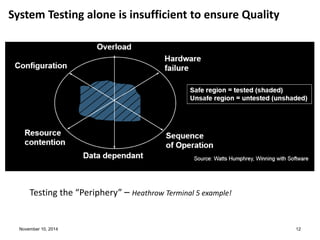
System Testing alone is insufficient to ensure Quality 
Testing the “Periphery” – Heathrow Terminal 5 example! 
November 10, 2014 12
www.unicomlearning.com 
Defect Detection 
vs 
Defect Prevention
Why Prevent Defects? – We have a QA team! 
“In the beginning of a malady it is easy to cure but difficult to detect, but in the 
course of time, not having been either detected or treated in the beginning, it 
becomes easy to detect, but difficult to cure.” 
-Machiavelli 
November 10, 2014 14
Defect Lifecycle : Early, Late & Too late 
 Early 
 Found in early development activities like: Static Code Analysis, Personal Reviews, Peer 
Reviews, Unit testing 
 Tracked through tools like Code Collaborator , Early Defect Recorder or Coverity Static 
Analysis Tool etc., 
 Late 
 Found after the code reaches System Testing, Integration Testing, Beta Testing etc., 
 Tracked through Bugzilla and other similar defect management tools 
 Too Late 
 Found by the Customer – either external or internal partner product 
November 10, 2014 15
Shifting to Early Defect Discovery 
Hours 
Early Late Too Late 
Early and Efficient Defect Removal is Key to Quality and Productivity 
November 10, 2014 16
How can Test team help in PREVENTING defects? 
 Participate in Code Reviews & Design Reviews 
 Review Requirements with Quality in mind 
 Validate Unit Testing 
 Are the unit tests making optimal use of the common harness, tools and libraries? 
 Do the unit test-cases overlap with your test-cases that can be avoided? 
 Customer Focus 
 Look into Customer issues and Support issues. 
 Test often has a better view of how the component actually works and is consumed 
by partners and customers. 
 Test has an opportunity to call out unwanted side effects of a change 
 Root Cause Analysis 
Learn From Mistakes to Prevent in the future 
 The Five Why’s of Toyota 
November 10, 2014 17
From TEST plan to QUALITY Plan.. 
Test Plan: a plan that details how the 
test team will measure the quality of 
the product is and report it back to the 
team 
Quality Plan: a plan that explains 
how various people working on a 
feature will work together to ensure 
it’s delivered with high quality 
 Quality isn’t just the responsibility of a single person 
 Quality Plans don’t have a single author. Rather, multiple people can contribute to 
them at various points throughout the feature development cycle 
 Dev, Test and PM’s work together on a Unified Quality strategy 
 Development: will describe how they plan to validate the code before committing 
changes, which scenarios will be covered by pre-check-in tests, any testability 
considerations in the code, etc. 
 Test team: will describe the additional testing to be done post-check-in and any 
other processes, procedures, test tools, to be used to get the job done. 
 This ensures Quality from Day one! 
November 10, 2014 18
Summary: The Flow of Quality 
Quality Plans 
• Define the 
Team Goals 
• Identify the 
KPI’s to be 
measured 
• Baseline 
from 
previous or 
similar 
releases 
• Commit to 
not only 
features but 
Quality 
Early 
Identification 
Test 
Execution 
Quality 
Reviews 
High 
Quality 
Release 
• Implement 
and utilize 
tools to do 
the work. 
• Peer Reviews, 
Unit tests, 
Static 
Analysis – 
Early Defect 
Discovery 
• Security 
reviews 
• Progress to 
Quality Plan 
• Quality Heat 
maps to 
identify 
hotspots and 
action items 
• Data Driven 
Frequent 
Project 
Quality 
Reviews to 
assess Risk & 
Readiness 
• Build off early 
identification 
quality 
• Automated 
instead of 
manual 
• Exploratory 
Testing 
focused on 
system and 
integration 
• Builds 
Customer 
Confidence 
• Reduces 
expenses 
• Drives 
Increased 
Revenue 
• Allows for 
more 
Innovation 
• Unsettles 
Competition 
19 November 10, 2014
www.unicomlearning.com 
Next Generation Testing
Critical Shifts towards Engineering Excellence 
• Problems with Manual Testing 
• Not easily repeatable 
• Very Effort Intensive 
• How long will it take to ‘re-run’ all the tests? 
• How often can you run it? 
• “Effective” & “Efficient” Automation 
Solution: Decrease 
amount of Manual 
Testing 
• Lower maintenance: Minimal cost from extending test cases 
• Maximum ROI 
• Finds issues that cannot be found through Manual testing 
• Increased Coverage 
• Good Code coverage through System Testing 
• Lot of White Box testing 
– Understand code changes 
– Smarter approach to what needs to be tested 
November 10, 2014 21
Critical Shifts towards Engineering Excellence [cont.] 
• Employ Intelligent Testing techniques 
– Equivalence Class Partitioning 
– Pairwise Testing 
– Model Based Testing 
• More focus on Non-functional Testing 
– Performance Testing 
– Security Testing 
• Move away from being Quality Police! 
– Quality is a team wide effort 
• Test Early, Test Often 
• Keep in touch with latest Tools & Technologies 
November 10, 2014 22
www.unicomlearning.com 
The Agile Tester
How does Agile change the tester’s role? 
Traditional Testing 
– In traditional methods, Test’s role is to expose risks in the system and 
communicate them to management, who can then make informed 
release decisions 
– In a sense, Test actively Verifies that product does not have any 
defects and exposes the risks to the management & to be addressed 
by Developers to make the product/service production ready 
Agile Testing 
– In Agile methods, Test team is still responsible for exposing and 
communicating risks, but Test also gets involved in the communication 
of specifications to developers via automated “acceptance” tests 
– In a sense, Test actively Ensures that the product meets the 
specification by putting the spec in terms that developers understand 
– failing tests 
Moving from Verifying Quality to Ensuring Quality 
N2o4vember 10, 2014
How does Agile change the tester’s role? 
Traditional Testing 
– Quality Police: Test’s responsibility is 
to be an impartial observer who 
reports findings to management 
– Not my job: Test is not responsible for 
making the code match the spec – 
bugs are a developer’s problem 
– Inspection: By definition, occurs after 
the code is written 
– Combative: Success is measured by 
number of bugs found, which creates 
a combative relationship with Dev 
– “There is a bug in your component.” 
Agile Testing 
– Equal Partner: Test’s responsibility is 
to collaborate with rest of team to 
build a quality system 
– All for one: Test becomes a full-fledged 
member of the team – a bug 
is a failure of a test to communicate 
– Injection: By definition, occurs before 
the code is written 
– Collaborative: Success is measured by 
consistent delivery of running 
software to business 
– “Can you help me figure out why this 
test is failing?” 
N2o5vember 10, 2014
www.unicomlearning.com 
Topic: 
Thank You 
Speaker name: Prasanna Vee 
Email ID: studoo@gmail.com 
Organized by 
UNICOM Trainings & Seminars Pvt. Ltd. 
contact@unicomlearning.com
www.unicomlearning.com 
Appendix

Leading with Quality

  • 1.
    www.unicomlearning.com Topic: LEADINGWITH QUALITY Speaker Name: PRASANNA VEE Speaker Designation: Founder Company: CrawlPal
  • 2.
    Agenda www.unicomlearning.com •What is Quality? • Quality Control Vs. Quality Assurance • Defect Prevention Vs. Defect Detection • Next Generation Testing • The Agile Tester
  • 3.
  • 4.
    Definition of Quality • Quality of Customer Experience – How well the functionality and end-to-end experience meets or exceeds customer expectations under actual usage – Do customers feel the product or service is consistently Reliable, Responsive, Compatible, Secure, aesthetically pleasing, and easy to use? • Quality of Engineering – How effectively the architecture, design, code, testing, and integration meet high engineering standards and product requirements Quality of Customer Experience Reliability Performance Compatibility Security Completeness Usability Aesthetics Market Relevance Availability Supportability Manageability … Quality of Engineering Architectural Quality Code Quality Design Quality Agility Cost Effectiveness Defect Rate Integration Maintainability Operational Cost Resiliency Testability … November 10, 2014 4
  • 5.
    Quality of CustomerExperience  What is Quality? “Delighting the customer by fully meeting their needs and expectations”  What does Quality Include? –Functionality, Performance, Reliability, Availability, Usability/User Experience, Maintainability  Why is Quality Critical? Ariane 5 example, Disappearing Warehouse, McAfee 5958 example  How to accomplish Total Quality? “Quality is the result of a carefully constructed cultural environment. It has to be the fabric of the organization, not part of the fabric.” -Philip Crosby The bottom line: Make customer experience the fabric of your organization.  Be a Customer Champion – Customer Empathy competency Goal: Making the Quality of the customer experience THE reason for purchasing your product/service over competition. November 10, 2014 5
  • 6.
    Quality of Engineering • Product Engineering Quality – How effective is each filter at finding the right defects at the right time? – How early do we remove defects? – How efficient are the Testing efforts? – Is this release or milestone better than previous releases? By how much? – What is the cost, benefit, and risk analysis for each fix? November 10, 2014 6
  • 7.
    Quality – AHub & Spoke model Who owns Quality? Program Support Management Customers & Partners Sustained Engg Product Mgmt Quality Development QA 7 Everyone!
  • 8.
  • 9.
  • 10.
    QA Vs QC Quality Control Quality Assurance A failure detection system that uses a testing technique to identify errors or flaws in products and tests the end products at specified intervals. A failure prevention system that continually checks the product quality and then takes steps to control and prevent flawed products or services from reaching the advanced stages of development cycle A series of analytical measurements used to assess the implementation of the requirements & non-existence of unwanted behavior  An overall management plan to guarantee the Quality & Integrity of the System More of a Reactive Approach Typical Software ‘Testing’ is a Quality Control mechanism More of a Proactive Approach Building an ecosystem where bug prevention and a quality culture are inherent in the development lifecycle Constant and Continuous focus on Quality Toyota Example Quality Control is more about the Product itself Quality Assurance is more about the Process November 10, 2014 10
  • 11.
    Top Quality Principles • Detect more defects closer to the phase of the product cycle where the defect was introduced rather than later in the cycle. • Products should be designed from the start with quality in mind. • Build Quality into the Development Process • It helps with detecting product bugs as early as possible, prior to implementation. • System Testing alone is not sufficient to Ensure Quality • Test Team can never find all the defects • Example: VE + IE memory leak issue • Quality Should be controlled at every node of a Development process D.R.P principle: Detect early, Reduce and Prevent Defects! November 10, 2014 11
  • 12.
    System Testing aloneis insufficient to ensure Quality Testing the “Periphery” – Heathrow Terminal 5 example! November 10, 2014 12
  • 13.
  • 14.
    Why Prevent Defects?– We have a QA team! “In the beginning of a malady it is easy to cure but difficult to detect, but in the course of time, not having been either detected or treated in the beginning, it becomes easy to detect, but difficult to cure.” -Machiavelli November 10, 2014 14
  • 15.
    Defect Lifecycle :Early, Late & Too late  Early  Found in early development activities like: Static Code Analysis, Personal Reviews, Peer Reviews, Unit testing  Tracked through tools like Code Collaborator , Early Defect Recorder or Coverity Static Analysis Tool etc.,  Late  Found after the code reaches System Testing, Integration Testing, Beta Testing etc.,  Tracked through Bugzilla and other similar defect management tools  Too Late  Found by the Customer – either external or internal partner product November 10, 2014 15
  • 16.
    Shifting to EarlyDefect Discovery Hours Early Late Too Late Early and Efficient Defect Removal is Key to Quality and Productivity November 10, 2014 16
  • 17.
    How can Testteam help in PREVENTING defects?  Participate in Code Reviews & Design Reviews  Review Requirements with Quality in mind  Validate Unit Testing  Are the unit tests making optimal use of the common harness, tools and libraries?  Do the unit test-cases overlap with your test-cases that can be avoided?  Customer Focus  Look into Customer issues and Support issues.  Test often has a better view of how the component actually works and is consumed by partners and customers.  Test has an opportunity to call out unwanted side effects of a change  Root Cause Analysis Learn From Mistakes to Prevent in the future  The Five Why’s of Toyota November 10, 2014 17
  • 18.
    From TEST planto QUALITY Plan.. Test Plan: a plan that details how the test team will measure the quality of the product is and report it back to the team Quality Plan: a plan that explains how various people working on a feature will work together to ensure it’s delivered with high quality  Quality isn’t just the responsibility of a single person  Quality Plans don’t have a single author. Rather, multiple people can contribute to them at various points throughout the feature development cycle  Dev, Test and PM’s work together on a Unified Quality strategy  Development: will describe how they plan to validate the code before committing changes, which scenarios will be covered by pre-check-in tests, any testability considerations in the code, etc.  Test team: will describe the additional testing to be done post-check-in and any other processes, procedures, test tools, to be used to get the job done.  This ensures Quality from Day one! November 10, 2014 18
  • 19.
    Summary: The Flowof Quality Quality Plans • Define the Team Goals • Identify the KPI’s to be measured • Baseline from previous or similar releases • Commit to not only features but Quality Early Identification Test Execution Quality Reviews High Quality Release • Implement and utilize tools to do the work. • Peer Reviews, Unit tests, Static Analysis – Early Defect Discovery • Security reviews • Progress to Quality Plan • Quality Heat maps to identify hotspots and action items • Data Driven Frequent Project Quality Reviews to assess Risk & Readiness • Build off early identification quality • Automated instead of manual • Exploratory Testing focused on system and integration • Builds Customer Confidence • Reduces expenses • Drives Increased Revenue • Allows for more Innovation • Unsettles Competition 19 November 10, 2014
  • 20.
  • 21.
    Critical Shifts towardsEngineering Excellence • Problems with Manual Testing • Not easily repeatable • Very Effort Intensive • How long will it take to ‘re-run’ all the tests? • How often can you run it? • “Effective” & “Efficient” Automation Solution: Decrease amount of Manual Testing • Lower maintenance: Minimal cost from extending test cases • Maximum ROI • Finds issues that cannot be found through Manual testing • Increased Coverage • Good Code coverage through System Testing • Lot of White Box testing – Understand code changes – Smarter approach to what needs to be tested November 10, 2014 21
  • 22.
    Critical Shifts towardsEngineering Excellence [cont.] • Employ Intelligent Testing techniques – Equivalence Class Partitioning – Pairwise Testing – Model Based Testing • More focus on Non-functional Testing – Performance Testing – Security Testing • Move away from being Quality Police! – Quality is a team wide effort • Test Early, Test Often • Keep in touch with latest Tools & Technologies November 10, 2014 22
  • 23.
  • 24.
    How does Agilechange the tester’s role? Traditional Testing – In traditional methods, Test’s role is to expose risks in the system and communicate them to management, who can then make informed release decisions – In a sense, Test actively Verifies that product does not have any defects and exposes the risks to the management & to be addressed by Developers to make the product/service production ready Agile Testing – In Agile methods, Test team is still responsible for exposing and communicating risks, but Test also gets involved in the communication of specifications to developers via automated “acceptance” tests – In a sense, Test actively Ensures that the product meets the specification by putting the spec in terms that developers understand – failing tests Moving from Verifying Quality to Ensuring Quality N2o4vember 10, 2014
  • 25.
    How does Agilechange the tester’s role? Traditional Testing – Quality Police: Test’s responsibility is to be an impartial observer who reports findings to management – Not my job: Test is not responsible for making the code match the spec – bugs are a developer’s problem – Inspection: By definition, occurs after the code is written – Combative: Success is measured by number of bugs found, which creates a combative relationship with Dev – “There is a bug in your component.” Agile Testing – Equal Partner: Test’s responsibility is to collaborate with rest of team to build a quality system – All for one: Test becomes a full-fledged member of the team – a bug is a failure of a test to communicate – Injection: By definition, occurs before the code is written – Collaborative: Success is measured by consistent delivery of running software to business – “Can you help me figure out why this test is failing?” N2o5vember 10, 2014
  • 26.
    www.unicomlearning.com Topic: ThankYou Speaker name: Prasanna Vee Email ID: studoo@gmail.com Organized by UNICOM Trainings & Seminars Pvt. Ltd. contact@unicomlearning.com
  • 27.