Openness and praxis:
Exploring the use of
open educational practices
in higher education
Catherine Cronin
CELT, NUI Galway
@catherinecronin
slideshare.net/cicronin
Society for Research into Higher Education
Digital University Network
18-Nov-2016 #SRHE
Image: CC0 1.0 cogdog
Education is inherently an
ethical and political act.
Michael Apple
summary of 1st phase
of my PhD research study:
exploring the use of
open educational practices (OEP)
in higher education
• Context
• Research Questions
• Key Literature
• Methodology
• Findings & Analysis
• Preliminary Conclusions
& Questions
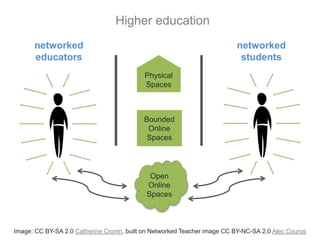
networked
educators
networked
students
Physical
Spaces
Bounded
Online
Spaces
Open
Online
Spaces
Image: CC BY-SA 2.0 Catherine Cronin, built on Networked Teacher image CC BY-NC-SA 2.0 Alec Couros
Higher education
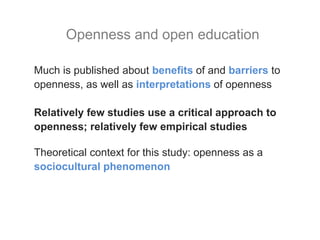
Much is published about benefits of and barriers to
openness, as well as interpretations of openness
Relatively few studies use a critical approach to
openness; relatively few empirical studies
Theoretical context for this study: openness as a
sociocultural phenomenon
Openness and open education
• Context
• Research Questions
• Key Literature
• Methodology
• Findings & Analysis
• Preliminary Conclusions
& Questions
1. In what ways do academic staff use
open educational practices (OEP) for teaching?
2. Why do/don’t academic staff use
open educational practices (OEP) for teaching?
3. What practices, values and/or strategies are
shared by open educators, if any?
4. [Phase 2] How do open educators and students
enact and negotiate their digital identities in the
open online spaces where they interact?
Research questions
• Context
• Research Questions
• Key Literature
• Methodology
• Findings & Analysis
• Preliminary Conclusions
& Questions
Image: CC BY-SA 2.0 Marcel Oosterwijk
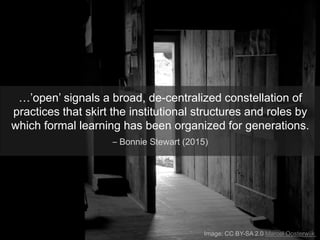
…’open’ signals a broad, de-centralized constellation of
practices that skirt the institutional structures and roles by
which formal learning has been organized for generations.
– Bonnie Stewart (2015)
Image: CC BY-SA 2.0 Marcel Oosterwijk
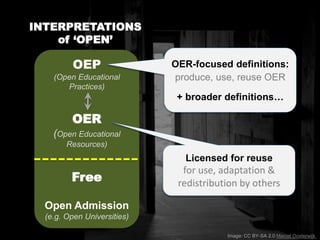
OEP
(Open Educational
Practices)
OER
(Open Educational
Resources)
Free
Open Admission
(e.g. Open Universities)
INTERPRETATIONS
of ‘OPEN’
OER-focused definitions:
produce, use, reuse OER
+ broader definitions…
Licensed for reuse
for use, adaptation &
redistribution by others
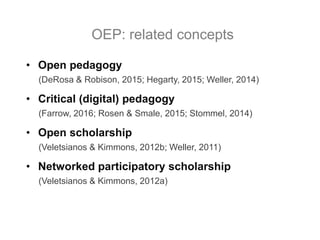
• Open pedagogy
(DeRosa & Robison, 2015; Hegarty, 2015; Weller, 2014)
• Critical (digital) pedagogy
(Farrow, 2016; Rosen & Smale, 2015; Stommel, 2014)
• Open scholarship
(Veletsianos & Kimmons, 2012b; Weller, 2011)
• Networked participatory scholarship
(Veletsianos & Kimmons, 2012a)
OEP: related concepts
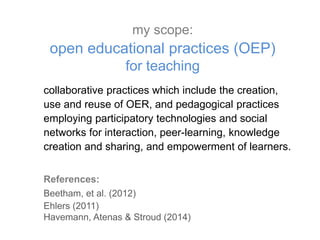
collaborative practices which include the creation,
use and reuse of OER, and pedagogical practices
employing participatory technologies and social
networks for interaction, peer-learning, knowledge
creation and sharing, and empowerment of learners.
References:
Beetham, et al. (2012)
Ehlers (2011)
Havemann, Atenas & Stroud (2014)
my scope:
open educational practices (OEP)
for teaching
Image: CC BY-SA 2.0 Marcel Oosterwijk
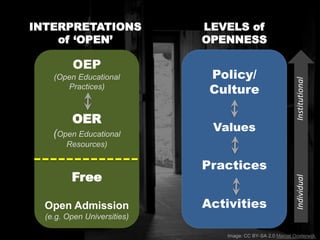
INTERPRETATIONS
of ‘OPEN’
Policy/
Culture
Values
Practices
Activities
LEVELS of
OPENNESS
OEP
(Open Educational
Practices)
OER
(Open Educational
Resources)
Free
Open Admission
(e.g. Open Universities)
IndividualInstitutional
An important question becomes not simply whether
education is more or less open, but what forms of
openness are worthwhile and for whom; openness
alone is not an educational virtue.
Edwards (2015)
“
Critical approach to openness
Additional references:
Bayne, Knox & Ross (2015)
Cottom (2015)
Czerniewicz (2015)
Gourlay (2015)
Selwyn & Facer (2013)
singh (2015)
Watters (2014)
• Context
• Research Questions
• Key Literature
• Methodology
• Findings & Analysis
• Preliminary Conclusions
& Questions
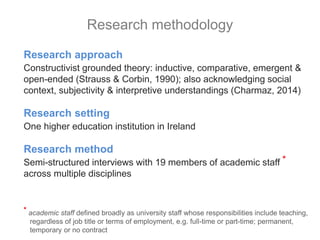
Research approach
Constructivist grounded theory: inductive, comparative, emergent &
open-ended (Strauss & Corbin, 1990); also acknowledging social
context, subjectivity & interpretive understandings (Charmaz, 2014)
Research setting
One higher education institution in Ireland
Research method
Semi-structured interviews with 19 members of academic staff *
across multiple disciplines
Research methodology
* academic staff defined broadly as university staff whose responsibilities include teaching,
regardless of job title or terms of employment, e.g. full-time or part-time; permanent,
temporary or no contract
• Context
• Research Questions
• Key Literature
• Methodology
• Findings & Analysis
• Preliminary Conclusions
& Questions
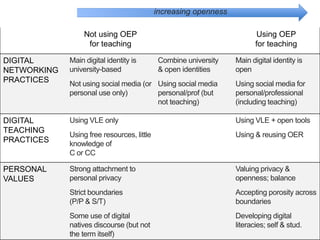
Not using OEP
for teaching
Using OEP
for teaching
DIGITAL
NETWORKING
PRACTICES
Main digital identity is
university-based
Not using social media (or
personal use only)
Combine university
& open identities
Using social media
personal/prof (but
not teaching)
Main digital identity is
open
Using social media for
personal/professional
(including teaching)
DIGITAL
TEACHING
PRACTICES
Using VLE only
Using free resources, little
knowledge of
C or CC
Using VLE + open tools
Using & reusing OER
PERSONAL
VALUES
Strong attachment to
personal privacy
Strict boundaries
(P/P & S/T)
Some use of digital
natives discourse (but not
the term itself)
Valuing privacy &
openness; balance
Accepting porosity across
boundaries
Developing digital
literacies; self & stud.
increasing openness
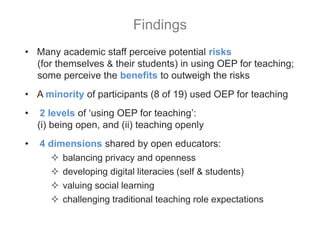
• Many academic staff perceive potential risks
(for themselves & their students) in using OEP for teaching;
some perceive the benefits to outweigh the risks
• A minority of participants (8 of 19) used OEP for teaching
• 2 levels of ‘using OEP for teaching’:
(i) being open, and (ii) teaching openly
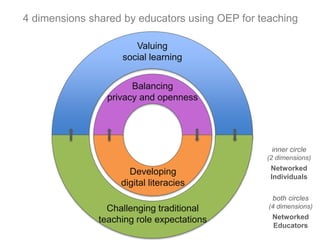
• 4 dimensions shared by open educators:
 balancing privacy and openness
 developing digital literacies (self & students)
 valuing social learning
 challenging traditional teaching role expectations
Findings
Balancing
privacy and openness
Developing
digital literacies
Valuing
social learning
Challenging traditional
teaching role expectations
inner circle
(2 dimensions)
Networked
Individuals
both circles
(4 dimensions)
Networked
Educators
4 dimensions shared by educators using OEP for teaching
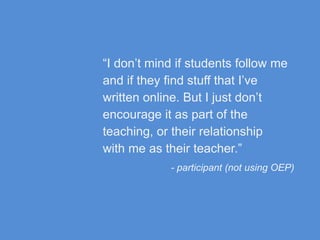
“I don’t mind if students follow me
and if they find stuff that I’ve
written online. But I just don’t
encourage it as part of the
teaching, or their relationship
with me as their teacher.”
- participant (not using OEP)
“I don’t let students know I’m on
Twitter, they seem to figure it out.
It depends on what email account I
reply to them with. Depending on the
teaching or contractual situation in
any given year, sometimes the
[university] email account just
evaporates and I have to fall back
and use my own email account. My
personal email signature has my
Twitter name, my blog. The
[university] account just has the
department name.”
- participant (using OEP)
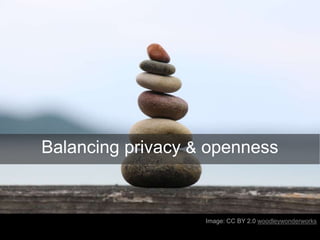
Balancing privacy & openness
Image: CC BY 2.0 woodleywonderworks
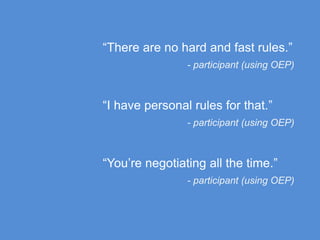
“There are no hard and fast rules.”
- participant (using OEP)
“I have personal rules for that.”
- participant (using OEP)
“You’re negotiating all the time.”
- participant (using OEP)
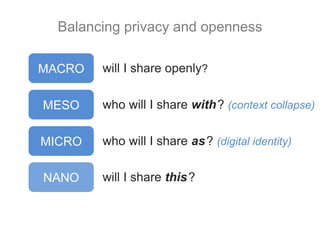
Balancing privacy and openness
will I share openly?
who will I share with? (context collapse)
who will I share as? (digital identity)
will I share this?
MACRO
MESO
MICRO
NANO
• Context
• Research Questions
• Key Literature
• Methodology
• Findings & Analysis
• Preliminary Conclusions
& Questions
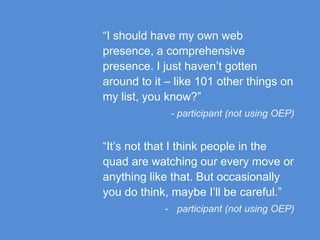
“I should have my own web
presence, a comprehensive
presence. I just haven’t gotten
around to it – like 101 other things on
my list, you know?”
- participant (not using OEP)
“It’s not that I think people in the
quad are watching our every move or
anything like that. But occasionally
you do think, maybe I’ll be careful.”
- participant (not using OEP)
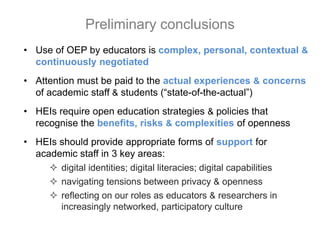
• Use of OEP by educators is complex, personal, contextual &
continuously negotiated
• Attention must be paid to the actual experiences & concerns
of academic staff & students (“state-of-the-actual”)
• HEIs require open education strategies & policies that
recognise the benefits, risks & complexities of openness
• HEIs should provide appropriate forms of support for
academic staff in 3 key areas:
 digital identities; digital literacies; digital capabilities
 navigating tensions between privacy & openness
 reflecting on our roles as educators & researchers in
increasingly networked, participatory culture
Preliminary conclusions
Thank you!
Catherine Cronin
@catherinecronin
about.me/catherinecronin
slideshare.net/cicronin
Image: CC BY 2.0 visualpanic
all presentation references :
http://tinyurl.com/hdgjksa
blog post summary of presentation:
catherinecronin.wordpress.com/2016/11/28
/openness-and-praxis/
Apple, M. (1990). Foreword. In O’Malley, Rosen & Vogt (Eds.) Politics of Education: Essays from
Radical Teacher. State University of New York Press.
Bayne, S., Knox, J. & Ross, J. (2015). Open education: the need for a critical approach. Learning,
Media and Technology, 40(3), 247-250.
Beetham, H., Falconer, I., McGill, L. & Littlejohn, A. (2012). Open Practices: Briefing Paper. Jisc.
Charmaz, K. (2014). Constructing grounded theory (2nd edition). London: Sage Publications.
Cottom, T. M. (2015). Open and accessible to what and for whom? tressiemc blog.
Czerniewicz, L. (2015). Confronting inequitable power dynamics of global knowledge production and
exchange. Water Wheel 14(5), 26-28.
DeRosa, R. & Robison, S. (2015). Pedagogy, technology, and the example of open educational
resources. EDUCAUSE Review.
Edwards, R. (2015). Knowledge infrastructures and the inscrutability of openness in education.
Learning, Media and Technology, 40(3), 251-264.
Ehlers, U-D. (2011). Extending the territory: From open educational resources to open educational
practices. Journal of Open, Flexible and Distance Learning, 15(2), 1–10.
Farrow, R. (2016). Open education and critical pedagogy. Learning, Media and Technology.
Gourlay, L. (2015). Open education as a “heterotopia of desire.” Learning, Media and Technology,
40(3), 310-327.
Havemann, L., Atenas, J. & Stroud, J. (2014). Breaking down barriers: Open educational practices as
an emerging academic literacy. Academic Practice & Technology conference, University of
Greenwich.
References (1 of 2)
Hegarty, B. (2015). Attributes of open pedagogy: A model for using open educational resources.
Educational Technology.
Rosen, J. R. & Smale, M. A. (2015). Open digital pedagogy = Critical pedagogy. Hybrid Pedagogy.
Selwyn, N. & Facer, K. (2013). The politics of education and technology: Conflicts, controversies, and
connections. Basingstoke: Palgrave Macmillan.
singh, s. (2015) The Fallacy of “Open”. savasavasava blog.
Stewart, B. (2015). Open to influence: What counts as academic influence in scholarly networked
Twitter participation. Learning, Media and Technology, 40(3), 1-23.
Stommel, J. (2014). Critical digital pedagogy: a definition. Hybrid Pedagogy.
Strauss, A. & Corbin, J. (1990). Basics of qualitative research: Grounded theory procedures and
techniques (2nd edition). Newbury Park, CA: Sage Publications.
Veletsianos, G. & Kimmons, R. (2012a). Assumptions and challenges of open scholarship.
International Review of Online & Distributed Learning, 13(4), 166-189.
Veletsianos, G. & Kimmons, R. (2012b). Networked participatory scholarship: Emergent techno-
cultural pressures toward open and digital scholarship in online networks. Computers & Education,
58(2), 766–774.
Watters, A. (2014). From “open” to justice. Hack Education blog.
Weller, M. (2011). The Digital Scholar: How technology is transforming scholarly practice.
Basingstoke: Bloomsbury Academic.
Weller, M. (2014). The Battle for Open: How openness won and why it doesn’t feel like victory.
London: Ubiquity Press.
References (2 of 2)

Openness and praxis (#SRHE)

  • 1.
    Openness and praxis: Exploringthe use of open educational practices in higher education Catherine Cronin CELT, NUI Galway @catherinecronin slideshare.net/cicronin Society for Research into Higher Education Digital University Network 18-Nov-2016 #SRHE Image: CC0 1.0 cogdog
  • 2.
    Education is inherentlyan ethical and political act. Michael Apple
  • 3.
    summary of 1stphase of my PhD research study: exploring the use of open educational practices (OEP) in higher education
  • 4.
    • Context • ResearchQuestions • Key Literature • Methodology • Findings & Analysis • Preliminary Conclusions & Questions
  • 5.
    networked educators networked students Physical Spaces Bounded Online Spaces Open Online Spaces Image: CC BY-SA2.0 Catherine Cronin, built on Networked Teacher image CC BY-NC-SA 2.0 Alec Couros Higher education
  • 6.
    Much is publishedabout benefits of and barriers to openness, as well as interpretations of openness Relatively few studies use a critical approach to openness; relatively few empirical studies Theoretical context for this study: openness as a sociocultural phenomenon Openness and open education
  • 7.
    • Context • ResearchQuestions • Key Literature • Methodology • Findings & Analysis • Preliminary Conclusions & Questions
  • 8.
    1. In whatways do academic staff use open educational practices (OEP) for teaching? 2. Why do/don’t academic staff use open educational practices (OEP) for teaching? 3. What practices, values and/or strategies are shared by open educators, if any? 4. [Phase 2] How do open educators and students enact and negotiate their digital identities in the open online spaces where they interact? Research questions
  • 9.
    • Context • ResearchQuestions • Key Literature • Methodology • Findings & Analysis • Preliminary Conclusions & Questions
  • 10.
    Image: CC BY-SA2.0 Marcel Oosterwijk …’open’ signals a broad, de-centralized constellation of practices that skirt the institutional structures and roles by which formal learning has been organized for generations. – Bonnie Stewart (2015)
  • 11.
    Image: CC BY-SA2.0 Marcel Oosterwijk OEP (Open Educational Practices) OER (Open Educational Resources) Free Open Admission (e.g. Open Universities) INTERPRETATIONS of ‘OPEN’ OER-focused definitions: produce, use, reuse OER + broader definitions… Licensed for reuse for use, adaptation & redistribution by others
  • 12.
    • Open pedagogy (DeRosa& Robison, 2015; Hegarty, 2015; Weller, 2014) • Critical (digital) pedagogy (Farrow, 2016; Rosen & Smale, 2015; Stommel, 2014) • Open scholarship (Veletsianos & Kimmons, 2012b; Weller, 2011) • Networked participatory scholarship (Veletsianos & Kimmons, 2012a) OEP: related concepts
  • 13.
    collaborative practices whichinclude the creation, use and reuse of OER, and pedagogical practices employing participatory technologies and social networks for interaction, peer-learning, knowledge creation and sharing, and empowerment of learners. References: Beetham, et al. (2012) Ehlers (2011) Havemann, Atenas & Stroud (2014) my scope: open educational practices (OEP) for teaching
  • 14.
    Image: CC BY-SA2.0 Marcel Oosterwijk INTERPRETATIONS of ‘OPEN’ Policy/ Culture Values Practices Activities LEVELS of OPENNESS OEP (Open Educational Practices) OER (Open Educational Resources) Free Open Admission (e.g. Open Universities) IndividualInstitutional
  • 15.
    An important questionbecomes not simply whether education is more or less open, but what forms of openness are worthwhile and for whom; openness alone is not an educational virtue. Edwards (2015) “ Critical approach to openness Additional references: Bayne, Knox & Ross (2015) Cottom (2015) Czerniewicz (2015) Gourlay (2015) Selwyn & Facer (2013) singh (2015) Watters (2014)
  • 16.
    • Context • ResearchQuestions • Key Literature • Methodology • Findings & Analysis • Preliminary Conclusions & Questions
  • 17.
    Research approach Constructivist groundedtheory: inductive, comparative, emergent & open-ended (Strauss & Corbin, 1990); also acknowledging social context, subjectivity & interpretive understandings (Charmaz, 2014) Research setting One higher education institution in Ireland Research method Semi-structured interviews with 19 members of academic staff * across multiple disciplines Research methodology * academic staff defined broadly as university staff whose responsibilities include teaching, regardless of job title or terms of employment, e.g. full-time or part-time; permanent, temporary or no contract
  • 18.
    • Context • ResearchQuestions • Key Literature • Methodology • Findings & Analysis • Preliminary Conclusions & Questions
  • 19.
    Not using OEP forteaching Using OEP for teaching DIGITAL NETWORKING PRACTICES Main digital identity is university-based Not using social media (or personal use only) Combine university & open identities Using social media personal/prof (but not teaching) Main digital identity is open Using social media for personal/professional (including teaching) DIGITAL TEACHING PRACTICES Using VLE only Using free resources, little knowledge of C or CC Using VLE + open tools Using & reusing OER PERSONAL VALUES Strong attachment to personal privacy Strict boundaries (P/P & S/T) Some use of digital natives discourse (but not the term itself) Valuing privacy & openness; balance Accepting porosity across boundaries Developing digital literacies; self & stud. increasing openness
  • 20.
    • Many academicstaff perceive potential risks (for themselves & their students) in using OEP for teaching; some perceive the benefits to outweigh the risks • A minority of participants (8 of 19) used OEP for teaching • 2 levels of ‘using OEP for teaching’: (i) being open, and (ii) teaching openly • 4 dimensions shared by open educators:  balancing privacy and openness  developing digital literacies (self & students)  valuing social learning  challenging traditional teaching role expectations Findings
  • 21.
    Balancing privacy and openness Developing digitalliteracies Valuing social learning Challenging traditional teaching role expectations inner circle (2 dimensions) Networked Individuals both circles (4 dimensions) Networked Educators 4 dimensions shared by educators using OEP for teaching
  • 22.
    “I don’t mindif students follow me and if they find stuff that I’ve written online. But I just don’t encourage it as part of the teaching, or their relationship with me as their teacher.” - participant (not using OEP)
  • 23.
    “I don’t letstudents know I’m on Twitter, they seem to figure it out. It depends on what email account I reply to them with. Depending on the teaching or contractual situation in any given year, sometimes the [university] email account just evaporates and I have to fall back and use my own email account. My personal email signature has my Twitter name, my blog. The [university] account just has the department name.” - participant (using OEP)
  • 24.
    Balancing privacy &openness Image: CC BY 2.0 woodleywonderworks
  • 25.
    “There are nohard and fast rules.” - participant (using OEP) “I have personal rules for that.” - participant (using OEP) “You’re negotiating all the time.” - participant (using OEP)
  • 26.
    Balancing privacy andopenness will I share openly? who will I share with? (context collapse) who will I share as? (digital identity) will I share this? MACRO MESO MICRO NANO
  • 27.
    • Context • ResearchQuestions • Key Literature • Methodology • Findings & Analysis • Preliminary Conclusions & Questions
  • 28.
    “I should havemy own web presence, a comprehensive presence. I just haven’t gotten around to it – like 101 other things on my list, you know?” - participant (not using OEP) “It’s not that I think people in the quad are watching our every move or anything like that. But occasionally you do think, maybe I’ll be careful.” - participant (not using OEP)
  • 29.
    • Use ofOEP by educators is complex, personal, contextual & continuously negotiated • Attention must be paid to the actual experiences & concerns of academic staff & students (“state-of-the-actual”) • HEIs require open education strategies & policies that recognise the benefits, risks & complexities of openness • HEIs should provide appropriate forms of support for academic staff in 3 key areas:  digital identities; digital literacies; digital capabilities  navigating tensions between privacy & openness  reflecting on our roles as educators & researchers in increasingly networked, participatory culture Preliminary conclusions
  • 30.
  • 31.
    all presentation references: http://tinyurl.com/hdgjksa blog post summary of presentation: catherinecronin.wordpress.com/2016/11/28 /openness-and-praxis/
  • 32.
    Apple, M. (1990).Foreword. In O’Malley, Rosen & Vogt (Eds.) Politics of Education: Essays from Radical Teacher. State University of New York Press. Bayne, S., Knox, J. & Ross, J. (2015). Open education: the need for a critical approach. Learning, Media and Technology, 40(3), 247-250. Beetham, H., Falconer, I., McGill, L. & Littlejohn, A. (2012). Open Practices: Briefing Paper. Jisc. Charmaz, K. (2014). Constructing grounded theory (2nd edition). London: Sage Publications. Cottom, T. M. (2015). Open and accessible to what and for whom? tressiemc blog. Czerniewicz, L. (2015). Confronting inequitable power dynamics of global knowledge production and exchange. Water Wheel 14(5), 26-28. DeRosa, R. & Robison, S. (2015). Pedagogy, technology, and the example of open educational resources. EDUCAUSE Review. Edwards, R. (2015). Knowledge infrastructures and the inscrutability of openness in education. Learning, Media and Technology, 40(3), 251-264. Ehlers, U-D. (2011). Extending the territory: From open educational resources to open educational practices. Journal of Open, Flexible and Distance Learning, 15(2), 1–10. Farrow, R. (2016). Open education and critical pedagogy. Learning, Media and Technology. Gourlay, L. (2015). Open education as a “heterotopia of desire.” Learning, Media and Technology, 40(3), 310-327. Havemann, L., Atenas, J. & Stroud, J. (2014). Breaking down barriers: Open educational practices as an emerging academic literacy. Academic Practice & Technology conference, University of Greenwich. References (1 of 2)
  • 33.
    Hegarty, B. (2015).Attributes of open pedagogy: A model for using open educational resources. Educational Technology. Rosen, J. R. & Smale, M. A. (2015). Open digital pedagogy = Critical pedagogy. Hybrid Pedagogy. Selwyn, N. & Facer, K. (2013). The politics of education and technology: Conflicts, controversies, and connections. Basingstoke: Palgrave Macmillan. singh, s. (2015) The Fallacy of “Open”. savasavasava blog. Stewart, B. (2015). Open to influence: What counts as academic influence in scholarly networked Twitter participation. Learning, Media and Technology, 40(3), 1-23. Stommel, J. (2014). Critical digital pedagogy: a definition. Hybrid Pedagogy. Strauss, A. & Corbin, J. (1990). Basics of qualitative research: Grounded theory procedures and techniques (2nd edition). Newbury Park, CA: Sage Publications. Veletsianos, G. & Kimmons, R. (2012a). Assumptions and challenges of open scholarship. International Review of Online & Distributed Learning, 13(4), 166-189. Veletsianos, G. & Kimmons, R. (2012b). Networked participatory scholarship: Emergent techno- cultural pressures toward open and digital scholarship in online networks. Computers & Education, 58(2), 766–774. Watters, A. (2014). From “open” to justice. Hack Education blog. Weller, M. (2011). The Digital Scholar: How technology is transforming scholarly practice. Basingstoke: Bloomsbury Academic. Weller, M. (2014). The Battle for Open: How openness won and why it doesn’t feel like victory. London: Ubiquity Press. References (2 of 2)

Editor's Notes

  • #2 I may be know to many of you not just as a researcher of open practices, but as an advocate of openness. Like many of us, I wear many hats. In my practice, I have been an advocate of openness, though not uncritical openness. I observed that despite the claims of open education practitioners and advocates, openness is unevenly Interpreted, Understood & Practiced within HE I sought to understand this more deeply. Q: How do individuals, actors within HE understand openness? What does it mean to them? Q: How do individuals within HE practice openness? Q: How might this greater understanding help us – as researchers, practitioners, leaders & policy makers in HE?
  • #3 Our task as educators… requires: criticism of what exists restoring what is being lost pointing towards possible futures & sometimes being criticized ourselves, this being something we should yearn for, since it signifies the mutuality and shifting role of Teachers and Taught that we must enhance.
  • #4 Exploring the digital and pedagogical strategies of a diverse group of university educators, focusing on whether, why and how they use open educational practices for teaching. The purpose is to understand how university educators conceive of, make sense of, and make use of OEP in their teaching, and to try to learn more about, and from, the practices and values of educators from across a broad continuum of ‘closed’ to open practices OEP = ethos of sharing & transparency = practices which include the creation, use & reuse of OER; open learning; open/public pedagogies; open scholarship; open access publishing; and use of open technologies. OEP = inclusive of but more than open content: learners & teachers share the processes of knowledge creation, i.e. broadest interpretation of open education This is not a study of the practices of OPEN educators/researcher, there are relatively few of these! This is a study of the practices of a broad range of educators – what factors contribute to educators choosing open practices.
  • #5 Signposts…
  • #6 One way to consider context is this image… Alec Couros – Networked Educators (10 years ago) + Networked Students 3 learning spaces… Typically, educators are not asked/required to teach in OOS. It is a *choice* It is this choice that I want to explore... Why/why not? What encourages/repels? What happens in OOS? While both individual & systemic motivators are drivers of openness, I want to explore the role of individual agency re: how open practices are used in HE
  • #7 Much literature re: benefits of openness, some re: barriers to openness. Few empirical studies, particularly in natural settings – i.e. university settings in which openness is not the agenda or the purpose of the research. Much more literature about OER and MOOCs than OEP. More recently, researchers are theorising openness, using a critical approach to openness. Explore this in the presentation “Educators can shape and/or be shaped by openness” – Veletsianos.
  • #11 Openness is a complex phenomenon… it is Technical, Social, Cultural, Economic Stewart – Weller – open is so broad, best used as an umbrella term Watters – multivalence can be a strength… “so widely applied that it is rendered meaningless”
  • #12 OEP = OER + open pedagogies; open learning; open scholarship; open sharing of teaching; open technologies (Beetham et al, JISC, 2012) OEP = OER + promote innovative pedagogies; respect & empower L’s as co-producers (Ehlers, 2011) OEP = OER + inc access to K; develop/strengthen CoP; promote innovative pedagogies (Havemann et al 2014) OEP = not just the artefacts/content… but the “live practice” of open education
  • #15 POLICY: OER + OEP initiatives MUST BE linked to university’s strategic drivers… otherwise, unsustainable. Terrain of my reseach = …
  • #16 OPEN tends to bias those already privileged. But having a critical, reflexive approach – and listening to those who are doing work in this vein – are two ways forward.
  • #18 Ethnography was considered, as was using networked, participatory technologies to conduct the research. However, wanted to understand the choices re: openness of a diverse range of academics (Closed to Open). One university Broad definition of academic staff.
  • #20 No clear boundary between academic staff who DO and DO NOT use OEP. Continuum of practices and values, ranging from closed to open. Complex picture of broad range of educators… some open, some not... some moving towards openness, some not... but all thinking deeply about their digical & pedagogical decisions. ALL Open educators: “being open” i.e. visible to students, interacting & sharing beyond the VLE/email A FEW Open educators: Teaching openly, i.e. creating learning/assessment activities in OOS (Twitter, WP, public FB, etc.)
  • #21 Pedagogical & Practical concern! RISKS = uncertain of ped value; S’s overuse of SM; overwhelming workloads; excessive noise in SM; context collapse BENEFITS = S’s feeling more connected; connect course to field; S’s share work openly w/ authentic audience; become part of future prof community 4 dimensions…
  • #22 Valuing social learning… Challenging trad role definition: Teachers as well as learners; humility as a teacher; commitment to democratic practices, e.g. openness not just as practice but Ethos, Way of being. Often goes hand-in-hand with Valuing Social Learning, but not always.
  • #25 Participants spoke about Privacy & Openness – their interpretations of these and the relationship between them – more than any other aspect of using OEP. Academic staff make that determination based on personal values & experiences, their own digital literacies, context, awareness of current sociotech issues – etc. P’s described making individual decisions appropriate to their own contexts, weighing up the Benefits & Risks for themselves and their students.
  • #28 Left with a sense of the complexity of this issue… and that academic staff are on their own dealing with these issues. Reactions to these challenges include acknowleding the tension, feeling overwhelmed, feeling exposed and at risk, all the way to feelings of anxiety.
  • #29 Left with a sense of the complexity of this issue… and that academic staff are on their own dealing with these issues. Reactions to these challenges include acknowleding the tension, feeling overwhelmed, feeling exposed and at risk, all the way to feelings of anxiety.
  • #30 Actual experiences: e.g. lack of use/reuse of OER