
Terry Anderson,
Professor, Athabasca University
Canada
Dec. 2013
Using Open Scholarship to Leapfrog
Traditional Educational Barriers
Republic of South Africa (2013) White paper
for Post-School Education and Training -
creating a post-school distance education landscape based on open learning
principles.
• It will consist of a network of education providers supported by learning support
centres and/or connectivity for students.
• Such a network will make available a wide range of learning opportunities to
potential students that are closer to their homes and at times appropriate
to their contexts.
• well-researched, high-quality national learning resources (made available as open
education resources [OER]),
• collaborative development of learning resources,
• more efficient use of existing infrastructure, and
• an increasing emphasis on independent study as preparation for subsequent
lifelong learning
Presentation Overview
• Open Education Practices
– Open Educational Resources
– Open Texts
– Open Data
– Open Article Publishing
– Open Pedagogy
– Researching OE Practice
Definitions of Open on the Web
(From Google)
• affording unobstructed entrance and exit; not shut or
closed;
• affording free passage or access;
• open to or in view of all;
• accessible to all;
• assailable: not defended or capable of being defended
• loose: (of textures) full of small openings or gaps;
• start to operate or function
• not brought to a conclusion;
• not sealed or having been unsealed
Open Scholars Create:
• A new type of education work maximizing:
– Social learning
– Media richness
– Participatory and connectivist pedagogies
– Ubiquity and persistence
– Transparency
– Open data collection and research process
– Open network Creation
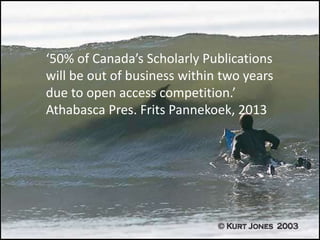
‘50% of Canada’s Scholarly Publications
will be out of business within two years
due to open access competition.’
Athabasca Pres. Frits Pannekoek, 2013
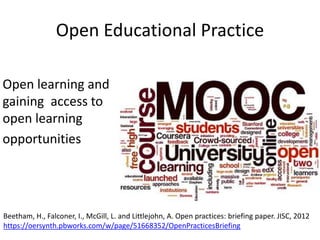
Open Educational Practice
Open learning and
gaining access to
open learning
opportunities
Beetham, H., Falconer, I., McGill, L. and Littlejohn, A. Open practices: briefing paper. JISC, 2012
https://oersynth.pbworks.com/w/page/51668352/OpenPracticesBriefing
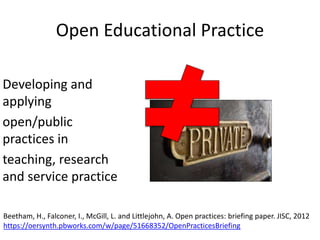
Open Educational Practice
Developing and
applying
open/public
practices in
teaching, research
and service practice
Beetham, H., Falconer, I., McGill, L. and Littlejohn, A. Open practices: briefing paper. JISC, 2012
https://oersynth.pbworks.com/w/page/51668352/OpenPracticesBriefing
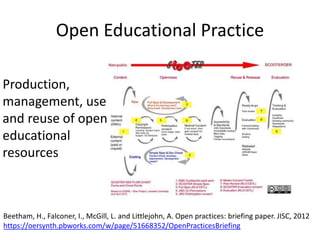
Open Educational Practice
Production,
management, use
and reuse of open
educational
resources
Beetham, H., Falconer, I., McGill, L. and Littlejohn, A. Open practices: briefing paper. JISC, 2012
https://oersynth.pbworks.com/w/page/51668352/OpenPracticesBriefing
Award winning video on OERs from
South Africa
Open Scholars Use and Contribute
Open Educational Resources
Because it saves time!!!
OER Barriers to Adoption
• Few instructor incentives
• Publisher push back
• Quality concerns
• Licensing, copyright issues
• “not invented here” syndrome
• Lack of open culture and practice
• Insufficient content
Open Educational Practice Networks
Open sharing of
teaching ideas and
know-how
Beetham, H., Falconer, I., McGill, L. and Littlejohn, A. Open practices: briefing paper. JISC, 2012
https://oersynth.pbworks.com/w/page/51668352/OpenPracticesBriefing
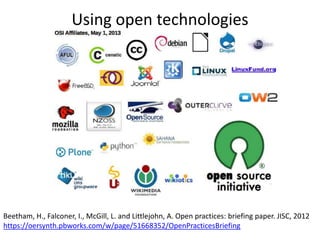
Using open technologies
Components of ‘Open Pedagogy’
• Student ownership and control
• Artifact Persistence
• Open to participation globally
• Creation and curation of open artifacts
• Affordable – the educational “digital dividend”
Innovating Pedagogy,
2013 Open University
Why Create OERs?
• Students as prosumers
• Teaches:
– Production skills
– Planning, network literacy
– Collaboration
– Altruism
– Participatory technologies
– Net presence
Pedagogy, Technology and Student as
Producer
Who Should Own Open Text Books?
• Faculty?
• Institution?
• Both – “Tragedy of the Anti-Commons”
“economic value may disappear into the ‘black hole’ of
resource underutilization” (Buchanan and Yoon 2000).”
In recent years, economic modeling of the anticommons
has become quite sophisticated.
• Everyone
Do Students Like Open Texts?
“We aggressively marketed the course as "textbook free"
and designed a survey to measure the impact of this
variable on student motivation to enroll and the overall
engagement level. The results were telling:
• 90 percent of our students found the course's digital
content "more engaging" than a traditional textbook.
• 25 percent said that the "no required textbook"
advertising was an incentive to enroll.
• 50 percent said that textbook costs had been an
academic barrier in the past.”
OneClick Digital and the Medrano Project: OER
as Content, OER as Pedagogy
We can’t afford textbooks
• Textbook prices skyrocketed 82% between 2002
and 2012,
• average student budget for books and supplies
has grown to $1,207 annually (USA figures).
• Current Bill to support open texts across US, goal
of reducing costs by 80%
• Washington State program since 2010 has saved
students $5.4 million versus State cost of less
than $1.8 Million
• All students get open text books!
http://www.sparc.arl.org/advocacy/national/act
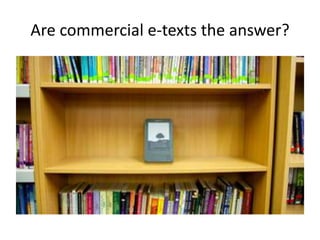
Are commercial e-texts the answer?
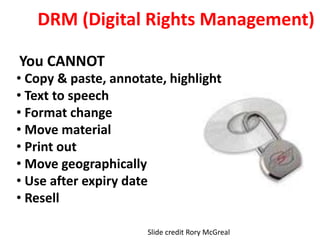
DRM (Digital Rights Management)
You CANNOT
• Copy & paste, annotate, highlight
• Text to speech
• Format change
• Move material
• Print out
• Move geographically
• Use after expiry date
• Resell
Slide credit Rory McGreal
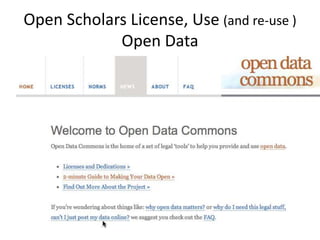
Open Scholars License, Use (and re-use )
Open Data
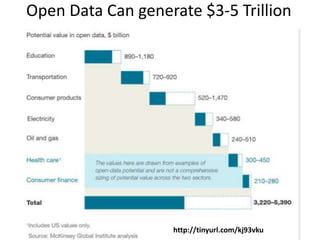
Open Data Can generate $3-5 Trillion
http://tinyurl.com/kj93vku
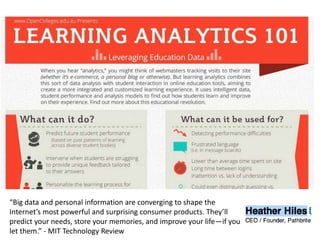
“Big data and personal information are converging to shape the
Internet’s most powerful and surprising consumer products. They’ll
predict your needs, store your memories, and improve your life—if you
let them.” - MIT Technology Review
Open Data
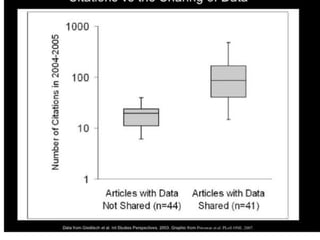
• Sharing not only research results, but the data
that generated these results
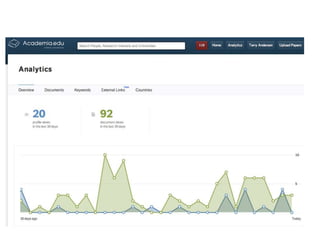
Open Scholars Filter and
Share With Others
If you don’t manage your digital
identity- someone else will!
Social Networks
• Facebook, LinkedIn,
• Academia,
• Twitter
• Blogs
• Listservs
• Private
– NING
– ELGG
– Drupal,
– Word Press
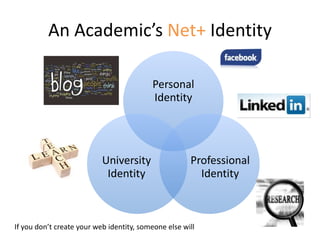
Personal
Identity
Professional
Identity
University
Identity
An Academic’s Net+ Identity
If you don’t create your web identity, someone else will
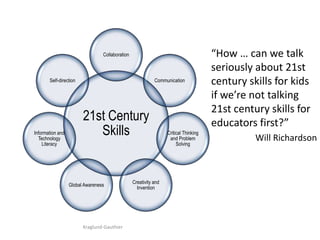
“How … can we talk
seriously about 21st
century skills for kids
if we’re not talking
21st century skills for
educators first?”
Will Richardson
21st Century
Skills
Collaboration
Communication
Critical Thinking
and Problem
Solving
Creativity and
Invention
Global Awareness
Information and
Technology
Literacy
Self-direction
Kraglund-Gauthier
Networks add diversity to learning
“People who live in
the intersection of
social worlds are at
higher risk of having
good ideas” Burt,
2005, p. 90
Edge effects, estuary learning
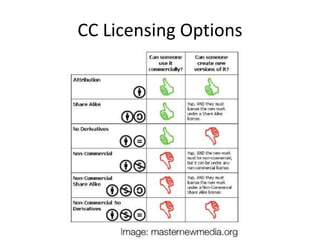
If it is not licensed,
it is not open.
CC Licensing Options
Predatory Open Access Journals
“those that unprofessionally exploit the author-pays model of
open-access publishing (Gold OA) for their own profit.
Typically, these publishers:
• spam professional email lists,
• broadly soliciting article submissions for the clear purpose
of gaining income.
• operate essentially as vanity presses,
• typically have a low article acceptance threshold,
• Have a false-front or non-existent peer review process.
– Jeff Beall
http://scholarlyoa.com/publishers/
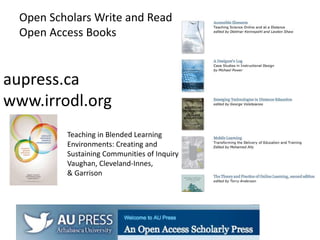
aupress.ca
www.irrodl.org
Open Scholars Write and Read
Open Access Books
Teaching in Blended Learning
Environments: Creating and
Sustaining Communities of Inquiry
Vaughan, Cleveland-Innes,
& Garrison
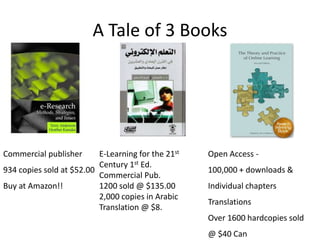
A Tale of 3 Books
Open Access -
100,000 + downloads &
Individual chapters
Translations
Over 1600 hardcopies sold
@ $40 Can
Commercial publisher
934 copies sold at $52.00
Buy at Amazon!!
E-Learning for the 21st
Century 1st Ed.
Commercial Pub.
1200 sold @ $135.00
2,000 copies in Arabic
Translation @ $8.
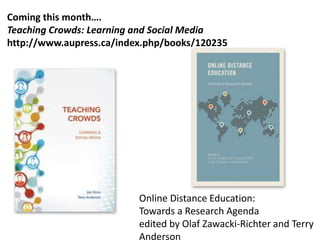
Coming this month….
Teaching Crowds: Learning and Social Media
http://www.aupress.ca/index.php/books/120235
Online Distance Education:
Towards a Research Agenda
edited by Olaf Zawacki-Richter and Terry
Anderson
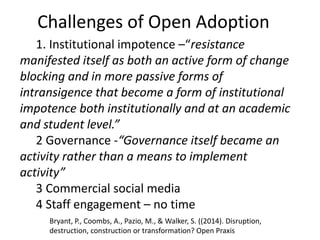
Challenges of Open Adoption
1. Institutional impotence –“resistance
manifested itself as both an active form of change
blocking and in more passive forms of
intransigence that become a form of institutional
impotence both institutionally and at an academic
and student level.”
2 Governance -“Governance itself became an
activity rather than a means to implement
activity”
3 Commercial social media
4 Staff engagement – no time
Bryant, P., Coombs, A., Pazio, M., & Walker, S. ((2014). Disruption,
destruction, construction or transformation? Open Praxis
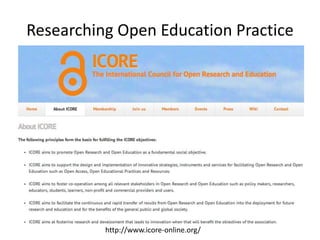
Researching Open Education Practice
http://www.icore-online.org/
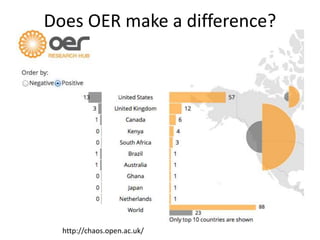
Does OER make a difference?
http://chaos.open.ac.uk/
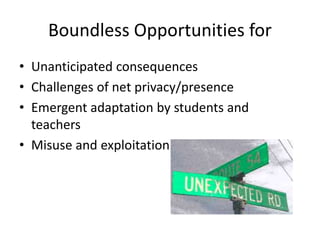
Boundless Opportunities for
• Unanticipated consequences
• Challenges of net privacy/presence
• Emergent adaptation by students and
teachers
• Misuse and exploitation
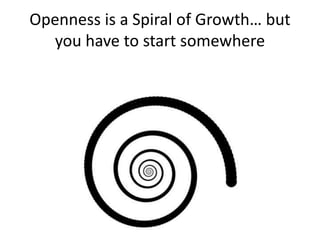
Openness is a Spiral of Growth… but
you have to start somewhere
Terry Anderson terrya@athabascau.ca
Blog: terrya.edublogs.org
Twitter: terguy
Your comments and questions
most welcomed!
Ndatenda/Masvita,
Asante, Ngiyabonga
In July, 2012,the Supreme Court ruled on the ‘Copyright Pentalogy”, a series of copyright
cases. The judgement was very favourable for education in Canada. The major implications for
education are summarized:
• Copyright law is not just about protection of the author; it also is about dissemination to
the public
• Technological neutrality: The law is neutral in terms of whatever technology is used. This
allows users to move technology from one platform or device to another.
• Fair dealing was once again stressed as being integral to copyright law, and it “must be
given a large and liberal interpretation".
• Instruction and research are essentially the same. Copies of reasonable amounts of works
can be duplicated by the instructor for class use.
• Research" is not restricted to "creative purposes". It can be personal interest.
• The user's purpose is paramount in deciding whether copying is “fair”
• If copying increases the sale of work, then it does not have a negative impact
Are LMS BAD?
• Bricolage – the LMS as Enterprise Systems
doesn’t allow or cater for bricolage.
• Affordances – resulting in an inability to
leverage the affordances of technology to
improve learning and teaching.
• Distribution – the idea that knowledge about
how to improve L&T is distributed and the
implications that has for the institutional
practice of e-learning."
http://davidtjones.wordpress.com/David Jones
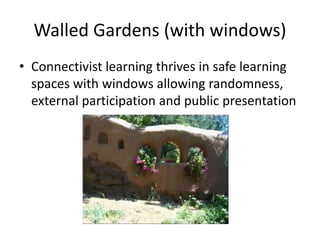
Walled Gardens (with windows)
• Connectivist learning thrives in safe learning
spaces with windows allowing randomness,
external participation and public presentation

Using Open Scholarship to Leapfrog Traditional Educational Barriers

  • 1.
    Terry Anderson, Professor, AthabascaUniversity Canada Dec. 2013 Using Open Scholarship to Leapfrog Traditional Educational Barriers
  • 3.
    Republic of SouthAfrica (2013) White paper for Post-School Education and Training - creating a post-school distance education landscape based on open learning principles. • It will consist of a network of education providers supported by learning support centres and/or connectivity for students. • Such a network will make available a wide range of learning opportunities to potential students that are closer to their homes and at times appropriate to their contexts. • well-researched, high-quality national learning resources (made available as open education resources [OER]), • collaborative development of learning resources, • more efficient use of existing infrastructure, and • an increasing emphasis on independent study as preparation for subsequent lifelong learning
  • 4.
    Presentation Overview • OpenEducation Practices – Open Educational Resources – Open Texts – Open Data – Open Article Publishing – Open Pedagogy – Researching OE Practice
  • 5.
    Definitions of Openon the Web (From Google) • affording unobstructed entrance and exit; not shut or closed; • affording free passage or access; • open to or in view of all; • accessible to all; • assailable: not defended or capable of being defended • loose: (of textures) full of small openings or gaps; • start to operate or function • not brought to a conclusion; • not sealed or having been unsealed
  • 6.
    Open Scholars Create: •A new type of education work maximizing: – Social learning – Media richness – Participatory and connectivist pedagogies – Ubiquity and persistence – Transparency – Open data collection and research process – Open network Creation
  • 8.
    ‘50% of Canada’sScholarly Publications will be out of business within two years due to open access competition.’ Athabasca Pres. Frits Pannekoek, 2013
  • 9.
    Open Educational Practice Openlearning and gaining access to open learning opportunities Beetham, H., Falconer, I., McGill, L. and Littlejohn, A. Open practices: briefing paper. JISC, 2012 https://oersynth.pbworks.com/w/page/51668352/OpenPracticesBriefing
  • 10.
    Open Educational Practice Developingand applying open/public practices in teaching, research and service practice Beetham, H., Falconer, I., McGill, L. and Littlejohn, A. Open practices: briefing paper. JISC, 2012 https://oersynth.pbworks.com/w/page/51668352/OpenPracticesBriefing
  • 11.
    Open Educational Practice Production, management,use and reuse of open educational resources Beetham, H., Falconer, I., McGill, L. and Littlejohn, A. Open practices: briefing paper. JISC, 2012 https://oersynth.pbworks.com/w/page/51668352/OpenPracticesBriefing
  • 12.
    Award winning videoon OERs from South Africa
  • 13.
    Open Scholars Useand Contribute Open Educational Resources Because it saves time!!!
  • 14.
    OER Barriers toAdoption • Few instructor incentives • Publisher push back • Quality concerns • Licensing, copyright issues • “not invented here” syndrome • Lack of open culture and practice • Insufficient content
  • 15.
    Open Educational PracticeNetworks Open sharing of teaching ideas and know-how
  • 16.
    Beetham, H., Falconer,I., McGill, L. and Littlejohn, A. Open practices: briefing paper. JISC, 2012 https://oersynth.pbworks.com/w/page/51668352/OpenPracticesBriefing Using open technologies
  • 17.
    Components of ‘OpenPedagogy’ • Student ownership and control • Artifact Persistence • Open to participation globally • Creation and curation of open artifacts • Affordable – the educational “digital dividend” Innovating Pedagogy, 2013 Open University
  • 18.
    Why Create OERs? •Students as prosumers • Teaches: – Production skills – Planning, network literacy – Collaboration – Altruism – Participatory technologies – Net presence Pedagogy, Technology and Student as Producer
  • 19.
    Who Should OwnOpen Text Books? • Faculty? • Institution? • Both – “Tragedy of the Anti-Commons” “economic value may disappear into the ‘black hole’ of resource underutilization” (Buchanan and Yoon 2000).” In recent years, economic modeling of the anticommons has become quite sophisticated. • Everyone
  • 20.
    Do Students LikeOpen Texts? “We aggressively marketed the course as "textbook free" and designed a survey to measure the impact of this variable on student motivation to enroll and the overall engagement level. The results were telling: • 90 percent of our students found the course's digital content "more engaging" than a traditional textbook. • 25 percent said that the "no required textbook" advertising was an incentive to enroll. • 50 percent said that textbook costs had been an academic barrier in the past.” OneClick Digital and the Medrano Project: OER as Content, OER as Pedagogy
  • 21.
    We can’t affordtextbooks • Textbook prices skyrocketed 82% between 2002 and 2012, • average student budget for books and supplies has grown to $1,207 annually (USA figures). • Current Bill to support open texts across US, goal of reducing costs by 80% • Washington State program since 2010 has saved students $5.4 million versus State cost of less than $1.8 Million • All students get open text books! http://www.sparc.arl.org/advocacy/national/act
  • 22.
  • 23.
    DRM (Digital RightsManagement) You CANNOT • Copy & paste, annotate, highlight • Text to speech • Format change • Move material • Print out • Move geographically • Use after expiry date • Resell Slide credit Rory McGreal
  • 24.
    Open Scholars License,Use (and re-use ) Open Data
  • 25.
    Open Data Cangenerate $3-5 Trillion http://tinyurl.com/kj93vku
  • 26.
    “Big data andpersonal information are converging to shape the Internet’s most powerful and surprising consumer products. They’ll predict your needs, store your memories, and improve your life—if you let them.” - MIT Technology Review
  • 27.
    Open Data • Sharingnot only research results, but the data that generated these results
  • 29.
    Open Scholars Filterand Share With Others
  • 31.
    If you don’tmanage your digital identity- someone else will!
  • 32.
    Social Networks • Facebook,LinkedIn, • Academia, • Twitter • Blogs • Listservs • Private – NING – ELGG – Drupal, – Word Press
  • 33.
    Personal Identity Professional Identity University Identity An Academic’s Net+Identity If you don’t create your web identity, someone else will
  • 34.
    “How … canwe talk seriously about 21st century skills for kids if we’re not talking 21st century skills for educators first?” Will Richardson 21st Century Skills Collaboration Communication Critical Thinking and Problem Solving Creativity and Invention Global Awareness Information and Technology Literacy Self-direction Kraglund-Gauthier
  • 35.
    Networks add diversityto learning “People who live in the intersection of social worlds are at higher risk of having good ideas” Burt, 2005, p. 90 Edge effects, estuary learning
  • 36.
    If it isnot licensed, it is not open.
  • 37.
  • 39.
    Predatory Open AccessJournals “those that unprofessionally exploit the author-pays model of open-access publishing (Gold OA) for their own profit. Typically, these publishers: • spam professional email lists, • broadly soliciting article submissions for the clear purpose of gaining income. • operate essentially as vanity presses, • typically have a low article acceptance threshold, • Have a false-front or non-existent peer review process. – Jeff Beall http://scholarlyoa.com/publishers/
  • 40.
    aupress.ca www.irrodl.org Open Scholars Writeand Read Open Access Books Teaching in Blended Learning Environments: Creating and Sustaining Communities of Inquiry Vaughan, Cleveland-Innes, & Garrison
  • 41.
    A Tale of3 Books Open Access - 100,000 + downloads & Individual chapters Translations Over 1600 hardcopies sold @ $40 Can Commercial publisher 934 copies sold at $52.00 Buy at Amazon!! E-Learning for the 21st Century 1st Ed. Commercial Pub. 1200 sold @ $135.00 2,000 copies in Arabic Translation @ $8.
  • 42.
    Coming this month…. TeachingCrowds: Learning and Social Media http://www.aupress.ca/index.php/books/120235 Online Distance Education: Towards a Research Agenda edited by Olaf Zawacki-Richter and Terry Anderson
  • 43.
    Challenges of OpenAdoption 1. Institutional impotence –“resistance manifested itself as both an active form of change blocking and in more passive forms of intransigence that become a form of institutional impotence both institutionally and at an academic and student level.” 2 Governance -“Governance itself became an activity rather than a means to implement activity” 3 Commercial social media 4 Staff engagement – no time Bryant, P., Coombs, A., Pazio, M., & Walker, S. ((2014). Disruption, destruction, construction or transformation? Open Praxis
  • 44.
    Researching Open EducationPractice http://www.icore-online.org/
  • 45.
    Does OER makea difference? http://chaos.open.ac.uk/
  • 46.
    Boundless Opportunities for •Unanticipated consequences • Challenges of net privacy/presence • Emergent adaptation by students and teachers • Misuse and exploitation
  • 47.
    Openness is aSpiral of Growth… but you have to start somewhere
  • 48.
    Terry Anderson terrya@athabascau.ca Blog:terrya.edublogs.org Twitter: terguy Your comments and questions most welcomed! Ndatenda/Masvita, Asante, Ngiyabonga
  • 49.
    In July, 2012,theSupreme Court ruled on the ‘Copyright Pentalogy”, a series of copyright cases. The judgement was very favourable for education in Canada. The major implications for education are summarized: • Copyright law is not just about protection of the author; it also is about dissemination to the public • Technological neutrality: The law is neutral in terms of whatever technology is used. This allows users to move technology from one platform or device to another. • Fair dealing was once again stressed as being integral to copyright law, and it “must be given a large and liberal interpretation". • Instruction and research are essentially the same. Copies of reasonable amounts of works can be duplicated by the instructor for class use. • Research" is not restricted to "creative purposes". It can be personal interest. • The user's purpose is paramount in deciding whether copying is “fair” • If copying increases the sale of work, then it does not have a negative impact
  • 50.
    Are LMS BAD? •Bricolage – the LMS as Enterprise Systems doesn’t allow or cater for bricolage. • Affordances – resulting in an inability to leverage the affordances of technology to improve learning and teaching. • Distribution – the idea that knowledge about how to improve L&T is distributed and the implications that has for the institutional practice of e-learning." http://davidtjones.wordpress.com/David Jones
  • 51.
    Walled Gardens (withwindows) • Connectivist learning thrives in safe learning spaces with windows allowing randomness, external participation and public presentation