SUPPORTING	OPEN	EDUCATIONAL	
PRACTICES:	AN	INSTITUTION-WIDE	
APPROACH
Dr	Carina	Bossu	– University	of	Tasmania,	Australia
Professor	Mike	Keppell – Swinburne	University	of	Technology,	Australia
This	Presentation
TASMANIAN	INSTITUTE	OF	LEARNING	AND	TEACHING 3
– Institutional	framework	
– Working	definitions
– Value	propositions
– Theoretical	foundations	
– Process	and	activities	undertaken
– Draft	framework
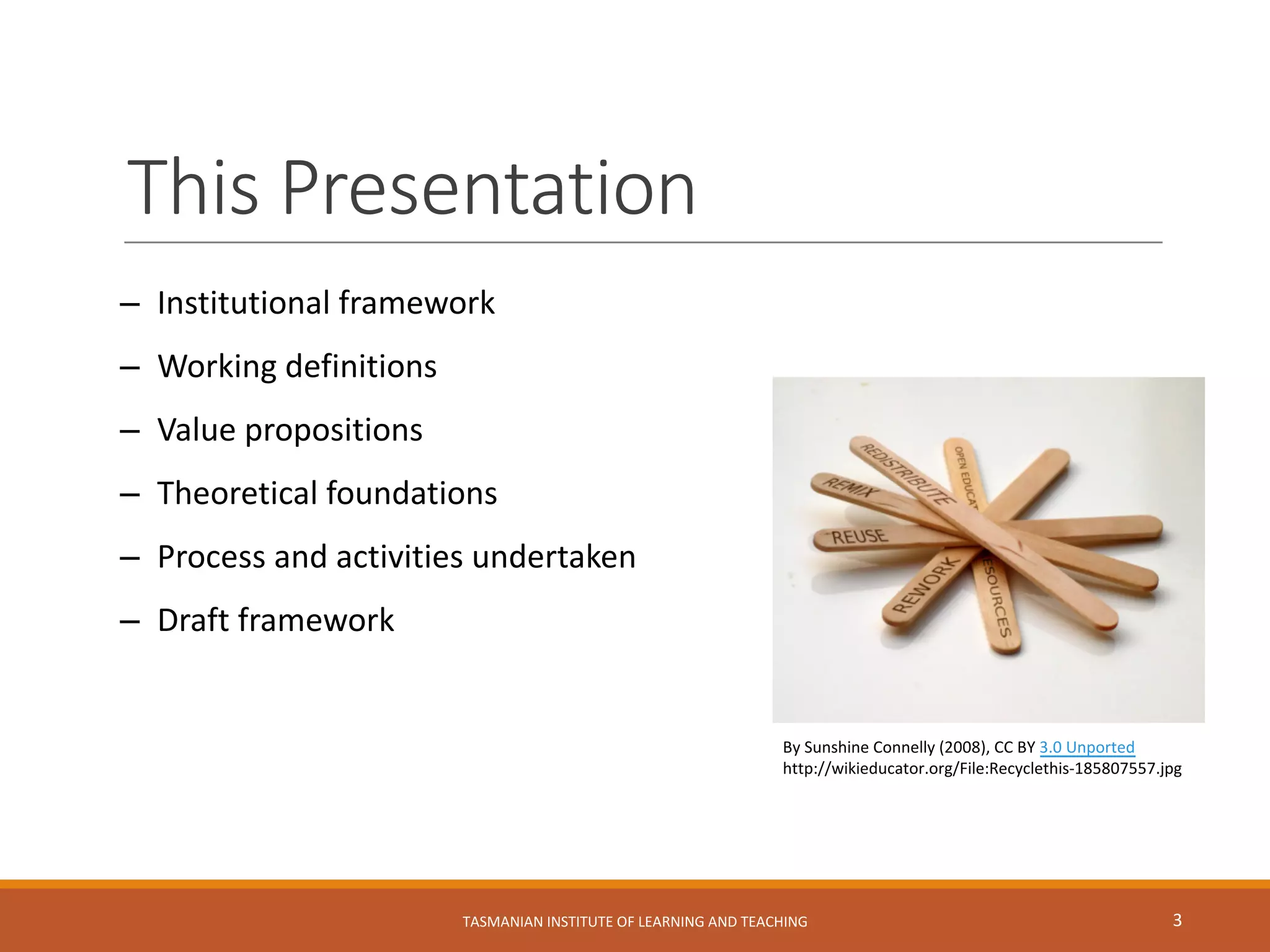
By	Sunshine	Connelly	(2008),	CC	BY	3.0	Unported
http://wikieducator.org/File:Recyclethis-185807557.jpg
Working	Definitions
Open	Educational	Resources	– OER
Open	Educational	Practices	– OEP
Open	Education	- OE
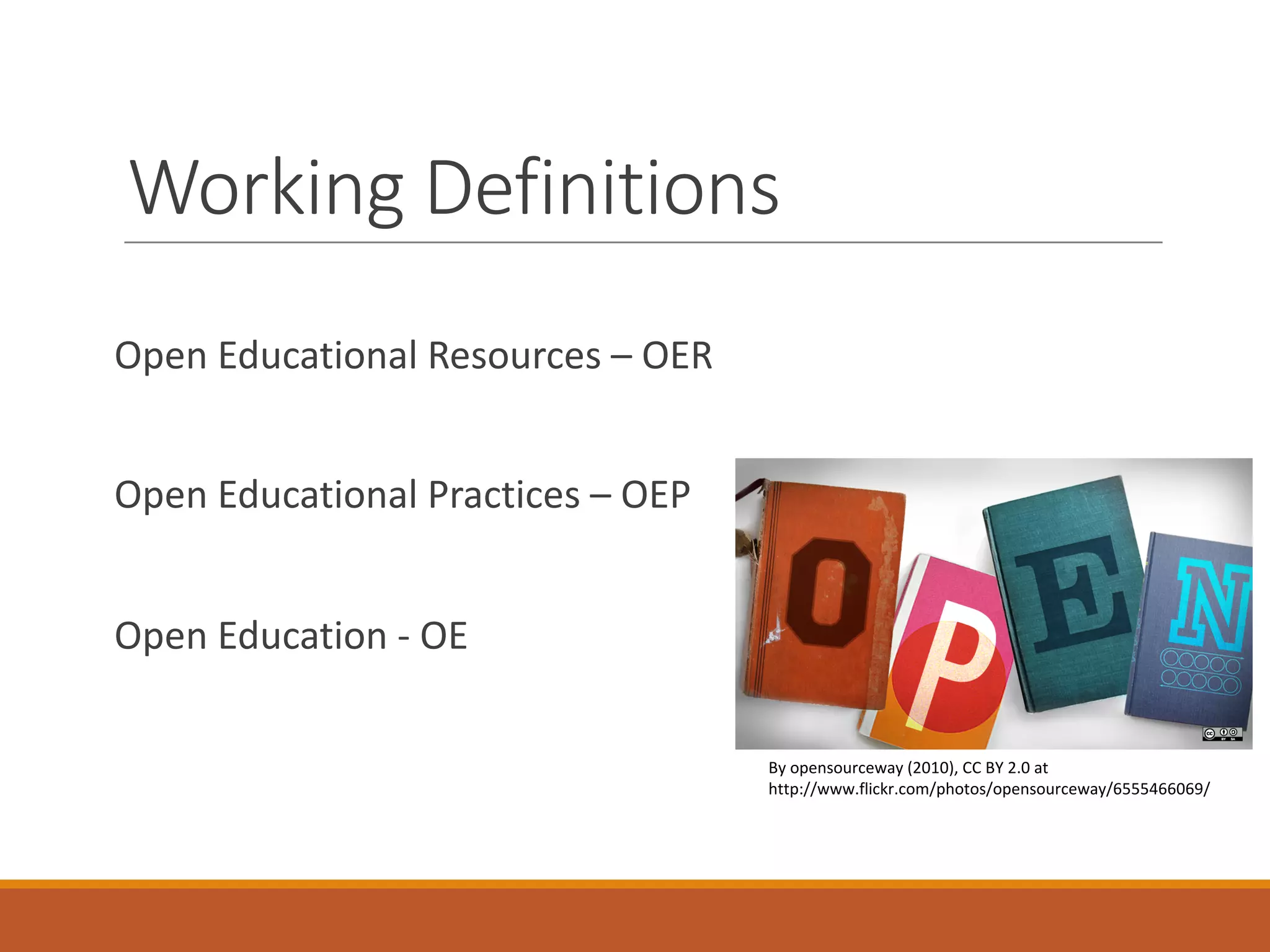
By	opensourceway (2010),	CC	BY	2.0	at	
http://www.flickr.com/photos/opensourceway/6555466069/
Value	Proposition
At	an	organisational level:
– Reputation – OEP	institutions	can	market	and	showcase	educational	
content,	raise	their	profile	and	attract	more	students
– Collaboration - OEP	provide	opportunities	for	national	and	
international	collaboration	with	other	universities	
– Access	- OEP	can	be	aligned	with	the	institution’s	agendas	for	social	
inclusion	and	widening	participation
– Innovation – OEP	promote	innovation	and	quality	in	teaching	and	
learning
Value	Proposition
For	Academic	staff:
– OEP	can	promote	collegial	and	subject	level	
collaboration
– OEP	can	assist	the	development	of	a	‘quality	
agenda	translated	into	better	teaching	practice’
– OER	and	OEP	create	efficiency	in	content	
development
– OEP	create	more	opportunities	for	flexible	and	
personalised learning
– OEP	enhance	existing	pedagogical	approaches	to	
learning	and	provide	the	basis	for	new	ones
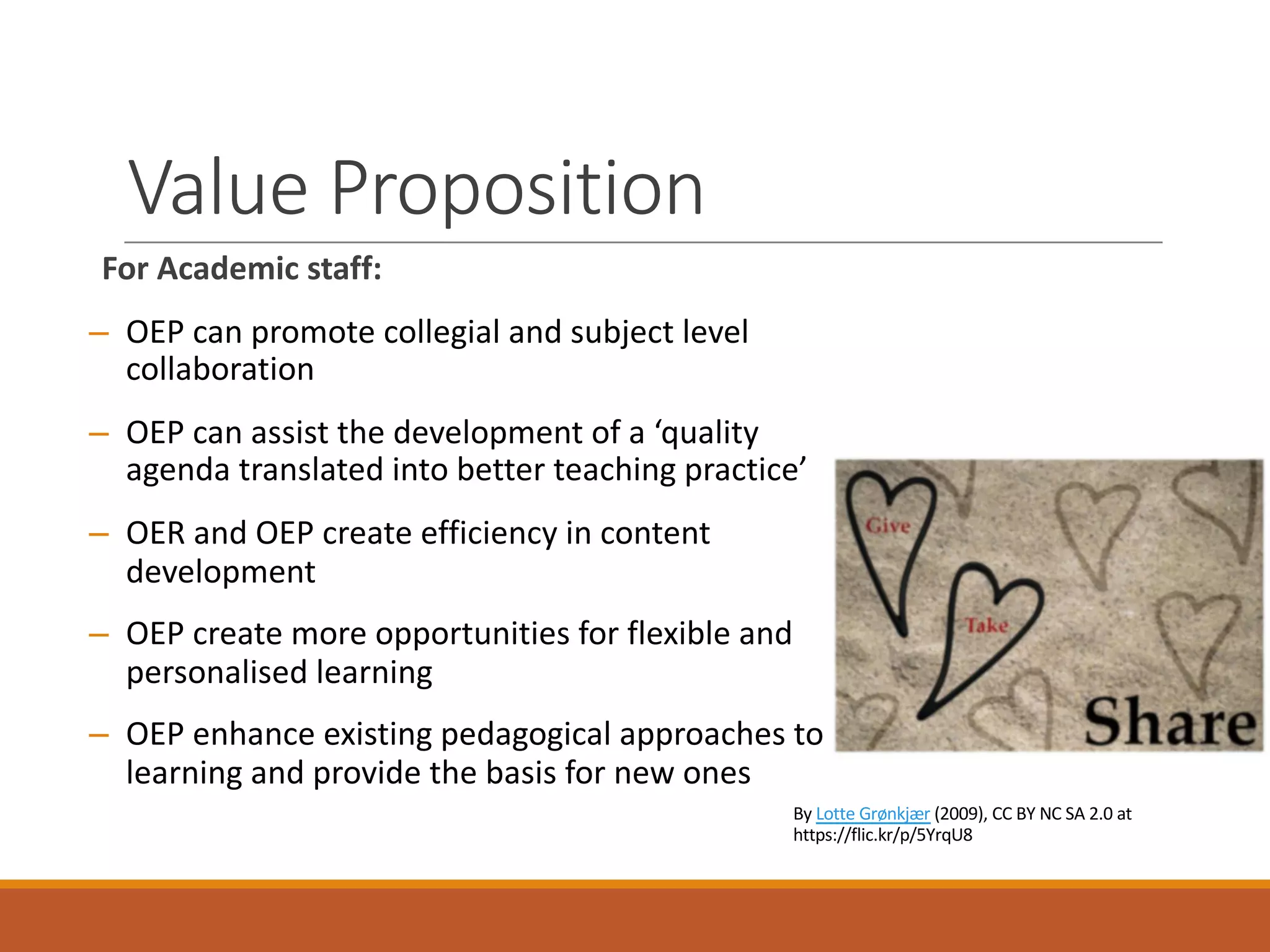
By	Lotte Grønkjær (2009),	CC	BY	NC	SA	2.0	at	
https://flic.kr/p/5YrqU8
Value	Proposition
For	students:
– Enhance	learning	through	networked	and	collaborative	learning;
– Promote	richer	learning	experiences	through	access	to	learning	
resources	available	outside	institutional	boundaries;
– Meets	students’	different	needs	and	learning	styles;	and
– Promote	and	enhance	lifelong	learning.
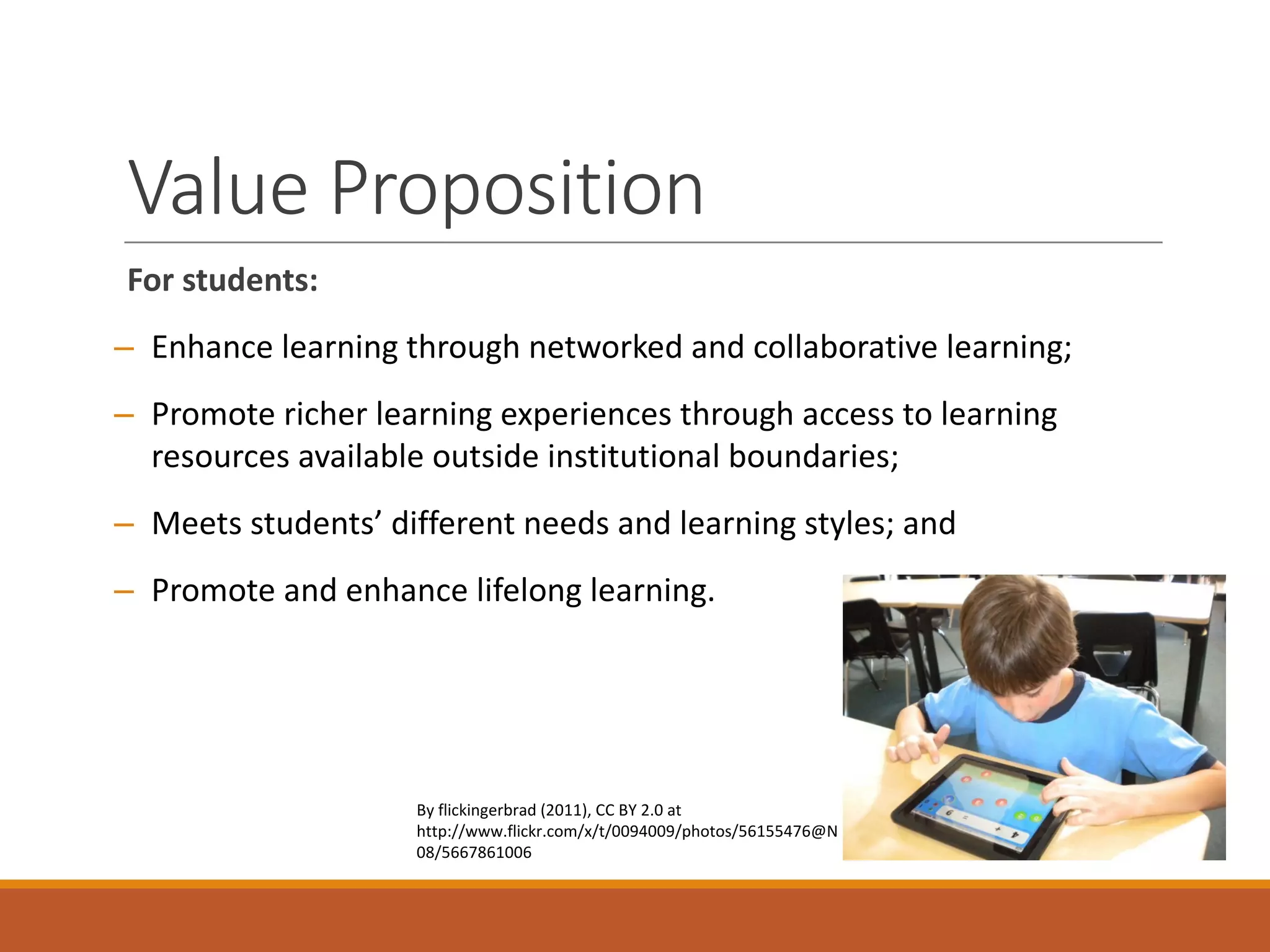
By	flickingerbrad (2011),	CC	BY	2.0	at	
http://www.flickr.com/x/t/0094009/photos/56155476@N
08/5667861006
Frameworks	and	Guidelines
– Guidelines	for	open	educational	resources	in	
higher	education	(Commonwealth	of	Learning,	
2011).	
– Open	Educational	Quality	Initiative	(OPAL,	2011)	
– Feasibility	Protocol	(Bossu,	Brown	&	Bull,	2014)
– The	2012	Paris	Declaration	(UNESCO,	2012)
Process	and	Activities	
Undertaken
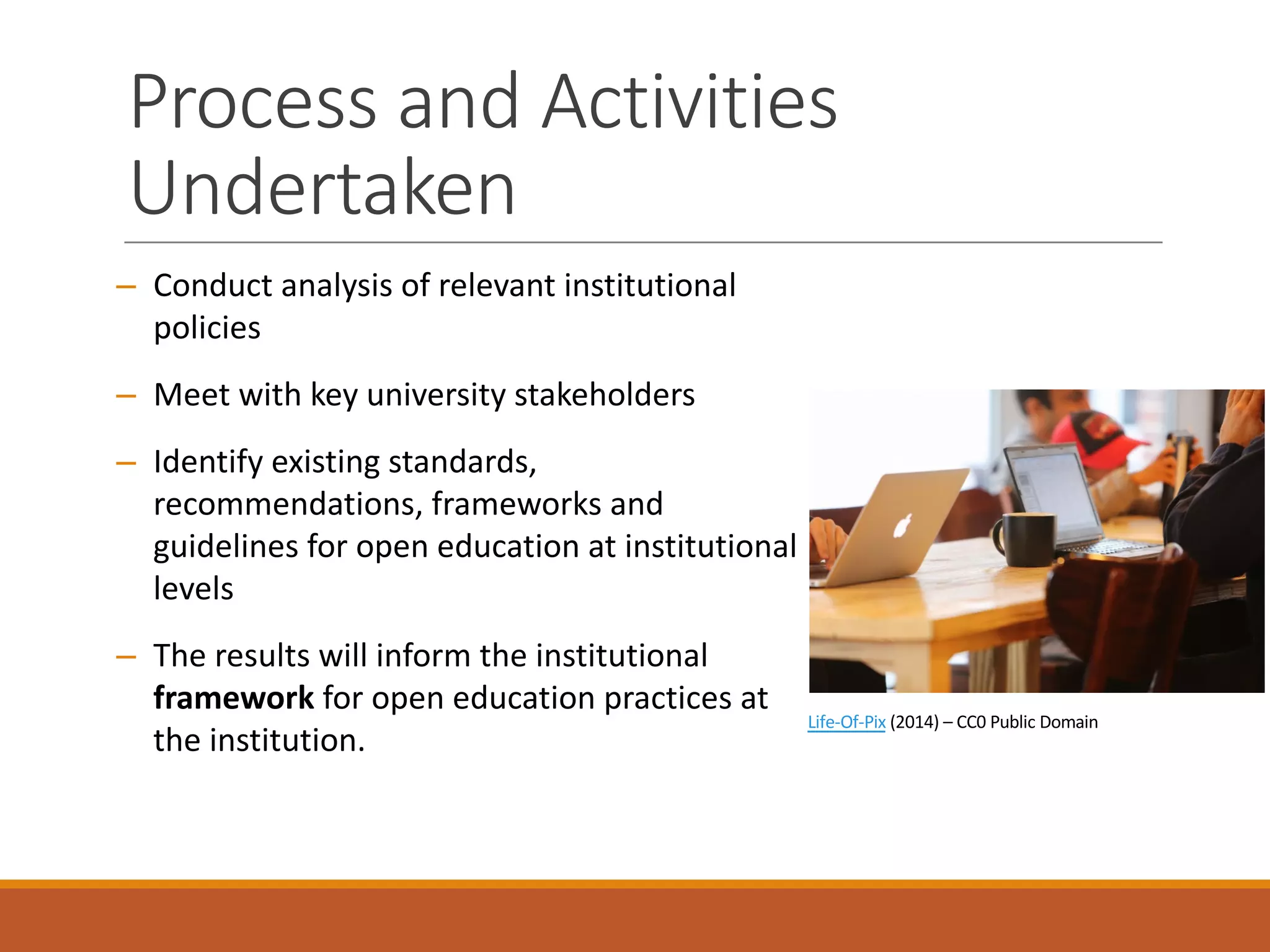
– Conduct	analysis	of	relevant	institutional	
policies
– Meet	with	key	university	stakeholders
– Identify	existing	standards,	
recommendations,	frameworks	and	
guidelines	for	open	education	at	institutional	
levels
– The	results	will	inform	the	institutional	
framework for	open	education	practices	at	
the	institution.
Life-Of-Pix (2014)	– CC0	Public	Domain
A)	Develop	institutional	strategies	for	the	integration	of	OER
◦ Why,	how,	benefits	for	staff,	students,	institution
B) Provide	incentives	to	support	investment	in	the	
development,	acquisition	and	adaptation	of	high	quality	
learning	materials
◦ Teaching	standards,	policies	on	learning	and	teaching
C)	Recognise	the	important	role	of	educational	resources	
within	internal	quality	assurance	processes
◦ Reuse	quality	resources
Guidelines	for	OER	in	Higher	
Education
D)	Consider	creating	flexible	copyright	policies
◦ Creative	commons,	IP,	licensing
E)	Undertake	institutional	advocacy	and	capacity	building
◦ Part	of	blended	learning	and	learning	design
F)	Ensure	ICT	access	for	staff	and	students
◦ Digital	literacies
Guidelines	for	OER	in	Higher	
Education
Thank	you	
Phoenix-Panarh (2015).	Licensed	as	CC0	Public	Domain	
- http://pixabay.com/en/exclamation-question-sign-491244/

2015 ICDE Open Educational Practice