Becoming and Being Open Educators
Catherine Cronin
#cesicon 01 March2014
@catherinecronin

slideshare.net/cicronin
“I don’t think
education is about
centralized instruction
anymore; rather, it is
the process [of]
establishing oneself
as a node in a broad
network of distributed
creativity.”
– Joi Ito @joi

Quote: Joi Ito

Image: CC BY-NC-SA 2.0 yo
about.me/catherinecronin
#cesicon
considering

OPEN
NESS

-

-
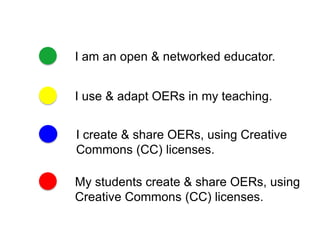
I am an open & networked educator.
I use & adapt OERs in my teaching.
I create & share OERs, using Creative
Commons (CC) licenses.
My students create & share OERs, using
Creative Commons (CC) licenses.
Image: @fordofthekings
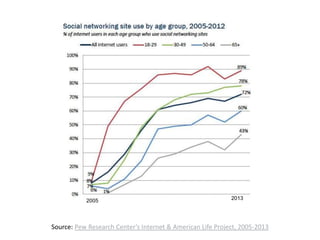
2005

2013

Source: Pew Research Center’s Internet & American Life Project, 2005-2013
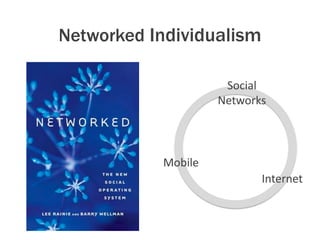
Networked Individualism
Social
Networks

Mobile

Internet
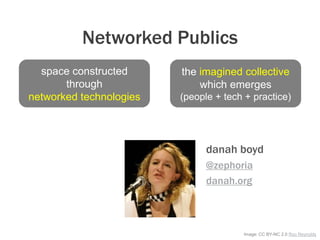
Networked Publics
space constructed
through
networked technologies

the imagined collective
which emerges
(people + tech + practice)

danah boyd
@zephoria
danah.org

Image: CC BY-NC 2.0 Roo Reynolds
http://www.danah.org/
itscomplicated/
Image: CC BY 2.0 dlofink
At its best openness is an ethos
not a license. It's an approach to
teaching and learning that
builds a community of learners
online and off.
- Jim Groom
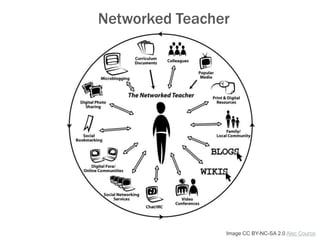
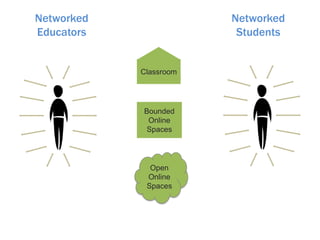
Networked Teacher

Image CC BY-NC-SA 2.0 Alec Couros
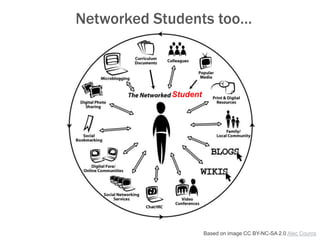
Networked Students too…

Student

Based on image CC BY-NC-SA 2.0 Alec Couros
Networked
Educators

Networked
Students

Classroom

Bounded
Online
Spaces

Open
Online
Spaces
Flickr CC images: cdessums, infidelic, sholeh!
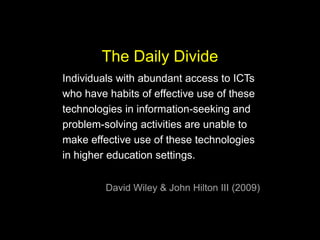
The Daily Divide
Individuals with abundant access to ICTs
who have habits of effective use of these
technologies in information-seeking and
problem-solving activities are unable to
make effective use of these technologies
in higher education settings.
David Wiley & John Hilton III (2009)
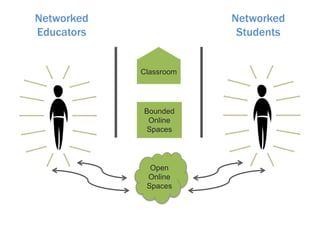
Networked
Educators

Networked
Students

Classroom

Bounded
Online
Spaces

Open
Online
Spaces
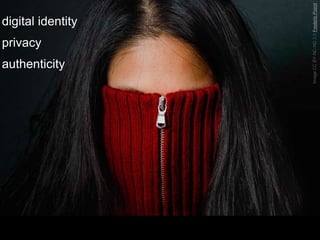
privacy

authenticity
Image CC BY-NC-ND 2.0 Frederic Poirot

digital identity
“If institutions of learning are going to help
learners with the real challenges they face...
[they] will have to shift their focus from
imparting curriculum to supporting the
negotiation of productive identities
through landscapes of practices.”
Etienne Wenger (2010)

CC BY-NC-SA 2.0
choconancy1
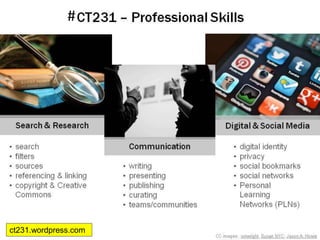
#

ct231.wordpress.com
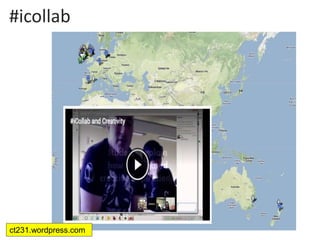
#icollab

icollab.wordpress.com
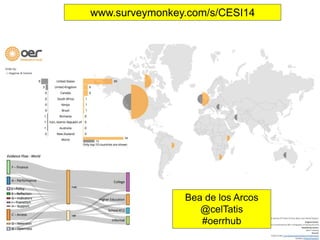
www.surveymonkey.com/s/CESI14

Bea de los Arcos
@celTatis
#oerrhub
The Politics of Education
and Technology
Conflicts, Controversies,
and Connections
Editors:
Neil Selwyn @Neil_Selwyn
Keri Facer @kerileef

First chapter available free
http://goo.gl/fTU1Ee
Learners need to practice and experiment with different
ways of enacting their identities, and adopt subject
positions through different social technologies and media.

These opportunities can only be supported by
academic staff who are themselves engaged in digital
practices and questioning their own relationship with
knowledge.
- Keri Facer & Neil Selwyn (2010)
Thank you!
Catherine Cronin
@catherinecronin
slideshare.net/cicronin
about.me/catherinecronin

Becoming and Being Open Educators

Editor's Notes

  • #4 Not connected/limited by geography, space, time... but connected by our own ideas, passion, commitment via open practices & social media. Daithi – web-based, web beings… multicultural, wholly connected.Deirdre Butler – complex communicationThis is one of the best definitions I’ve seen of Open Education… and its future possibilities. QUESTION: How best can I help my students to live & thrive in this world?…this informs my practice (learning, teaching, research)
  • #9 Fastest growing? 45-54 year-olds on FB/G+ and 55-64 on Twitter (Fast Company study)95% CT231 studentsOnline ADULTS:72% (Pew, 2013)  80% in Ireland67% use Facebook 18% use Twitter & 13% use InstagramCreate (not just Consume) content (Produce, Comment, Classify & Curate)Relationships are the lifeblood of social media
  • #10 “Networked Individualism”CONTEXT = 3 Revolutions:SOCIAL NETWORKS – (more than FB!) existed for a long time… fluid changing networks, not groups, sometimes communitiesINTERNET… baked-in ethic of OPENNESS, freedom & innovationMOBILE… affects our sense of Time and Place… Presence… Social Connectedness… “hyperconnectivity”We (people & institutions) exist now in Information & Communication Ecologies that are strikingly different from the ones that existed just a generation ago.We live in a different media landscape than the one we lived in and were educated in. (learn anything, anywhere, any time)EXTRA: We often hear that “the network” is changing social dynamics. According to Manuel Castells, the morphology of contemporary societies is the network. What this means is that previous sociological models defined by hierarchies and one-to-many communication patterns are rendered archaic. Being a relevant social actor does not solely depend on economic power, but on social capital derived from the people you are connected to and how well you maintain those connections. This is aided by the use of information technologies, from desktop computers to mobile media. http://mobyconsulting.com/what-are-networked-publics/
  • #11 danahboyd defined NETWORKED PUBLICS… networked, open, online spaces (a new kind of public space)Global networks, different audiences… data is PERSISTENT _ REPLICABLE _ SCALABLE _ SEARCHABLE The audience is unknown… Context Collapse.
  • #13 The term “open”, in traditional terms means being open to ideas, experience, evidence, argument, discussion, persuasion, method and reason. NOW:= tools, practices, knowledge= Resources which are shared, free of copyright (or CC that allows sharing), collaborative & free to modify and/or distribute(also visible + persistent)OPEN =philosophy or value system – a belief that having activity out in the open yields multiple positive benefits & a commitment to continually work on becoming more accessible and inclusive (Grant Potter)
  • #14 https://docs.google.com/presentation/d/1PZz2q3B5O5fPKv0isBbc0HZcxbOGc_3PfB0O43JOq8g/edit#slide=id.gda69e593_2_75
  • #15 2006 diagram created by Alec Couros…. (when uptake of SM was much lower & mobile not as widespread).
  • #16 81% [94%] of online teens use social networking sites (Pew, 2013)94% [90%] use Facebook 24% [60%] use Twitter 11% [23%] use Instagram[40%] use WhatsApp[35%] use Snapchat
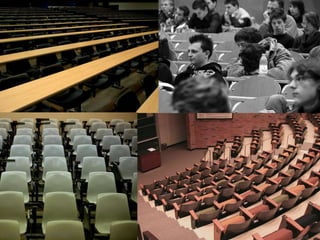
  • #17 3 main spaces where we encounter one another…Physical classroomsLMS / VLE (e.g. Blackboard, or other members-only communities)On the web, using open tools, open source, open access… e.g. social media (Twitter, Facebook, G+, Flickr), blogs, wikis, etc. Each of these spaces has particular affordancesClassrooms = safe spaces for learners to develop & to share their work – with teacher, sometimes one another.Group dialogue, collaboration, communitySynchronousBodily markersBOS:AsynchronousFewer identity markersChallenges:Private & closedWe are connected, but we cannot simultaneously share our community with our networks – combine them – share our work with wider audience.MESSAGE: what we do here is separate from Life; Formal learning divorced from rather than integrated with Informal learning.
  • #19 David Wiley & John Hilton have called this the Daily Divide.The well-known phrase “digital divide” describes the gulf between individuals who have access to information technology and individuals who do not.Also a Daily Divide…Connected students may, of course, choose to “go rogue” outside of class and usetechnologies and their skills outside of class, but this only serves to reinforce the feeling of disconnection and disorientation on in-class exams.
  • #20 Some educators are seeking to make this connection, to cross this boundary between formal and informal learning. This is the area of my study.Open Online Spaces or Networked Publics (= blogs, wikis, social networks such as Twitter, G+, etc.) = enable Networked or Connected LearningWhat are the affordances of OOS?Organising principle is the NETWORK (fleeting membership, weak ties) rather than the GROUP (designed, strong ties)Enables Cooperative networked dependencies, not just collaborative group dependenciesOpen, DiversityFlexibility & NonlinearityEducators & students can share their networks.
  • #21 Giddens (1991) examines identity as a constantly re-worked personal narrative  we continually create/develop our identities, in interactions with othersGoffman (1975) emphasised multiple identities equated with differentiated roles, framed by contextIn classrooms & BOS, our identies are our real-name identities, our roles are ascribed to a great extent.e.g. in Blackboard, students & lecturers have different privileges. In grading this is right! Is it necessary for all learning activities?In OOS, each individual creates their own online persona  digital identityReal name (@catherinecronin)Pseudonym or alter ego Students are creating and experessing their DI’s every day… using SM & SNS such as FB, Tw, SnapChat… Many students already have a confidence social digital identity, but developing an identitiy as a learner, a writer, a scholar, a citizen…. these are the important tasks as part of education. Many educators feel that we have a role in supporting students in developing their digital identities, to support lifelong learning, to model good practices in these online spaces.
  • #22 Knowledge NOT= CurriculumKnowledge = “a living landscape of communities of practice that contribute in various ways” to our learning and to our identitiesSo… HOW do we do this?!
  • #27 Final quote from KF and NS...