pen
Choosing
Image: CC0 by Nadine Shaabana
Catherine Cronin  CELT, NUI Galway
Virtual Symposium, LRNT521, Royal Roads University  20th April 2017
Catherine Cronin
@catherinecronin  catherinecronin.net
CELT, National University of Ireland, Galway
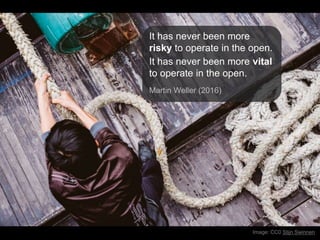
Image: CC0 Stijn Swinnen
It has never been more
risky to operate in the open.
It has never been more vital
to operate in the open.
Martin Weller (2016)
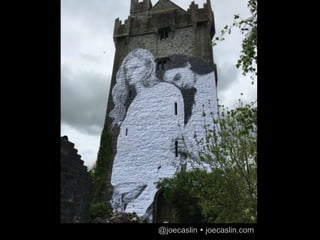
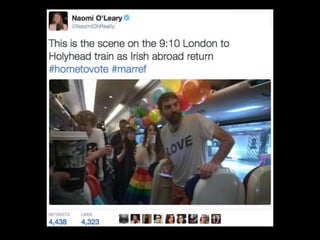
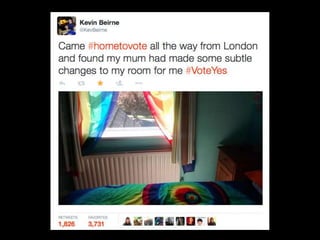
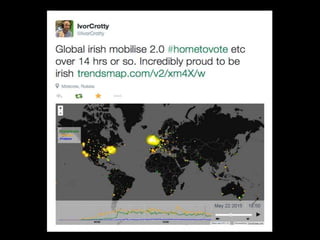
sharing a story from Ireland, 2015…
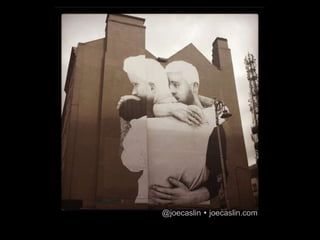
@joecaslin  joecaslin.com
@hendinarts
@joecaslin  joecaslin.com
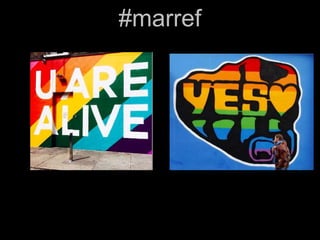
#marref
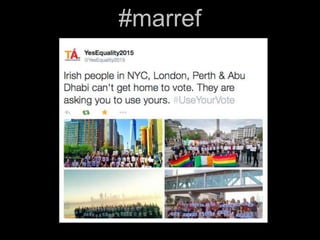
#marref
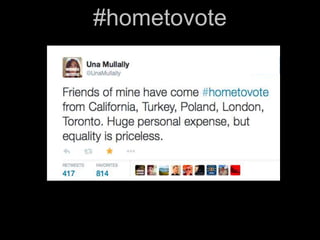
#hometovote
#RRUMALAT
#MALATmemes
#OxfordComma
#OER17
#TowardsOpenness
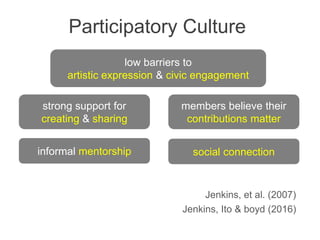
Participatory Culture:
low barriers to
artistic expression & civic engagement
strong support for
creating & sharing
informal mentorship
members believe their
contributions matter
social connection
Jenkins, et al. (2007)
Jenkins, Ito & boyd (2016)
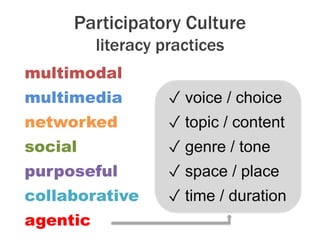
multimodal
multimedia ✓ voice / choice
networked ✓ topic / content
social ✓ genre / tone
purposeful ✓ space / place
collaborative ✓ time / duration
agentic
Participatory Culture
literacy practices
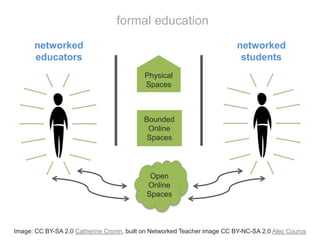
networked
educators
networked
students
Physical
Spaces
Bounded
Online
Spaces
Open
Online
Spaces
Image: CC BY-SA 2.0 Catherine Cronin, built on Networked Teacher image CC BY-NC-SA 2.0 Alec Couros
formal education
Openness and praxis:
Exploring the use of
open educational practices (OEP)
in higher education
my PhD research
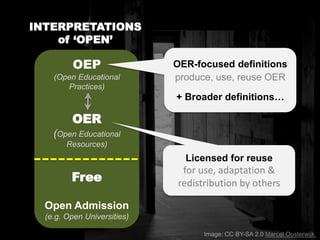
OEP
(Open Educational
Practices)
OER
(Open Educational
Resources)
Free
Open Admission
(e.g. Open Universities)
INTERPRETATIONS
of ‘OPEN’
OER-focused definitions
produce, use, reuse OER
+ Broader definitions…
Licensed for reuse
for use, adaptation &
redistribution by others
Image: CC BY-SA 2.0 Marcel Oosterwijk
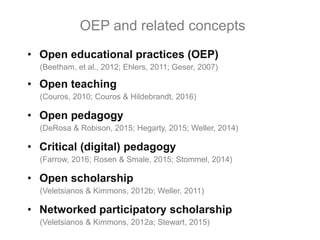
• Open educational practices (OEP)
(Beetham, et al., 2012; Ehlers, 2011; Geser, 2007)
• Open teaching
(Couros, 2010; Couros & Hildebrandt, 2016)
• Open pedagogy
(DeRosa & Robison, 2015; Hegarty, 2015; Weller, 2014)
• Critical (digital) pedagogy
(Farrow, 2016; Rosen & Smale, 2015; Stommel, 2014)
• Open scholarship
(Veletsianos & Kimmons, 2012b; Weller, 2011)
• Networked participatory scholarship
(Veletsianos & Kimmons, 2012a; Stewart, 2015)
OEP and related concepts
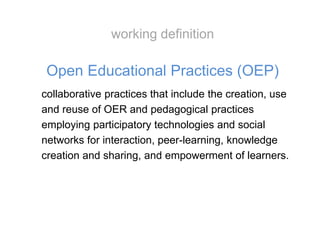
collaborative practices that include the creation, use
and reuse of OER and pedagogical practices
employing participatory technologies and social
networks for interaction, peer-learning, knowledge
creation and sharing, and empowerment of learners.
Open Educational Practices (OEP)
working definition
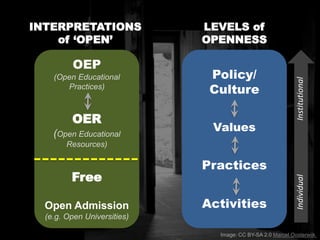
INTERPRETATIONS
of ‘OPEN’
Policy/
Culture
Values
Practices
Activities
LEVELS of
OPENNESS
OEP
(Open Educational
Practices)
OER
(Open Educational
Resources)
Free
Open Admission
(e.g. Open Universities)
IndividualInstitutional
Image: CC BY-SA 2.0 Marcel Oosterwijk
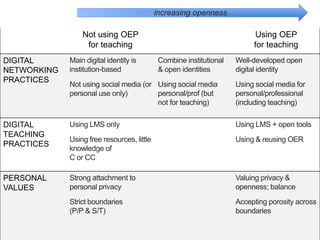
Not using OEP
for teaching
Using OEP
for teaching
DIGITAL
NETWORKING
PRACTICES
Main digital identity is
institution-based
Not using social media (or
personal use only)
Combine institutional
& open identities
Using social media
personal/prof (but
not for teaching)
Well-developed open
digital identity
Using social media for
personal/professional
(including teaching)
DIGITAL
TEACHING
PRACTICES
Using LMS only
Using free resources, little
knowledge of
C or CC
Using LMS + open tools
Using & reusing OER
PERSONAL
VALUES
Strong attachment to
personal privacy
Strict boundaries
(P/P & S/T)
Valuing privacy &
openness; balance
Accepting porosity across
boundaries
increasing openness
Image: CC0 photo by Saksham Gangwar
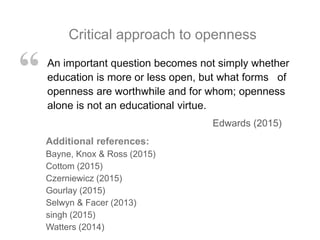
An important question becomes not simply whether
education is more or less open, but what forms of
openness are worthwhile and for whom; openness
alone is not an educational virtue.
Edwards (2015)
“
Critical approach to openness
Additional references:
Bayne, Knox & Ross (2015)
Cottom (2015)
Czerniewicz (2015)
Gourlay (2015)
Selwyn & Facer (2013)
singh (2015)
Watters (2014)
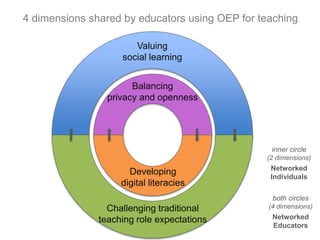
Balancing
privacy and openness
Developing
digital literacies
Valuing
social learning
Challenging traditional
teaching role expectations
inner circle
(2 dimensions)
Networked
Individuals
both circles
(4 dimensions)
Networked
Educators
4 dimensions shared by educators using OEP for teaching
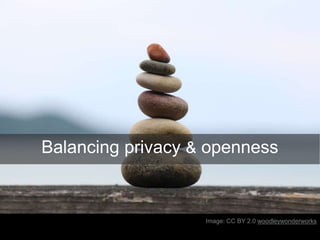
Balancing privacy & openness
Image: CC BY 2.0 woodleywonderworks
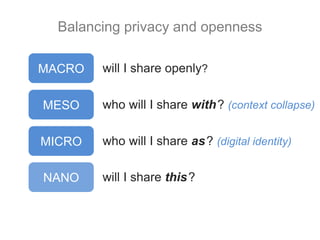
Balancing privacy and openness
will I share openly?
who will I share with? (context collapse)
who will I share as? (digital identity)
will I share this?
MACRO
MESO
MICRO
NANO
Practicing openness is:
 complex
 personal
 contextual
 continuously negotiated
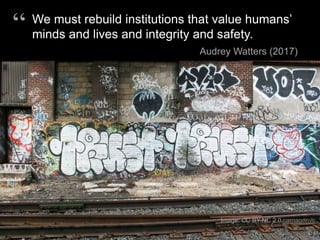
We must rebuild institutions that value humans’
minds and lives and integrity and safety.
Audrey Watters (2017)
“
Image: CC BY-NC 2.0 carnagenyc
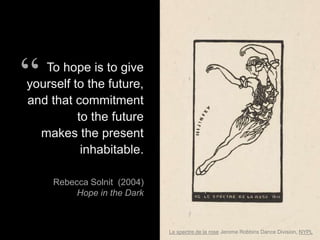
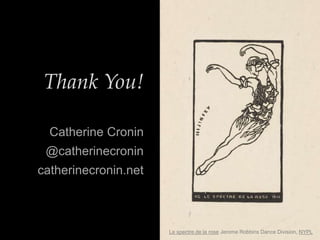
Le spectre de la rose Jerome Robbins Dance Division, NYPL
To hope is to give
yourself to the future,
and that commitment
to the future
makes the present
inhabitable.
Rebecca Solnit (2004)
Hope in the Dark
“
Le spectre de la rose Jerome Robbins Dance Division, NYPL
Thank You!
Catherine Cronin
@catherinecronin
catherinecronin.net
How do our own choices re:
openness affect learning,
teaching, policy, and culture?
During the discussion following the presentation, the
issue of risk arose again (as highlighted in the Martin
Weller quote shared at the start). A growing body of
research in open education advocates and uses a
critical approach to openness – acknowledging, for
example, that open practices can bias those already
privileged. Additional ‘critical approach’ resources
are shared on the following slide and also in the full
list of resources for the webinar.
An important question becomes not simply whether
education is more or less open, but what forms of
openness are worthwhile and for whom; openness
alone is not an educational virtue.
Edwards (2015)
“
Critical approach to openness
Additional references:
Bayne, Knox & Ross (2015)
Cottom (2015)
Czerniewicz (2015)
Gourlay (2015)
Selwyn & Facer (2013)
singh (2015)
Watters (2014)
Links to all presentation references:
http://bit.ly/ChoosingOpen
Bayne, S., Knox, J. & Ross, J. (2015). Open education: the need for a critical approach. Learning, Media and
Technology, 40(3), 247-250.
Beetham, H., Falconer, I., McGill, L. & Littlejohn, A. (2012). Open Practices: Briefing Paper. Jisc.
Cottom, T. (2015). Open and accessible to what and for whom? tressiemc blog.
Couros, A. (2010). Developing personal learning networks for open and social learning. In G. Veletsianos
(Ed.), Emerging Technologies in Distance Education. Athabasca University Press.
Couros, A. & Hildebrandt, K. (2016). Designing for open and social learning. In G. Veletsianos, Emergence
and Innovation in Digital Learning. Athabasca University Press.
Czerniewicz, L. (2015). Confronting inequitable power dynamics of global knowledge production and
exchange. Water Wheel 14(5), 26-28.
DeRosa, R. & Robison, S. (2015, November 9). Pedagogy, technology, and the example of open educational
resources. EDUCAUSE Review.
Edwards, R. (2015). Knowledge infrastructures and the inscrutability of openness in education. Learning,
Media and Technology, 40(3), 251-264.
Ehlers, U-D. (2011). Extending the territory: From open educational resources to open educational practices.
Journal of Open, Flexible and Distance Learning, 15(2), 1–10.
Farrow, R. (2016). Open education and critical pedagogy. Learning, Media and Technology.
Geser, G. (2007). Open educational practices and resources: OLCOS Roadmap, 2012.
Gourlay, L. (2015). Open education as a “heterotopia of desire.” Learning, Media and Technology, 40(3), 310-
327.
Hegarty, B. (2015). Attributes of open pedagogy: A model for using open educational resources. Educational
Technology. (July/August).
References (1 of 2)
Jenkins, H., et al. (2007). Confronting the Challenges of Participatory Culture: Media Education for the 21st
Century. Chicago: MacArthur Foundation.
Jenkins, H., Ito, M. & boyd, d. (2016) Participatory Culture in a Networked Era. Cambridge: Polity Press.
Rosen, J. R. & Smale, M. A. (2015). Open digital pedagogy = Critical pedagogy. Hybrid Pedagogy.
Selwyn, N. & Facer, K. (2013). The politics of education and technology: Conflicts, controversies, and
connections. Basingstoke: Palgrave Macmillan.
singh, s. (2015) The Fallacy of “Open”. savasavasava blog.
Solnit, R. (2004). Hope in the Dark: Untold Histories, Wild Possibilities. New York: Nation Books.
Stewart, B. (2015). In abundance: Networked participatory practices as scholarship. IRRODL, 16(3).
Stommel, J. (2014, November 18). Critical digital pedagogy: a definition. Hybrid Pedagogy.
Veletsianos, G. & Kimmons, R. (2012a). Assumptions and challenges of open scholarship. IRRODL, 13(4),
166-189.
Veletsianos, G. & Kimmons, R. (2012b). Networked participatory scholarship: Emergent techno-cultural
pressures toward open and digital scholarship in online networks. Computers & Education, 58(2), 766–774.
Watters, A. (2014). From “open” to justice. Hack Education blog.
Watters, A. (2017, February 2). Ed-tech in a time of Trump. Hack Education blog.
Weller, M. (2011). The Digital Scholar: How technology is transforming scholarly practice. Basingstoke:
Bloomsbury Academic.
Weller, M. (2014). The Battle for Open: How openness won and why it doesn’t feel like victory. London:
Ubiquity Press.
Weller, M. (2016, December 13). The paradoxes of open scholarship. The Ed Techie.
References (2 of 2)

Choosing Open (webinar)

  • 1.
    pen Choosing Image: CC0 byNadine Shaabana Catherine Cronin  CELT, NUI Galway Virtual Symposium, LRNT521, Royal Roads University  20th April 2017
  • 2.
    Catherine Cronin @catherinecronin catherinecronin.net CELT, National University of Ireland, Galway
  • 4.
    Image: CC0 StijnSwinnen It has never been more risky to operate in the open. It has never been more vital to operate in the open. Martin Weller (2016)
  • 5.
    sharing a storyfrom Ireland, 2015…
  • 6.
  • 8.
  • 9.
  • 10.
  • 11.
  • 12.
  • 16.
  • 17.
    Participatory Culture: low barriersto artistic expression & civic engagement strong support for creating & sharing informal mentorship members believe their contributions matter social connection Jenkins, et al. (2007) Jenkins, Ito & boyd (2016)
  • 18.
    multimodal multimedia ✓ voice/ choice networked ✓ topic / content social ✓ genre / tone purposeful ✓ space / place collaborative ✓ time / duration agentic Participatory Culture literacy practices
  • 19.
    networked educators networked students Physical Spaces Bounded Online Spaces Open Online Spaces Image: CC BY-SA2.0 Catherine Cronin, built on Networked Teacher image CC BY-NC-SA 2.0 Alec Couros formal education
  • 20.
    Openness and praxis: Exploringthe use of open educational practices (OEP) in higher education my PhD research
  • 21.
    OEP (Open Educational Practices) OER (Open Educational Resources) Free OpenAdmission (e.g. Open Universities) INTERPRETATIONS of ‘OPEN’ OER-focused definitions produce, use, reuse OER + Broader definitions… Licensed for reuse for use, adaptation & redistribution by others Image: CC BY-SA 2.0 Marcel Oosterwijk
  • 22.
    • Open educationalpractices (OEP) (Beetham, et al., 2012; Ehlers, 2011; Geser, 2007) • Open teaching (Couros, 2010; Couros & Hildebrandt, 2016) • Open pedagogy (DeRosa & Robison, 2015; Hegarty, 2015; Weller, 2014) • Critical (digital) pedagogy (Farrow, 2016; Rosen & Smale, 2015; Stommel, 2014) • Open scholarship (Veletsianos & Kimmons, 2012b; Weller, 2011) • Networked participatory scholarship (Veletsianos & Kimmons, 2012a; Stewart, 2015) OEP and related concepts
  • 23.
    collaborative practices thatinclude the creation, use and reuse of OER and pedagogical practices employing participatory technologies and social networks for interaction, peer-learning, knowledge creation and sharing, and empowerment of learners. Open Educational Practices (OEP) working definition
  • 24.
    INTERPRETATIONS of ‘OPEN’ Policy/ Culture Values Practices Activities LEVELS of OPENNESS OEP (OpenEducational Practices) OER (Open Educational Resources) Free Open Admission (e.g. Open Universities) IndividualInstitutional Image: CC BY-SA 2.0 Marcel Oosterwijk
  • 25.
    Not using OEP forteaching Using OEP for teaching DIGITAL NETWORKING PRACTICES Main digital identity is institution-based Not using social media (or personal use only) Combine institutional & open identities Using social media personal/prof (but not for teaching) Well-developed open digital identity Using social media for personal/professional (including teaching) DIGITAL TEACHING PRACTICES Using LMS only Using free resources, little knowledge of C or CC Using LMS + open tools Using & reusing OER PERSONAL VALUES Strong attachment to personal privacy Strict boundaries (P/P & S/T) Valuing privacy & openness; balance Accepting porosity across boundaries increasing openness
  • 26.
    Image: CC0 photoby Saksham Gangwar
  • 27.
    An important questionbecomes not simply whether education is more or less open, but what forms of openness are worthwhile and for whom; openness alone is not an educational virtue. Edwards (2015) “ Critical approach to openness Additional references: Bayne, Knox & Ross (2015) Cottom (2015) Czerniewicz (2015) Gourlay (2015) Selwyn & Facer (2013) singh (2015) Watters (2014)
  • 28.
    Balancing privacy and openness Developing digitalliteracies Valuing social learning Challenging traditional teaching role expectations inner circle (2 dimensions) Networked Individuals both circles (4 dimensions) Networked Educators 4 dimensions shared by educators using OEP for teaching
  • 29.
    Balancing privacy &openness Image: CC BY 2.0 woodleywonderworks
  • 30.
    Balancing privacy andopenness will I share openly? who will I share with? (context collapse) who will I share as? (digital identity) will I share this? MACRO MESO MICRO NANO
  • 31.
    Practicing openness is: complex  personal  contextual  continuously negotiated
  • 32.
    We must rebuildinstitutions that value humans’ minds and lives and integrity and safety. Audrey Watters (2017) “ Image: CC BY-NC 2.0 carnagenyc
  • 33.
    Le spectre dela rose Jerome Robbins Dance Division, NYPL To hope is to give yourself to the future, and that commitment to the future makes the present inhabitable. Rebecca Solnit (2004) Hope in the Dark “
  • 34.
    Le spectre dela rose Jerome Robbins Dance Division, NYPL Thank You! Catherine Cronin @catherinecronin catherinecronin.net
  • 35.
    How do ourown choices re: openness affect learning, teaching, policy, and culture?
  • 36.
    During the discussionfollowing the presentation, the issue of risk arose again (as highlighted in the Martin Weller quote shared at the start). A growing body of research in open education advocates and uses a critical approach to openness – acknowledging, for example, that open practices can bias those already privileged. Additional ‘critical approach’ resources are shared on the following slide and also in the full list of resources for the webinar.
  • 37.
    An important questionbecomes not simply whether education is more or less open, but what forms of openness are worthwhile and for whom; openness alone is not an educational virtue. Edwards (2015) “ Critical approach to openness Additional references: Bayne, Knox & Ross (2015) Cottom (2015) Czerniewicz (2015) Gourlay (2015) Selwyn & Facer (2013) singh (2015) Watters (2014)
  • 38.
    Links to allpresentation references: http://bit.ly/ChoosingOpen
  • 39.
    Bayne, S., Knox,J. & Ross, J. (2015). Open education: the need for a critical approach. Learning, Media and Technology, 40(3), 247-250. Beetham, H., Falconer, I., McGill, L. & Littlejohn, A. (2012). Open Practices: Briefing Paper. Jisc. Cottom, T. (2015). Open and accessible to what and for whom? tressiemc blog. Couros, A. (2010). Developing personal learning networks for open and social learning. In G. Veletsianos (Ed.), Emerging Technologies in Distance Education. Athabasca University Press. Couros, A. & Hildebrandt, K. (2016). Designing for open and social learning. In G. Veletsianos, Emergence and Innovation in Digital Learning. Athabasca University Press. Czerniewicz, L. (2015). Confronting inequitable power dynamics of global knowledge production and exchange. Water Wheel 14(5), 26-28. DeRosa, R. & Robison, S. (2015, November 9). Pedagogy, technology, and the example of open educational resources. EDUCAUSE Review. Edwards, R. (2015). Knowledge infrastructures and the inscrutability of openness in education. Learning, Media and Technology, 40(3), 251-264. Ehlers, U-D. (2011). Extending the territory: From open educational resources to open educational practices. Journal of Open, Flexible and Distance Learning, 15(2), 1–10. Farrow, R. (2016). Open education and critical pedagogy. Learning, Media and Technology. Geser, G. (2007). Open educational practices and resources: OLCOS Roadmap, 2012. Gourlay, L. (2015). Open education as a “heterotopia of desire.” Learning, Media and Technology, 40(3), 310- 327. Hegarty, B. (2015). Attributes of open pedagogy: A model for using open educational resources. Educational Technology. (July/August). References (1 of 2)
  • 40.
    Jenkins, H., etal. (2007). Confronting the Challenges of Participatory Culture: Media Education for the 21st Century. Chicago: MacArthur Foundation. Jenkins, H., Ito, M. & boyd, d. (2016) Participatory Culture in a Networked Era. Cambridge: Polity Press. Rosen, J. R. & Smale, M. A. (2015). Open digital pedagogy = Critical pedagogy. Hybrid Pedagogy. Selwyn, N. & Facer, K. (2013). The politics of education and technology: Conflicts, controversies, and connections. Basingstoke: Palgrave Macmillan. singh, s. (2015) The Fallacy of “Open”. savasavasava blog. Solnit, R. (2004). Hope in the Dark: Untold Histories, Wild Possibilities. New York: Nation Books. Stewart, B. (2015). In abundance: Networked participatory practices as scholarship. IRRODL, 16(3). Stommel, J. (2014, November 18). Critical digital pedagogy: a definition. Hybrid Pedagogy. Veletsianos, G. & Kimmons, R. (2012a). Assumptions and challenges of open scholarship. IRRODL, 13(4), 166-189. Veletsianos, G. & Kimmons, R. (2012b). Networked participatory scholarship: Emergent techno-cultural pressures toward open and digital scholarship in online networks. Computers & Education, 58(2), 766–774. Watters, A. (2014). From “open” to justice. Hack Education blog. Watters, A. (2017, February 2). Ed-tech in a time of Trump. Hack Education blog. Weller, M. (2011). The Digital Scholar: How technology is transforming scholarly practice. Basingstoke: Bloomsbury Academic. Weller, M. (2014). The Battle for Open: How openness won and why it doesn’t feel like victory. London: Ubiquity Press. Weller, M. (2016, December 13). The paradoxes of open scholarship. The Ed Techie. References (2 of 2)

Editor's Notes

  • #3  I’m Catherine Cronin – open educator & open researcher
  • #4 Q: Where are you?
  • #5 Many educators working in the area of open education increasingly speak about the importance of a critical approach to openness, recognising that while it is wonderful to learn/connect in the Open, there are Risks as well... and those most at risk of negative consequences of openness are those who are marginalised, in any way. Navigating this tension IS OUR WORK as educators.
  • #7 2 years ago, this mural appeared on a gable wall on one of the busiest streets in Dublin, South Georges Street. Created by Joe Caslin, artist & activist – in support of the referendum for Marriage Equality which took place in Ireland in May 2015. A 3-month campaign led up to the referendum, which was eventually passed.
  • #9 … became the subject of other artwork, remixed & reshared, again via social media.
  • #10 art/activism not only in urban spaces – a 2nd Joe Caslin mural was created on a castle in rural Galway.
  • #11 more guerilla artwork in small spaces…. blank walls, shop windows, etc. #HASHTAG!!
  • #12 Irish citizens used the power of SM to express themselves, in visual & compelling ways. In the weeks leading up to the ref, many Irish citizens in cities around the world gathered to communicate their wish for a YES vote. e.g. intentionally gathering together to create powerful images (photos, videos) – shared using hashtags.
  • #13 In the final days before the referendum, use of the #HOMETOVOTE hashtag emerged… Peaking on the night before the vote and the morning of the vote…
  • #14  morning of the vote..
  • #15 …and they weren’t all serious. Widely shared & favourited ;)
  • #16 Ivor Crotty, an Irish journalist, shared SM analytics – like this one from the day of the vote, to visualise those communications Not a coherent narrative, framed by anyone… through messages, photos, artwork, visualisations created by many, many individuals, shared on SM using hashtags, a story was being told -- collectively,  Particularly powerful ex of PARTICIPATORY CULTURE = i.e. individuals & groups, collectively, having an impact on shared culture Just a single example… atypical in that it was centred on a referendum, and had an endpoint – though it was the result of activism over many years. There are so many examples of people using openly networked platforms as they seek to have an impact on shared culture. This is the essence of PC. There are countless other examples…
  • #17 I looked at your hashtags 
  • #18 characterised by 5 features.
  • #19 HOW successful are our educational institutions in teaching and designing learning to help students to develop these literacy practices? HOW can we help every learner to develop their own voice & agency so they can contribute to the shared production of KNOWLEDGE & CULTURE ?
  • #21 RQ: Whether, why & how do educators use OEP for teaching in HE? Approach: qualitative / interpretive / critical Setting: one university Participants (19): across disciplines, different positions on openness
  • #22 Also Dave Cormier’s definitions: open TO, open BY, open FOR… . This is another way… but we must always dig under “open” when we hear it, see it, read it… to decipher the definition being used.
  • #25 Importance of CONTEXT!!!
  • #26 Some of my findings: description of practices and values of academic staff. Openness is not a binary construct! Open is not a state… like open or closed. Open is a quality and it is contextual… more or less, depending on where/when/what/why
  • #27 Open is Complex... Personal... Context-dependent Most academic staff perceive potential risks (for themselves & their students) in using OEP for teaching; some perceive the benefits to outweigh the risks. A minority of participants (8 of 19) used OEP for teaching 2 levels of ‘using OEP for teaching’: (i) being open, and (ii) teaching openly Q: Any qualities/skills/dispositions that characterise Open Educators?
  • #28 One more note about the literature: Much of the OE literature does not use a critical approach to openness  openness is assumed to be “a good thing” Growing body of critical research in the area of openness. OPEN tends to bias those already privileged.
  • #36  My question for you…