EP
Conceptualising
Image: CC0 by Nadine Shaabana
Catherine Cronin & Iain MacLaren  CELT, NUI Galway
#OEGlobal18 #go_gn  Delft  24th April 2018
A review of theoretical & empirical literature
contact details:
@catherinecronin
@iainmacl
all sources and references available at:
bit.ly/OEGlobal18_Cronin
open education
goal  philosophy  values
resources, tools and practices
that employ a framework of open sharing
to improve educational access
and effectiveness worldwide
- The Open Education Consortium
Image: CC0 by pulpolux
There are many histories,
many stories of open education
see recent work by
Christina Hendricks, Tannis Morgan, Vivien Rolfe, & more
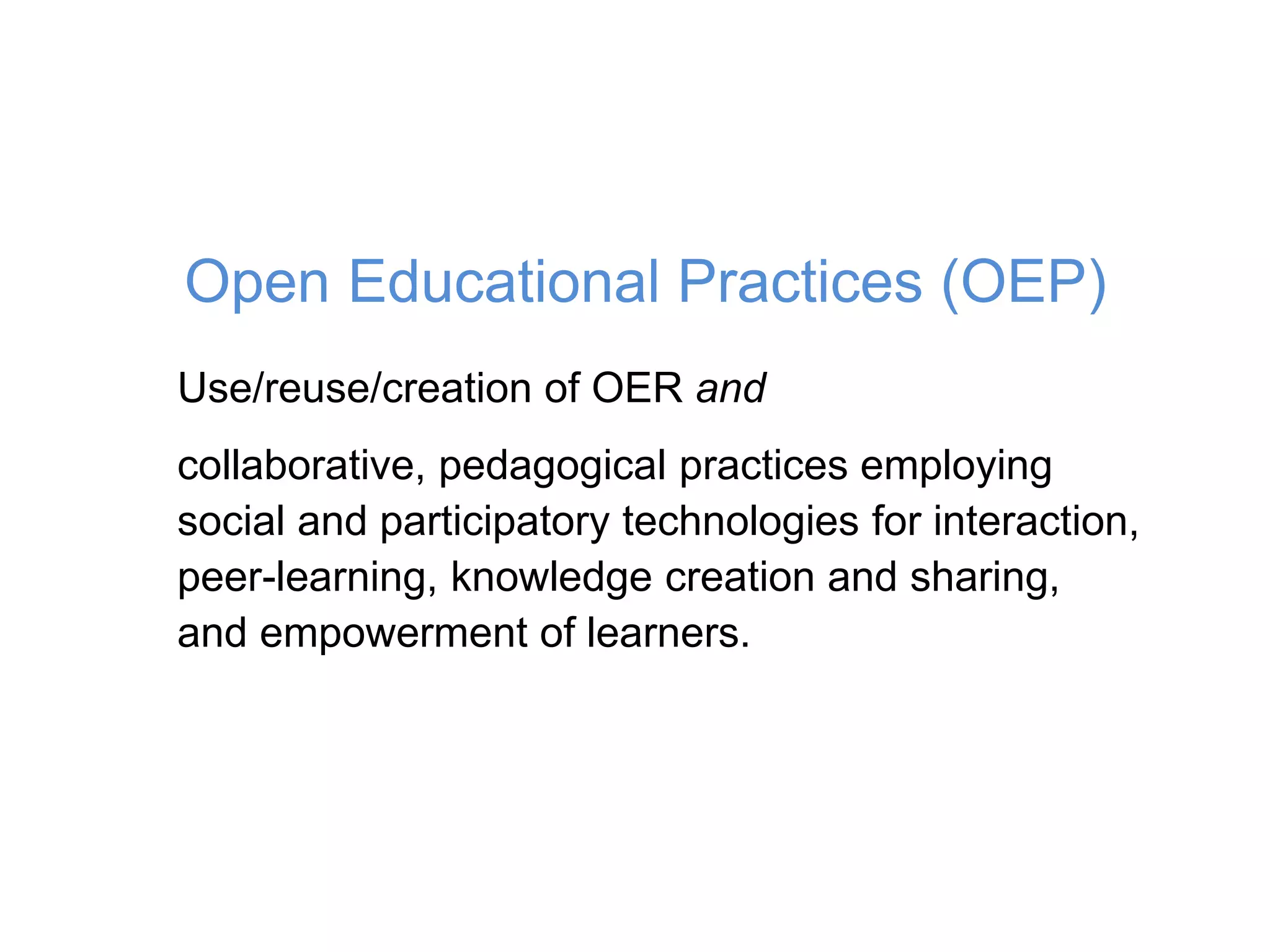
Use/reuse/creation of OER and
collaborative, pedagogical practices employing
social and participatory technologies for interaction,
peer-learning, knowledge creation and sharing,
and empowerment of learners.
Open Educational Practices (OEP)
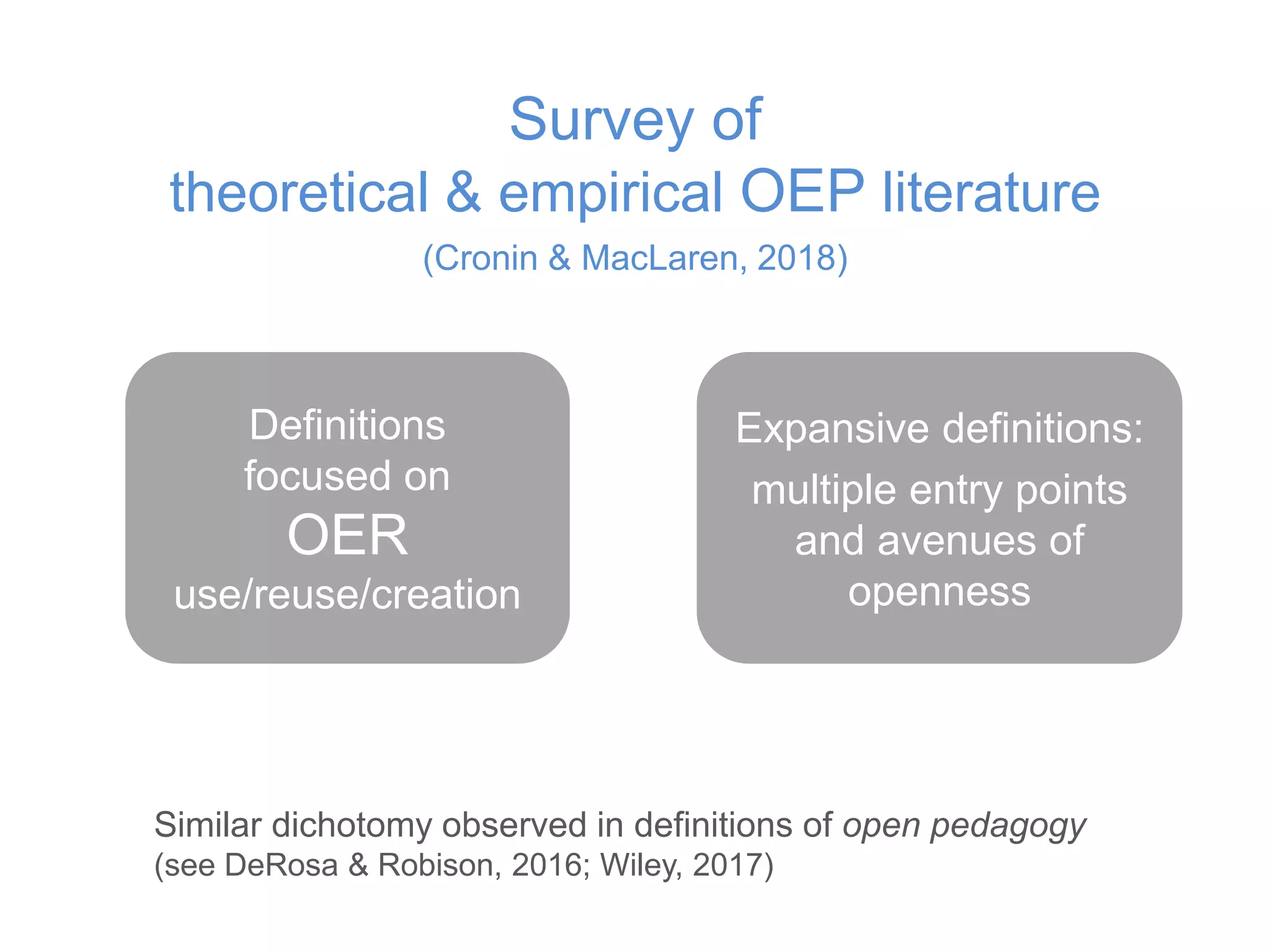
Survey of
theoretical & empirical OEP literature
(Cronin & MacLaren, 2018)
Definitions
focused on
OER
use/reuse/creation
Expansive definitions:
multiple entry points
and avenues of
openness
Similar dichotomy observed in definitions of open pedagogy
(see DeRosa & Robison, 2016; Wiley, 2017)
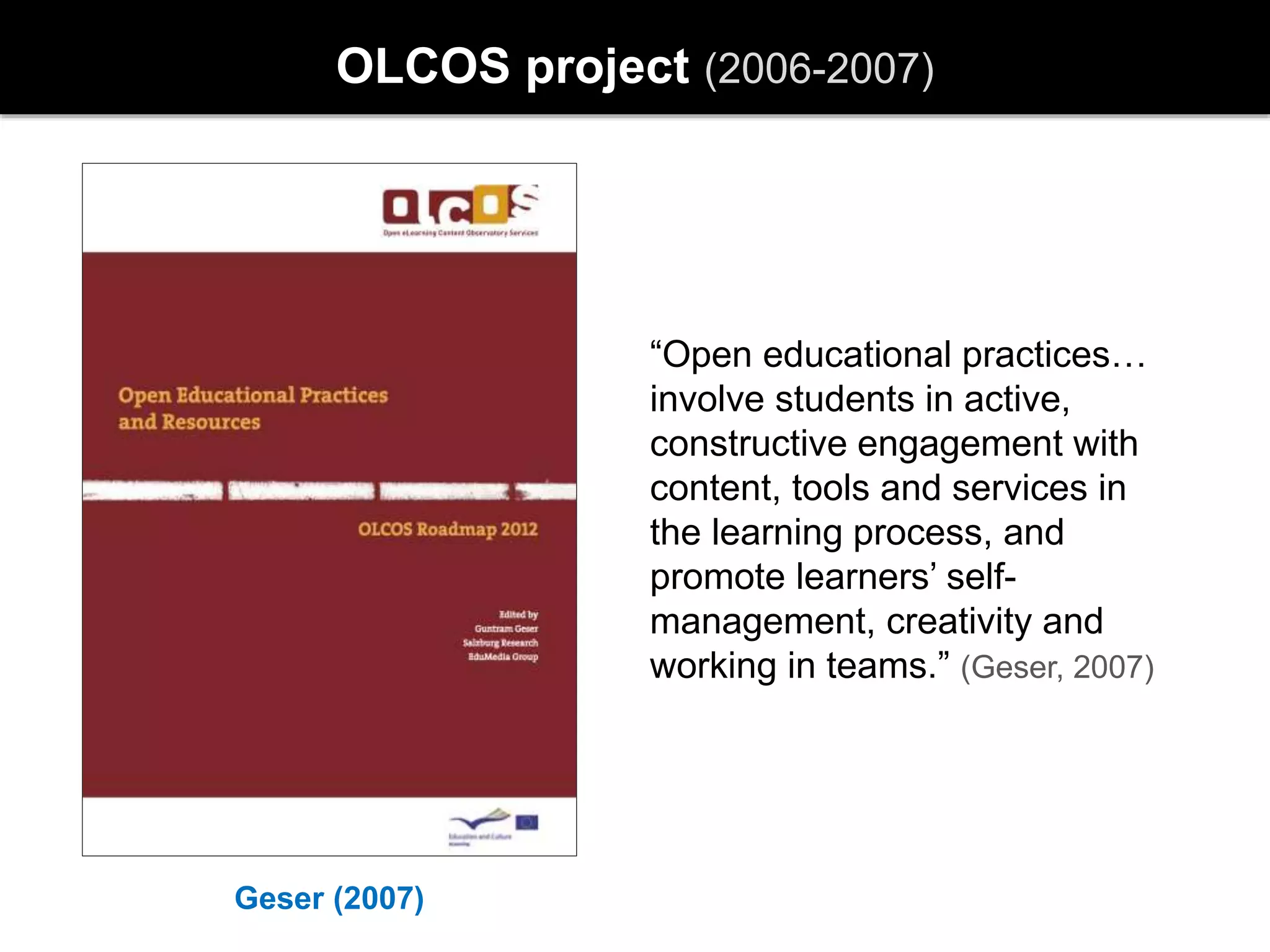
Geser (2007)
OLCOS project (2006-2007)
“Open educational practices…
involve students in active,
constructive engagement with
content, tools and services in
the learning process, and
promote learners’ self-
management, creativity and
working in teams.” (Geser, 2007)
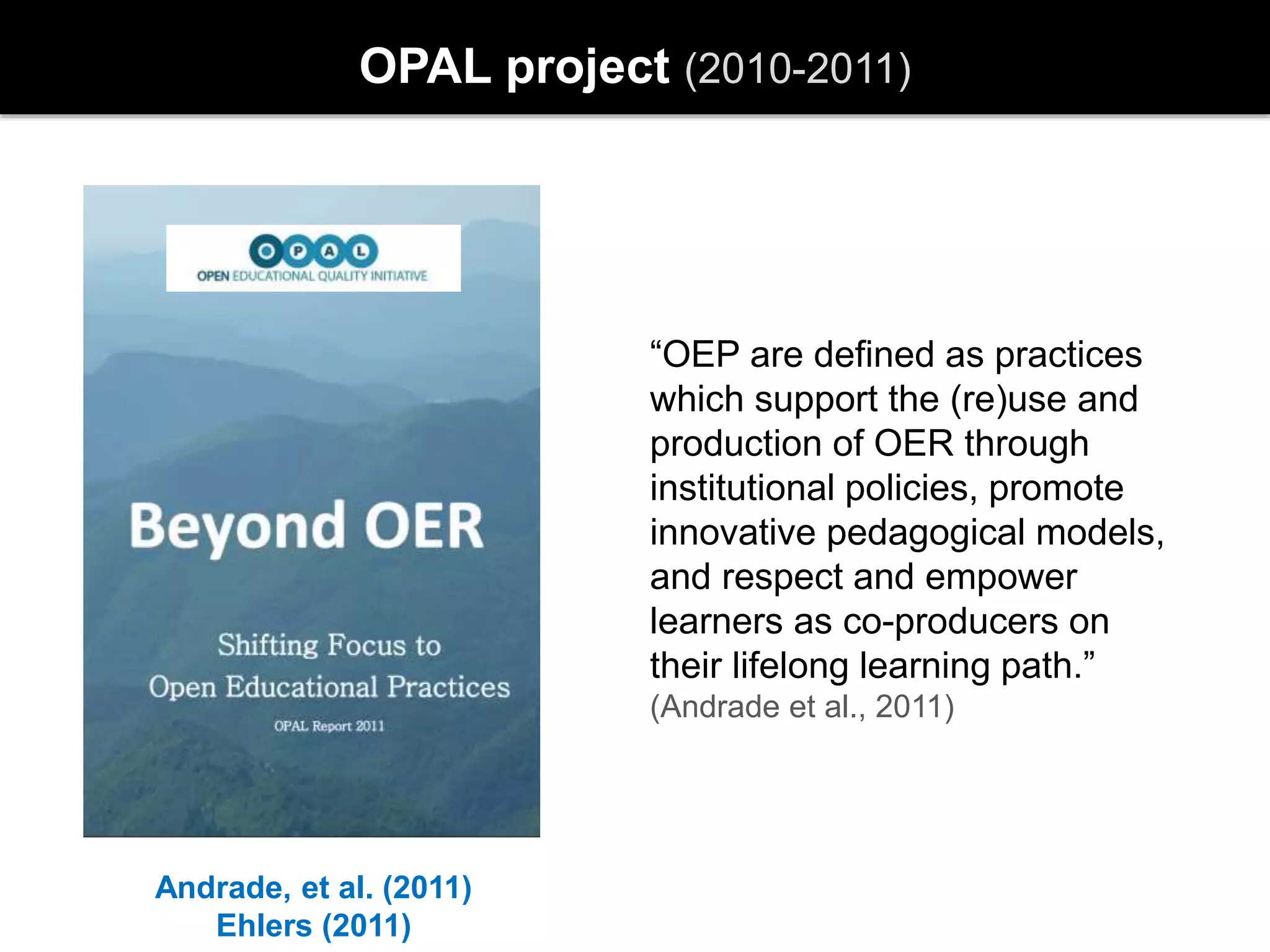
OPAL project (2010-2011)
Andrade, et al. (2011)
Ehlers (2011)
“OEP are defined as practices
which support the (re)use and
production of OER through
institutional policies, promote
innovative pedagogical models,
and respect and empower
learners as co-producers on
their lifelong learning path.”
(Andrade et al., 2011)
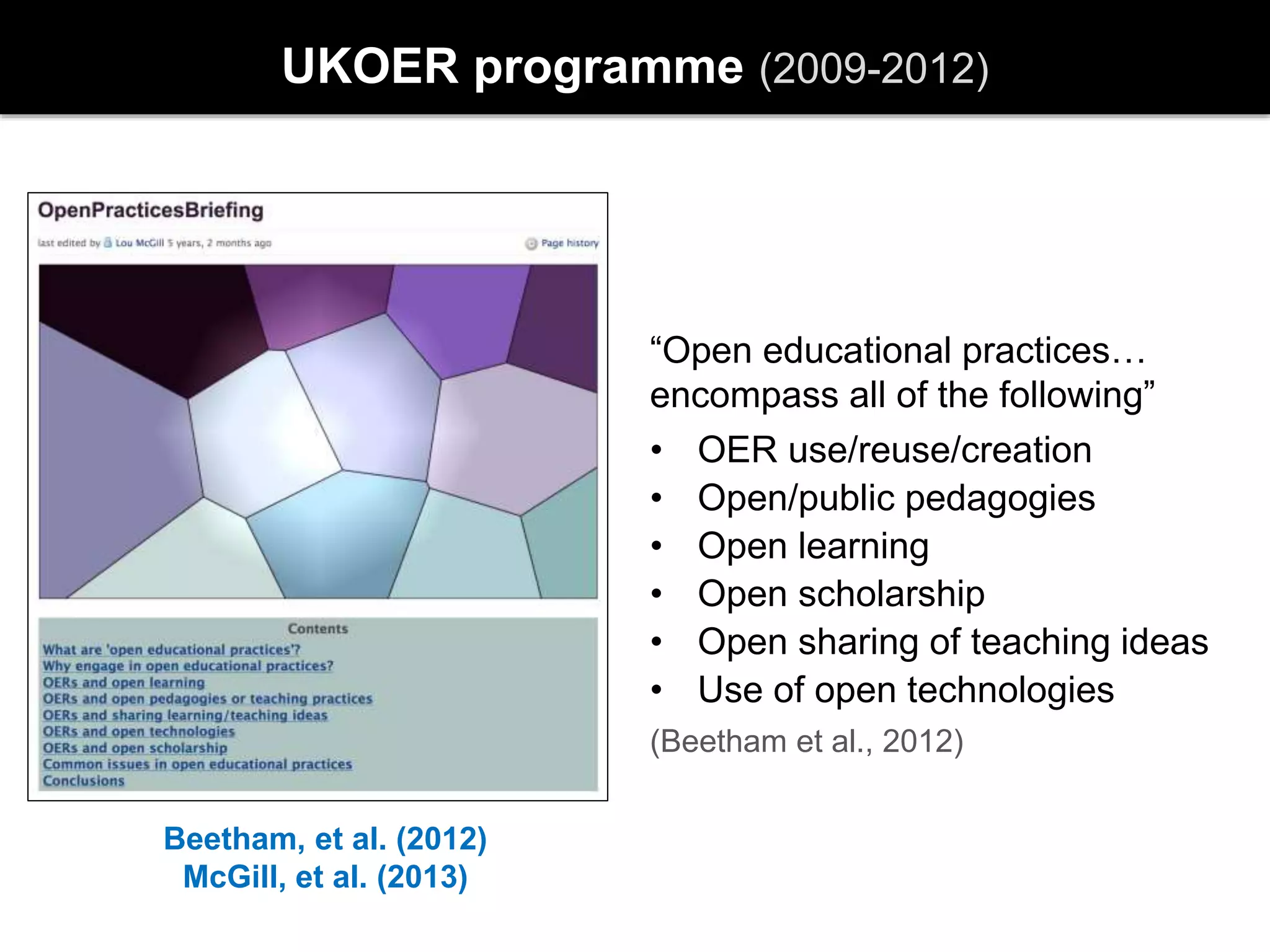
UKOER programme (2009-2012)
Beetham, et al. (2012)
McGill, et al. (2013)
“Open educational practices…
encompass all of the following”
• OER use/reuse/creation
• Open/public pedagogies
• Open learning
• Open scholarship
• Open sharing of teaching ideas
• Use of open technologies
(Beetham et al., 2012)
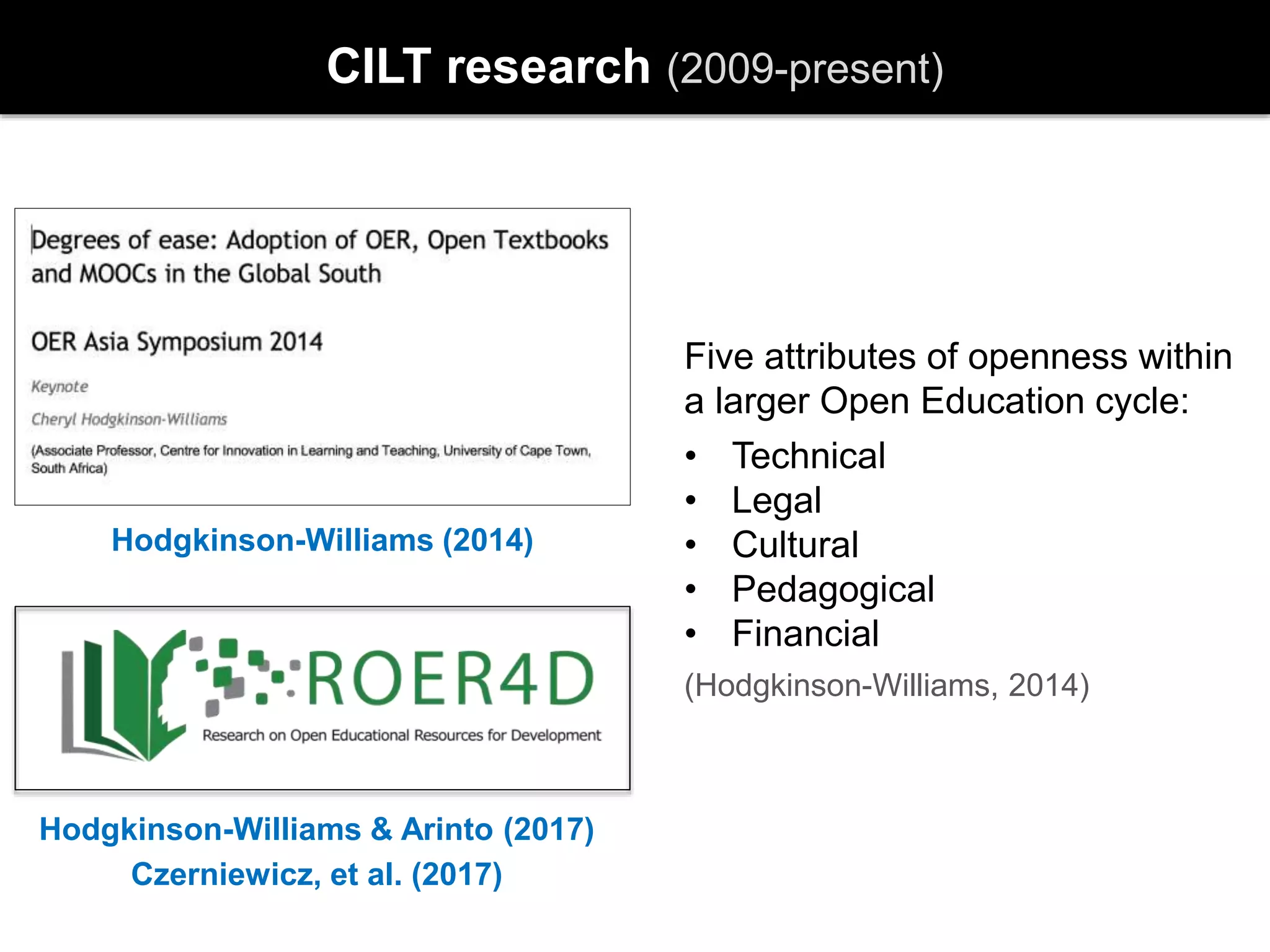
CILT research (2009-present)
Hodgkinson-Williams (2014)
Hodgkinson-Williams & Arinto (2017)
Czerniewicz, et al. (2017)
Five attributes of openness within
a larger Open Education cycle:
• Technical
• Legal
• Cultural
• Pedagogical
• Financial
(Hodgkinson-Williams, 2014)
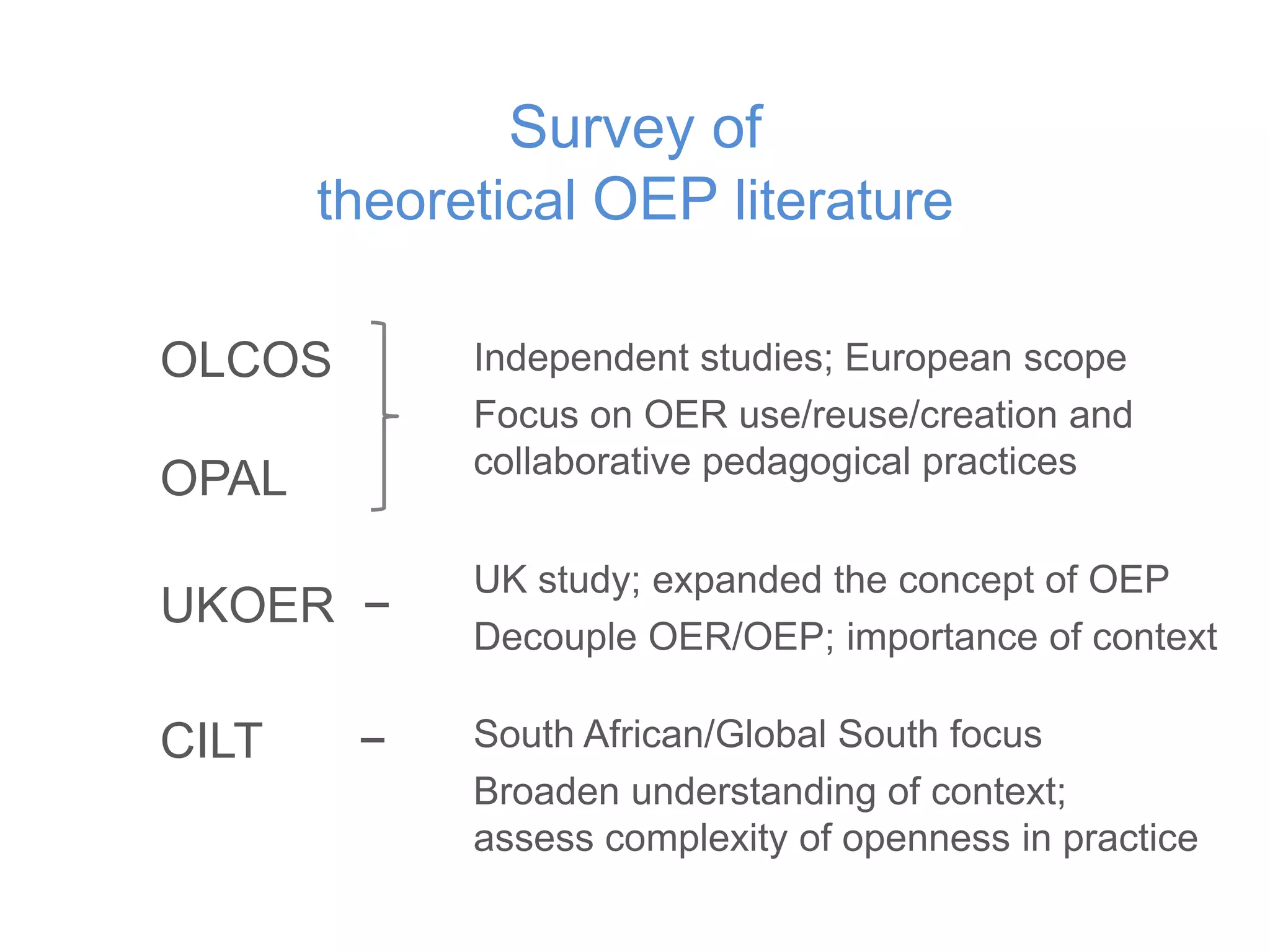
Survey of
theoretical OEP literature
OLCOS
OPAL
UKOER −
CILT −
Independent studies; European scope
Focus on OER use/reuse/creation and
collaborative pedagogical practices
UK study; expanded the concept of OEP
Decouple OER/OEP; importance of context
South African/Global South focus
Broaden understanding of context;
assess complexity of openness in practice
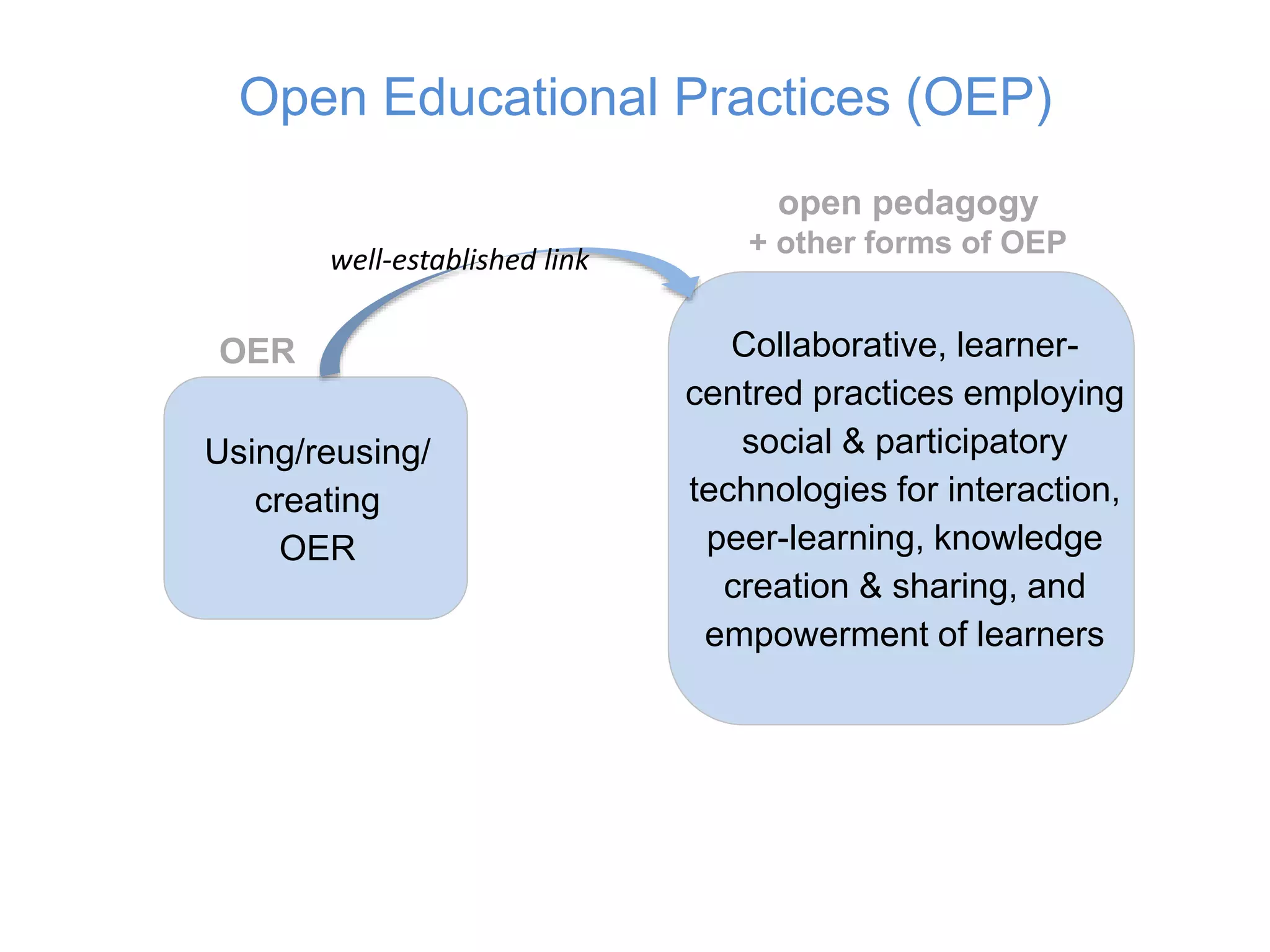
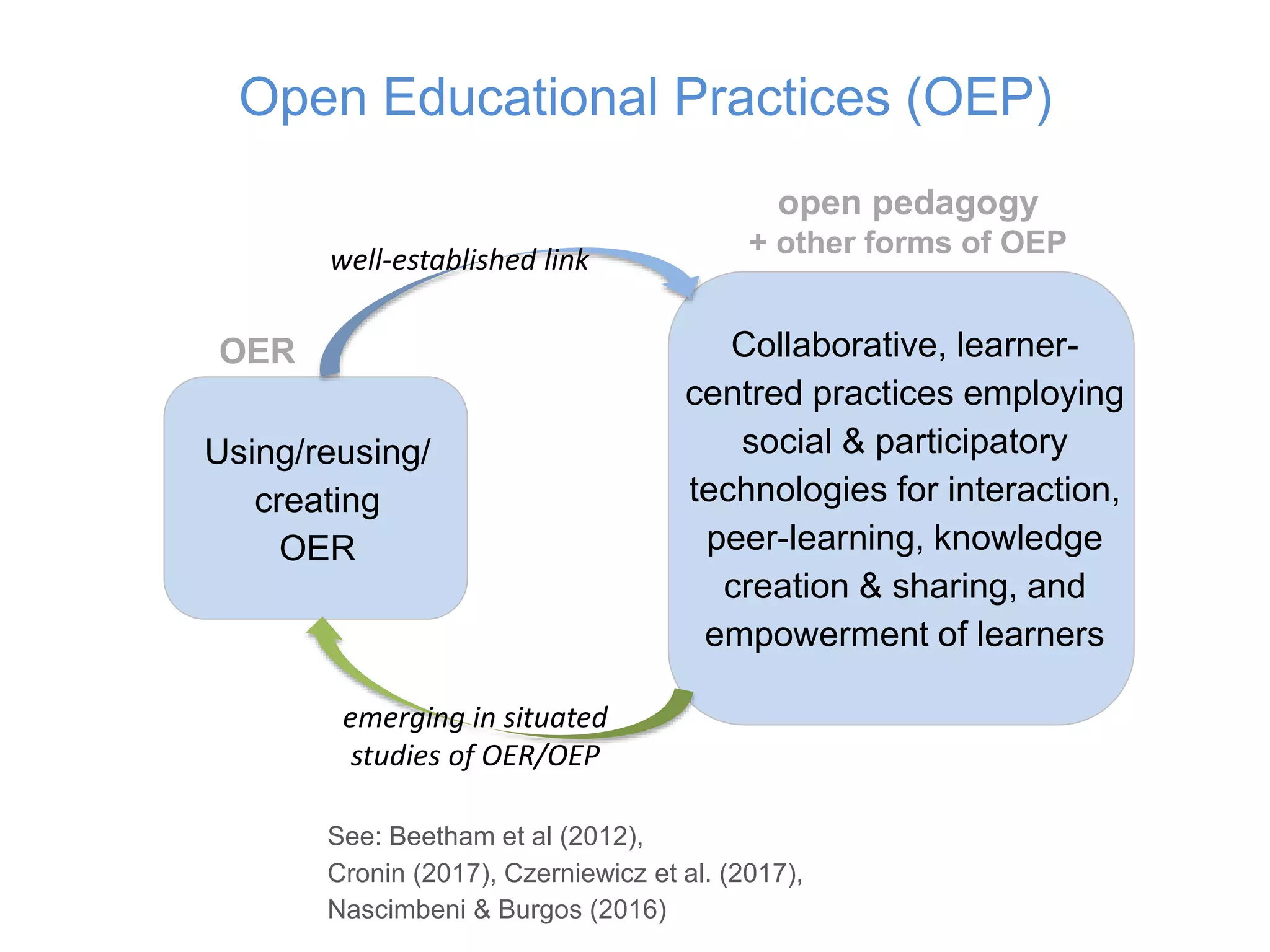
Open Educational Practices (OEP)
Using/reusing/
creating
OER
Collaborative, learner-
centred practices employing
social & participatory
technologies for interaction,
peer-learning, knowledge
creation & sharing, and
empowerment of learners
OER
open pedagogy
+ other forms of OEP
well-established link
Open Educational Practices (OEP)
Using/reusing/
creating
OER
Collaborative, learner-
centred practices employing
social & participatory
technologies for interaction,
peer-learning, knowledge
creation & sharing, and
empowerment of learners
OER
open pedagogy
+ other forms of OEP
emerging in situated
studies of OER/OEP
well-established link
See: Beetham et al (2012),
Cronin (2017), Czerniewicz et al. (2017),
Nascimbeni & Burgos (2016)
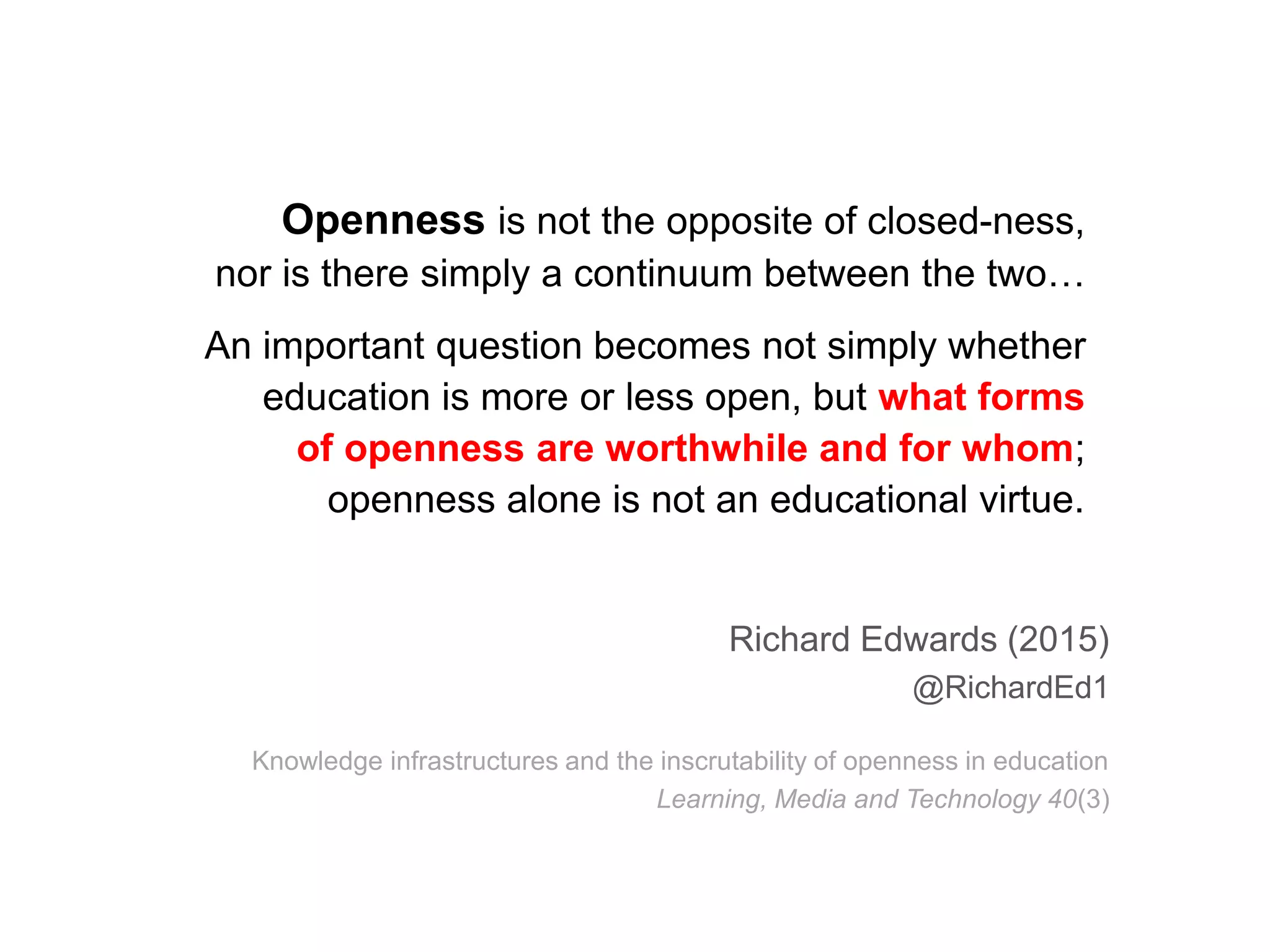
Openness is not the opposite of closed-ness,
nor is there simply a continuum between the two…
An important question becomes not simply whether
education is more or less open, but what forms
of openness are worthwhile and for whom;
openness alone is not an educational virtue.
Richard Edwards (2015)
@RichardEd1
Knowledge infrastructures and the inscrutability of openness in education
Learning, Media and Technology 40(3)
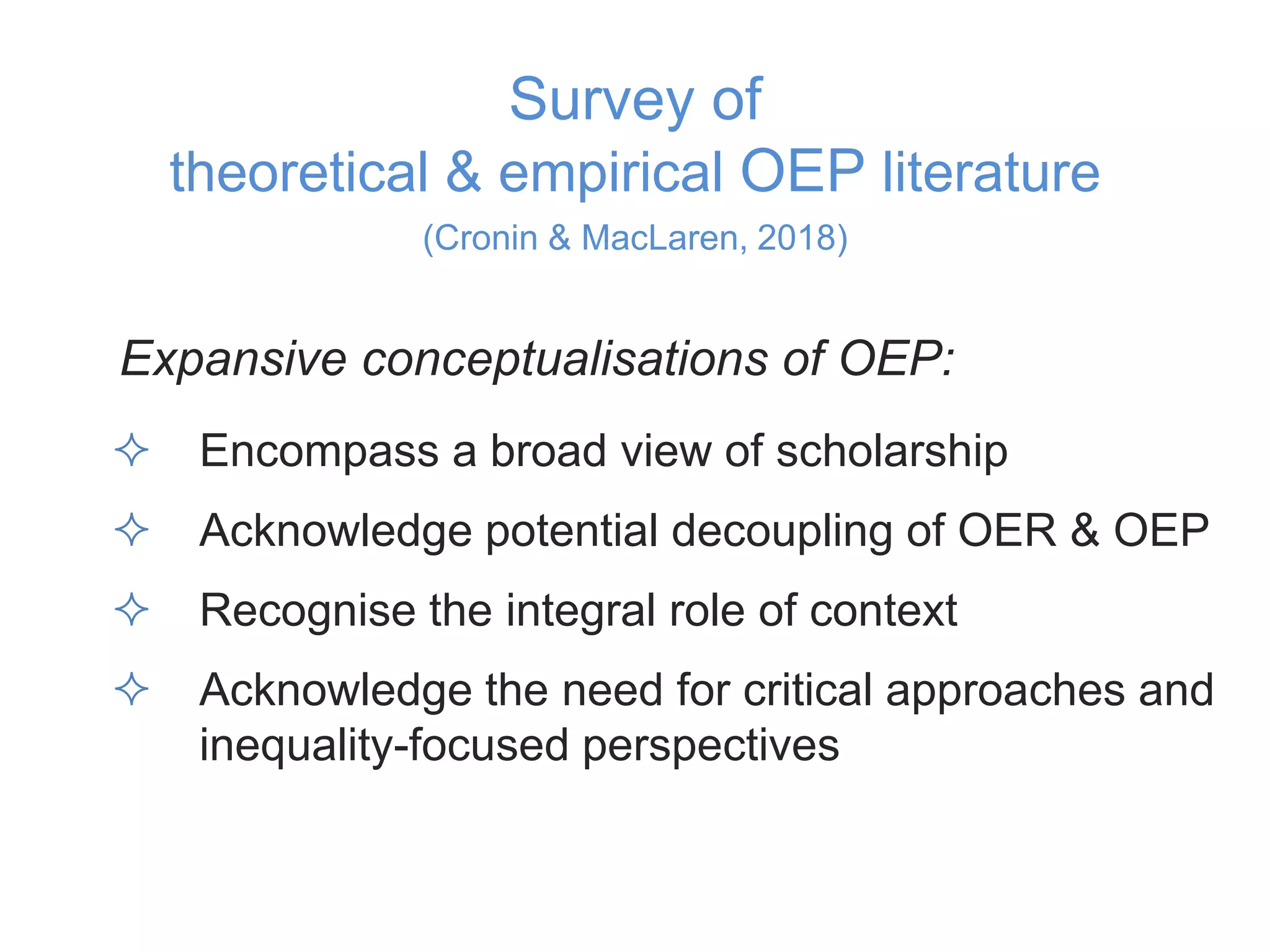
Survey of
theoretical & empirical OEP literature
(Cronin & MacLaren, 2018)
Expansive conceptualisations of OEP:
 Encompass a broad view of scholarship
 Acknowledge potential decoupling of OER & OEP
 Recognise the integral role of context
 Acknowledge the need for critical approaches and
inequality-focused perspectives
Le spectre de la rose Jerome Robbins Dance Division, NYPL
Thank You!
slideshare.net/cicronin
bit.ly/OEGlobal_Cronin

Conceptualising OEP: A review of theoretical and empirical literature in Open Educational Practices

  • 1.
    EP Conceptualising Image: CC0 byNadine Shaabana Catherine Cronin & Iain MacLaren  CELT, NUI Galway #OEGlobal18 #go_gn  Delft  24th April 2018 A review of theoretical & empirical literature
  • 2.
    contact details: @catherinecronin @iainmacl all sourcesand references available at: bit.ly/OEGlobal18_Cronin
  • 3.
    open education goal philosophy  values resources, tools and practices that employ a framework of open sharing to improve educational access and effectiveness worldwide - The Open Education Consortium
  • 4.
    Image: CC0 bypulpolux
  • 5.
    Image: CC0 bypulpolux There are many histories, many stories of open education see recent work by Christina Hendricks, Tannis Morgan, Vivien Rolfe, & more
  • 6.
    Use/reuse/creation of OERand collaborative, pedagogical practices employing social and participatory technologies for interaction, peer-learning, knowledge creation and sharing, and empowerment of learners. Open Educational Practices (OEP)
  • 7.
    Survey of theoretical &empirical OEP literature (Cronin & MacLaren, 2018) Definitions focused on OER use/reuse/creation Expansive definitions: multiple entry points and avenues of openness Similar dichotomy observed in definitions of open pedagogy (see DeRosa & Robison, 2016; Wiley, 2017)
  • 8.
    Geser (2007) OLCOS project(2006-2007) “Open educational practices… involve students in active, constructive engagement with content, tools and services in the learning process, and promote learners’ self- management, creativity and working in teams.” (Geser, 2007)
  • 9.
    OPAL project (2010-2011) Andrade,et al. (2011) Ehlers (2011) “OEP are defined as practices which support the (re)use and production of OER through institutional policies, promote innovative pedagogical models, and respect and empower learners as co-producers on their lifelong learning path.” (Andrade et al., 2011)
  • 10.
    UKOER programme (2009-2012) Beetham,et al. (2012) McGill, et al. (2013) “Open educational practices… encompass all of the following” • OER use/reuse/creation • Open/public pedagogies • Open learning • Open scholarship • Open sharing of teaching ideas • Use of open technologies (Beetham et al., 2012)
  • 11.
    CILT research (2009-present) Hodgkinson-Williams(2014) Hodgkinson-Williams & Arinto (2017) Czerniewicz, et al. (2017) Five attributes of openness within a larger Open Education cycle: • Technical • Legal • Cultural • Pedagogical • Financial (Hodgkinson-Williams, 2014)
  • 12.
    Survey of theoretical OEPliterature OLCOS OPAL UKOER − CILT − Independent studies; European scope Focus on OER use/reuse/creation and collaborative pedagogical practices UK study; expanded the concept of OEP Decouple OER/OEP; importance of context South African/Global South focus Broaden understanding of context; assess complexity of openness in practice
  • 13.
    Open Educational Practices(OEP) Using/reusing/ creating OER Collaborative, learner- centred practices employing social & participatory technologies for interaction, peer-learning, knowledge creation & sharing, and empowerment of learners OER open pedagogy + other forms of OEP well-established link
  • 14.
    Open Educational Practices(OEP) Using/reusing/ creating OER Collaborative, learner- centred practices employing social & participatory technologies for interaction, peer-learning, knowledge creation & sharing, and empowerment of learners OER open pedagogy + other forms of OEP emerging in situated studies of OER/OEP well-established link See: Beetham et al (2012), Cronin (2017), Czerniewicz et al. (2017), Nascimbeni & Burgos (2016)
  • 15.
    Openness is notthe opposite of closed-ness, nor is there simply a continuum between the two… An important question becomes not simply whether education is more or less open, but what forms of openness are worthwhile and for whom; openness alone is not an educational virtue. Richard Edwards (2015) @RichardEd1 Knowledge infrastructures and the inscrutability of openness in education Learning, Media and Technology 40(3)
  • 16.
    Survey of theoretical &empirical OEP literature (Cronin & MacLaren, 2018) Expansive conceptualisations of OEP:  Encompass a broad view of scholarship  Acknowledge potential decoupling of OER & OEP  Recognise the integral role of context  Acknowledge the need for critical approaches and inequality-focused perspectives
  • 17.
    Le spectre dela rose Jerome Robbins Dance Division, NYPL Thank You! slideshare.net/cicronin bit.ly/OEGlobal_Cronin

Editor's Notes

  • #2 My PhD research study  literature review re: OEP
  • #4 ‘openness’ advocates transparency & lowering or removal of barriers (at all levels within an institution) including processes involved in R, T + L. AIM = improve educational access, effectiveness & equality
  • #5 At this top level (‘OPEN EDUCATION’) and particularly below (‘OEP’, ‘OPEN PEDAGOGY’)… consistent difficulty in defining term. Much depends on knowledge of history, but also on our context and standpoint. https://www.flickr.com/photos/pulpolux/2139569265/
  • #6 There are many histories, many stories of open education. Some wonderful open practitioners, researchers, and people who think deeply about connections are wrestling with these ideas – I wish to cite the contributions of these people to my paper… but there are many more. Q: How much of what we are doing is recreating the past?
  • #8 2 broad categories of definitions… we wanted to understand the roots of these and other differences. 4 distinct strands of OEP research.
  • #12 Technical (interoperability and open formats; connectivity; technical skills & equipment) Legal (open license parameters, knowledge & advice) Cultural (conceptions of knowledge as given or constructed) Pedagogical (student demographics and types of engagement; pedagogic, learning & assessment strategies; accreditation/certification) Financial (costs ranging from free to fees; sustainable business models)
  • #13 Underlying assumptions in early studies of OEP remain evident in more recent OEP literature. One = OEP is predicated on the use of OER. When concept of OEP first emerged in the OLCOS & OPAL it facilitated new conversations about OE in practice
  • #14 Underlying assumptions in early studies of OEP remain evident in more recent OEP literature. One = OEP is predicated on the use of OER. When concept of OEP first emerged in the OLCOS & OPAL it facilitated new conversations about OE in practice
  • #15 Later empirical studies  aspects of OEP may emerge independently of OER and may in fact lead to OER use Adoption of OEP is often uneven and does not always begin with the use of OER *** remains a clear delineation in empirical lit: studies that define OEP as necessarily inclusive of OER & studies of emergent practices that highlight multiple entry points to, and avenues of, openness
  • #16 Expansive conceptualisations of OEP also adopt a critical approach, often with the aim of challenging traditional educational practice.
  • #17 We contend that expansive conceptualisations of OEP acknowledge the complex, actual & situated practices of T+L… where context influences the choice and use of OEP, where OEP may emerge before the use of OEP & where critical approaches to open education may be realised