Open Educational Practices (OEP):
What They Mean For Me and
How I Use Them
Brian Kelly

Contact Details

Innovation Advocate
Cetis
University of Bolton
Bolton, UK

Email: ukwebfocus@gmail.com
Twitter: @briankelly
Cetis Web site: http://www.cetis.ac.uk/
Blog: http://ukwebfocus.wordpress.com/

Slides and further information available at
http://ukwebfocus.wordpress.com/events/webinar-on-open-educationalpractices/

1
Abstract
We have seen a growing interest across a spectrum of
openness, covering definitions of the technical infrastructure (open
standards), licences for the technical implementation of products & services
(open source software), licences which permit reuse of content (Creative
Commons), content with minimal barriers to reuse (open access
papers, OERs, open data) & encouragement for wider engagement in
activities (open science / citizen science). These are complemented by a
culture of openness for those involved in a variety of professional
activities, including open notebook approaches taken by scientific
researchers, open educational practices taken by those involved in supporting
teaching & learning & the generic open practices embraced by those in a
range of disciplines who feel that such approaches can enhance the
quality of their activities.
Brian Kelly has embraced open practices to support his work in advising
the UK's higher and further education sector on best practices for exploiting
the potential of the Web, as well as helping to ensure that the ideas described
in his research papers are exposed to a wide audience
In this webinar Brian summarises the benefits he feels he has gained from
open practices & how such approaches can be applied in a teaching &
learning context. However he acknowledges there may be associated risks.
Brian provides a risks and opportunities framework which may help in

2
About Me: My Past
Brian Kelly:
• Was UK Web Focus at UKOLN from 1997 – July 2013
• Embraced open practices to support work in helping UK
HE/FE sector to exploit potential of Web
• Approaches included use of:
 UK Web Focus blog as an open notebook
 Twitter for engagement and dissemination
 Facebook for syndication of blog posts to new
audiences
 Slideshare for enhancing access to my slides and
enabling them to be embedding in blogs posts and on
Web sites
 Amplified events for extending the reach of ideas and
discussions at events
 …
3
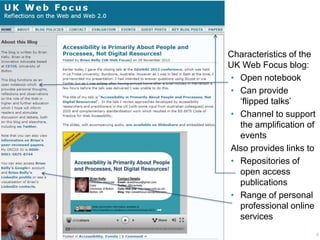
Characteristics of the
UK Web Focus blog:
• Open notebook
• Can provide
„flipped talks‟
• Channel to support
the amplification of
events
Also provides links to
• Repositories of
open access
publications
• Range of personal
professional online
services
4
About Me: My Present
Brian Kelly:
• Now Innovation Advocate at Cetis, University of Bolton
since October 2013
• Remit to promote innovative technologies and
practices
Work will include:
• Continued used of Open Educational Practices (OEP)
• Promotion of Open Educational Practices
• Evidence-gathering of benefits of OEP
• Acknowledgement of possible risks in use of OEP
• Development of a framework to support take-up of
OEP
5
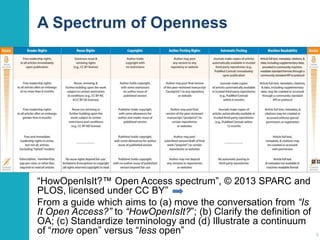
A Spectrum of Openness

“HowOpenIsIt?™ Open Access spectrum”, © 2013 SPARC and
PLOS, licensed under CC BY”
From a guide which aims to (a) move the conversation from “Is
It Open Access?” to “HowOpenIsIt?”; (b) Clarify the definition of
OA; (c) Standardize terminology and (d) Illustrate a continuum
of “more open” versus “less open”

6
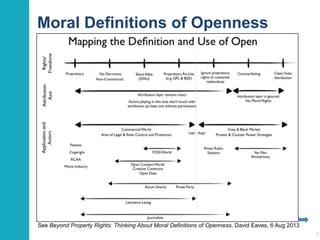
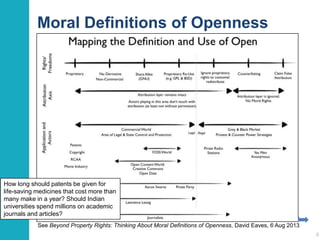
Moral Definitions of Openness

See Beyond Property Rights: Thinking About Moral Definitions of Openness, David Eaves, 6 Aug 2013
7
Moral Definitions of Openness

How long should patents be given for
life-saving medicines that cost more than
many make in a year? Should Indian
universities spend millions on academic
journals and articles?
See Beyond Property Rights: Thinking About Moral Definitions of Openness, David Eaves, 6 Aug 2013
8
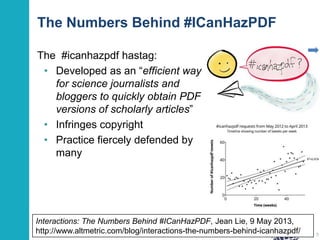
The Numbers Behind #ICanHazPDF
The #icanhazpdf hastag:
• Developed as an “efficient way
for science journalists and
bloggers to quickly obtain PDF
versions of scholarly articles”
• Infringes copyright
• Practice fiercely defended by
many

Interactions: The Numbers Behind #ICanHazPDF, Jean Lie, 9 May 2013,
http://www.altmetric.com/blog/interactions-the-numbers-behind-icanhazpdf/

9
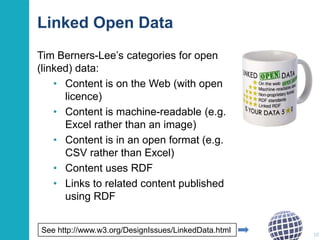
Linked Open Data
Tim Berners-Lee‟s categories for open
(linked) data:
• Content is on the Web (with open
licence)
• Content is machine-readable (e.g.
Excel rather than an image)
• Content is in an open format (e.g.
CSV rather than Excel)
• Content uses RDF
• Links to related content published
using RDF
See http://www.w3.org/DesignIssues/LinkedData.html

10
Open Notebook Science
Open Notebook Science:
• The practice of making the entire primary record of a
research project publicly available online as it is recorded.
• Placing the personal, or laboratory, researcher‟s
notebook online with all raw & processed data and
associated material, as material is generated.
• Approach may be summed up by the slogan 'no insider
information'.
• Forms part of general trend towards more open
approaches in research practice and publishing.
• Can be described as part of a wider open science
movement that includes the advocacy and adoption
of open access publication, open
data, crowdsourcing data, and citizen science.
From Open notebook
science, Wikipedia, https://en.wikipedia.org/wiki/Open

11
Characteristics of Open Practices
What we have seen:
• Open licensing to minimise legal barriers
to reuse
• Technical aspects which facilitate reuse
• Disciplines moving towards open
approaches (e.g. scientists and
researchers)
We have also seen:
• Legal and licensing barriers and a
willingness to challenges such barriers
12
OEP: a Definition
Open Educational Practices are:
Teaching techniques that draw upon open technologies and high-quality Open
Educational Resources (OER) in order to facilitate collaborative and flexible
learning.
They may involve students participating in online, peer production communities
within activities intended to support learning or more broadly, any context where
access to educational opportunity through freely available online content and
services is the norm.
Such activities may include the creation, use and repurposing of Open Educational
Resources and their adaptation to the contextual setting.
OEP can also include the open sharing of teaching practices and aim "to raise the
quality of education and training and innovate educational practices on an
institutional, professional and individual level".
The OEP community includes policy makers, managers/ administrators of
organisations, educational professionals and learners. OEP are also viewed as the
next phase in OER development that continues to transform 21st century learning
and learners.

Taken from Wikipedia entry for Open educational practices
13
More Definitions
• The Center for Open Learning and Teaching (University of
Mississippi) state that "Open Educational Practices (OEP) are
teaching techniques that introduce students to online peer
production communities. Such communities (for
instance, Wikipedia, YouTube, Open Street Map) host dynamic
communities and offer rich learning environments“
• The UK OER support and evaluation team suggest that
"a broader definition would encompass all activities that open up
access to educational opportunity, in a context where freely
available online content and services (whether
'open', 'educational' or not) are taken as the norm".
• Cape Town Open Education Declaration: “ open education
is not limited to just open educational resources. It also draws
upon open technologies that facilitate collaborative, flexible
learning and the open sharing of teaching practices that
empower educators to benefit from the best ideas of their
colleagues. It may also grow to include new approaches to
assessment, accreditation and collaborative learning".
14
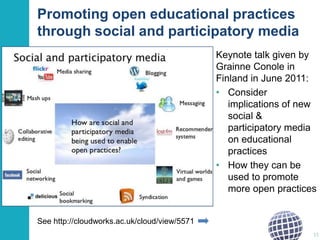
Promoting open educational practices
through social and participatory media
Keynote talk given by
Grainne Conole in
Finland in June 2011:
• Consider
implications of new
social &
participatory media
on educational
practices
• How they can be
used to promote
more open practices
See http://cloudworks.ac.uk/cloud/view/5571
15
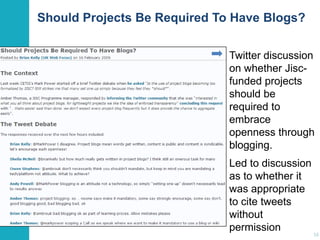
Should Projects Be Required To Have Blogs?
Twitter discussion
on whether Jiscfunded projects
should be
required to
embrace
openness through
blogging.
Led to discussion
as to whether it
was appropriate
to cite tweets
without
permission

16
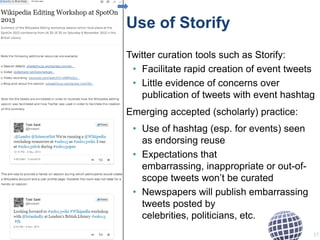
Use of Storify
Twitter curation tools such as Storify:
• Facilitate rapid creation of event tweets
• Little evidence of concerns over
publication of tweets with event hashtag
Emerging accepted (scholarly) practice:
• Use of hashtag (esp. for events) seen
as endorsing reuse
• Expectations that
embarrassing, inappropriate or out-ofscope tweets won‟t be curated
• Newspapers will publish embarrassing
tweets posted by
celebrities, politicians, etc.
17
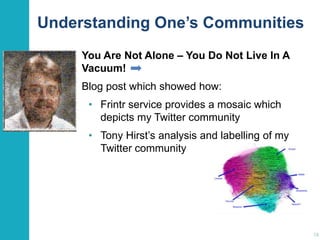
Understanding One’s Communities
You Are Not Alone – You Do Not Live In A
Vacuum!
Blog post which showed how:
• Frintr service provides a mosaic which
depicts my Twitter community
• Tony Hirst‟s analysis and labelling of my
Twitter community

18
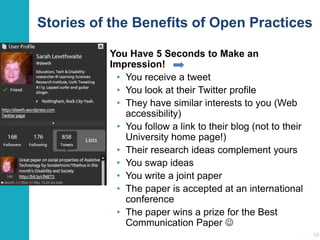
Stories of the Benefits of Open Practices
You Have 5 Seconds to Make an
Impression!
• You receive a tweet
• You look at their Twitter profile
• They have similar interests to you (Web
accessibility)
• You follow a link to their blog (not to their
University home page!)
• Their research ideas complement yours
• You swap ideas
• You write a joint paper
• The paper is accepted at an international
conference
• The paper wins a prize for the Best
Communication Paper 
19
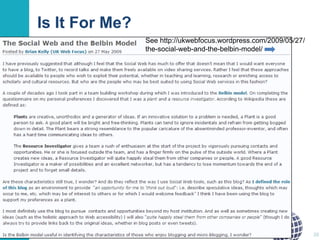
Is It For Me?
See http://ukwebfocus.wordpress.com/2009/05/27/
the-social-web-and-the-belbin-model/

20
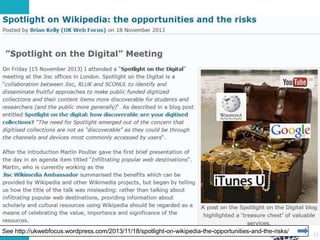
Risks In Use of Third Party Services
• Wikipedia

See http://ukwebfocus.wordpress.com/2013/11/18/spotlight-on-wikipedia-the-opportunities-and-the-risks/

21
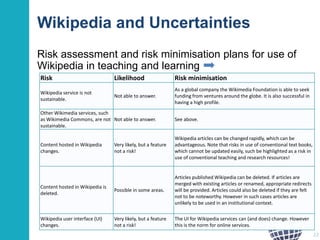
Wikipedia and Uncertainties
Risk assessment and risk minimisation plans for use of
Wikipedia in teaching and learning
Risk

Likelihood

Risk minimisation

Wikipedia service is not
sustainable.

Not able to answer.

As a global company the Wikimedia Foundation is able to seek
funding from ventures around the globe. It is also successful in
having a high profile.

Other Wikimedia services, such
as Wikimedia Commons, are not Not able to answer.
sustainable.

See above.

Content hosted in Wikipedia
changes.

Very likely, but a feature
not a risk!

Wikipedia articles can be changed rapidly, which can be
advantageous. Note that risks in use of conventional text books,
which cannot be updated easily, such be highlighted as a risk in
use of conventional teaching and research resources!

Content hosted in Wikipedia is
deleted.

Possible in some areas.

Articles published Wikipedia can be deleted. If articles are
merged with existing articles or renamed, appropriate redirects
will be provided. Articles could also be deleted if they are felt
not to be noteworthy. However in such cases articles are
unlikely to be used in an institutional context.

Wikipedia user interface (UI)
changes.

Very likely, but a feature
not a risk!

The UI for Wikipedia services can (and does) change. However
this is the norm for online services.
22
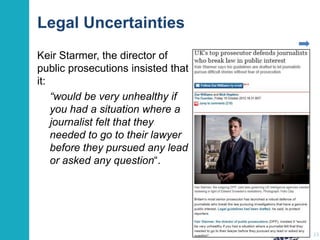
Legal Uncertainties
Keir Starmer, the director of
public prosecutions insisted that
it:
“would be very unhealthy if
you had a situation where a
journalist felt that they
needed to go to their lawyer
before they pursued any lead
or asked any question“.

23
Legal Uncertainties of the Past
Some legal challenges the Web has faced:
• Do web caches infringe copyright?
• Can search engines provide an index of
Web sites without infringing copyright?
• Can Web archive services (e.g.
archive.org) copy Web site
• Do you need permission to link to a Web
page? Is it good etiquette to ask for
permission?
• Can you use cookies on your Web site
without users opting-in?
24
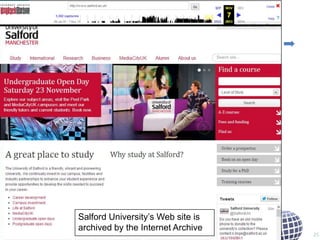
Salford University‟s Web site is
archived by the Internet Archive

25
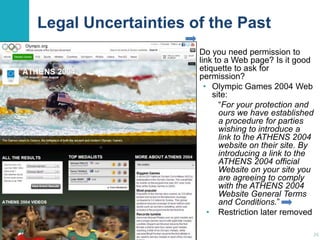
Legal Uncertainties of the Past
Do you need permission to
link to a Web page? Is it good
etiquette to ask for
permission?
• Olympic Games 2004 Web
site:
“For your protection and
ours we have established
a procedure for parties
wishing to introduce a
link to the ATHENS 2004
website on their site. By
introducing a link to the
ATHENS 2004 official
Website on your site you
are agreeing to comply
with the ATHENS 2004
Website General Terms
and Conditions.”
• Restriction later removed
26
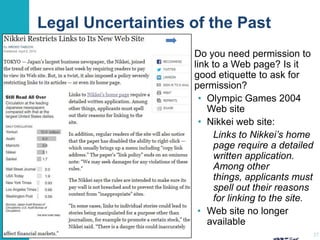
Legal Uncertainties of the Past
Do you need permission to
link to a Web page? Is it
good etiquette to ask for
permission?
• Olympic Games 2004
Web site
• Nikkei web site:
Links to Nikkei’s home
page require a detailed
written application.
Among other
things, applicants must
spell out their reasons
for linking to the site.
• Web site no longer
available
27
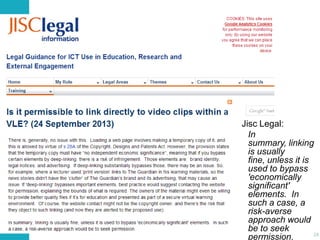
Jisc Legal:
In
summary, linking
is usually
fine, unless it is
used to bypass
'economically
significant'
elements. In
such a case, a
risk-averse
approach would
be to seek
28
permission.
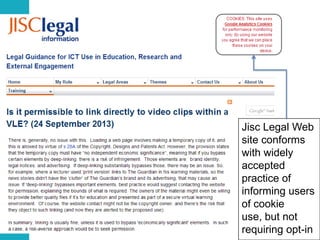
Jisc Legal Web
site conforms
with widely
accepted
practice of
informing users
of cookie
use, but not
requiring opt-in 29
Legal Risks
Which reflects your view:
• “We should ensure that we never infringe
the law or other‟s licence conditions”
• “Yes, we will infringe the law and break
licence conditions. Accept it!”

30
Dealing With Legal People
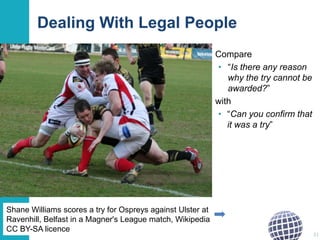
Compare
• “Is there any reason
why the try cannot be
awarded?”
with
• “Can you confirm that
it was a try”

Shane Williams scores a try for Ospreys against Ulster at
Ravenhill, Belfast in a Magner's League match, Wikipedia
CC BY-SA licence

31
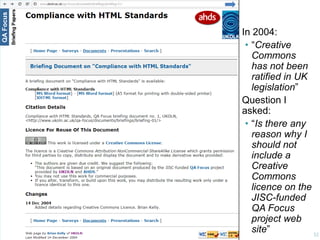
Dealing With Legal People

In 2004:
• “Creative
Commons
has not been
ratified in UK
legislation”
Question I
asked:
• “Is there any
reason why I
should not
include a
Creative
Commons
licence on the
JISC-funded
QA Focus
project web
site”
32
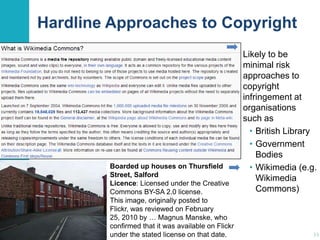
Hardline Approaches to Copyright

Boarded up houses on Thursfield
Street, Salford
Licence: Licensed under the Creative
Commons BY-SA 2.0 license.
This image, originally posted to
Flickr, was reviewed on February
25, 2010 by … Magnus Manske, who
confirmed that it was available on Flickr
under the stated license on that date.

Likely to be
minimal risk
approaches to
copyright
infringement at
organisations
such as
• British Library
• Government
Bodies
• Wikimedia (e.g.
Wikimedia
Commons)

33
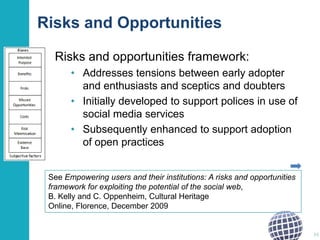
Risks and Opportunities
Risks and opportunities framework:
• Addresses tensions between early adopter
and enthusiasts and sceptics and doubters
• Initially developed to support polices in use of
social media services
• Subsequently enhanced to support adoption
of open practices
See Empowering users and their institutions: A risks and opportunities
framework for exploiting the potential of the social web,
B. Kelly and C. Oppenheim, Cultural Heritage
Online, Florence, December 2009

34
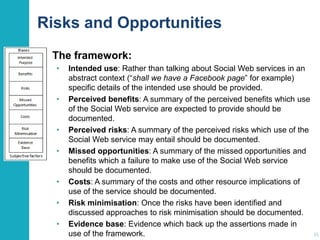
Risks and Opportunities
The framework:
•

•

•
•

•

•
•

Intended use: Rather than talking about Social Web services in an
abstract context (“shall we have a Facebook page” for example)
specific details of the intended use should be provided.
Perceived benefits: A summary of the perceived benefits which use
of the Social Web service are expected to provide should be
documented.
Perceived risks: A summary of the perceived risks which use of the
Social Web service may entail should be documented.
Missed opportunities: A summary of the missed opportunities and
benefits which a failure to make use of the Social Web service
should be documented.
Costs: A summary of the costs and other resource implications of
use of the service should be documented.
Risk minimisation: Once the risks have been identified and
discussed approaches to risk minimisation should be documented.
Evidence base: Evidence which back up the assertions made in
use of the framework.

35
Using The Framework
The updated framework:
•

•
•
•
•
•
•

Intended use: We shall publish slides and an accompanying blog post
in advance of talks (towards the „flipped lecture‟).
Perceived benefits: Motivated students will be in a better position to
maximise their understanding of ideas outlined in the lecture.
Perceived risks: May be perceived as unfair for those unable or
unwilling to access the resources in advance.
Missed opportunities: Seeing the talk in advance may result in
additional interest in the talk.
Resource implications: Minimal additional costs.
Risk minimisation: May chose not to do this if the slides will give
away a significant point, if content is embargoed, …
Evidence base: Evidence which back up the assertions made in use
of the framework.

36
Planning For Open Educational Practices
Planning process described on the Hyperlinked Library
MOOC:
• Convince ______ that by _______ they will
________ which will ________ because _______.
How I used it:
• Convince the senior management team in the
Library that by promoting creation and maintenance
of content using Wikipedia and Wikimedia
Commons they will provide a cost-effective way of
providing access to quality content and provide
students with valuable skills which will enhance the
employability of students and raise the profile of the
institution within the local town because of the
popularity of the service and its growing importance
within the educational and cultural heritage sectors.

37
Personal Approaches to Open Practices
My personal approaches to open practices:
• I will publish regular blog posts about areas of
professional interest to myself and my peers which
can be beneficial and encourage open feedback:
 To me, by getting feedback from my peers
(“That’s a daft idea Brian, you haven’t
considered …”)
 To my peers, as they may benefit from the
ideas
 To both parties, as discussions can provide
new insights

38
Personal Approaches to Open Practices
My personal approaches to open practices:
• In publishing blog posts I understand the risks and
will use the following risk minimisation strategies:
 My posts may contain errors, due to lack of
reviewing before publication:
Response: the open peer-reviewing will help
avoid such errors in presentations
 My posts may infringe copyright or have other
legal concerns:
Response: No evidence of this in over 7 years
 Comments on posts may include spam, bad
language, …
Response: Spam occurs, and is dealt with.
One occurrence of a swear word which was
deleted (as policy permits)
39
What Next?

Conclusions
To conclude:
• Be open for a purpose (which may include
experimentation)
• There are risks, but they needn‟t be an
insurmountable barriers
• Documented risk and opportunities statements
may help in appreciating the risks approaches to
minimising such risks
• The norms are decided by society. Question for
individuals and institutions as to whether we
should lead moves towards greater openness?

40
Questions?
Any questions, comments, …?

Continue the discussion: blog post about this presentation published at
http://ukwebfocus.wordpress.com/2013/12/06/open-educationalpractices-oep-what-they-mean-for-me-and-how-i-use-them/

41
Licence and Additional Resources

This presentation, “Open Educational Practices (OEP): What They
Mean for Me and How I Use Them” by Brian Kelly, Cetis is licensed
under the Creative Commons Attribution 3.0 Unported Licence
Note the licence covers most of the text in this presentation. Quotations
may have other licence conditions.
Images may have other licence conditions. Where possible links are
provided to the source of images so that licence conditions can be found.
Slides and further information available at
http://ukwebfocus.wordpress.com/events/webinar-on-open-educationalpractices
42

Open Educational Practices (OEP): What They Mean For Me and How I Use Them

  • 1.
    Open Educational Practices(OEP): What They Mean For Me and How I Use Them Brian Kelly Contact Details Innovation Advocate Cetis University of Bolton Bolton, UK Email: ukwebfocus@gmail.com Twitter: @briankelly Cetis Web site: http://www.cetis.ac.uk/ Blog: http://ukwebfocus.wordpress.com/ Slides and further information available at http://ukwebfocus.wordpress.com/events/webinar-on-open-educationalpractices/ 1
  • 2.
    Abstract We have seena growing interest across a spectrum of openness, covering definitions of the technical infrastructure (open standards), licences for the technical implementation of products & services (open source software), licences which permit reuse of content (Creative Commons), content with minimal barriers to reuse (open access papers, OERs, open data) & encouragement for wider engagement in activities (open science / citizen science). These are complemented by a culture of openness for those involved in a variety of professional activities, including open notebook approaches taken by scientific researchers, open educational practices taken by those involved in supporting teaching & learning & the generic open practices embraced by those in a range of disciplines who feel that such approaches can enhance the quality of their activities. Brian Kelly has embraced open practices to support his work in advising the UK's higher and further education sector on best practices for exploiting the potential of the Web, as well as helping to ensure that the ideas described in his research papers are exposed to a wide audience In this webinar Brian summarises the benefits he feels he has gained from open practices & how such approaches can be applied in a teaching & learning context. However he acknowledges there may be associated risks. Brian provides a risks and opportunities framework which may help in 2
  • 3.
    About Me: MyPast Brian Kelly: • Was UK Web Focus at UKOLN from 1997 – July 2013 • Embraced open practices to support work in helping UK HE/FE sector to exploit potential of Web • Approaches included use of:  UK Web Focus blog as an open notebook  Twitter for engagement and dissemination  Facebook for syndication of blog posts to new audiences  Slideshare for enhancing access to my slides and enabling them to be embedding in blogs posts and on Web sites  Amplified events for extending the reach of ideas and discussions at events  … 3
  • 4.
    Characteristics of the UKWeb Focus blog: • Open notebook • Can provide „flipped talks‟ • Channel to support the amplification of events Also provides links to • Repositories of open access publications • Range of personal professional online services 4
  • 5.
    About Me: MyPresent Brian Kelly: • Now Innovation Advocate at Cetis, University of Bolton since October 2013 • Remit to promote innovative technologies and practices Work will include: • Continued used of Open Educational Practices (OEP) • Promotion of Open Educational Practices • Evidence-gathering of benefits of OEP • Acknowledgement of possible risks in use of OEP • Development of a framework to support take-up of OEP 5
  • 6.
    A Spectrum ofOpenness “HowOpenIsIt?™ Open Access spectrum”, © 2013 SPARC and PLOS, licensed under CC BY” From a guide which aims to (a) move the conversation from “Is It Open Access?” to “HowOpenIsIt?”; (b) Clarify the definition of OA; (c) Standardize terminology and (d) Illustrate a continuum of “more open” versus “less open” 6
  • 7.
    Moral Definitions ofOpenness See Beyond Property Rights: Thinking About Moral Definitions of Openness, David Eaves, 6 Aug 2013 7
  • 8.
    Moral Definitions ofOpenness How long should patents be given for life-saving medicines that cost more than many make in a year? Should Indian universities spend millions on academic journals and articles? See Beyond Property Rights: Thinking About Moral Definitions of Openness, David Eaves, 6 Aug 2013 8
  • 9.
    The Numbers Behind#ICanHazPDF The #icanhazpdf hastag: • Developed as an “efficient way for science journalists and bloggers to quickly obtain PDF versions of scholarly articles” • Infringes copyright • Practice fiercely defended by many Interactions: The Numbers Behind #ICanHazPDF, Jean Lie, 9 May 2013, http://www.altmetric.com/blog/interactions-the-numbers-behind-icanhazpdf/ 9
  • 10.
    Linked Open Data TimBerners-Lee‟s categories for open (linked) data: • Content is on the Web (with open licence) • Content is machine-readable (e.g. Excel rather than an image) • Content is in an open format (e.g. CSV rather than Excel) • Content uses RDF • Links to related content published using RDF See http://www.w3.org/DesignIssues/LinkedData.html 10
  • 11.
    Open Notebook Science OpenNotebook Science: • The practice of making the entire primary record of a research project publicly available online as it is recorded. • Placing the personal, or laboratory, researcher‟s notebook online with all raw & processed data and associated material, as material is generated. • Approach may be summed up by the slogan 'no insider information'. • Forms part of general trend towards more open approaches in research practice and publishing. • Can be described as part of a wider open science movement that includes the advocacy and adoption of open access publication, open data, crowdsourcing data, and citizen science. From Open notebook science, Wikipedia, https://en.wikipedia.org/wiki/Open 11
  • 12.
    Characteristics of OpenPractices What we have seen: • Open licensing to minimise legal barriers to reuse • Technical aspects which facilitate reuse • Disciplines moving towards open approaches (e.g. scientists and researchers) We have also seen: • Legal and licensing barriers and a willingness to challenges such barriers 12
  • 13.
    OEP: a Definition OpenEducational Practices are: Teaching techniques that draw upon open technologies and high-quality Open Educational Resources (OER) in order to facilitate collaborative and flexible learning. They may involve students participating in online, peer production communities within activities intended to support learning or more broadly, any context where access to educational opportunity through freely available online content and services is the norm. Such activities may include the creation, use and repurposing of Open Educational Resources and their adaptation to the contextual setting. OEP can also include the open sharing of teaching practices and aim "to raise the quality of education and training and innovate educational practices on an institutional, professional and individual level". The OEP community includes policy makers, managers/ administrators of organisations, educational professionals and learners. OEP are also viewed as the next phase in OER development that continues to transform 21st century learning and learners. Taken from Wikipedia entry for Open educational practices 13
  • 14.
    More Definitions • TheCenter for Open Learning and Teaching (University of Mississippi) state that "Open Educational Practices (OEP) are teaching techniques that introduce students to online peer production communities. Such communities (for instance, Wikipedia, YouTube, Open Street Map) host dynamic communities and offer rich learning environments“ • The UK OER support and evaluation team suggest that "a broader definition would encompass all activities that open up access to educational opportunity, in a context where freely available online content and services (whether 'open', 'educational' or not) are taken as the norm". • Cape Town Open Education Declaration: “ open education is not limited to just open educational resources. It also draws upon open technologies that facilitate collaborative, flexible learning and the open sharing of teaching practices that empower educators to benefit from the best ideas of their colleagues. It may also grow to include new approaches to assessment, accreditation and collaborative learning". 14
  • 15.
    Promoting open educationalpractices through social and participatory media Keynote talk given by Grainne Conole in Finland in June 2011: • Consider implications of new social & participatory media on educational practices • How they can be used to promote more open practices See http://cloudworks.ac.uk/cloud/view/5571 15
  • 16.
    Should Projects BeRequired To Have Blogs? Twitter discussion on whether Jiscfunded projects should be required to embrace openness through blogging. Led to discussion as to whether it was appropriate to cite tweets without permission 16
  • 17.
    Use of Storify Twittercuration tools such as Storify: • Facilitate rapid creation of event tweets • Little evidence of concerns over publication of tweets with event hashtag Emerging accepted (scholarly) practice: • Use of hashtag (esp. for events) seen as endorsing reuse • Expectations that embarrassing, inappropriate or out-ofscope tweets won‟t be curated • Newspapers will publish embarrassing tweets posted by celebrities, politicians, etc. 17
  • 18.
    Understanding One’s Communities YouAre Not Alone – You Do Not Live In A Vacuum! Blog post which showed how: • Frintr service provides a mosaic which depicts my Twitter community • Tony Hirst‟s analysis and labelling of my Twitter community 18
  • 19.
    Stories of theBenefits of Open Practices You Have 5 Seconds to Make an Impression! • You receive a tweet • You look at their Twitter profile • They have similar interests to you (Web accessibility) • You follow a link to their blog (not to their University home page!) • Their research ideas complement yours • You swap ideas • You write a joint paper • The paper is accepted at an international conference • The paper wins a prize for the Best Communication Paper  19
  • 20.
    Is It ForMe? See http://ukwebfocus.wordpress.com/2009/05/27/ the-social-web-and-the-belbin-model/ 20
  • 21.
    Risks In Useof Third Party Services • Wikipedia See http://ukwebfocus.wordpress.com/2013/11/18/spotlight-on-wikipedia-the-opportunities-and-the-risks/ 21
  • 22.
    Wikipedia and Uncertainties Riskassessment and risk minimisation plans for use of Wikipedia in teaching and learning Risk Likelihood Risk minimisation Wikipedia service is not sustainable. Not able to answer. As a global company the Wikimedia Foundation is able to seek funding from ventures around the globe. It is also successful in having a high profile. Other Wikimedia services, such as Wikimedia Commons, are not Not able to answer. sustainable. See above. Content hosted in Wikipedia changes. Very likely, but a feature not a risk! Wikipedia articles can be changed rapidly, which can be advantageous. Note that risks in use of conventional text books, which cannot be updated easily, such be highlighted as a risk in use of conventional teaching and research resources! Content hosted in Wikipedia is deleted. Possible in some areas. Articles published Wikipedia can be deleted. If articles are merged with existing articles or renamed, appropriate redirects will be provided. Articles could also be deleted if they are felt not to be noteworthy. However in such cases articles are unlikely to be used in an institutional context. Wikipedia user interface (UI) changes. Very likely, but a feature not a risk! The UI for Wikipedia services can (and does) change. However this is the norm for online services. 22
  • 23.
    Legal Uncertainties Keir Starmer,the director of public prosecutions insisted that it: “would be very unhealthy if you had a situation where a journalist felt that they needed to go to their lawyer before they pursued any lead or asked any question“. 23
  • 24.
    Legal Uncertainties ofthe Past Some legal challenges the Web has faced: • Do web caches infringe copyright? • Can search engines provide an index of Web sites without infringing copyright? • Can Web archive services (e.g. archive.org) copy Web site • Do you need permission to link to a Web page? Is it good etiquette to ask for permission? • Can you use cookies on your Web site without users opting-in? 24
  • 25.
    Salford University‟s Website is archived by the Internet Archive 25
  • 26.
    Legal Uncertainties ofthe Past Do you need permission to link to a Web page? Is it good etiquette to ask for permission? • Olympic Games 2004 Web site: “For your protection and ours we have established a procedure for parties wishing to introduce a link to the ATHENS 2004 website on their site. By introducing a link to the ATHENS 2004 official Website on your site you are agreeing to comply with the ATHENS 2004 Website General Terms and Conditions.” • Restriction later removed 26
  • 27.
    Legal Uncertainties ofthe Past Do you need permission to link to a Web page? Is it good etiquette to ask for permission? • Olympic Games 2004 Web site • Nikkei web site: Links to Nikkei’s home page require a detailed written application. Among other things, applicants must spell out their reasons for linking to the site. • Web site no longer available 27
  • 28.
    Jisc Legal: In summary, linking isusually fine, unless it is used to bypass 'economically significant' elements. In such a case, a risk-averse approach would be to seek 28 permission.
  • 29.
    Jisc Legal Web siteconforms with widely accepted practice of informing users of cookie use, but not requiring opt-in 29
  • 30.
    Legal Risks Which reflectsyour view: • “We should ensure that we never infringe the law or other‟s licence conditions” • “Yes, we will infringe the law and break licence conditions. Accept it!” 30
  • 31.
    Dealing With LegalPeople Compare • “Is there any reason why the try cannot be awarded?” with • “Can you confirm that it was a try” Shane Williams scores a try for Ospreys against Ulster at Ravenhill, Belfast in a Magner's League match, Wikipedia CC BY-SA licence 31
  • 32.
    Dealing With LegalPeople In 2004: • “Creative Commons has not been ratified in UK legislation” Question I asked: • “Is there any reason why I should not include a Creative Commons licence on the JISC-funded QA Focus project web site” 32
  • 33.
    Hardline Approaches toCopyright Boarded up houses on Thursfield Street, Salford Licence: Licensed under the Creative Commons BY-SA 2.0 license. This image, originally posted to Flickr, was reviewed on February 25, 2010 by … Magnus Manske, who confirmed that it was available on Flickr under the stated license on that date. Likely to be minimal risk approaches to copyright infringement at organisations such as • British Library • Government Bodies • Wikimedia (e.g. Wikimedia Commons) 33
  • 34.
    Risks and Opportunities Risksand opportunities framework: • Addresses tensions between early adopter and enthusiasts and sceptics and doubters • Initially developed to support polices in use of social media services • Subsequently enhanced to support adoption of open practices See Empowering users and their institutions: A risks and opportunities framework for exploiting the potential of the social web, B. Kelly and C. Oppenheim, Cultural Heritage Online, Florence, December 2009 34
  • 35.
    Risks and Opportunities Theframework: • • • • • • • Intended use: Rather than talking about Social Web services in an abstract context (“shall we have a Facebook page” for example) specific details of the intended use should be provided. Perceived benefits: A summary of the perceived benefits which use of the Social Web service are expected to provide should be documented. Perceived risks: A summary of the perceived risks which use of the Social Web service may entail should be documented. Missed opportunities: A summary of the missed opportunities and benefits which a failure to make use of the Social Web service should be documented. Costs: A summary of the costs and other resource implications of use of the service should be documented. Risk minimisation: Once the risks have been identified and discussed approaches to risk minimisation should be documented. Evidence base: Evidence which back up the assertions made in use of the framework. 35
  • 36.
    Using The Framework Theupdated framework: • • • • • • • Intended use: We shall publish slides and an accompanying blog post in advance of talks (towards the „flipped lecture‟). Perceived benefits: Motivated students will be in a better position to maximise their understanding of ideas outlined in the lecture. Perceived risks: May be perceived as unfair for those unable or unwilling to access the resources in advance. Missed opportunities: Seeing the talk in advance may result in additional interest in the talk. Resource implications: Minimal additional costs. Risk minimisation: May chose not to do this if the slides will give away a significant point, if content is embargoed, … Evidence base: Evidence which back up the assertions made in use of the framework. 36
  • 37.
    Planning For OpenEducational Practices Planning process described on the Hyperlinked Library MOOC: • Convince ______ that by _______ they will ________ which will ________ because _______. How I used it: • Convince the senior management team in the Library that by promoting creation and maintenance of content using Wikipedia and Wikimedia Commons they will provide a cost-effective way of providing access to quality content and provide students with valuable skills which will enhance the employability of students and raise the profile of the institution within the local town because of the popularity of the service and its growing importance within the educational and cultural heritage sectors. 37
  • 38.
    Personal Approaches toOpen Practices My personal approaches to open practices: • I will publish regular blog posts about areas of professional interest to myself and my peers which can be beneficial and encourage open feedback:  To me, by getting feedback from my peers (“That’s a daft idea Brian, you haven’t considered …”)  To my peers, as they may benefit from the ideas  To both parties, as discussions can provide new insights 38
  • 39.
    Personal Approaches toOpen Practices My personal approaches to open practices: • In publishing blog posts I understand the risks and will use the following risk minimisation strategies:  My posts may contain errors, due to lack of reviewing before publication: Response: the open peer-reviewing will help avoid such errors in presentations  My posts may infringe copyright or have other legal concerns: Response: No evidence of this in over 7 years  Comments on posts may include spam, bad language, … Response: Spam occurs, and is dealt with. One occurrence of a swear word which was deleted (as policy permits) 39
  • 40.
    What Next? Conclusions To conclude: •Be open for a purpose (which may include experimentation) • There are risks, but they needn‟t be an insurmountable barriers • Documented risk and opportunities statements may help in appreciating the risks approaches to minimising such risks • The norms are decided by society. Question for individuals and institutions as to whether we should lead moves towards greater openness? 40
  • 41.
    Questions? Any questions, comments,…? Continue the discussion: blog post about this presentation published at http://ukwebfocus.wordpress.com/2013/12/06/open-educationalpractices-oep-what-they-mean-for-me-and-how-i-use-them/ 41
  • 42.
    Licence and AdditionalResources This presentation, “Open Educational Practices (OEP): What They Mean for Me and How I Use Them” by Brian Kelly, Cetis is licensed under the Creative Commons Attribution 3.0 Unported Licence Note the licence covers most of the text in this presentation. Quotations may have other licence conditions. Images may have other licence conditions. Where possible links are provided to the source of images so that licence conditions can be found. Slides and further information available at http://ukwebfocus.wordpress.com/events/webinar-on-open-educationalpractices 42

Editor's Notes

  • #2 Hello. My name is Brian Kelly. I’m the Innovation Advocate at Cetis, a national Centre for Educational Technologies and Innovation Standards based atthe University of Bolton in the UK.The title of my talkis "Open Educational Practices (OEP): What They Mean for Me and How I Use Them".  
  • #3 The abstract for this talk is shown. 
  • #42 I’d welcome questions and comments. Note that I’ve published a blog post on which can be used for questions.Thank you.
  • #43 body copy no bullets