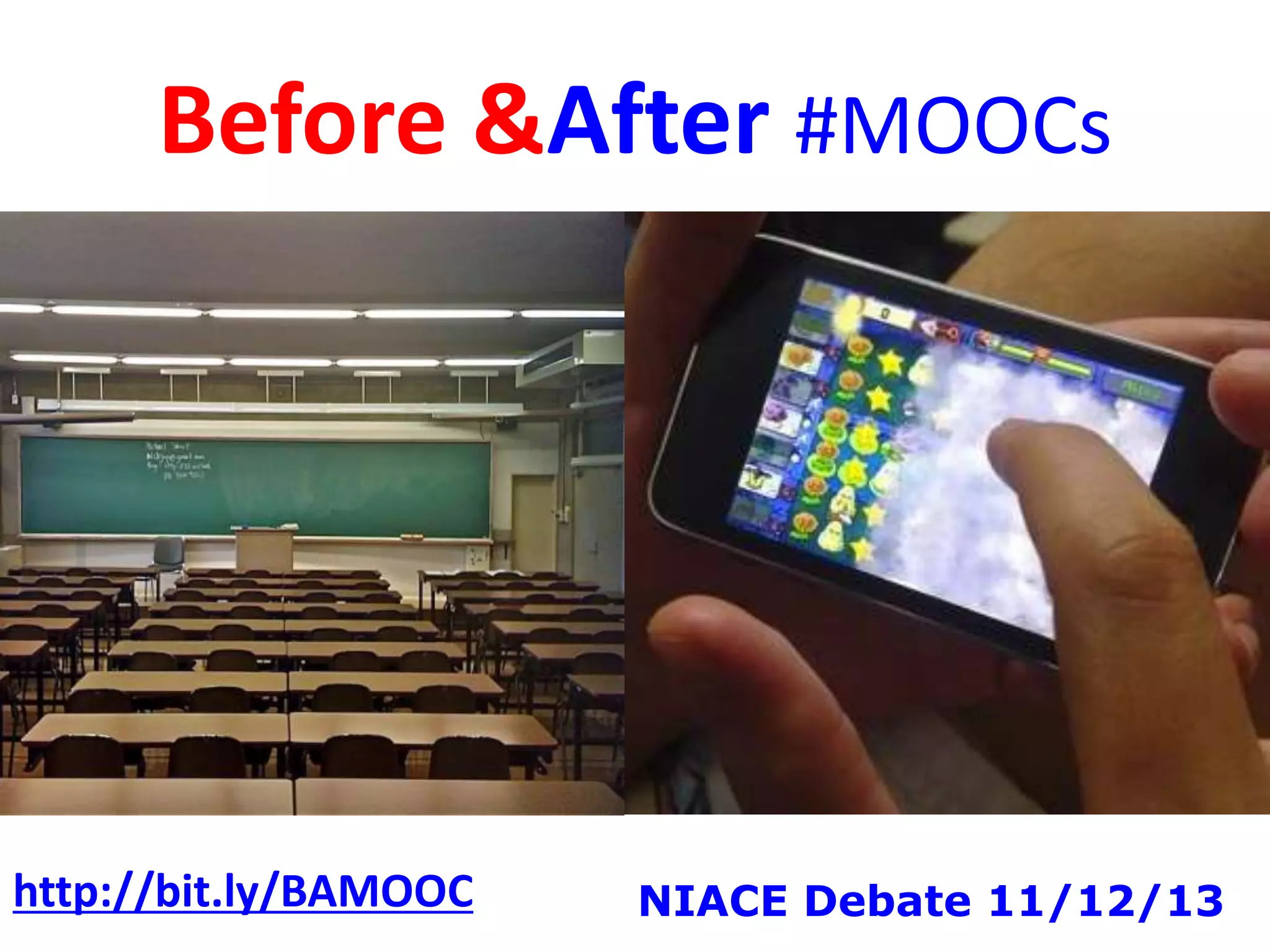
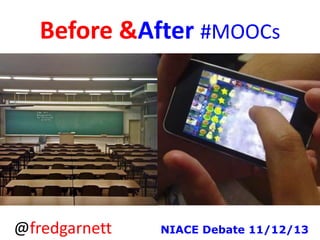
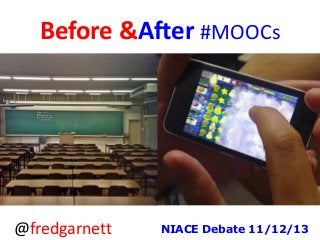
Before &After #MOOCs

@fredgarnett

NIACE Debate 11/12/13
niace Digital Learning Conference
This house proposes that
“Adult Education must embrace
the MOOC culture”

This presentation presents a position
AGAINST MOOCs BUT for Adult &
Community e-Learning (ACL)
Learning at the Digital Frontier Senate House, London
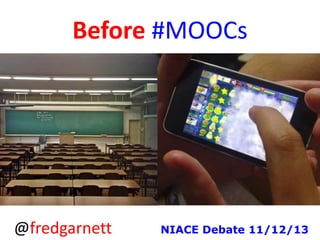
Before #MOOCs

@fredgarnett

NIACE Debate 11/12/13
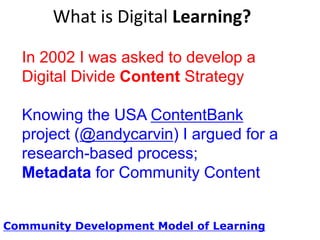
What is Digital Learning?
In 2002 I was asked to develop a
Digital Divide Content Strategy
Knowing the USA ContentBank
project (@andycarvin) I argued for a
research-based process;
Metadata for Community Content
Community Development Model of Learning
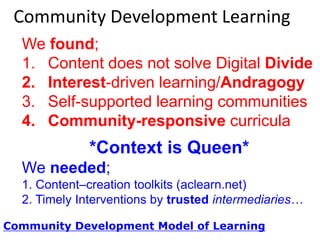
Community Development Learning
We found;
1. NO Content solves the Digital Divide
2. Interest-driven learning/Andragogy
3. Self-supported learning communities
4. Community-responsive curricula

*Context is Queen*
We needed;
1. Content–creation toolkits (aclearn.net)
2. Timely Interventions by trusted intermediaries…
Community Development Model of Learning
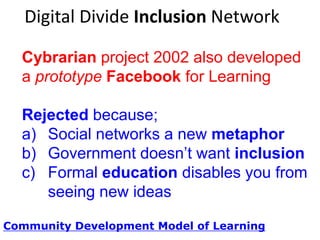
Digital Divide Inclusion Network
Cybrarian project 2002 also developed a
prototype Facebook for Learning
Rejected because;
a) Need new metaphor; social networks
b) Government doesn‟t want inclusion
c) Formal education disables you from
seeing new ideas
Community Development Model of Learning
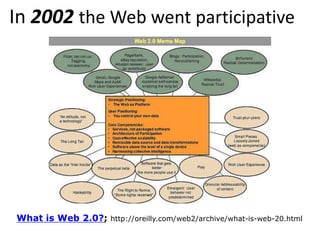
In 2002 the Web went participative

What is Web 2.0?;

http://oreilly.com/web2/archive/what-is-web-20.html
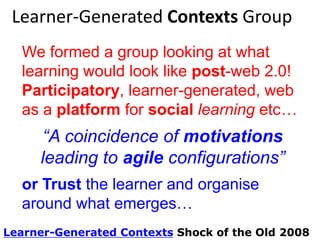
Learner-Generated Contexts Group
LGC; a group looking at what learning
would look like post-web 2.0!
Participatory, learner-generated, web
as a platform for social learning etc…

“A coincidence of motivations
leading to agile configurations”
or Trust the learner and organise
around what emerges…
Learner-Generated Contexts Shock of the Old 2008
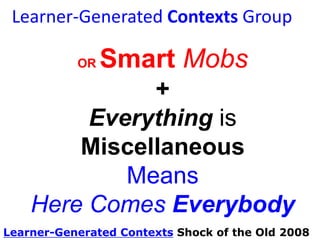
Learner-Generated Contexts Group

Smart Mobs +
Everything is
Miscellaneous
Means
Here Comes Everybody
OR

Smart Mobs – Howard Rheingold
Everything is Miscellaneous – Dave Weinberger
Here Comes Everybody – Clay Shirky
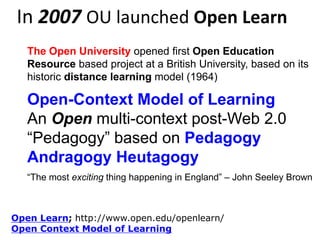
In 2007 OU launched Open Learn
The Open University opened first Open Education
Resource based project at a British University, based on its
historic distance learning model (1964)

Open-Context Model of Learning
An Open multi-context post-Web 2.0
“Pedagogy” based on Pedagogy
Andragogy Heutagogy Continuum…
“The most exciting thing happening in England” – John Seeley Brown

Open Learn; http://www.open.edu/openlearn/
Open Context Model of Learning
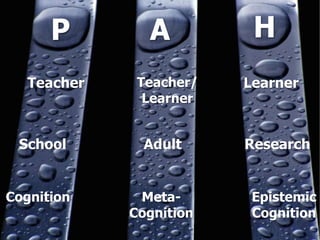
P
Teacher

School

Cognition

A
Teacher/
Learner

Adult

MetaCognition

H
Learner

Research

Epistemic
Cognition
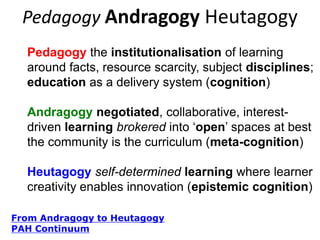
Pedagogy Andragogy Heutagogy
Pedagogy the institutionalisation of learning
around facts, resource scarcity, subject disciplines;
education as a delivery system (cognition)
Andragogy negotiated, collaborative, interestdriven learning brokered into „open‟ spaces. At best
the community is the curriculum (meta-cognition)
Heutagogy self-determined learning where learner
creativity enables innovation (epistemic cognition)
From Andragogy to Heutagogy
PAH Continuum
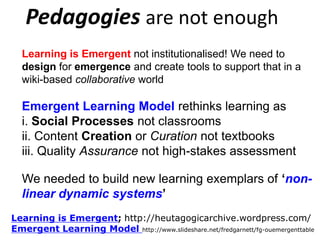
Pedagogies are not enough
Learning is Emergent not institutionalised! We need to
design for emergence and create tools to support that in a
wiki-based collaborative world;

“Fit for Context” Learning;
Emergent Learning Model rethinks learning as
i. Social Processes not classrooms
ii. Content Creation or Curation not textbooks
iii. Quality Assurance not high-stakes assessment
We needed to build new learning exemplars of „nonlinear dynamic systems‟
Learning is Emergent; http://heutagogicarchive.wordpress.com/
Emergent Learning Model http://www.slideshare.net/fredgarnett/fg-ouemergenttable
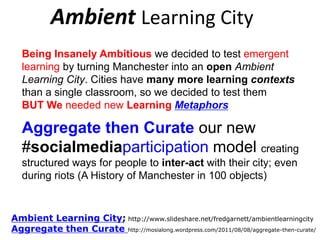
Ambient Learning City
Being Insanely Ambitious we decided to test emergent
learning by turning Manchester into an Ambient Learning
CityCities have many more learning contexts than a single
classroom, so we decided to design for them;

BUT We needed new Learning Metaphors

Aggregate then Curate our new
#socialmediaparticipation model
Creating structured ways for people to inter-act with their city;
even during riots (A History of Manchester in 100 objects)
Ambient Learning City; http://www.slideshare.net/fredgarnett/ambientlearningcity
Aggregate then Curate http://mosialong.wordpress.com/2011/08/08/aggregate-then-curate/
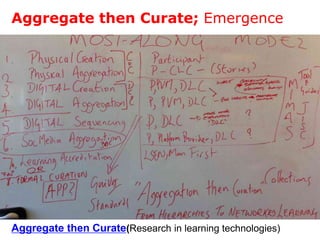
Aggregate then Curate; Emergence

Aggregate then Curate(Research in learning technologies)
Before the xMOOC
1. No “killer” content makes learning easy/inclusive
2. Context is Queen
3. People want to learn – trust them
4. People want to collaborate – support them
5. Create tools for learning and allow free use
6. New learning contexts need new learning metaphors
7. New learning metaphors need new processes
8. Learners are naturally andragogic online
9. Web 2.0 tools and social networks enable heutagogy
10. Learning is emergent & we can design for that

Learning is Emergent; http://heutagogicarchive.wordpress.com/
Emergent Learning Model http://www.slideshare.net/fredgarnett/fg-ouemergenttable
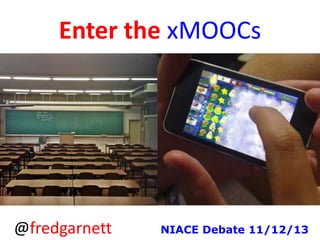
Enter the xMOOCs

@fredgarnett

NIACE Debate 11/12/13
Enter the MOOC
I assume we are talking about xMOOCs
1. xMOOCs are pedagogically-driven course-based
educational content-delivery systems.
2. xMOOCs reflect NOTHING whatsoever that we
have learnt about LEARNING based on the
digital disruption of the last 20 years
3. xMOOCs Not even a “sage on the stage” but
hierarchically-based; reflecting 1000 years of
“Education under the Lecturn”
4. xMOOCs are unheated digital libraries in the sky
Building Democractic Learning
The problem with xMOOCs
1. xMOOCs ignore everything learnt about learning
2. xMOOCs return the Technology-Enhanced
Learning debate back to technology-push
3. xMOOCsare about 19th Century institutions
crowding out debate about 21stC learning
4. That debate is driven by people who do not
know how to teach nor what learning is
5. xMOOCsare about using the values of the credit
crunch to create an education crunch
Building Democractic Learning
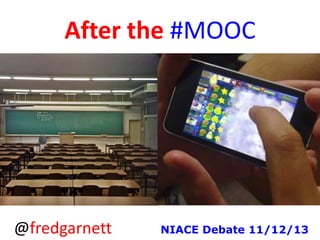
After the #MOOC

Making Learning – Fit for Context
If we want Digital Learning
We have discovered that;
1.
2.
3.
4.

People want to learn
Learning is social and informal
Collaboration and discussion enable learning
Digital tools enable Search & evaluation, Collaboration
& discussion AND curation and creation (andragogy &
heutagogy) in learning

We need;
New teaching skills participatory learning processes

New metaphors social platforms learning literacies

Are we e-enabling traditional education
or transforming learning?
Digital Practitioner;
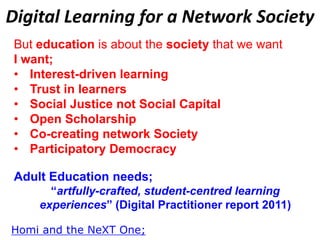
Digital Learning for a Network Society
But education is about designing the society that we
want to live in. It has to be “Fit for Context”
I want;
• Interest-driven learning
• Trust in learners
• Social Justice not Social Capital
• Open Scholarship
• Co-creating network Society
• Participatory Democracy
Adult Education needs;
“artfully-crafted, student-centred learning
experiences” (Digital Practitioner report 2011)
Homi and the NeXT One;
Accrediting Emergent Learning
In WikiQuals we are looking at how you “accredit” the
heutagogy of self-determined learning
Trust the Sqolar
Co-creating Open Scholarship
Develop Personal Learning Networks
Act in the real world (and document it)
Participatory Democracy needs participatory learning
We need to rethink the society we want and how we
use learning networks and democracy to get there
Co-creating Open Scholarship
WikiQuals Project
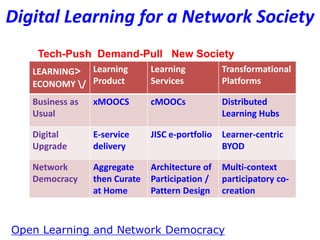
Digital Learning for a Network Society
Econ-model Tech-Push Demand-Pull New Society
LEARNING> Learning
ECONOMY / Product

Learning
Services

Transformational
Platforms

Business as
Usual

xMOOCS

cMOOCs

Distributed
Learning Hubs

Digital
Upgrade

E-service
delivery

JISC e-portfolio

Learner-centric
BYOD

Network
Democracy

Aggregate
then Curate
at Home

Architecture of
Participation /
Pattern Design

Multi-context
participatory cocreation

Open Learning and Network Democracy
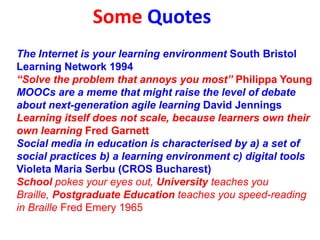
Some Quotes
The Internet is your learning environment South Bristol
Learning Network 1994
“Solve the problem that annoys you most” Philippa Young
MOOCs are a meme that might raise the level of debate
about next-generation agile learning David Jennings
Learning itself does not scale, because learners own their
own learning Fred Garnett
Social media in education is characterised by a) a set of
social practices b) a learning environment c) digital tools
Violeta Maria Serbu (CROS Bucharest)
School pokes your eyes out, University teaches you Braille,
Postgraduate Education teaches you speed-reading in Braille
Fred Emery 1965
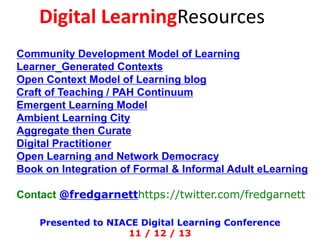
Digital LearningResources Links
Community Development Model of Learning
Learner_Generated Contexts
Open Context Model of Learning blog
Craft of Teaching / PAH Continuum
Emergent Learning Model
Ambient Learning City
Aggregate then Curate
Digital Practitioner
Open Learning and Network Democracy
CROS Alternative University
Book on Integration of Formal & Informal Adult eLearning
Contact @fredgarnetthttps://twitter.com/fredgarnett
Presented to NIACE Digital Learning Conference
11 / 12 / 13
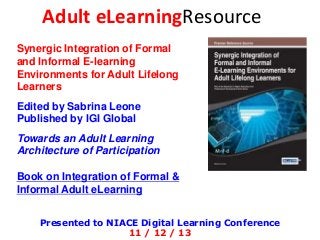
Adult eLearningResource
Synergic Integration of Formal
and Informal E-learning
Environments for Adult Lifelong
Learners
Edited by Sabrina Leone
Published by IGI Global

Towards an Adult Learning
Architecture of Participation
Book on Integration of Formal &
Informal Adult eLearning
Presented to NIACE Digital Learning Conference
11 / 12 / 13
Before &After #MOOCs

@fredgarnett

NIACE Debate 11/12/13

Before and After MOOCs

  • 1.
  • 2.
    niace Digital LearningConference This house proposes that “Adult Education must embrace the MOOC culture” This presentation presents a position AGAINST MOOCs BUT for Adult & Community e-Learning (ACL) Learning at the Digital Frontier Senate House, London
  • 3.
  • 4.
    What is DigitalLearning? In 2002 I was asked to develop a Digital Divide Content Strategy Knowing the USA ContentBank project (@andycarvin) I argued for a research-based process; Metadata for Community Content Community Development Model of Learning
  • 5.
    Community Development Learning Wefound; 1. NO Content solves the Digital Divide 2. Interest-driven learning/Andragogy 3. Self-supported learning communities 4. Community-responsive curricula *Context is Queen* We needed; 1. Content–creation toolkits (aclearn.net) 2. Timely Interventions by trusted intermediaries… Community Development Model of Learning
  • 6.
    Digital Divide InclusionNetwork Cybrarian project 2002 also developed a prototype Facebook for Learning Rejected because; a) Need new metaphor; social networks b) Government doesn‟t want inclusion c) Formal education disables you from seeing new ideas Community Development Model of Learning
  • 7.
    In 2002 theWeb went participative What is Web 2.0?; http://oreilly.com/web2/archive/what-is-web-20.html
  • 8.
    Learner-Generated Contexts Group LGC;a group looking at what learning would look like post-web 2.0! Participatory, learner-generated, web as a platform for social learning etc… “A coincidence of motivations leading to agile configurations” or Trust the learner and organise around what emerges… Learner-Generated Contexts Shock of the Old 2008
  • 9.
    Learner-Generated Contexts Group SmartMobs + Everything is Miscellaneous Means Here Comes Everybody OR Smart Mobs – Howard Rheingold Everything is Miscellaneous – Dave Weinberger Here Comes Everybody – Clay Shirky
  • 10.
    In 2007 OUlaunched Open Learn The Open University opened first Open Education Resource based project at a British University, based on its historic distance learning model (1964) Open-Context Model of Learning An Open multi-context post-Web 2.0 “Pedagogy” based on Pedagogy Andragogy Heutagogy Continuum… “The most exciting thing happening in England” – John Seeley Brown Open Learn; http://www.open.edu/openlearn/ Open Context Model of Learning
  • 11.
  • 12.
    Pedagogy Andragogy Heutagogy Pedagogythe institutionalisation of learning around facts, resource scarcity, subject disciplines; education as a delivery system (cognition) Andragogy negotiated, collaborative, interestdriven learning brokered into „open‟ spaces. At best the community is the curriculum (meta-cognition) Heutagogy self-determined learning where learner creativity enables innovation (epistemic cognition) From Andragogy to Heutagogy PAH Continuum
  • 13.
    Pedagogies are notenough Learning is Emergent not institutionalised! We need to design for emergence and create tools to support that in a wiki-based collaborative world; “Fit for Context” Learning; Emergent Learning Model rethinks learning as i. Social Processes not classrooms ii. Content Creation or Curation not textbooks iii. Quality Assurance not high-stakes assessment We needed to build new learning exemplars of „nonlinear dynamic systems‟ Learning is Emergent; http://heutagogicarchive.wordpress.com/ Emergent Learning Model http://www.slideshare.net/fredgarnett/fg-ouemergenttable
  • 14.
    Ambient Learning City BeingInsanely Ambitious we decided to test emergent learning by turning Manchester into an Ambient Learning CityCities have many more learning contexts than a single classroom, so we decided to design for them; BUT We needed new Learning Metaphors Aggregate then Curate our new #socialmediaparticipation model Creating structured ways for people to inter-act with their city; even during riots (A History of Manchester in 100 objects) Ambient Learning City; http://www.slideshare.net/fredgarnett/ambientlearningcity Aggregate then Curate http://mosialong.wordpress.com/2011/08/08/aggregate-then-curate/
  • 15.
    Aggregate then Curate;Emergence Aggregate then Curate(Research in learning technologies)
  • 16.
    Before the xMOOC 1.No “killer” content makes learning easy/inclusive 2. Context is Queen 3. People want to learn – trust them 4. People want to collaborate – support them 5. Create tools for learning and allow free use 6. New learning contexts need new learning metaphors 7. New learning metaphors need new processes 8. Learners are naturally andragogic online 9. Web 2.0 tools and social networks enable heutagogy 10. Learning is emergent & we can design for that Learning is Emergent; http://heutagogicarchive.wordpress.com/ Emergent Learning Model http://www.slideshare.net/fredgarnett/fg-ouemergenttable
  • 17.
  • 18.
    Enter the MOOC Iassume we are talking about xMOOCs 1. xMOOCs are pedagogically-driven course-based educational content-delivery systems. 2. xMOOCs reflect NOTHING whatsoever that we have learnt about LEARNING based on the digital disruption of the last 20 years 3. xMOOCs Not even a “sage on the stage” but hierarchically-based; reflecting 1000 years of “Education under the Lecturn” 4. xMOOCs are unheated digital libraries in the sky Building Democractic Learning
  • 19.
    The problem withxMOOCs 1. xMOOCs ignore everything learnt about learning 2. xMOOCs return the Technology-Enhanced Learning debate back to technology-push 3. xMOOCsare about 19th Century institutions crowding out debate about 21stC learning 4. That debate is driven by people who do not know how to teach nor what learning is 5. xMOOCsare about using the values of the credit crunch to create an education crunch Building Democractic Learning
  • 20.
    After the #MOOC MakingLearning – Fit for Context
  • 21.
    If we wantDigital Learning We have discovered that; 1. 2. 3. 4. People want to learn Learning is social and informal Collaboration and discussion enable learning Digital tools enable Search & evaluation, Collaboration & discussion AND curation and creation (andragogy & heutagogy) in learning We need; New teaching skills participatory learning processes New metaphors social platforms learning literacies Are we e-enabling traditional education or transforming learning? Digital Practitioner;
  • 22.
    Digital Learning fora Network Society But education is about designing the society that we want to live in. It has to be “Fit for Context” I want; • Interest-driven learning • Trust in learners • Social Justice not Social Capital • Open Scholarship • Co-creating network Society • Participatory Democracy Adult Education needs; “artfully-crafted, student-centred learning experiences” (Digital Practitioner report 2011) Homi and the NeXT One;
  • 23.
    Accrediting Emergent Learning InWikiQuals we are looking at how you “accredit” the heutagogy of self-determined learning Trust the Sqolar Co-creating Open Scholarship Develop Personal Learning Networks Act in the real world (and document it) Participatory Democracy needs participatory learning We need to rethink the society we want and how we use learning networks and democracy to get there Co-creating Open Scholarship WikiQuals Project
  • 24.
    Digital Learning fora Network Society Econ-model Tech-Push Demand-Pull New Society LEARNING> Learning ECONOMY / Product Learning Services Transformational Platforms Business as Usual xMOOCS cMOOCs Distributed Learning Hubs Digital Upgrade E-service delivery JISC e-portfolio Learner-centric BYOD Network Democracy Aggregate then Curate at Home Architecture of Participation / Pattern Design Multi-context participatory cocreation Open Learning and Network Democracy
  • 25.
    Some Quotes The Internetis your learning environment South Bristol Learning Network 1994 “Solve the problem that annoys you most” Philippa Young MOOCs are a meme that might raise the level of debate about next-generation agile learning David Jennings Learning itself does not scale, because learners own their own learning Fred Garnett Social media in education is characterised by a) a set of social practices b) a learning environment c) digital tools Violeta Maria Serbu (CROS Bucharest) School pokes your eyes out, University teaches you Braille, Postgraduate Education teaches you speed-reading in Braille Fred Emery 1965
  • 26.
    Digital LearningResources Links CommunityDevelopment Model of Learning Learner_Generated Contexts Open Context Model of Learning blog Craft of Teaching / PAH Continuum Emergent Learning Model Ambient Learning City Aggregate then Curate Digital Practitioner Open Learning and Network Democracy CROS Alternative University Book on Integration of Formal & Informal Adult eLearning Contact @fredgarnetthttps://twitter.com/fredgarnett Presented to NIACE Digital Learning Conference 11 / 12 / 13
  • 27.
    Adult eLearningResource Synergic Integrationof Formal and Informal E-learning Environments for Adult Lifelong Learners Edited by Sabrina Leone Published by IGI Global Towards an Adult Learning Architecture of Participation Book on Integration of Formal & Informal Adult eLearning Presented to NIACE Digital Learning Conference 11 / 12 / 13
  • 28.