Image: CC BY-NC 2.0 owaief89
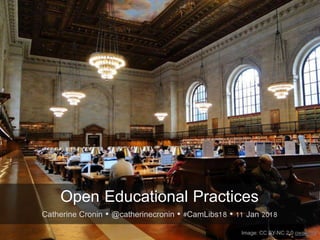
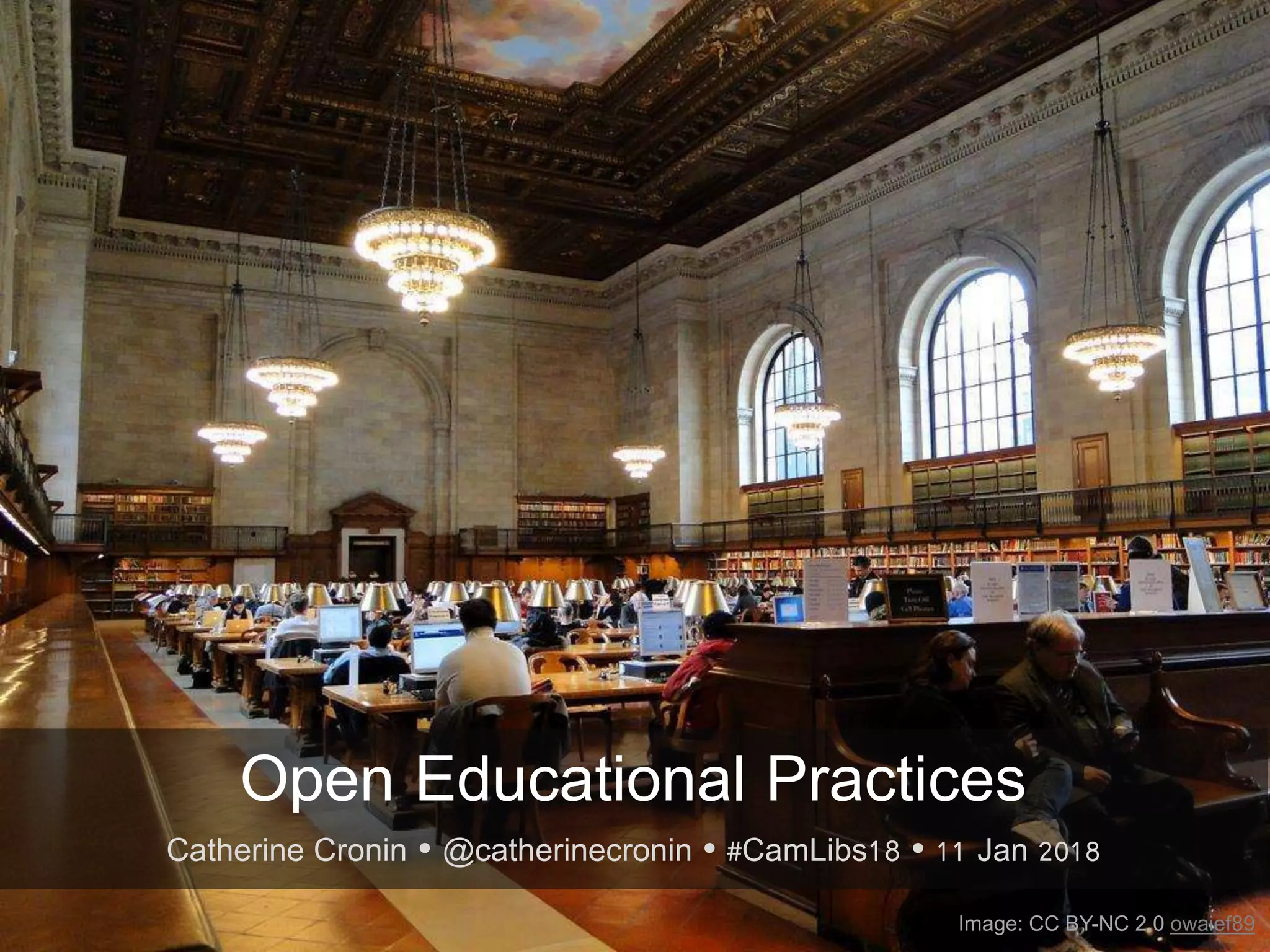
Open Educational Practices
Catherine Cronin  @catherinecronin  #CamLibs18  11 Jan 2018
Catherine Cronin
open educator, open resercher
CELT, National University of Ireland, Galway
@catherinecronin  catherinecronin.net
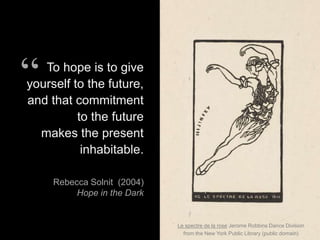
Le spectre de la rose Jerome Robbins Dance Division
from the New York Public Library (public domain)
To hope is to give
yourself to the future,
and that commitment
to the future
makes the present
inhabitable.
Rebecca Solnit (2004)
Hope in the Dark
“
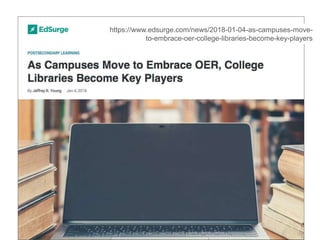
https://www.edsurge.com/news/2018-01-04-as-campuses-move-
to-embrace-oer-college-libraries-become-key-players
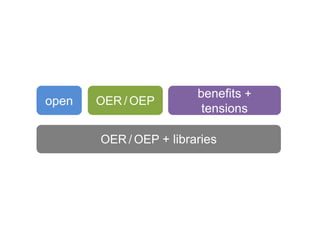
OER / OEP + libraries
open
benefits +
tensions
OER / OEP
pen
Image: CC0 by Nadine Shaabana
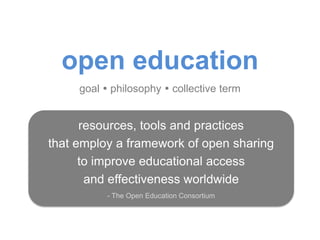
open education
goal  philosophy  collective term
resources, tools and practices
that employ a framework of open sharing
to improve educational access
and effectiveness worldwide
- The Open Education Consortium
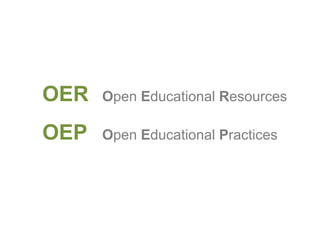
OER Open Educational Resources
OEP Open Educational Practices
Image: CC BY-SA 2.0 Marcel Oosterwijk
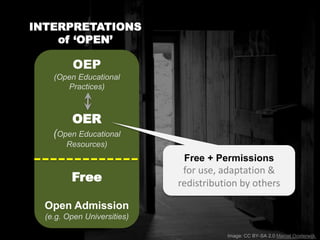
OEP
(Open Educational
Practices)
OER
(Open Educational
Resources)
Free
Open Admission
(e.g. Open Universities)
INTERPRETATIONS
of ‘OPEN’
Free + Permissions
for use, adaptation &
redistribution by others
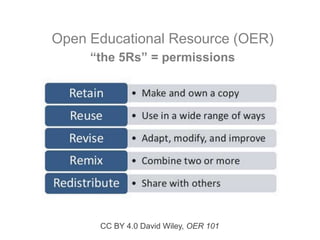
CC BY 4.0 David Wiley, OER 101
Open Educational Resource (OER)
“the 5Rs” = permissions
OEP
(Open Educational
Practices)
OER
(Open Educational
Resources)
Free
Open Admission
(e.g. Open Universities)
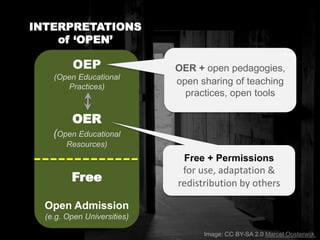
INTERPRETATIONS
of ‘OPEN’
OER + open pedagogies,
open sharing of teaching
practices, open tools
Free + Permissions
for use, adaptation &
redistribution by others
Image: CC BY-SA 2.0 Marcel Oosterwijk
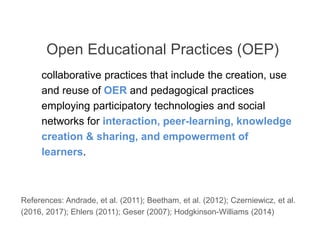
collaborative practices that include the creation, use
and reuse of OER and pedagogical practices
employing participatory technologies and social
networks for interaction, peer-learning, knowledge
creation & sharing, and empowerment of
learners.
Open Educational Practices (OEP)
References: Andrade, et al. (2011); Beetham, et al. (2012); Czerniewicz, et al.
(2016, 2017); Ehlers (2011); Geser (2007); Hodgkinson-Williams (2014)
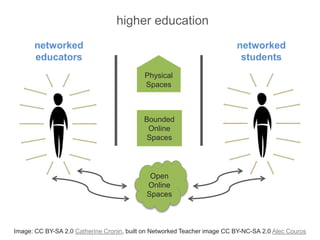
networked
educators
networked
students
Physical
Spaces
Bounded
Online
Spaces
Open
Online
Spaces
Image: CC BY-SA 2.0 Catherine Cronin, built on Networked Teacher image CC BY-NC-SA 2.0 Alec Couros
higher education
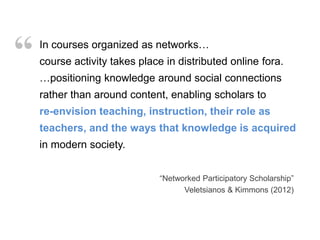
In courses organized as networks…
course activity takes place in distributed online fora.
…positioning knowledge around social connections
rather than around content, enabling scholars to
re-envision teaching, instruction, their role as
teachers, and the ways that knowledge is acquired
in modern society.
“Networked Participatory Scholarship”
Veletsianos & Kimmons (2012)
“
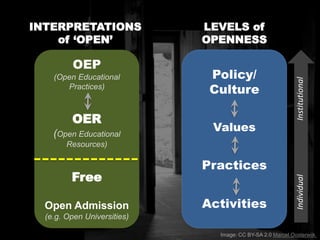
INTERPRETATIONS
of ‘OPEN’
Policy/
Culture
Values
Practices
Activities
LEVELS of
OPENNESS
OEP
(Open Educational
Practices)
OER
(Open Educational
Resources)
Free
Open Admission
(e.g. Open Universities)
IndividualInstitutional
Image: CC BY-SA 2.0 Marcel Oosterwijk
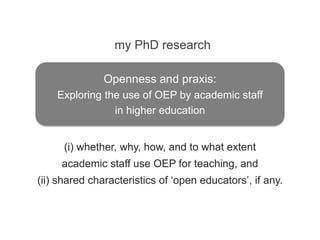
(i) whether, why, how, and to what extent
academic staff use OEP for teaching, and
(ii) shared characteristics of ‘open educators’, if any.
my PhD research
Openness and praxis:
Exploring the use of OEP by academic staff
in higher education
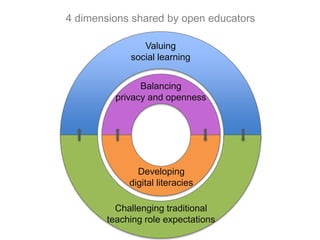
Balancing
privacy and openness
Developing
digital literacies
Valuing
social learning
Challenging traditional
teaching role expectations
4 dimensions shared by open educators
Balancing privacy & openness
Image: CC BY 2.0 woodleywonderworks
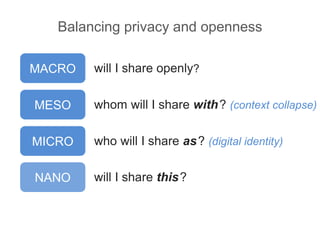
Balancing privacy and openness
will I share openly?
whom will I share with? (context collapse)
who will I share as? (digital identity)
will I share this?
MACRO
MESO
MICRO
NANO
For individuals, the use of OEP is:
 complex
 personal
 contextual
 continually negotiated
OER / OEP + libraries
open
benefits +
tensions
OER / OEP
Image: CC0 Stijn Swinnen
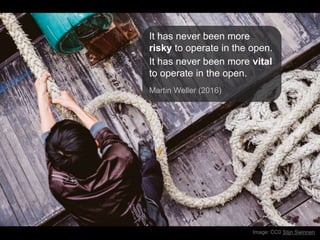
It has never been more
risky to operate in the open.
It has never been more vital
to operate in the open.
Martin Weller (2016)
OEP: Potential benefits
• Increased access to education
• Decreased cost (e.g. OER, open textbooks)
• Developing digital, data, & network literacies
• New forms of dialogue and global collaboration
• Student agency & empowerment
• Bridging formal & informal learning
• Public outreach and engagement
• Enhancing & expanding the scope of learning
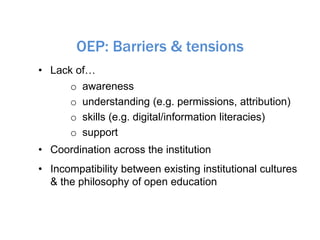
OEP: Barriers & tensions
• Lack of…
o awareness
o understanding (e.g. permissions, attribution)
o skills (e.g. digital/information literacies)
o support
• Coordination across the institution
• Incompatibility between existing institutional cultures
& the philosophy of open education
OER / OEP + libraries
open
benefits +
tensions
OER / OEP
Resources
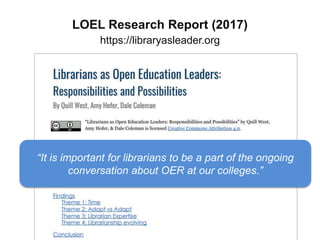
LOEL Research Report (2017)
https://libraryasleader.org
“It is important for librarians to be a part of the ongoing
conversation about OER at our colleges.”
Civic Switchboard (2017)
https://civic-switchboard.github.io/
@civicswitch
Encourages partnerships between libraries and local data
intermediaries; these partnerships will better serve data users,
further democratize data, and support equitable access to
information.
The project will create a toolkit for libraries interested in
expanding (or beginning) their role around civic information.
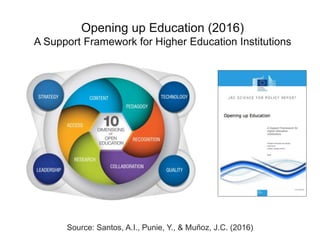
Opening up Education (2016)
A Support Framework for Higher Education Institutions
Source: Santos, A.I., Punie, Y., & Muñoz, J.C. (2016)
Open education is a tool
for social change.
Santos, A.I., Punie, Y., & Muñoz, J.C. (2016)
Opening up Education: A Support Framework for Higher Education Institutions
“
Thank You!
Catherine Cronin
@catherinecronin
catherinecronin.net
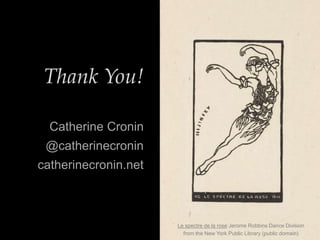
Le spectre de la rose Jerome Robbins Dance Division
from the New York Public Library (public domain)
all sources and references available at:
http://bit.ly/oep-CamLibs18

Open Educational Practices (OEP) #CamLibs18

  • 1.
    Image: CC BY-NC2.0 owaief89 Open Educational Practices Catherine Cronin  @catherinecronin  #CamLibs18  11 Jan 2018
  • 2.
    Catherine Cronin open educator,open resercher CELT, National University of Ireland, Galway @catherinecronin  catherinecronin.net
  • 3.
    Le spectre dela rose Jerome Robbins Dance Division from the New York Public Library (public domain) To hope is to give yourself to the future, and that commitment to the future makes the present inhabitable. Rebecca Solnit (2004) Hope in the Dark “
  • 4.
  • 5.
    OER / OEP+ libraries open benefits + tensions OER / OEP
  • 6.
    pen Image: CC0 byNadine Shaabana
  • 7.
    open education goal philosophy  collective term resources, tools and practices that employ a framework of open sharing to improve educational access and effectiveness worldwide - The Open Education Consortium
  • 8.
    OER Open EducationalResources OEP Open Educational Practices
  • 9.
    Image: CC BY-SA2.0 Marcel Oosterwijk OEP (Open Educational Practices) OER (Open Educational Resources) Free Open Admission (e.g. Open Universities) INTERPRETATIONS of ‘OPEN’ Free + Permissions for use, adaptation & redistribution by others
  • 10.
    CC BY 4.0David Wiley, OER 101 Open Educational Resource (OER) “the 5Rs” = permissions
  • 11.
    OEP (Open Educational Practices) OER (Open Educational Resources) Free OpenAdmission (e.g. Open Universities) INTERPRETATIONS of ‘OPEN’ OER + open pedagogies, open sharing of teaching practices, open tools Free + Permissions for use, adaptation & redistribution by others Image: CC BY-SA 2.0 Marcel Oosterwijk
  • 12.
    collaborative practices thatinclude the creation, use and reuse of OER and pedagogical practices employing participatory technologies and social networks for interaction, peer-learning, knowledge creation & sharing, and empowerment of learners. Open Educational Practices (OEP) References: Andrade, et al. (2011); Beetham, et al. (2012); Czerniewicz, et al. (2016, 2017); Ehlers (2011); Geser (2007); Hodgkinson-Williams (2014)
  • 13.
    networked educators networked students Physical Spaces Bounded Online Spaces Open Online Spaces Image: CC BY-SA2.0 Catherine Cronin, built on Networked Teacher image CC BY-NC-SA 2.0 Alec Couros higher education
  • 14.
    In courses organizedas networks… course activity takes place in distributed online fora. …positioning knowledge around social connections rather than around content, enabling scholars to re-envision teaching, instruction, their role as teachers, and the ways that knowledge is acquired in modern society. “Networked Participatory Scholarship” Veletsianos & Kimmons (2012) “
  • 15.
    INTERPRETATIONS of ‘OPEN’ Policy/ Culture Values Practices Activities LEVELS of OPENNESS OEP (OpenEducational Practices) OER (Open Educational Resources) Free Open Admission (e.g. Open Universities) IndividualInstitutional Image: CC BY-SA 2.0 Marcel Oosterwijk
  • 16.
    (i) whether, why,how, and to what extent academic staff use OEP for teaching, and (ii) shared characteristics of ‘open educators’, if any. my PhD research Openness and praxis: Exploring the use of OEP by academic staff in higher education
  • 17.
    Balancing privacy and openness Developing digitalliteracies Valuing social learning Challenging traditional teaching role expectations 4 dimensions shared by open educators
  • 18.
    Balancing privacy &openness Image: CC BY 2.0 woodleywonderworks
  • 19.
    Balancing privacy andopenness will I share openly? whom will I share with? (context collapse) who will I share as? (digital identity) will I share this? MACRO MESO MICRO NANO
  • 20.
    For individuals, theuse of OEP is:  complex  personal  contextual  continually negotiated
  • 21.
    OER / OEP+ libraries open benefits + tensions OER / OEP
  • 22.
    Image: CC0 StijnSwinnen It has never been more risky to operate in the open. It has never been more vital to operate in the open. Martin Weller (2016)
  • 23.
    OEP: Potential benefits •Increased access to education • Decreased cost (e.g. OER, open textbooks) • Developing digital, data, & network literacies • New forms of dialogue and global collaboration • Student agency & empowerment • Bridging formal & informal learning • Public outreach and engagement • Enhancing & expanding the scope of learning
  • 24.
    OEP: Barriers &tensions • Lack of… o awareness o understanding (e.g. permissions, attribution) o skills (e.g. digital/information literacies) o support • Coordination across the institution • Incompatibility between existing institutional cultures & the philosophy of open education
  • 25.
    OER / OEP+ libraries open benefits + tensions OER / OEP
  • 26.
  • 27.
    LOEL Research Report(2017) https://libraryasleader.org “It is important for librarians to be a part of the ongoing conversation about OER at our colleges.”
  • 28.
    Civic Switchboard (2017) https://civic-switchboard.github.io/ @civicswitch Encouragespartnerships between libraries and local data intermediaries; these partnerships will better serve data users, further democratize data, and support equitable access to information. The project will create a toolkit for libraries interested in expanding (or beginning) their role around civic information.
  • 29.
    Opening up Education(2016) A Support Framework for Higher Education Institutions Source: Santos, A.I., Punie, Y., & Muñoz, J.C. (2016)
  • 30.
    Open education isa tool for social change. Santos, A.I., Punie, Y., & Muñoz, J.C. (2016) Opening up Education: A Support Framework for Higher Education Institutions “
  • 31.
    Thank You! Catherine Cronin @catherinecronin catherinecronin.net Lespectre de la rose Jerome Robbins Dance Division from the New York Public Library (public domain)
  • 32.
    all sources andreferences available at: http://bit.ly/oep-CamLibs18

Editor's Notes

  • #2 I often use this image as a wonderful illustration of OPEN… No music. No coffee. Just an awesome (in the true sense of the word), open, public space… Open & connected. Begs Q: How can education (HE) aspire to this idea of open, inclusive & connected learning, in its biggest sense?
  • #3  I’m Catherine Cronin – open educator & open researcher
  • #7 Flexible concept! constantly evolving, assuming different meanings in different contexts and discourses. All the OPENS… education, access, science, research, data, MOOCs, OER, OEP, pedagogy, etc.
  • #8 ‘openness’ advocates transparency & lowering or removal of barriers (at all levels within an institution) including processes involved in R, T + L. AIM = improve educational access, effectiveness & equality
  • #10 OER = K. as public good: Take it! Use it! Change it! Reuse it in your context… Licensed for reuse – Reuse –use the content in a wide range of ways – Revise –adapt, adjust, modify, or alter the content – Remix –combine the original or revised content with other open content to create something new – Redistribute –share copies of the original content, your revisions, or your remixes with others – Retain –make, own & control copies of the content
  • #12 OER: licensed for reuse: 5 Rs… (Reuse – Revise – Remix – Redistribute – Retain) Definition of OEP is more complex… not just the artifacts/content, but the “live practices” of open education 2 broad families of definitions of OEP: OER-focused or OER plus! open pedagogies; open learning; open scholarship; open tech respect & empower L’s as co-producers
  • #14  In academic settings in which the use of OEP is not required, requested, expected, or specifically supported, why do some educators, and not others, choose to use OEP? (...and then what happens?)
  • #15 Networked participatory scholarship is the emergent practice of scholars’ use of participatory technologies and online social networks to share, reflect upon, critique, improve, validate, and further their scholarship...
  • #16 I have found this to be a useful map both for positioning my own research, and considering other work in the Open Education domain. WHERE DOES IT FIT? Terrain of my research = UPPER LEFT + MID/LOWER RIGHT Applicability of my research, hopefully = UPPER RIGHT
  • #17 GOAL was to understand…
  • #23 Many educators working in the area of open education increasingly speak about the importance of a critical approach to openness, recognising that while it is wonderful to learn/connect in the Open, there are Risks as well... and those most at risk of negative consequences of openness are those who are marginalised, in any way. Navigating this tension IS OUR WORK as educators.
  • #28 The LOEL faculty & librarian participants redesigned courses with open content  they also offered insight into why & how librarians can be essential collaborators on open ed projects
  • #29 3-year project by faculty & librarians at 34 colleges in Washington. How librarians can add value to the open course creation process: Time required Adopt vs. Adapt Librarian role: Search + Licensing + “librarians can better define the role that they want to play in course design before projects begin”
  • #31 Local & and global collaboration Resources will be better deployed New practices on knowledge exchange New practices on credit recognition Make education more inclusive & more mobile Lower barriers to access & progression  Education more closely with needs of the labour market & increasingly open, networked & participatory culture