Using social media for impact
Workshop presented at ESRC Final Year Conference
Edinburgh, 25th April 2014
Professor Hazel Hall
http://hazelhall.org
http://slideshare.net/hazelhall
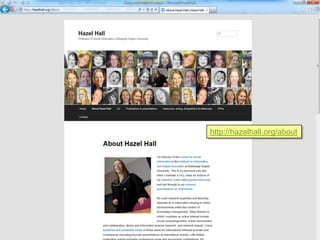
http://hazelhall.org/about
Why this session?
This one-hour interactive session covers
1. Consideration of the range of social media tools available to help increase
research impact
2. Practical suggestions and recommendations for researchers keen to
develop their presence on, and use of, social media for a number of work-
related purposes, both at a personal and project level
Workshop format
Introductory slides (10 minutes)
 These ones!
Exercise (30 minutes)
 Team work
Round-up (20 minutes)
 Teams report back
 Suggestions and recommendations on where you should “be”
Established impact measures
Bibliometric indicators measure “academic” impact of individuals’
output
 Quantity of publications
 Quantity of citations to those publications
 Codified in citation databases
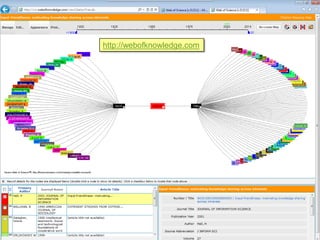
Established impact measures
Bibliometric indicators measure “academic” impact
 Quantity of publications
 Quantity of citations to those publications
http://webofknowledge.com
Alternative impact measures
Altmetrics assess the impact of individual output using various
criteria across a range of platforms
 recommended by others
 praised by opinion leaders
 mentioned in social media
 etc.
 downloaded
 acknowledged
 included in syllabi
 quoted in the press
 cited in policy documents
Judgements of esteem rely on more than
“mere” publication record. Visibility is
becoming increasingly important for
personal research impact and the
reputational benefits that this brings, e.g.
invitations to collaborate, speak at
conferences, serve on committees etc.
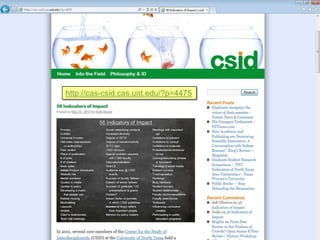
http://cas-csid.cas.unt.edu/?p=4475
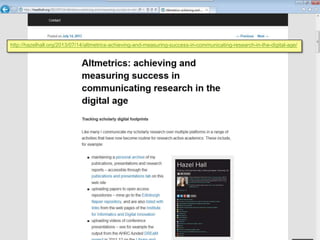
http://hazelhall.org/2013/07/14/altmetrics-achieving-and-measuring-success-in-communicating-research-in-the-digital-age/
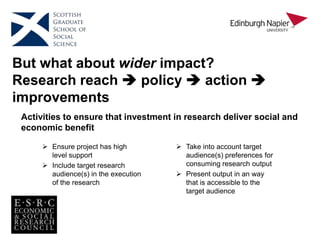
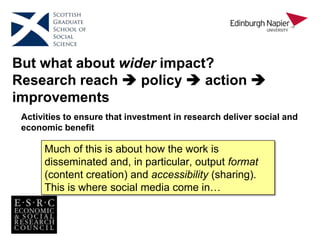
But what about wider impact?
Research reach  policy  action 
improvements
 Take into account target
audience(s) preferences for
consuming research output
 Present output in an way
that is accessible to the
target audience
 Ensure project has high
level support
 Include target research
audience(s) in the execution
of the research
Activities to ensure that investment in research deliver social and
economic benefit
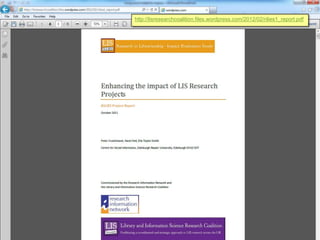
http://lisresearchcoalition.files.wordpress.com/2012/02/rilies1_report.pdf
But what about wider impact?
Research reach  policy  action 
improvements
 Take into account target
audience(s) preferences for
consuming research output
 Present output in an way
that is accessible to the
target audience
 Ensure project has high
level support
 Include target research
audience(s) in the execution
of the research
Activities to ensure that investment in research deliver social and
economic benefit
Much of this is about how the work is
disseminated and, in particular, output format
(content creation) and accessibility (sharing).
This is where social media come in…
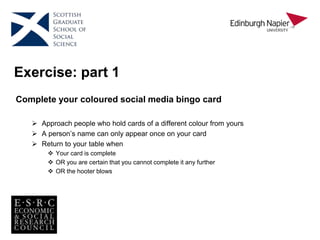
Exercise: part 1
Complete your coloured social media bingo card
 Approach people who hold cards of a different colour from yours
 A person’s name can only appear once on your card
 Return to your table when
 Your card is complete
 OR you are certain that you cannot complete it any further
 OR the hooter blows
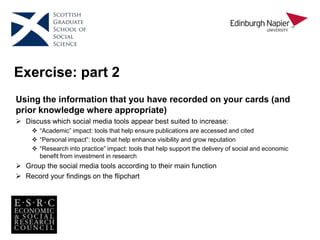
Exercise: part 2
Using the information that you have recorded on your cards (and
prior knowledge where appropriate)
 Discuss which social media tools appear best suited to increase:
 “Academic” impact: tools that help ensure publications are accessed and cited
 “Personal impact”: tools that help enhance visibility and grow reputation
 “Research into practice” impact: tools that help support the delivery of social and economic
benefit from investment in research
 Group the social media tools according to their main function
 Record your findings on the flipchart
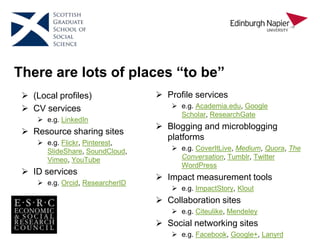
There are lots of places “to be”
 (Local profiles)
 CV services
 e.g. LinkedIn
 Resource sharing sites
 e.g. Flickr, Pinterest,
SlideShare, SoundCloud,
Vimeo, YouTube
 ID services
 e.g. Orcid, ResearcherID
 Profile services
 e.g. Academia.edu, Google
Scholar, ResearchGate
 Blogging and microblogging
platforms
 e.g. CoverItLive, Medium, Quora, The
Conversation, Tumblr, Twitter
WordPress
 Impact measurement tools
 e.g. ImpactStory, Klout
 Collaboration sites
 e.g. Citeulike, Mendeley
 Social networking sites
 e.g. Facebook, Google+, Lanyrd
So where should you (your projects) be?
For wide dissemination of publications
 ID services (e.g. Orcid, ResearcherID) and research profile services (e.g.
Academia.edu, Google Scholar, ResearchGate)
For wide dissemination of presentations
 Resource sharing sites (e.g. SlideShare, SoundCloud, Vimeo, YouTube)
If you are interested in tracking your impact
 Impact measurement tools (e.g. ImpactStory, Klout)
If you want to keep up to date/others updated
 Twitter
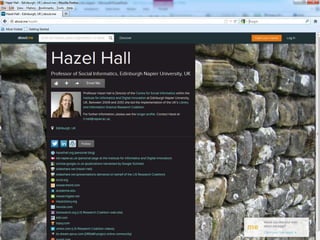
And to provide a directory of it all
 About.me
Should you set up a personal blog?
1. Do you want/need a full “independent” online profile?
2. Do you enjoy writing?
3. Are you prepared to give up your free time to blog regularly?
4. What would a blog give you that you can’t get from use of
other services?
 In-house news platform
 Update function on LinkedIn
 Ad hoc blogging on Medium, guest contributions to The Conversation
Resources
For further detail on individual services mentioned in this presentation
see Using social media to promote your research by Hazel Hall.
The London School of Economics blog Maximising the impact of
academic research is well worth following
Sharing the DREaM blueprint gives an account of how social media
extended the reach of an AHRC project in 2011/12
Using social media for impact
Workshop presented at ESRC Final Year Conference
Edinburgh, 25th April 2014
Professor Hazel Hall
http://hazelhall.org
http://slideshare.net/hazelhall

Using social media for impact

  • 1.
    Using social mediafor impact Workshop presented at ESRC Final Year Conference Edinburgh, 25th April 2014 Professor Hazel Hall http://hazelhall.org http://slideshare.net/hazelhall
  • 2.
  • 3.
    Why this session? Thisone-hour interactive session covers 1. Consideration of the range of social media tools available to help increase research impact 2. Practical suggestions and recommendations for researchers keen to develop their presence on, and use of, social media for a number of work- related purposes, both at a personal and project level
  • 4.
    Workshop format Introductory slides(10 minutes)  These ones! Exercise (30 minutes)  Team work Round-up (20 minutes)  Teams report back  Suggestions and recommendations on where you should “be”
  • 5.
    Established impact measures Bibliometricindicators measure “academic” impact of individuals’ output  Quantity of publications  Quantity of citations to those publications  Codified in citation databases
  • 6.
    Established impact measures Bibliometricindicators measure “academic” impact  Quantity of publications  Quantity of citations to those publications http://webofknowledge.com
  • 7.
    Alternative impact measures Altmetricsassess the impact of individual output using various criteria across a range of platforms  recommended by others  praised by opinion leaders  mentioned in social media  etc.  downloaded  acknowledged  included in syllabi  quoted in the press  cited in policy documents Judgements of esteem rely on more than “mere” publication record. Visibility is becoming increasingly important for personal research impact and the reputational benefits that this brings, e.g. invitations to collaborate, speak at conferences, serve on committees etc.
  • 8.
  • 9.
  • 10.
    But what aboutwider impact? Research reach  policy  action  improvements  Take into account target audience(s) preferences for consuming research output  Present output in an way that is accessible to the target audience  Ensure project has high level support  Include target research audience(s) in the execution of the research Activities to ensure that investment in research deliver social and economic benefit
  • 11.
  • 12.
    But what aboutwider impact? Research reach  policy  action  improvements  Take into account target audience(s) preferences for consuming research output  Present output in an way that is accessible to the target audience  Ensure project has high level support  Include target research audience(s) in the execution of the research Activities to ensure that investment in research deliver social and economic benefit Much of this is about how the work is disseminated and, in particular, output format (content creation) and accessibility (sharing). This is where social media come in…
  • 13.
    Exercise: part 1 Completeyour coloured social media bingo card  Approach people who hold cards of a different colour from yours  A person’s name can only appear once on your card  Return to your table when  Your card is complete  OR you are certain that you cannot complete it any further  OR the hooter blows
  • 14.
    Exercise: part 2 Usingthe information that you have recorded on your cards (and prior knowledge where appropriate)  Discuss which social media tools appear best suited to increase:  “Academic” impact: tools that help ensure publications are accessed and cited  “Personal impact”: tools that help enhance visibility and grow reputation  “Research into practice” impact: tools that help support the delivery of social and economic benefit from investment in research  Group the social media tools according to their main function  Record your findings on the flipchart
  • 15.
    There are lotsof places “to be”  (Local profiles)  CV services  e.g. LinkedIn  Resource sharing sites  e.g. Flickr, Pinterest, SlideShare, SoundCloud, Vimeo, YouTube  ID services  e.g. Orcid, ResearcherID  Profile services  e.g. Academia.edu, Google Scholar, ResearchGate  Blogging and microblogging platforms  e.g. CoverItLive, Medium, Quora, The Conversation, Tumblr, Twitter WordPress  Impact measurement tools  e.g. ImpactStory, Klout  Collaboration sites  e.g. Citeulike, Mendeley  Social networking sites  e.g. Facebook, Google+, Lanyrd
  • 16.
    So where shouldyou (your projects) be? For wide dissemination of publications  ID services (e.g. Orcid, ResearcherID) and research profile services (e.g. Academia.edu, Google Scholar, ResearchGate) For wide dissemination of presentations  Resource sharing sites (e.g. SlideShare, SoundCloud, Vimeo, YouTube) If you are interested in tracking your impact  Impact measurement tools (e.g. ImpactStory, Klout) If you want to keep up to date/others updated  Twitter And to provide a directory of it all  About.me
  • 18.
    Should you setup a personal blog? 1. Do you want/need a full “independent” online profile? 2. Do you enjoy writing? 3. Are you prepared to give up your free time to blog regularly? 4. What would a blog give you that you can’t get from use of other services?  In-house news platform  Update function on LinkedIn  Ad hoc blogging on Medium, guest contributions to The Conversation
  • 19.
    Resources For further detailon individual services mentioned in this presentation see Using social media to promote your research by Hazel Hall. The London School of Economics blog Maximising the impact of academic research is well worth following Sharing the DREaM blueprint gives an account of how social media extended the reach of an AHRC project in 2011/12
  • 20.
    Using social mediafor impact Workshop presented at ESRC Final Year Conference Edinburgh, 25th April 2014 Professor Hazel Hall http://hazelhall.org http://slideshare.net/hazelhall