Open Instructional Design and
Assessments
Naomi Wahls
Learning Developer - TU Delft
Co-Instructor to Designing an Online Course and Teaching an Online Course
EU hub coordinator - OE4BW
Technische Universiteit Delft (TU Delft) 2020
Webinar Agenda
● Organization of a learning experience
● Learning outcomes, learner levels, and accessibility
● Active learning in self-directed and distance contexts
● Turning resources and assessments into a course or textbook
What does Open Education mean to you in 3
words?
Photo by Adam Birkett
on Unsplash
Independence, Freedom, and Equality
Photo by Robin Benzrihem on Unsplash Photo by Zoltan Tasi on Unsplash Photo by Serhat Beyazkaya on Unsplash
What does open instructional design mean?
Designing an OER?
Open Practices while creating an OER?
What OER exists already?
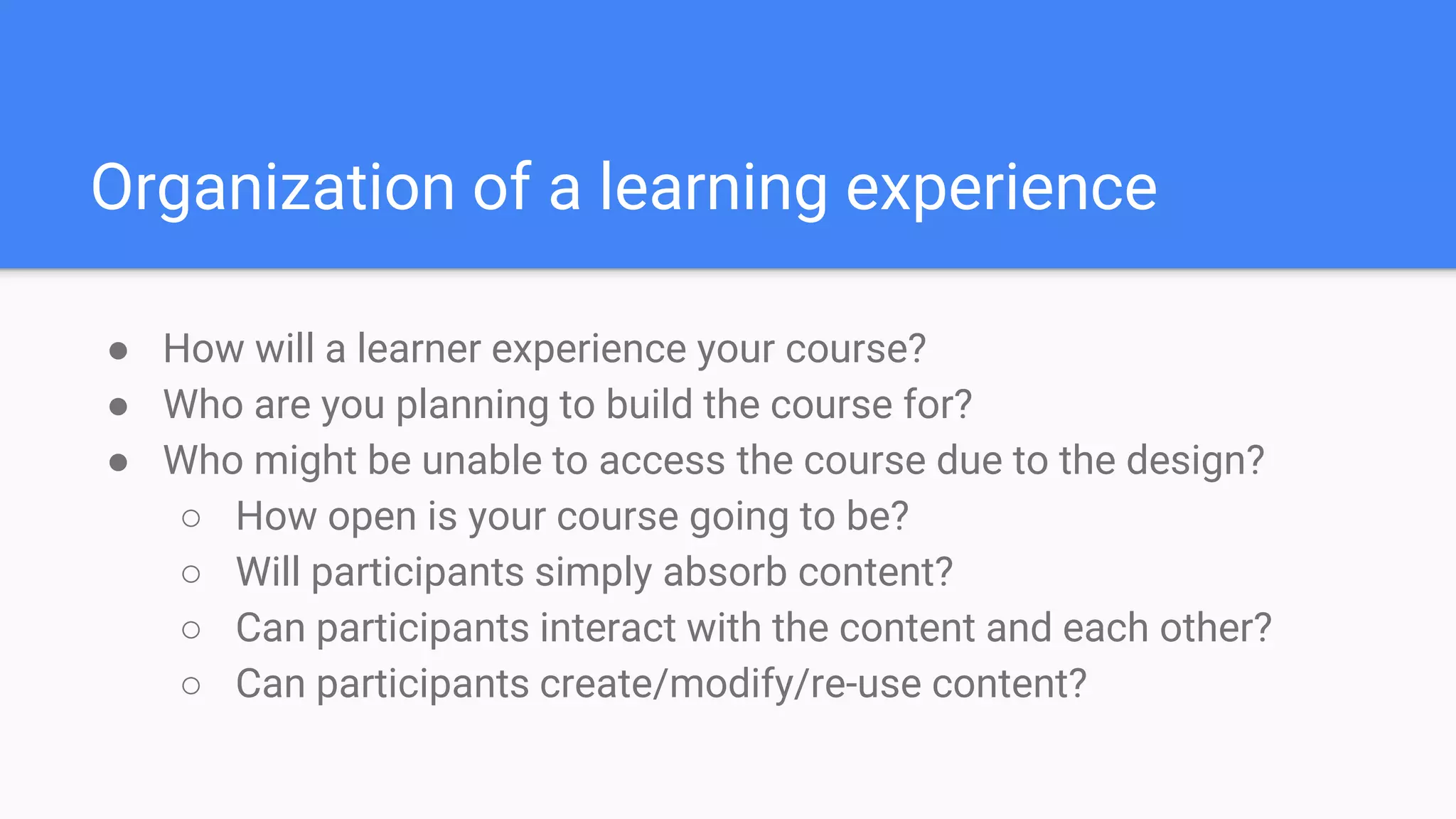
Organization of a learning experience
● How will a learner experience your course?
● Who are you planning to build the course for?
● Who might be unable to access the course due to the design?
○ How open is your course going to be?
○ Will participants simply absorb content?
○ Can participants interact with the content and each other?
○ Can participants create/modify/re-use content?
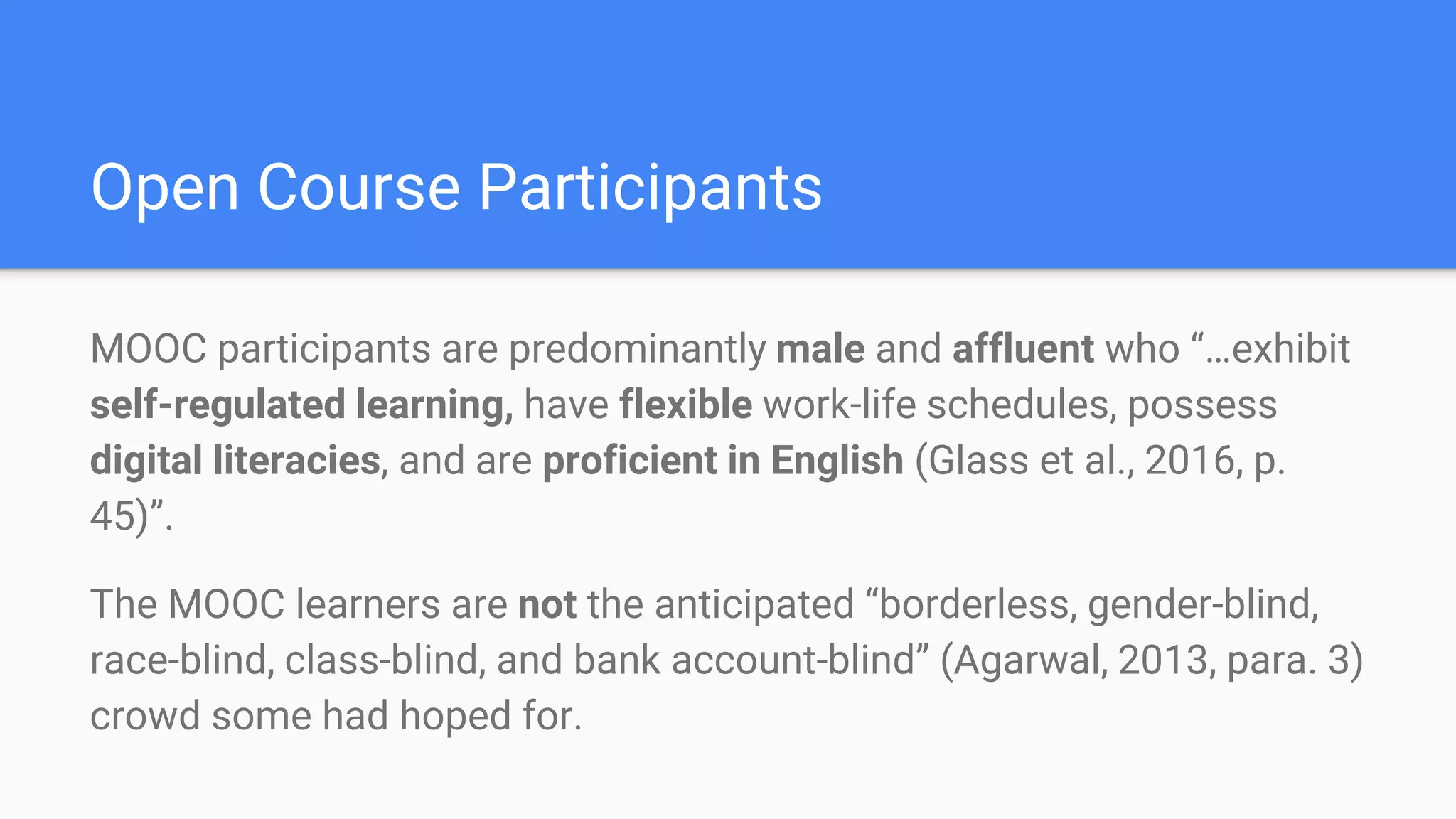
Open Course Participants
MOOC participants are predominantly male and affluent who “…exhibit
self-regulated learning, have flexible work-life schedules, possess
digital literacies, and are proficient in English (Glass et al., 2016, p.
45)”.
The MOOC learners are not the anticipated “borderless, gender-blind,
race-blind, class-blind, and bank account-blind” (Agarwal, 2013, para. 3)
crowd some had hoped for.
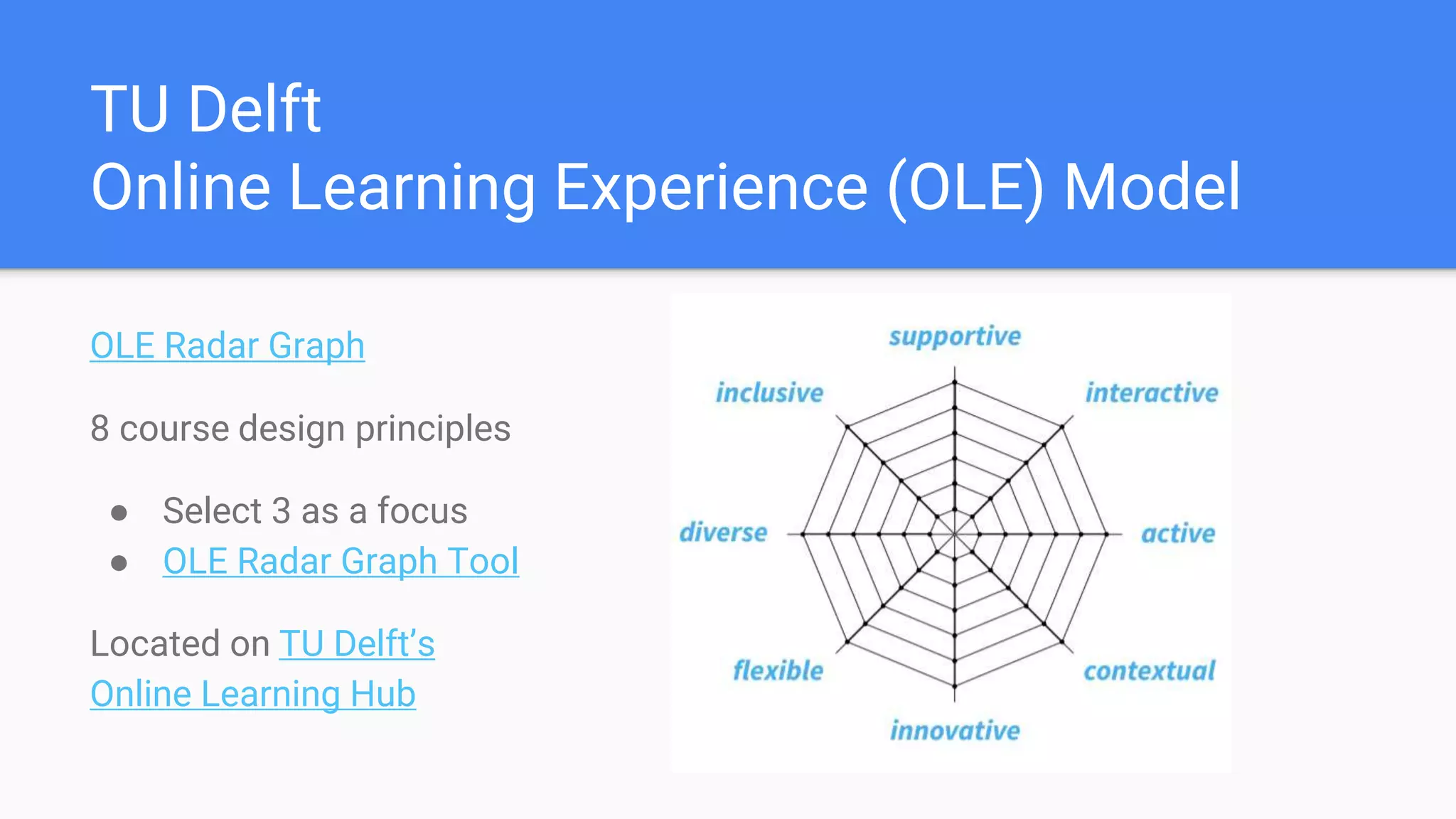
TU Delft
Online Learning Experience (OLE) Model
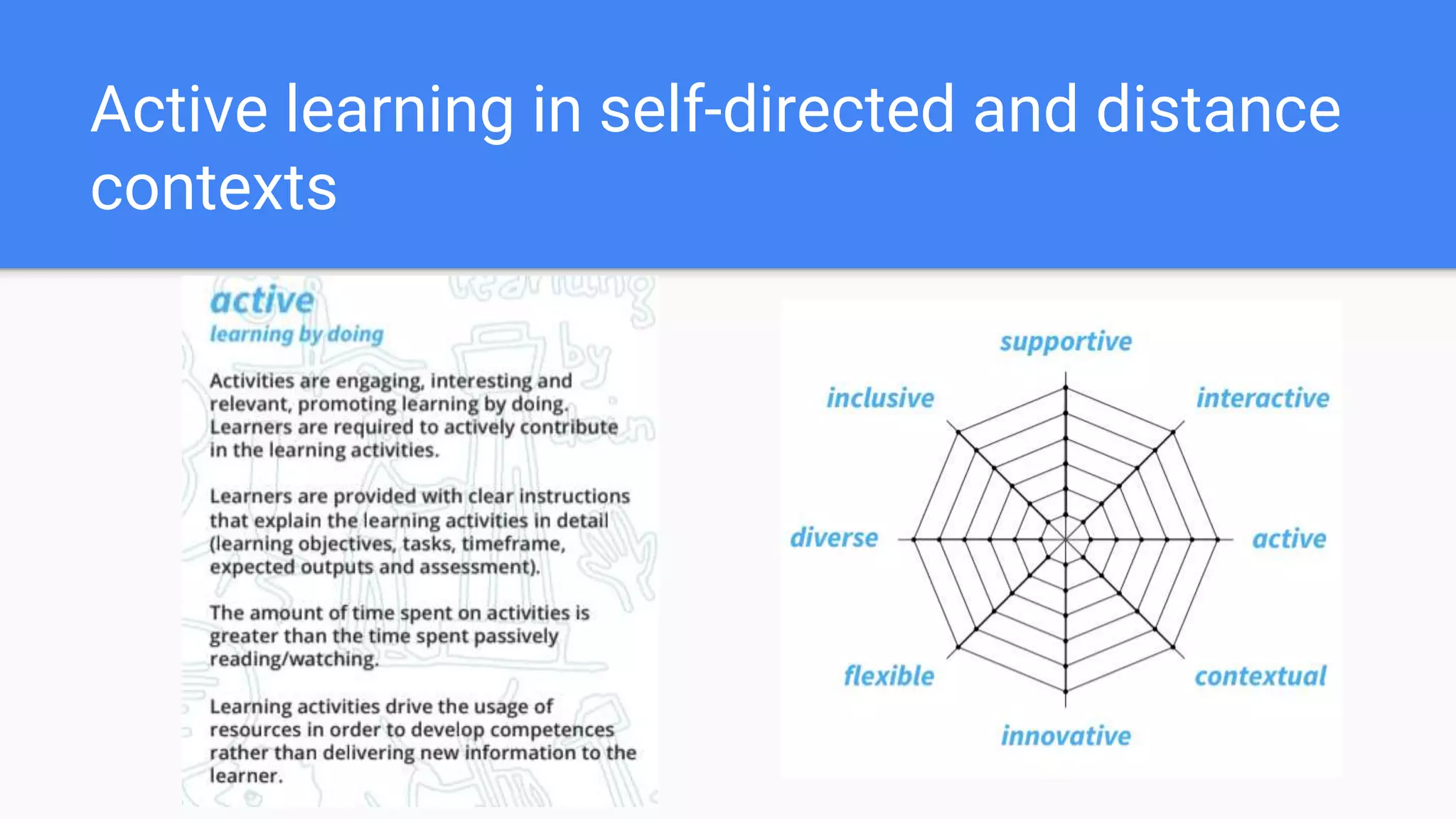
OLE Radar Graph
8 course design principles
● Select 3 as a focus
● OLE Radar Graph Tool
Located on TU Delft’s
Online Learning Hub
3 considerations that affect design in
professional development
(a) educational background considerations (e.g., significant
interruptions in formal education),
(b) disability considerations (e.g., learning disabilities and students on
the autism spectrum), and
(c) status considerations (e.g., domestic violence and mental health
issues).
Housel, David (2019). When Co-Occurring Factors Impact Adult Learners:
Suggestions for Instruction, Preservice Training, and Professional Development.
Learning outcomes, learner levels, and
accessibility
https://onlinelearninghub.tudelft.nl/
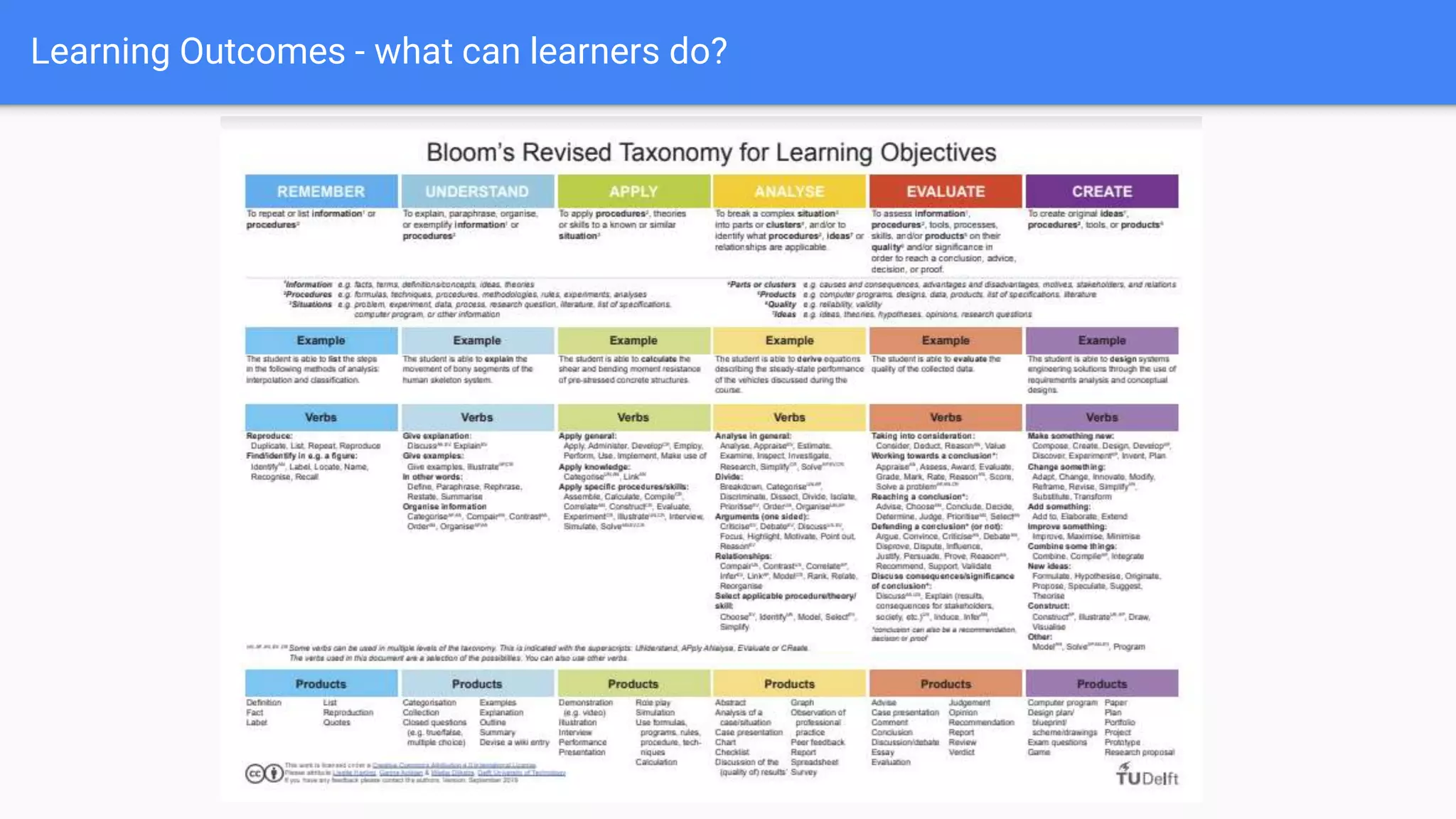
Learning Outcomes - what can learners do?
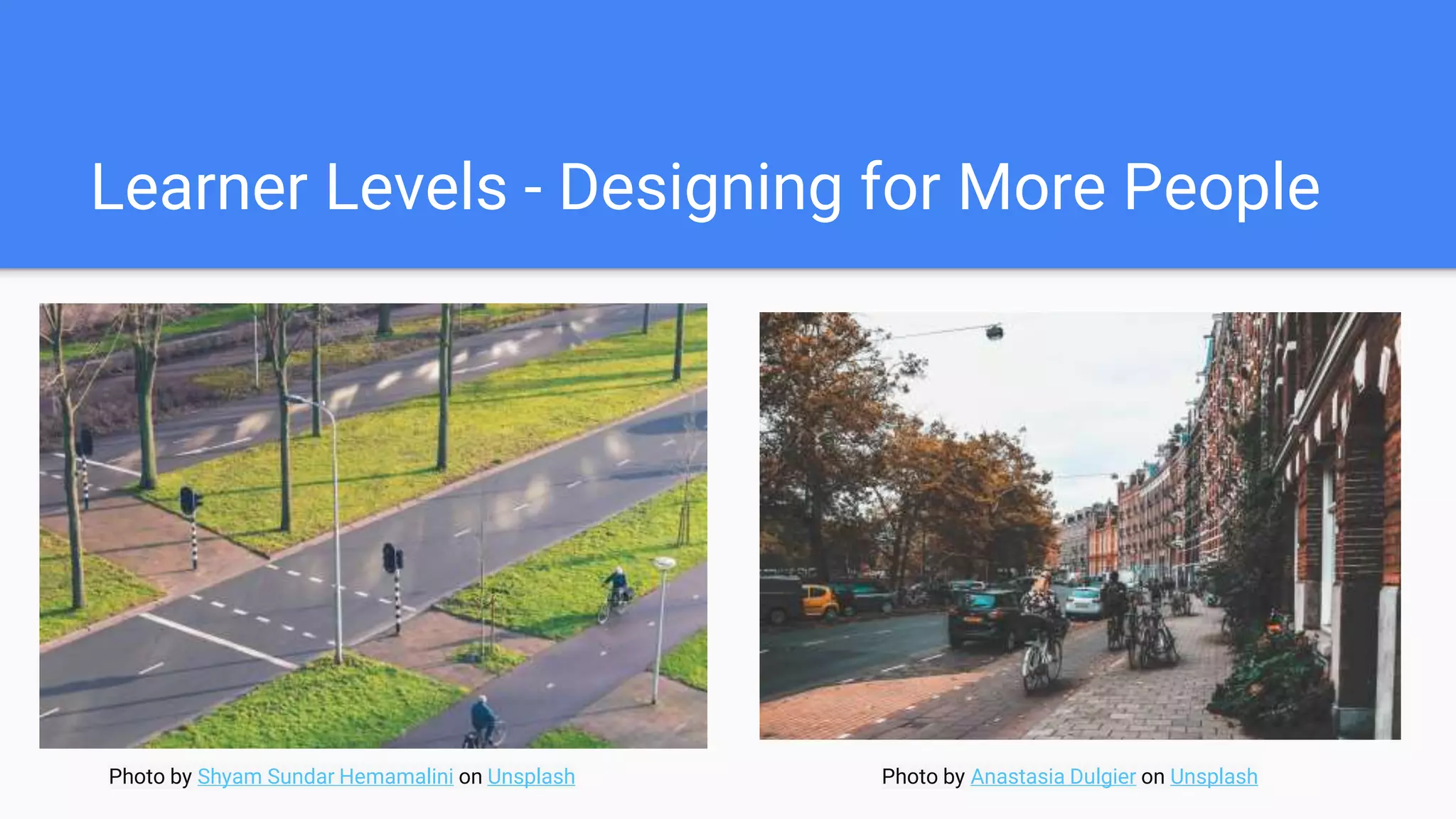
Learner Levels - Designing for More People
Photo by Shyam Sundar Hemamalini on Unsplash Photo by Anastasia Dulgier on Unsplash
Professional Development Design
Considerations
To transform instructional practices and student outcomes for adult learners,
“deficit model” thinking must be confronted, and strengths-based approaches,
like universal design for learning (UDL) and culturally responsive pedagogy
(CRP), must be promoted in all aspects of teacher training. (Housel 2019, p. 8)
Universal Design for Learning (UDL)
7 principles of Universal Design - a PDF created as OER by Teaching Tolerance
1. Equitable Use
2. Flexibility in Use
3. Simple and Intuitive Use
4. Perceptible Information
5. Tolerance for Error
6. Low Physical Effort
7. Size and Space for Approach and Use
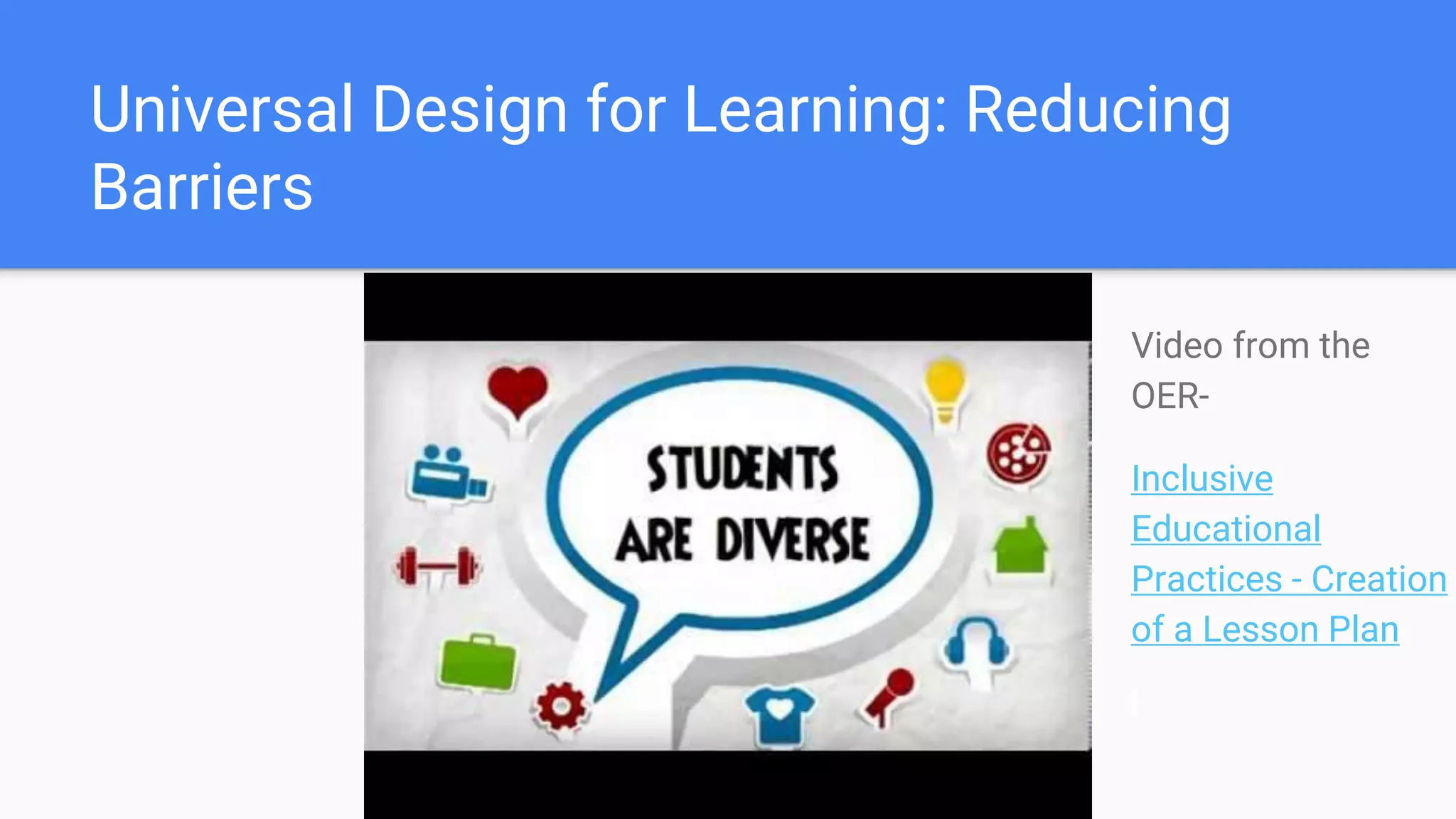
Universal Design for Learning: Reducing
Barriers
Video from the
OER-
Inclusive
Educational
Practices - Creation
of a Lesson Plan
Active learning in self-directed and distance
contexts
Turning resources and assessments into a
course or textbook
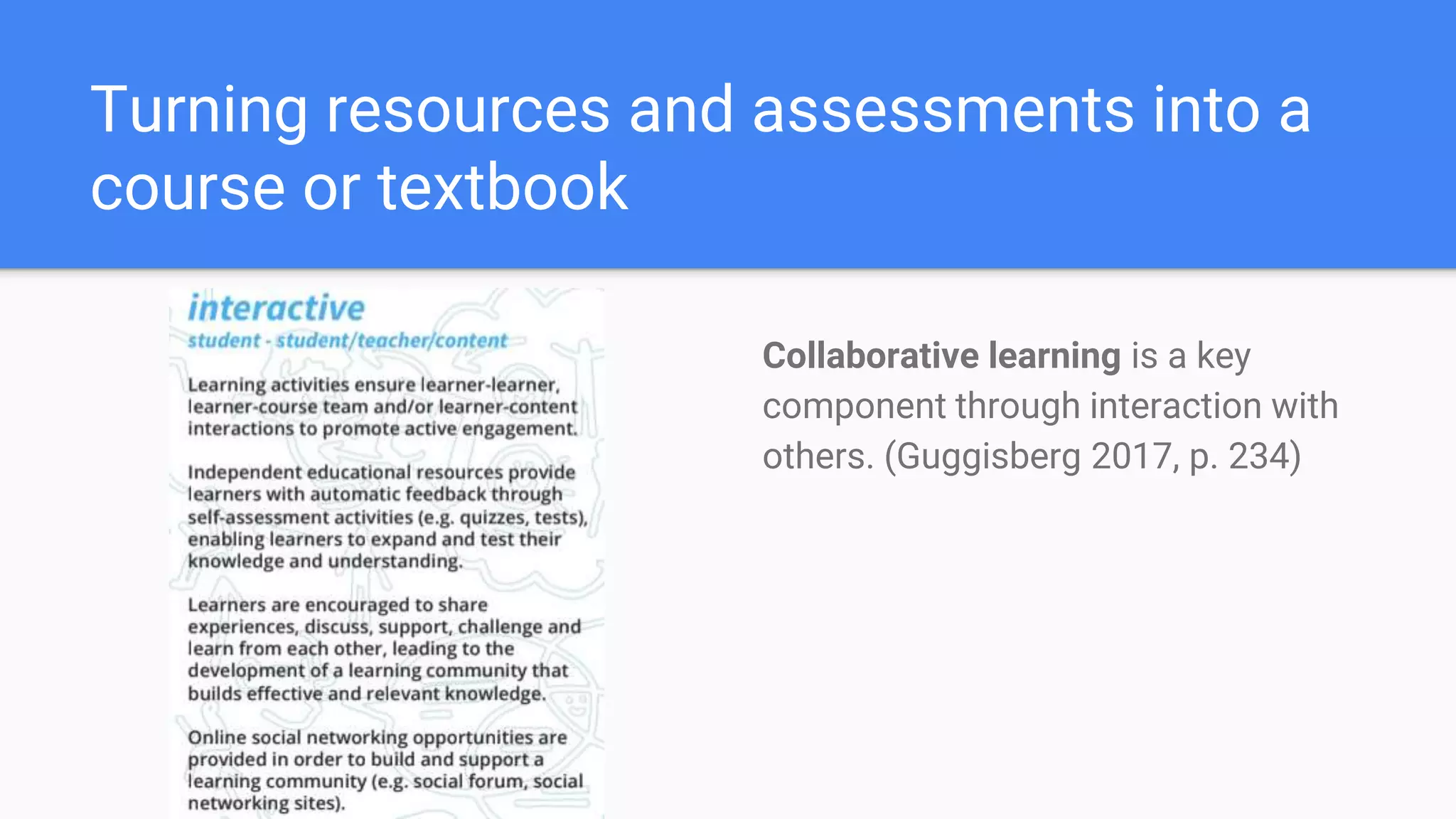
Collaborative learning is a key
component through interaction with
others. (Guggisberg 2017, p. 234)
Additional Resources
● Top Tips for Assessment in MOOCs - TU Delft
● Toolkit. Robert Schuwer.
● Creating Online Learning Experiences: A Brief Guide to Online
Courses, from Small and Private to Massive and Open. Matt
Crosslin, et al.
● Teaching in a Digital Age – Second Edition: Guidelines for
designing teaching and learning. A.W. (Tony) Bates.
Any questions, comments, observations?
UNESCO project page
http://unesco.ijs.si/project/profdevoer/
Contact:
n.l.wahls@tudelft.nl
References
Agarwal, A. (2013, June 15). Online universities: It’s time for teachers to join the revolution. The Observer. Bolognini,
Rose and Foster, Natalie, editors. (2018) Preparing our Youth for an Inclusive and Sustainable World. The OECD
PISA global competence framework. Harvard University. OECD. Retrieved from http://www.oecd.org/pisa/Handbook-
PISA-2018-Global-Competence.pdf
Glass, Chris R.; Shiokawa-Baklan, Mitsue S.; Saltarelli, Andrew J. (2016). Who takes MOOCs? MOOCS And Higher
Education: Implications For Institutional Research. New Directions For Institutional Research, no. 167. Wiley
Periodicals, Inc. Published online in Wiley Online Library (wileyonlinelibrary.com) • DOI: 10.1002/ir.20153
Housel, David (2019). When Co-Occurring Factors Impact Adult Learners: Suggestions for Instruction, Preservice
Training, and Professional Development. Adult Learning. DOI: 10.1177/1045159519849910.

Open instructional design and assessments - OE4BW 2020

  • 1.
    Open Instructional Designand Assessments Naomi Wahls Learning Developer - TU Delft Co-Instructor to Designing an Online Course and Teaching an Online Course EU hub coordinator - OE4BW Technische Universiteit Delft (TU Delft) 2020
  • 2.
    Webinar Agenda ● Organizationof a learning experience ● Learning outcomes, learner levels, and accessibility ● Active learning in self-directed and distance contexts ● Turning resources and assessments into a course or textbook
  • 3.
    What does OpenEducation mean to you in 3 words? Photo by Adam Birkett on Unsplash
  • 4.
    Independence, Freedom, andEquality Photo by Robin Benzrihem on Unsplash Photo by Zoltan Tasi on Unsplash Photo by Serhat Beyazkaya on Unsplash
  • 5.
    What does openinstructional design mean? Designing an OER? Open Practices while creating an OER? What OER exists already?
  • 6.
    Organization of alearning experience ● How will a learner experience your course? ● Who are you planning to build the course for? ● Who might be unable to access the course due to the design? ○ How open is your course going to be? ○ Will participants simply absorb content? ○ Can participants interact with the content and each other? ○ Can participants create/modify/re-use content?
  • 7.
    Open Course Participants MOOCparticipants are predominantly male and affluent who “…exhibit self-regulated learning, have flexible work-life schedules, possess digital literacies, and are proficient in English (Glass et al., 2016, p. 45)”. The MOOC learners are not the anticipated “borderless, gender-blind, race-blind, class-blind, and bank account-blind” (Agarwal, 2013, para. 3) crowd some had hoped for.
  • 8.
    TU Delft Online LearningExperience (OLE) Model OLE Radar Graph 8 course design principles ● Select 3 as a focus ● OLE Radar Graph Tool Located on TU Delft’s Online Learning Hub
  • 9.
    3 considerations thataffect design in professional development (a) educational background considerations (e.g., significant interruptions in formal education), (b) disability considerations (e.g., learning disabilities and students on the autism spectrum), and (c) status considerations (e.g., domestic violence and mental health issues). Housel, David (2019). When Co-Occurring Factors Impact Adult Learners: Suggestions for Instruction, Preservice Training, and Professional Development.
  • 10.
    Learning outcomes, learnerlevels, and accessibility https://onlinelearninghub.tudelft.nl/
  • 11.
    Learning Outcomes -what can learners do?
  • 12.
    Learner Levels -Designing for More People Photo by Shyam Sundar Hemamalini on Unsplash Photo by Anastasia Dulgier on Unsplash
  • 13.
    Professional Development Design Considerations Totransform instructional practices and student outcomes for adult learners, “deficit model” thinking must be confronted, and strengths-based approaches, like universal design for learning (UDL) and culturally responsive pedagogy (CRP), must be promoted in all aspects of teacher training. (Housel 2019, p. 8)
  • 14.
    Universal Design forLearning (UDL) 7 principles of Universal Design - a PDF created as OER by Teaching Tolerance 1. Equitable Use 2. Flexibility in Use 3. Simple and Intuitive Use 4. Perceptible Information 5. Tolerance for Error 6. Low Physical Effort 7. Size and Space for Approach and Use
  • 15.
    Universal Design forLearning: Reducing Barriers Video from the OER- Inclusive Educational Practices - Creation of a Lesson Plan
  • 16.
    Active learning inself-directed and distance contexts
  • 17.
    Turning resources andassessments into a course or textbook Collaborative learning is a key component through interaction with others. (Guggisberg 2017, p. 234)
  • 18.
    Additional Resources ● TopTips for Assessment in MOOCs - TU Delft ● Toolkit. Robert Schuwer. ● Creating Online Learning Experiences: A Brief Guide to Online Courses, from Small and Private to Massive and Open. Matt Crosslin, et al. ● Teaching in a Digital Age – Second Edition: Guidelines for designing teaching and learning. A.W. (Tony) Bates.
  • 19.
    Any questions, comments,observations? UNESCO project page http://unesco.ijs.si/project/profdevoer/ Contact: n.l.wahls@tudelft.nl
  • 20.
    References Agarwal, A. (2013,June 15). Online universities: It’s time for teachers to join the revolution. The Observer. Bolognini, Rose and Foster, Natalie, editors. (2018) Preparing our Youth for an Inclusive and Sustainable World. The OECD PISA global competence framework. Harvard University. OECD. Retrieved from http://www.oecd.org/pisa/Handbook- PISA-2018-Global-Competence.pdf Glass, Chris R.; Shiokawa-Baklan, Mitsue S.; Saltarelli, Andrew J. (2016). Who takes MOOCs? MOOCS And Higher Education: Implications For Institutional Research. New Directions For Institutional Research, no. 167. Wiley Periodicals, Inc. Published online in Wiley Online Library (wileyonlinelibrary.com) • DOI: 10.1002/ir.20153 Housel, David (2019). When Co-Occurring Factors Impact Adult Learners: Suggestions for Instruction, Preservice Training, and Professional Development. Adult Learning. DOI: 10.1177/1045159519849910.

Editor's Notes

  • #4 What does Open Education mean to you in 3 words?
  • #6 With the excitement of OER, we tend to create the OER without fully reviewing what OER is already available and without considering how we can update, modify, or re-use it. In the chat box, share where you go to find OER before creating anything new.
  • #7 Garr Reynolds, author of Presentation Zen, talks about simplicity as an element to be used when designing presentations. The same philosophy can be applied towards building an open course.
  • #9 As you consider your audience, think about the design principles you want to include.
  • #17 How active do you want your course to be? Are you designing it to be active?
  • #19 In the chatbox, share other open books on Instructional Design that you have found helpful.