Quality online education:
Bringing Educational Resources For
Teachers in Africa - BERTA
Panel: TEACHER PROFESSIONAL DEVELOPMENT
University of Pennsylvania, Philadelphia, USA 11 April 2014
Gard Titlestad
Secretary General
International Council For Open and Distance
Education, ICDE
• The leading global membership organization for open, distance and online
education
• An NGO official partner of UNESCO, and shares that agency’s key aim – the
attainment of quality education for all
• ICDE believes that in pursuing education as a universal right, the needs of the
learner must be central.
• Members in all regions of the world
25 Years Support
From Norway
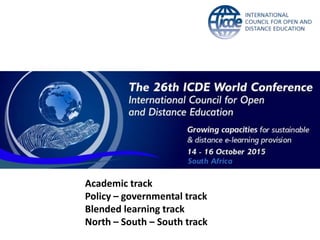
Academic track
Policy – governmental track
Blended learning track
North – South – South track
The picture
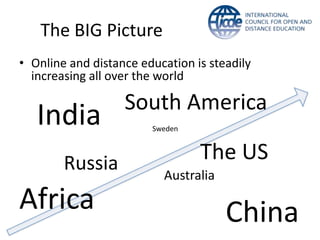
The BIG Picture
• Online and distance education is steadily
increasing all over the world
India Sweden
Russia
South America
The US
Africa
Australia
China
The BIG picture
• The growth in higher education is massive
20442030
320
400
2007 - 2030
Mill. students
EU/OECD projections
the need for HE
by 2030: 400 mill.
New teachers
needed
in classroom (??)
by 2015
And the need
For new teachers
by 2030……….
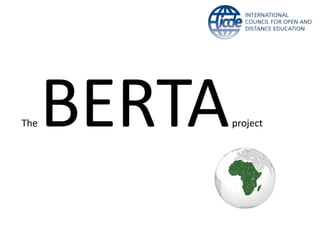
The BERTAproject
BERTA: Background
Need for qualified teacher trainers in ODL
Need for teachers offering quality ODL
Need for quality ODL
Need for teachers
BERTA
Bringing Educational Resources For
Teachers in Africa
An idea consulted
among stakeholders:
• To develop a high quality Open Educational
Resource, OER, as open online courseware for
training teachers/ faculty in open, , distance and
online learning.
• Target group for the project result: Teacher
trainers.
• The first regional area of priority should be Africa.
• A regional focus on Asia will be considered when
the project has delivered.
The Consortium
• Fundació per a la
Universitat Oberta de
Catalunya (FUOC) –
Spain
• South African Institute
for Distance Education,
SAIDE, South Africa
BERTA: Objectives
• 1. Collate a set of OER organised into a course format that will enable
teacher trainers in African higher education institutions to learn about the
potential of distance and eLearning to support teacher development and
empower them to adapt existing OER to suit their own contexts of
practice.
• 2. The set or collection of themed resources will be in a form that
promotes flexible delivery options of the full set or a selection thereof by
the target audience.
• 3. Offer teachers the possibility to participate in a pilot of the HANDSON
ICT project: http://handsonict.eu/.
• 4. The resource and its constituent parts will be developed in consultation
with the target stakeholder community but the final version will be
published under a creative commons CCBY licence and hence will become
available to anybody with an interest in using distance and eLearning
provision to support expanded quality teacher development.
Stakeholders
Cooperaiton: Knowledge network
Stakeholders invited
• African Council for Open and
Distance Education (ACDE)
• The African Virtual University
• The OpenCourseWare Consortium.
• UKOU TESSA
• Cambridge’s oer4schools project
• Distance Education and Teacher
Education in Africa (DETA)
• Active members of the OER Africa
African Teacher Education Network:
– Mauritius
– Tanzania
– Zambia
– Kenya
– South Africa
– Togo
– Ghana
• Asian Association of Open
Universities (AAOU)
• China Open University
• Contact North, Canada
• Universitas Terbuka, Indonesia
• Open University, UK
• UNISA, South Africa
• Open University of Netherlands
• The Commonwealth of Learning
(COL)
• The European Association of Distance
Teaching Universities (EADTU)
• The Sloan Consortium
• UNESCO
• The European Commission
• The African Commission
Timeline
Phase 1
Idea
Consult
Call
Consortium
1/2012 2/12 1/13 2/13 1/14
Project
Deliver
Implement
2/14 1/15 2/15
Effect
Expand
Cooperation
Awareness
Anchoring
Improvement
Fundraising
Phase 1
A few reflections
MOOC – MOC
Diversity
Fundamental principles - education
The Appendix
Are MOOCs Really Open? MOOC or MOC?
No, all rights reserved.
No, non-OER license.
No, all rights reserved.
Note: some institutions using CC anyway.
Yes, CC BY or CC BY-SA
Partial, CC BY-NC on some
Most MOOCs are open only in the sense of free enrollment.
Paul Stacey, Associate Director of Global Learning, Creative Commons, Oktober 2013
MOOC or MOC
Mind to MOOCs
Overview, reflections and brainstorming in whitening water
Think tank 20 October 2013, Open
Universitty of China, Beijing, China
To be reported to the ICDE Standing Conference of Presidents meeting and
Policy Forum
Excerpts from ICDE Mind to MOOCs report
A few of the issues and recommendations
Equity.
• Consider this initiative as an opportunity to rethink our role as universities and take
up MOOCs. .
• Integrate open MOOCs in our respective institutions
• National, regional and transnational cooperation is a great opportunity in developing
MOOC and MOOC-alike concepts.
Diversity.
• Undertake contextualized strategies when implementing MOOCs
• Be aware of cultural and language aspects → anglo-centric core, colonialism
• OER and OCW as the basis for MOOC will ease contextual, cultural and language
adaptation
Innovation and Quality.
• Improve and innovate on pedagogical aspects: methodologies, content formats,
assessment.
• Provide learning analytics as a tool for improving the courses. Connect the learning
process and research for new knowledge and improvements.
• Promote research about MOOCs.
• Keep moving towards quality. Beyond quantity of MOOCs and users, the focus on
quality is essential for sustainability.
Dr Qian Tang, Assistant Director-General for Education, UNESCO (8/11/2013).
It is necessary to repeat the confirmation of fundamental principles:
• Education is
– A fundamental human rights
– A public good
– A basis for man's attainment of peace, sustainable development,
gender equality and responsible global citizenship
– A key factor in reducing inequality and poverty.
• And further: Imperative for Education for post 2015 agenda must
be:
– Equitable access to education for all and at all levels
– Quality of education and learning
– Fairness
– Gender equality
– Lifelong learning
Thank you!
titlestad@icde.org
www.icde.org
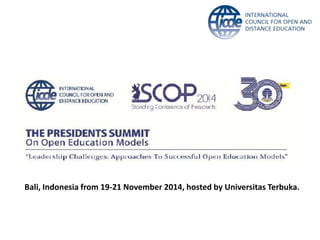
Bali, Indonesia from 19-21 November 2014, hosted by Universitas Terbuka.
Academic track
Policy – governmental track
Blended learning track
North – South – South track
From the UNESCO OER
Declaration
• Foster awareness and use of OER
• Encourage the development and adaptation of
OER in a variety of languages and cultural
contexts
• Encourage the open licensing of educational
materials produced with public funds.
ICDE work shouder to shoulder with UNESCO and
other stakeholders to have this implementet
OER and Open and
Distance Learning can
increase the impact of
investments in knowledge
OER &
ODL
Open Access – open science
Research based OER
Research based teaching
Innovation in education – open innovation
Innovate the learning system – flip the classroom
Knowledge supply for innovation
High quality education
Research based education
Resource based education
Open education

Bringing Educational Resources For Teachers in Africa - BERTA

  • 1.
    Quality online education: BringingEducational Resources For Teachers in Africa - BERTA Panel: TEACHER PROFESSIONAL DEVELOPMENT University of Pennsylvania, Philadelphia, USA 11 April 2014 Gard Titlestad Secretary General International Council For Open and Distance Education, ICDE
  • 2.
    • The leadingglobal membership organization for open, distance and online education • An NGO official partner of UNESCO, and shares that agency’s key aim – the attainment of quality education for all • ICDE believes that in pursuing education as a universal right, the needs of the learner must be central. • Members in all regions of the world 25 Years Support From Norway
  • 4.
    Academic track Policy –governmental track Blended learning track North – South – South track
  • 5.
  • 6.
    The BIG Picture •Online and distance education is steadily increasing all over the world India Sweden Russia South America The US Africa Australia China
  • 7.
    The BIG picture •The growth in higher education is massive
  • 8.
    20442030 320 400 2007 - 2030 Mill.students EU/OECD projections the need for HE by 2030: 400 mill.
  • 9.
  • 10.
    And the need Fornew teachers by 2030……….
  • 11.
  • 12.
    BERTA: Background Need forqualified teacher trainers in ODL Need for teachers offering quality ODL Need for quality ODL Need for teachers
  • 13.
  • 14.
    An idea consulted amongstakeholders: • To develop a high quality Open Educational Resource, OER, as open online courseware for training teachers/ faculty in open, , distance and online learning. • Target group for the project result: Teacher trainers. • The first regional area of priority should be Africa. • A regional focus on Asia will be considered when the project has delivered.
  • 15.
    The Consortium • Fundacióper a la Universitat Oberta de Catalunya (FUOC) – Spain • South African Institute for Distance Education, SAIDE, South Africa
  • 16.
    BERTA: Objectives • 1.Collate a set of OER organised into a course format that will enable teacher trainers in African higher education institutions to learn about the potential of distance and eLearning to support teacher development and empower them to adapt existing OER to suit their own contexts of practice. • 2. The set or collection of themed resources will be in a form that promotes flexible delivery options of the full set or a selection thereof by the target audience. • 3. Offer teachers the possibility to participate in a pilot of the HANDSON ICT project: http://handsonict.eu/. • 4. The resource and its constituent parts will be developed in consultation with the target stakeholder community but the final version will be published under a creative commons CCBY licence and hence will become available to anybody with an interest in using distance and eLearning provision to support expanded quality teacher development.
  • 17.
  • 18.
    Stakeholders invited • AfricanCouncil for Open and Distance Education (ACDE) • The African Virtual University • The OpenCourseWare Consortium. • UKOU TESSA • Cambridge’s oer4schools project • Distance Education and Teacher Education in Africa (DETA) • Active members of the OER Africa African Teacher Education Network: – Mauritius – Tanzania – Zambia – Kenya – South Africa – Togo – Ghana • Asian Association of Open Universities (AAOU) • China Open University • Contact North, Canada • Universitas Terbuka, Indonesia • Open University, UK • UNISA, South Africa • Open University of Netherlands • The Commonwealth of Learning (COL) • The European Association of Distance Teaching Universities (EADTU) • The Sloan Consortium • UNESCO • The European Commission • The African Commission
  • 19.
  • 20.
    Idea Consult Call Consortium 1/2012 2/12 1/132/13 1/14 Project Deliver Implement 2/14 1/15 2/15 Effect Expand Cooperation Awareness Anchoring Improvement Fundraising Phase 1
  • 21.
    A few reflections MOOC– MOC Diversity Fundamental principles - education The Appendix
  • 22.
    Are MOOCs ReallyOpen? MOOC or MOC? No, all rights reserved. No, non-OER license. No, all rights reserved. Note: some institutions using CC anyway. Yes, CC BY or CC BY-SA Partial, CC BY-NC on some Most MOOCs are open only in the sense of free enrollment. Paul Stacey, Associate Director of Global Learning, Creative Commons, Oktober 2013 MOOC or MOC
  • 23.
    Mind to MOOCs Overview,reflections and brainstorming in whitening water Think tank 20 October 2013, Open Universitty of China, Beijing, China To be reported to the ICDE Standing Conference of Presidents meeting and Policy Forum
  • 24.
    Excerpts from ICDEMind to MOOCs report A few of the issues and recommendations Equity. • Consider this initiative as an opportunity to rethink our role as universities and take up MOOCs. . • Integrate open MOOCs in our respective institutions • National, regional and transnational cooperation is a great opportunity in developing MOOC and MOOC-alike concepts. Diversity. • Undertake contextualized strategies when implementing MOOCs • Be aware of cultural and language aspects → anglo-centric core, colonialism • OER and OCW as the basis for MOOC will ease contextual, cultural and language adaptation Innovation and Quality. • Improve and innovate on pedagogical aspects: methodologies, content formats, assessment. • Provide learning analytics as a tool for improving the courses. Connect the learning process and research for new knowledge and improvements. • Promote research about MOOCs. • Keep moving towards quality. Beyond quantity of MOOCs and users, the focus on quality is essential for sustainability.
  • 25.
    Dr Qian Tang,Assistant Director-General for Education, UNESCO (8/11/2013). It is necessary to repeat the confirmation of fundamental principles: • Education is – A fundamental human rights – A public good – A basis for man's attainment of peace, sustainable development, gender equality and responsible global citizenship – A key factor in reducing inequality and poverty. • And further: Imperative for Education for post 2015 agenda must be: – Equitable access to education for all and at all levels – Quality of education and learning – Fairness – Gender equality – Lifelong learning
  • 26.
  • 27.
    Bali, Indonesia from19-21 November 2014, hosted by Universitas Terbuka.
  • 28.
    Academic track Policy –governmental track Blended learning track North – South – South track
  • 29.
    From the UNESCOOER Declaration • Foster awareness and use of OER • Encourage the development and adaptation of OER in a variety of languages and cultural contexts • Encourage the open licensing of educational materials produced with public funds. ICDE work shouder to shoulder with UNESCO and other stakeholders to have this implementet
  • 30.
    OER and Openand Distance Learning can increase the impact of investments in knowledge OER & ODL Open Access – open science Research based OER Research based teaching Innovation in education – open innovation Innovate the learning system – flip the classroom Knowledge supply for innovation High quality education Research based education Resource based education Open education