AU (M)OOC research

M. Cleveland-Innes, PhD
Professor and Chair
Centre for Distance Education
Athabasca University
Guest Professor, Department of Learning
KTH Royal Institute of Technology
Stockholm, Sweden
AU (M)OOC Advisory Group Co-leaders
Dr. Derek Briton Professor, Master of Arts in Integrated Studies
Dr. Marti Cleveland-Innes Professor and Chair, Centre for
Distance Education.
Dr. Mike Gismondi Professor, Sociology and Global Studies,
Master of Arts in Integrated Studies
Dr. Cindy Ives Acting Associate Vice President Academic
(Learning Resources) and Director, Centre for Learning Design
and Development.
Dr. George Siemens Faculty member, Centre for Distance
Education and Director, Director of TEKRI

Open, ad-hoc committee
2
Brief review of the MOOC initiative and
recent developments
Report on MOOC research and activity
at AU

3
Brief review

4
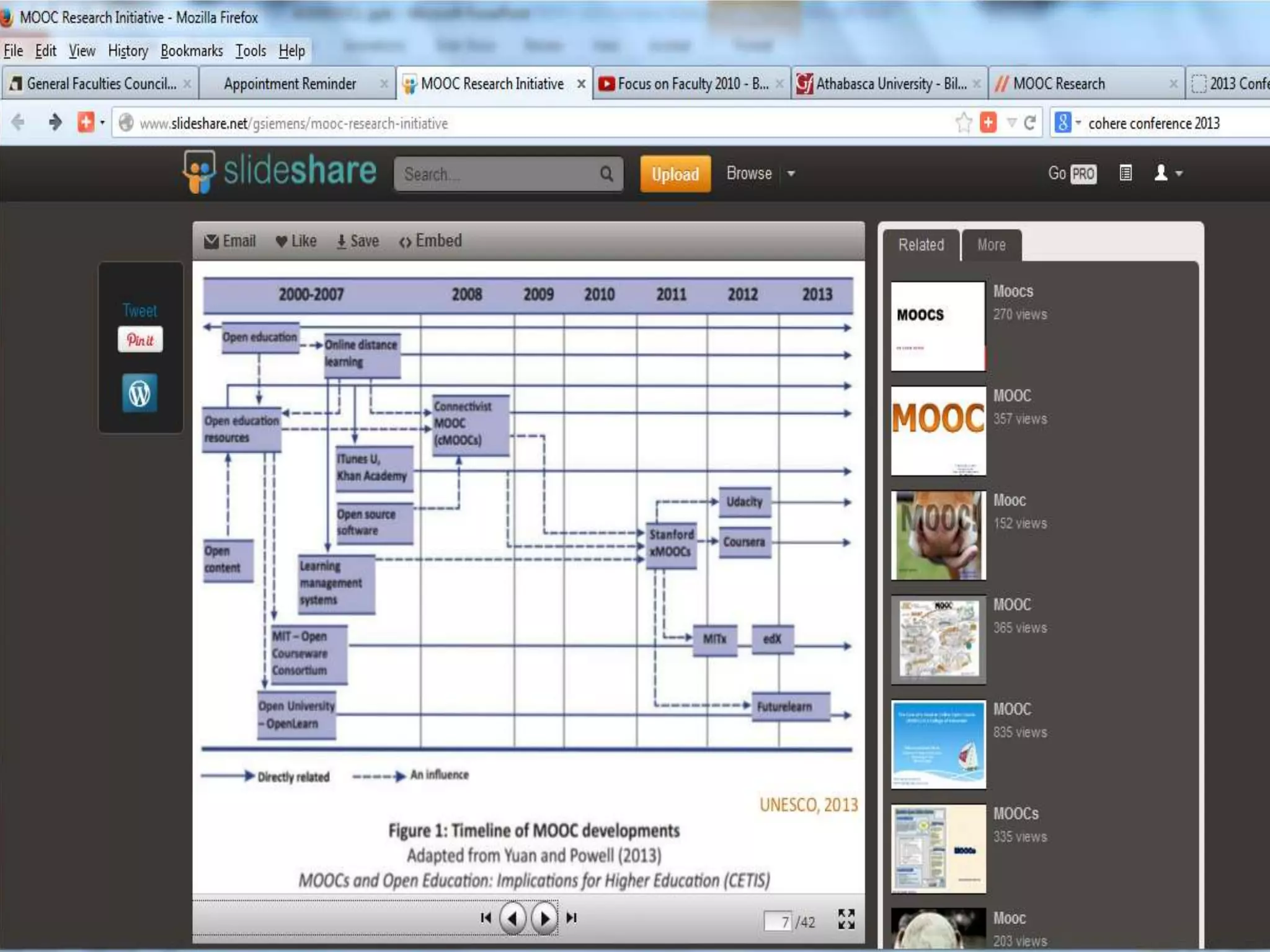
• Original cMOOCs (2008) versus better known xMOOCs
(2011)
• xMOOCs took off in fall of 2011 with Intro AI Course at
Stanford
• Platform providers (Coursera, edX, Udacity, FutureLearn)
vs content providers (Stanford, Harvard, MIT, Edinburgh,
OU, ...)

Adapted from the work of Peter Sloep –
http://preview.tinyurl.com/petersloep

5
MOOCs as a solution
“We are cautiously optimistic that MOOC’s might be able to
improve outcomes for low-income students who are working
toward credentials, but there are a lot of questions that we can’t
yet answer,” says Josh Jarrett, the foundation’s deputy director
for postsecondary success.”

“A well developed MOOC that could be easily customized and
adapted locally may be very attractive to many colleges and
universities that are under great pressure to control rising
instructional costs.”
6
MOOCs and traditional ed
• Intention for offering certification of completion, course
completion credentials, etc.
• Intellectual rationale for teaching the course through a MOOC
• Anticipated length of the course
• Anticipated audience for the course
• An estimate of the effort and time required to develop the
MOOC
• Proposed means for measuring the effectiveness of the course
• Whether you expect to use the course materials created for
the MOOC in your subsequent on-campus courses
• If possible, a budget and budget justification Information on
teaching experience, including teaching awards or innovative
teaching methods
Case Western Reserve
http://www.case.edu/its/moocproposal/

7
Amateurs at work
MOOCs subscribe to offline broadcasting model and apply that online
(behaviourist models in transmission mode)
But open, distance-learning institutions have done ‘teaching at a distance’
have 3 decades of research results
MOOC providers seem to be ignoring these results; “It appears that students
get more excited about learning when they try to puzzle out a
problem.”

8
Adapted from the work of Peter Sloep http://preview.tinyurl.com/petersloep
MOOC Research Initiative at AU
• http://www.gatesfoundation.org/How-We-Work/QuickLinks/Grants-Database/Grants/2013/06/OPP1078781
• Grant increased to $840,000
• http://www.athabascau.ca/aboutau/news/index.php?new&id
=139
• 266 submissions; 78 second round review; 28 successful
submissions – 2 projects in support of AU projects
• http://www.moocresearch.com/
• Site to report on MOOC research jointly sponsored by B&MGF
and AU
• http://www.slideshare.net/gsiemens/mooc-research-initiative
• George’s report on MOOC initiative

9
AU (M)OOC Advisory Group
Draft - Taxonomy Development Process
1. Create and provide an expert, evidence-based assessment
of, and a critical, academic, and practical voice on, (M)OOC
issues to our local, national and international networks.
2. Determine direction regarding the assignment of credit for
individuals who participate in (M)OOCs outside AU.
3. Support those interested in constructing an AU version of a
(M)OOC, where such an endeavor will continue our
mandate to remove barriers to learning and engage/recruit
learners we may not have otherwise engaged.
4. Observe, document, measure, analyze and disseminate our
(M)OOC experience.
Thank you

11

Moocs

  • 1.
    AU (M)OOC research M.Cleveland-Innes, PhD Professor and Chair Centre for Distance Education Athabasca University Guest Professor, Department of Learning KTH Royal Institute of Technology Stockholm, Sweden
  • 2.
    AU (M)OOC AdvisoryGroup Co-leaders Dr. Derek Briton Professor, Master of Arts in Integrated Studies Dr. Marti Cleveland-Innes Professor and Chair, Centre for Distance Education. Dr. Mike Gismondi Professor, Sociology and Global Studies, Master of Arts in Integrated Studies Dr. Cindy Ives Acting Associate Vice President Academic (Learning Resources) and Director, Centre for Learning Design and Development. Dr. George Siemens Faculty member, Centre for Distance Education and Director, Director of TEKRI Open, ad-hoc committee 2
  • 3.
    Brief review ofthe MOOC initiative and recent developments Report on MOOC research and activity at AU 3
  • 4.
  • 5.
    • Original cMOOCs(2008) versus better known xMOOCs (2011) • xMOOCs took off in fall of 2011 with Intro AI Course at Stanford • Platform providers (Coursera, edX, Udacity, FutureLearn) vs content providers (Stanford, Harvard, MIT, Edinburgh, OU, ...) Adapted from the work of Peter Sloep – http://preview.tinyurl.com/petersloep 5
  • 6.
    MOOCs as asolution “We are cautiously optimistic that MOOC’s might be able to improve outcomes for low-income students who are working toward credentials, but there are a lot of questions that we can’t yet answer,” says Josh Jarrett, the foundation’s deputy director for postsecondary success.” “A well developed MOOC that could be easily customized and adapted locally may be very attractive to many colleges and universities that are under great pressure to control rising instructional costs.” 6
  • 7.
    MOOCs and traditionaled • Intention for offering certification of completion, course completion credentials, etc. • Intellectual rationale for teaching the course through a MOOC • Anticipated length of the course • Anticipated audience for the course • An estimate of the effort and time required to develop the MOOC • Proposed means for measuring the effectiveness of the course • Whether you expect to use the course materials created for the MOOC in your subsequent on-campus courses • If possible, a budget and budget justification Information on teaching experience, including teaching awards or innovative teaching methods Case Western Reserve http://www.case.edu/its/moocproposal/ 7
  • 8.
    Amateurs at work MOOCssubscribe to offline broadcasting model and apply that online (behaviourist models in transmission mode) But open, distance-learning institutions have done ‘teaching at a distance’ have 3 decades of research results MOOC providers seem to be ignoring these results; “It appears that students get more excited about learning when they try to puzzle out a problem.” 8 Adapted from the work of Peter Sloep http://preview.tinyurl.com/petersloep
  • 9.
    MOOC Research Initiativeat AU • http://www.gatesfoundation.org/How-We-Work/QuickLinks/Grants-Database/Grants/2013/06/OPP1078781 • Grant increased to $840,000 • http://www.athabascau.ca/aboutau/news/index.php?new&id =139 • 266 submissions; 78 second round review; 28 successful submissions – 2 projects in support of AU projects • http://www.moocresearch.com/ • Site to report on MOOC research jointly sponsored by B&MGF and AU • http://www.slideshare.net/gsiemens/mooc-research-initiative • George’s report on MOOC initiative 9
  • 10.
    AU (M)OOC AdvisoryGroup Draft - Taxonomy Development Process 1. Create and provide an expert, evidence-based assessment of, and a critical, academic, and practical voice on, (M)OOC issues to our local, national and international networks. 2. Determine direction regarding the assignment of credit for individuals who participate in (M)OOCs outside AU. 3. Support those interested in constructing an AU version of a (M)OOC, where such an endeavor will continue our mandate to remove barriers to learning and engage/recruit learners we may not have otherwise engaged. 4. Observe, document, measure, analyze and disseminate our (M)OOC experience.
  • 11.

Editor's Notes

  • #9 Amateurs are at work. Stated by the president of the EdX corporation, a pioneer in the MOOC movement: “It appears that students get more excited about learning when they try to puzzle out a problem.” This sort of off-handed, over-generalization about a constituency so complex as students, and a glib reference to an extraordinarily complex human activity like learning, is an approach that academics familiar with teaching and learning online wish to quell. Higher education is well-known for its range of teaching quality; some of very high quality, some very low. Unlike the elementary and secondary school systems, teachers at universities do little if anything to become competent teachers and there is little or no certification. Cross-reference this with distance education, where the materials play a much bigger role in the instruction of the student, and in online learning, where collaborative, constructivist methods are common. In these delivery modes, knowledge about learning and teaching plays a much bigger role. Now enter MOOCs. Those with a foundation in learning theory, and an understanding of the range of teaching modalities that foster learning, will create a MOOC much different than those replicating lecture-based delivery through electronic form.