





Dr Greig Krull
6 September 2018
Open Learning Conference
Unisa, Pretoria
Exploring Digital
Assessment
Strategies
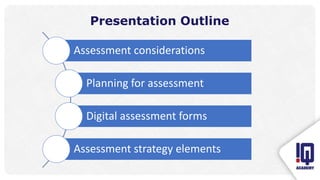
Presentation Outline
Assessment considerations
Planning for assessment
Digital assessment forms
Assessment strategy elements
Fit image to this frame
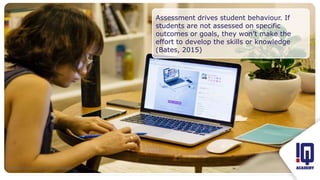
Assessment drives student behaviour. If
students are not assessed on specific
outcomes or goals, they won’t make the
effort to develop the skills or knowledge
(Bates, 2015)
Photo by Tran Mau Tri Tam on Unsplash
Fit image to this frame
The traditional view of
assessment seeks to
evaluate a student’s
comprehension of
factual knowledge…
More contemporary
assessment seeks to
design activities
primarily to foster
student learning…
(Webber, 2012)
Photo by Kinga Cichewicz on Unsplash
Fit image to this frame
Importance of
constructive
alignment:
Coherence between
learning outcomes,
materials and
assessments
(Biggs, 1999)
Photo by Helloquence on Unsplash
Fit image to this frame
Authentic assessments present
learners with opportunities to
make connections with prior
knowledge and to build
relationships between their
own learning and real-life
situations.
Authentic assessments are ill-
defined and permit learners to
engage with open-ended tasks
(Conrad & Openo, 2018)
Photo by rawpixel on Unsplash
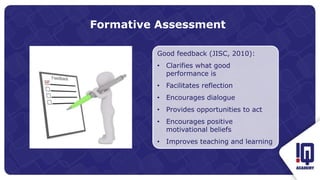
Formative Assessment
Good feedback (JISC, 2010):
• Clarifies what good
performance is
• Facilitates reflection
• Encourages dialogue
• Provides opportunities to act
• Encourages positive
motivational beliefs
• Improves teaching and learning
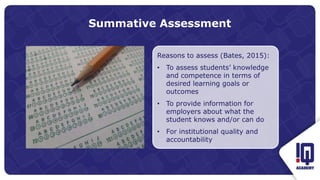
Summative Assessment
Reasons to assess (Bates, 2015):
• To assess students’ knowledge
and competence in terms of
desired learning goals or
outcomes
• To provide information for
employers about what the
student knows and/or can do
• For institutional quality and
accountability
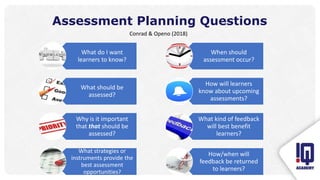
Assessment Planning Questions
What do I want
learners to know?
What should be
assessed?
Why is it important
that that should be
assessed?
What strategies or
instruments provide the
best assessment
opportunities?
Conrad & Openo (2018)
When should
assessment occur?
How will learners
know about upcoming
assessments?
What kind of feedback
will best benefit
learners?
How/when will
feedback be returned
to learners?
Fit image to this frame
Moving from paper-based
assessments to more digital and
continuous assessment as part of
a teaching and learning strategy
for a digital age…
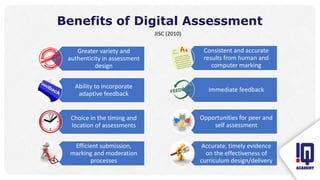
Benefits of Digital Assessment
JISC (2010)
Greater variety and
authenticity in assessment
design
Ability to incorporate
adaptive feedback
Choice in the timing and
location of assessments
Efficient submission,
marking and moderation
processes
Consistent and accurate
results from human and
computer marking
Immediate feedback
Opportunities for peer and
self assessment
Accurate, timely evidence
on the effectiveness of
curriculum design/delivery
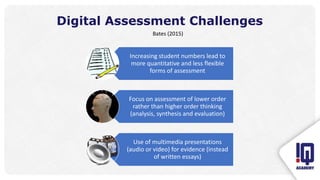
Digital Assessment Challenges
Bates (2015)
Increasing student numbers lead to
more quantitative and less flexible
forms of assessment
Focus on assessment of lower order
rather than higher order thinking
(analysis, synthesis and evaluation)
Use of multimedia presentations
(audio or video) for evidence (instead
of written essays)
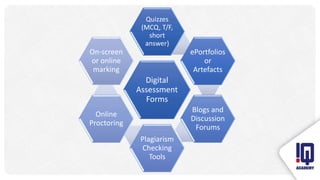
Digital
Assessment
Forms
Quizzes
(MCQ, T/F,
short
answer)
ePortfolios
or
Artefacts
Blogs and
Discussion
Forums
Plagiarism
Checking
Tools
Online
Proctoring
On-screen
or online
marking
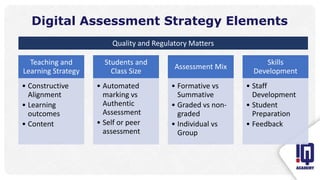
Teaching and
Learning Strategy
• Constructive
Alignment
• Learning
outcomes
• Content
Students and
Class Size
• Automated
marking vs
Authentic
Assessment
• Self or peer
assessment
Assessment Mix
• Formative vs
Summative
• Graded vs non-
graded
• Individual vs
Group
Skills
Development
• Staff
Development
• Student
Preparation
• Feedback
Digital Assessment Strategy Elements
Quality and Regulatory Matters
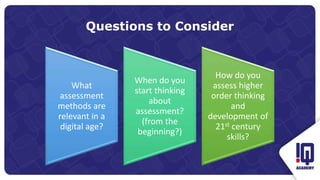
Questions to Consider
What
assessment
methods are
relevant in a
digital age?
When do you
start thinking
about
assessment?
(from the
beginning?)
How do you
assess higher
order thinking
and
development of
21st century
skills?
Thank you
gkrull@iqacademy.ac.za
greigkr
Greig Krull (slideshare.net/greigk)
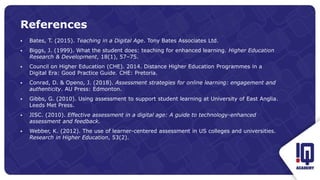
References
 Bates, T. (2015). Teaching in a Digital Age. Tony Bates Associates Ltd.
 Biggs, J. (1999). What the student does: teaching for enhanced learning. Higher Education
Research & Development, 18(1), 57–75.
 Council on Higher Education (CHE). 2014. Distance Higher Education Programmes in a
Digital Era: Good Practice Guide. CHE: Pretoria.
 Conrad, D. & Openo, J. (2018). Assessment strategies for online learning: engagement and
authenticity. AU Press: Edmonton.
 Gibbs, G. (2010). Using assessment to support student learning at University of East Anglia.
Leeds Met Press.
 JISC. (2010). Effective assessment in a digital age: A guide to technology-enhanced
assessment and feedback.
 Webber, K. (2012). The use of learner-centered assessment in US colleges and universities.
Research in Higher Education, 53(2).

Exploring Digital Assessment Strategies in a Digital Age

  • 1.
    Dr Greig Krull 6September 2018 Open Learning Conference Unisa, Pretoria Exploring Digital Assessment Strategies
  • 2.
    Presentation Outline Assessment considerations Planningfor assessment Digital assessment forms Assessment strategy elements
  • 3.
    Fit image tothis frame Assessment drives student behaviour. If students are not assessed on specific outcomes or goals, they won’t make the effort to develop the skills or knowledge (Bates, 2015) Photo by Tran Mau Tri Tam on Unsplash
  • 4.
    Fit image tothis frame The traditional view of assessment seeks to evaluate a student’s comprehension of factual knowledge… More contemporary assessment seeks to design activities primarily to foster student learning… (Webber, 2012) Photo by Kinga Cichewicz on Unsplash
  • 5.
    Fit image tothis frame Importance of constructive alignment: Coherence between learning outcomes, materials and assessments (Biggs, 1999) Photo by Helloquence on Unsplash
  • 6.
    Fit image tothis frame Authentic assessments present learners with opportunities to make connections with prior knowledge and to build relationships between their own learning and real-life situations. Authentic assessments are ill- defined and permit learners to engage with open-ended tasks (Conrad & Openo, 2018) Photo by rawpixel on Unsplash
  • 7.
    Formative Assessment Good feedback(JISC, 2010): • Clarifies what good performance is • Facilitates reflection • Encourages dialogue • Provides opportunities to act • Encourages positive motivational beliefs • Improves teaching and learning
  • 8.
    Summative Assessment Reasons toassess (Bates, 2015): • To assess students’ knowledge and competence in terms of desired learning goals or outcomes • To provide information for employers about what the student knows and/or can do • For institutional quality and accountability
  • 9.
    Assessment Planning Questions Whatdo I want learners to know? What should be assessed? Why is it important that that should be assessed? What strategies or instruments provide the best assessment opportunities? Conrad & Openo (2018) When should assessment occur? How will learners know about upcoming assessments? What kind of feedback will best benefit learners? How/when will feedback be returned to learners?
  • 10.
    Fit image tothis frame Moving from paper-based assessments to more digital and continuous assessment as part of a teaching and learning strategy for a digital age…
  • 11.
    Benefits of DigitalAssessment JISC (2010) Greater variety and authenticity in assessment design Ability to incorporate adaptive feedback Choice in the timing and location of assessments Efficient submission, marking and moderation processes Consistent and accurate results from human and computer marking Immediate feedback Opportunities for peer and self assessment Accurate, timely evidence on the effectiveness of curriculum design/delivery
  • 12.
    Digital Assessment Challenges Bates(2015) Increasing student numbers lead to more quantitative and less flexible forms of assessment Focus on assessment of lower order rather than higher order thinking (analysis, synthesis and evaluation) Use of multimedia presentations (audio or video) for evidence (instead of written essays)
  • 13.
  • 14.
    Teaching and Learning Strategy •Constructive Alignment • Learning outcomes • Content Students and Class Size • Automated marking vs Authentic Assessment • Self or peer assessment Assessment Mix • Formative vs Summative • Graded vs non- graded • Individual vs Group Skills Development • Staff Development • Student Preparation • Feedback Digital Assessment Strategy Elements Quality and Regulatory Matters
  • 15.
    Questions to Consider What assessment methodsare relevant in a digital age? When do you start thinking about assessment? (from the beginning?) How do you assess higher order thinking and development of 21st century skills?
  • 16.
  • 17.
    References  Bates, T.(2015). Teaching in a Digital Age. Tony Bates Associates Ltd.  Biggs, J. (1999). What the student does: teaching for enhanced learning. Higher Education Research & Development, 18(1), 57–75.  Council on Higher Education (CHE). 2014. Distance Higher Education Programmes in a Digital Era: Good Practice Guide. CHE: Pretoria.  Conrad, D. & Openo, J. (2018). Assessment strategies for online learning: engagement and authenticity. AU Press: Edmonton.  Gibbs, G. (2010). Using assessment to support student learning at University of East Anglia. Leeds Met Press.  JISC. (2010). Effective assessment in a digital age: A guide to technology-enhanced assessment and feedback.  Webber, K. (2012). The use of learner-centered assessment in US colleges and universities. Research in Higher Education, 53(2).

Editor's Notes

  • #4 Image: https://unsplash.com/photos/tZnbakTUcTI Why focus on assessment? Assessment is an important part of the learning process. As distance education institutions move towards more online learning, questions are raised about how and why assessments are performed in programmes and courses. Assessment lies at the heart of the learning experience: how learners are assessed shapes their understanding of the curriculum and determines their ability to progress. (JISC, 2010) The main challenge may not be in setting appropriate goals for online learning, but ensuring that you have the tools and means to assess whether students have achieved those goals. (Bates 2015) Assessment is an essential feature of the teaching and learning process, is properly managed, and meets the requirements of accreditation bodies and employers. (NADEOSA Quality Criteria)
  • #5  Image: https://unsplash.com/photos/n6judbg4SOY Angelo and Cross (1993) define assessment as an interactive process between students and teachers that informs teachers how well their students are learning what they are teaching. Too often the act of assessment is used instead to “audit” learning rather than “enhance learning and motivation” (Wlodkowski, 2008, p. 314);
  • #6 Image: https://unsplash.com/photos/5fNmWej4tAA Purpose of assessment (CHE Good Practice Guide) The activity is related to course-level outcomes and content (e.g. Bloom’s Taxonomy). • The activity is relate to the type of knowledge, skills and values that need to be acquired. • Students are provided with clear expectations and criteria. Research has shown that students do not attempt activities if they are unclear about what to do and have insufficient background knowledge. Students need adequate support in the form of clear and unambiguous explanations and guidelines, including illustrative examples where necessary. Assessment should be clear for students so that they know what is being assessed and how they are being assessed from the beginning.
  • #7 Image: https://unsplash.com/photos/kiCAigL92eI Links to the development of 21st Century skills
  • #8 Image: https://pixabay.com/en/fax-white-male-3d-model-isolated-1889009/ Feedback is probably the most crucial way in which we can support our students through their learning process. The way in which we provide feedback can have a dramatic influence on our students’ confidence in the subject, and their motivation to persevere, especially if they are struggling (CHE, 2014). Help to clarify what good performance is (goals, criteria, standards): To what extent do learners on your course have, opportunities to engage actively with goals, criteria and standards before, during and after an assessment task? Facilitate the development of self-assessment and reflection in learning: To what extent are there formal opportunities for reflection, self-assessment or peer assessment in your course? Encourage interaction and dialogue around learning (peer–peer and teacher–learner): What opportunities are there for feedback dialogue (peer–peer and/or tutor–learner) around assessment tasks on your course? Deliver high-quality feedback that helps learners to self-correct: What kind of teacher feedback do you provide? How does it help reflection? Encourage positive motivational beliefs and self-esteem: To what extent do your assessment and feedback processes enhance your learners’ motivation to learn and be successful? Provide information to teachers that can be used to help shape their teaching: To what extent do your assessment and feedback processes inform and shape your teaching?
  • #9 Image: https://pixabay.com/en/test-testing-bubble-form-test-form-986935/
  • #11 A challenge for distance institutions…
  • #12 Adaptive feedback is dynamic. As learners progress through an assessment, different learners will receive different information and feedback from the sytsrem.
  • #15 individual or group project work for self or peer assessment; An individual student blog or e-portfolio that enables the student to reflect on their recent learning, and which may be shared with the instructor or other students; Other aspects to explore (not mentioned here) are As part of this strategy, the aim is to develop staff, e.g. to design online MCQs. Skills development for students to be able to engage with assessments is equally important.