Preparing Open Educators:
Essential Conceptual Understandings & Proficiencies
Gail Matthews-DeNatale
Lecturer, CPS Graduate School of Education
Senior Associate Director, CATLR
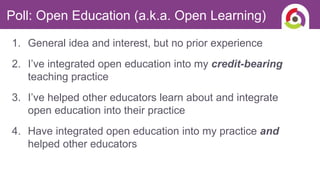
1. General idea and interest, but no prior experience
2. I’ve integrated open education into my credit-bearing
teaching practice
3. I’ve helped other educators learn about and integrate
open education into their practice
4. Have integrated open education into my practice and
helped other educators
Poll: Open Education (a.k.a. Open Learning)
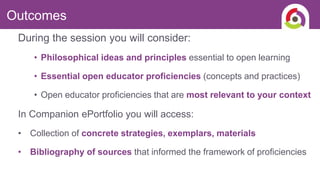
During the session you will consider:
• Philosophical ideas and principles essential to open learning
• Essential open educator proficiencies (concepts and practices)
• Open educator proficiencies that are most relevant to your context
In Companion ePortfolio you will access:
• Collection of concrete strategies, exemplars, materials
• Bibliography of sources that informed the framework of proficiencies
Outcomes
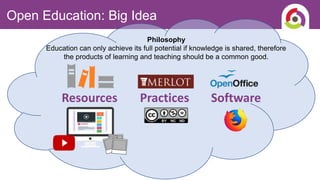
Open Education: Big Idea
Practices
Resources Software
Philosophy
Education can only achieve its full potential if knowledge is shared, therefore
the products of learning and teaching should be a common good.
Open Learning: Principle
Hegarty, 2015, OAResources, n.d.
“Engage with students as creators
of information rather than simply
consumers of it. [Open Learning] is
a form of experiential learning in
which students demonstrate
understanding through the act of
creation.”
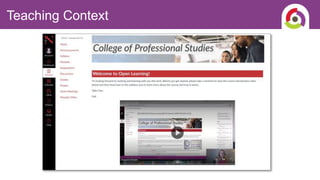
Teaching Context
If you were teaching or taking
a graduate-level education
course titled “open learning,”
what would you expect to
course participants to learn?
Articulating Priorities (In the Chat)
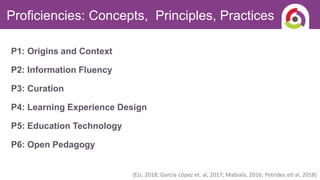
Proficiencies: Concepts, Principles, Practices
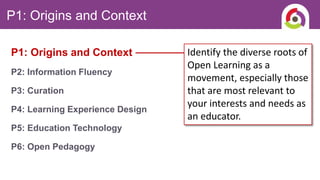
P1: Origins and Context
P2: Information Fluency
P3: Curation
P4: Learning Experience Design
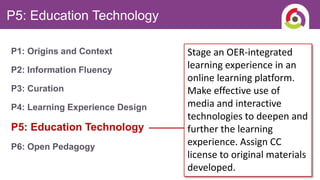
P5: Education Technology
P6: Open Pedagogy
(ELI, 2018; García-López et. al, 2017; Mabiala, 2016; Petrides etl al, 2018)
Which proficiencies were expected?
Which, if any, proficiencies surprise you?
Why?
Which ones are intriguing, but less clear
for you? [Examples will follow]
The Proficiencies (In the Chat)
P1: Origins and Context
P2: Information Fluency
P3: Curation
P4: Learning Experience Design
P5: Education Technology
P6: Open Pedagogy
Identify the diverse roots of
Open Learning as a
movement, especially those
that are most relevant to
your interests and needs as
an educator.
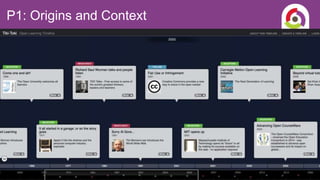
P1: Origins and Context
Essential Understanding
Open education is not a fad.
It builds on centuries of work
by educators and technical
innovators.
Timeline Assignment
• How far back does the concept of
"openness" go? What are the big ideas?
• What have been the major developments?
Who was involved? In what sectors?
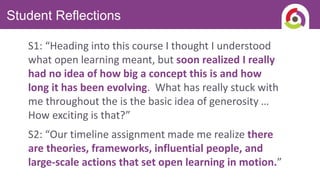
Student Reflections
S1: “Heading into this course I thought I understood
what open learning meant, but soon realized I really
had no idea of how big a concept this is and how
long it has been evolving. What has really stuck with
me throughout the is the basic idea of generosity …
How exciting is that?”
S2: “Our timeline assignment made me realize there
are theories, frameworks, influential people, and
large-scale actions that set open learning in motion.”
P2: Information Fluency
P1: Origins and Context
P2: Information Fluency
P3: Curation
P4: Learning Experience Design
P5: Education Technology
P6: Open Pedagogy
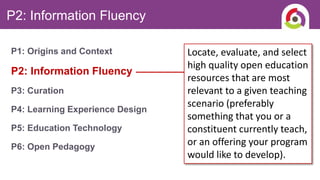
Locate, evaluate, and select
high quality open education
resources that are most
relevant to a given teaching
scenario (preferably
something that you or a
constituent currently teach,
or an offering your program
would like to develop).
P2: Information Fluency
Essential Understanding
There are many elements
that need to be considered
when evaluating OER.
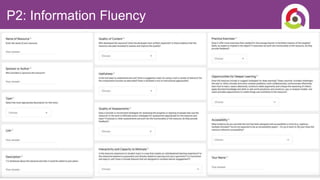
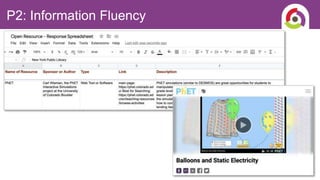
Crowdsourced Open Online Learning (COOL)
• Identify a course scenario or topic
• Look for relevant OERs
• Evaluate and pool OERs
(NUS Libraries, 2021; TEMOA, 2011; Achieve, 2011)
P2: Information Fluency
Essential Understanding
There are many elements
that need to be considered
when evaluating OER.
Student Reflections
“In the first week we were asked to post a reflective
response to a video by David Wiley. My first response came
from a place of defensiveness and closed mindedness.
Why should educators be expected to share their
intellectual property with others for free?
I started to see that open education and its history is far
more complex … a network of ideas that allows for more
equitable educational experiences for so many people.”
P3: Curation
P1: Origins and Context
P2: Information Fluency
P3: Curation
P4: Learning Experience Design
P5: Education Technology
P6: Open Pedagogy
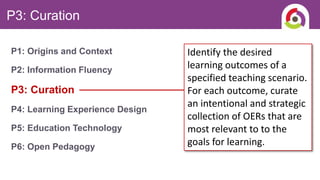
Identify the desired
learning outcomes of a
specified teaching scenario.
For each outcome, curate
an intentional and strategic
collection of OERs that are
most relevant to to the
goals for learning.
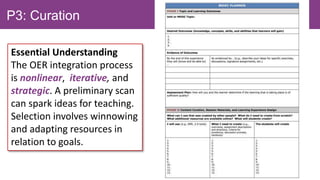
P3: Curation
Essential Understanding
The OER integration process
is nonlinear, iterative, and
strategic. A preliminary scan
can spark ideas for teaching.
Selection involves winnowing
and adapting resources in
relation to goals.
Mini-MOOC (plan 2-week learning experience)
• Individual choice of topic
• Topic selected the same week of COOL
• Process guided by a multi-week planner
• Buddy triads provide feedback
• Content includes at least three forms of
high-quality open learning resources that
were created by another entity (e.g.,
materials, videos, tools)
Student Reflection
“In a field constantly striving for innovation,
Open Education Resources provide a tangible
record of content and pedagogy that allows us
as educators to continue to reform and improve,
providing better education to students around
the world for years to come.”
P4: Learning Experience Design
P1: Origins and Context
P2: Information Fluency
P3: Curation
P4: Learning Experience Design
P5: Education Technology
P6: Open Pedagogy
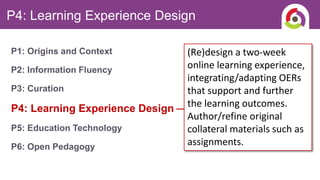
(Re)design a two-week
online learning experience,
integrating/adapting OERs
that support and further
the learning outcomes.
Author/refine original
collateral materials such as
assignments.
P4: Learning Experience Design
Mini-MOOC (plan 2-week learning experience)
• Reflect on buddy feedback input, note and
share how you acted upon it and why.
• Engage your learners in content (read/view),
intentionally designed activities (do), and
metacognition (reflect)
• Content includes at least two substantive
open learning resources created by you
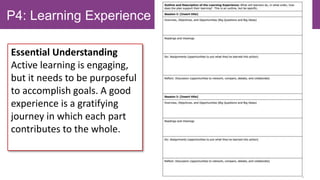
Essential Understanding
Active learning is engaging,
but it needs to be purposeful
to accomplish goals. A good
experience is a gratifying
journey in which each part
contributes to the whole.
Student Reflection
I really didn't know what to expect. [When I found out about the
Mini-MOOC assignment] I thought ‘I can't do that. That's too
much.’
I’d call it a guided creativity. It wasn't, ‘These are the five learning
resources that you're supposed to put in your MOOC and put them
in a certain order.’ ... It was just so much more than that. There are
parameters that you gave … but they were broad enough that I had
free rein.
As the course went on, I got a better picture of what Open Learning
really was … [OERs] helped give the meatiness to the course.
P5: Education Technology
P1: Origins and Context
P2: Information Fluency
P3: Curation
P4: Learning Experience Design
P5: Education Technology
P6: Open Pedagogy
Stage an OER-integrated
learning experience in an
online learning platform.
Make effective use of
media and interactive
technologies to deepen and
further the learning
experience. Assign CC
license to original materials
developed.
P5: Educational Technology
Essential Understanding
While LXD is more important
than technology, effective
implementation is critical.
Creative yet purposeful use
of technology increases
engagement.
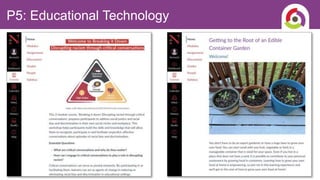
Mini-MOOC (plan 2-week learning experience)
• Each student provided with their own Canvas
course. In previous terms they had the
option to stage it in other platforms.
• Students encouraged to share strategies,
mentor each other in use of tools.
• Make effective use of multimedia that
combines images, words, and sound. Cite all
sources.
• Assign a Creative Commons license and set
for self-enrollment
P6: Open Pedagogy
P1: Origins and Context
P2: Information Fluency
P3: Curation
P4: Learning Experience Design
P5: Education Technology
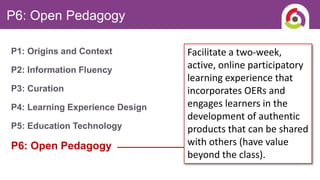
P6: Open Pedagogy
Facilitate a two-week,
active, online participatory
learning experience that
incorporates OERs and
engages learners in the
development of authentic
products that can be shared
with others (have value
beyond the class).
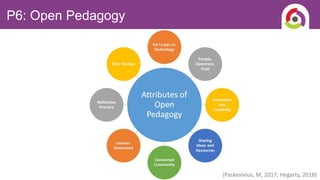
P6: Open Pedagogy
Essential Understanding
Roles between educators and
student can be fluid;
partnership increases a sense
of mattering and
empowerment. Teaching,
and the improvement of
teaching, is iterative.
Mini-MOOC
• Run the MOOC with your buddies in the final
two weeks of the course. They and your
course instructor role play being students in
the class.
• Buddy Feedback Form is provided in a
template that aligns with Min-MOOC
assignment rubric.
(Paskevivius, M, 2017; Hegarty, 2018)
Student Reflection
“This class’s format made us comment on each
other’s work in a way that required the
recipient to do something. I am not saying I had
to make the changes, but I really had to reflect
on the comments. As much as I want to say my
biggest take away was making the MOOC, it
really wasn’t. My biggest takeaway was the
power of someone else’s point of view.”
Final Reflections
S1: “This course has fundamentally shifted the way I view the
field of education.”
S2: “I feel this is the most I have changed since beginning my
master’s program. The feedback from peers … helped me
understand the material, assignments, and that I wasn’t
alone.”
S3: “I plan to make the educational materials I create openly
available to give back to the OER community … To design
authentic and engaging learning experiences, I have to
leverage and collaborate with the open learning community.”
How might the principles of open
learning inform your teaching context?
Revisiting Early Questions (In Chat/Verbally)
Questions and Comments?
Thank you!
Access the companion ePortfolio at
https://openeducators.sites.northeastern.edu
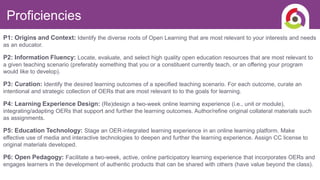
Proficiencies
P1: Origins and Context: Identify the diverse roots of Open Learning that are most relevant to your interests and needs
as an educator.
P2: Information Fluency: Locate, evaluate, and select high quality open education resources that are most relevant to
a given teaching scenario (preferably something that you or a constituent currently teach, or an offering your program
would like to develop).
P3: Curation: Identify the desired learning outcomes of a specified teaching scenario. For each outcome, curate an
intentional and strategic collection of OERs that are most relevant to to the goals for learning.
P4: Learning Experience Design: (Re)design a two-week online learning experience (i.e., unit or module),
integrating/adapting OERs that support and further the learning outcomes. Author/refine original collateral materials such
as assignments.
P5: Education Technology: Stage an OER-integrated learning experience in an online learning platform. Make
effective use of media and interactive technologies to deepen and further the learning experience. Assign CC license to
original materials developed.
P6: Open Pedagogy: Facilitate a two-week, active, online participatory learning experience that incorporates OERs and
engages learners in the development of authentic products that can be shared with others (have value beyond the class).

Preparing Open Educators

  • 1.
    Preparing Open Educators: EssentialConceptual Understandings & Proficiencies Gail Matthews-DeNatale Lecturer, CPS Graduate School of Education Senior Associate Director, CATLR
  • 2.
    1. General ideaand interest, but no prior experience 2. I’ve integrated open education into my credit-bearing teaching practice 3. I’ve helped other educators learn about and integrate open education into their practice 4. Have integrated open education into my practice and helped other educators Poll: Open Education (a.k.a. Open Learning)
  • 3.
    During the sessionyou will consider: • Philosophical ideas and principles essential to open learning • Essential open educator proficiencies (concepts and practices) • Open educator proficiencies that are most relevant to your context In Companion ePortfolio you will access: • Collection of concrete strategies, exemplars, materials • Bibliography of sources that informed the framework of proficiencies Outcomes
  • 4.
    Open Education: BigIdea Practices Resources Software Philosophy Education can only achieve its full potential if knowledge is shared, therefore the products of learning and teaching should be a common good.
  • 5.
    Open Learning: Principle Hegarty,2015, OAResources, n.d. “Engage with students as creators of information rather than simply consumers of it. [Open Learning] is a form of experiential learning in which students demonstrate understanding through the act of creation.”
  • 6.
  • 7.
    If you wereteaching or taking a graduate-level education course titled “open learning,” what would you expect to course participants to learn? Articulating Priorities (In the Chat)
  • 8.
    Proficiencies: Concepts, Principles,Practices P1: Origins and Context P2: Information Fluency P3: Curation P4: Learning Experience Design P5: Education Technology P6: Open Pedagogy (ELI, 2018; García-López et. al, 2017; Mabiala, 2016; Petrides etl al, 2018)
  • 9.
    Which proficiencies wereexpected? Which, if any, proficiencies surprise you? Why? Which ones are intriguing, but less clear for you? [Examples will follow] The Proficiencies (In the Chat)
  • 10.
    P1: Origins andContext P1: Origins and Context P2: Information Fluency P3: Curation P4: Learning Experience Design P5: Education Technology P6: Open Pedagogy Identify the diverse roots of Open Learning as a movement, especially those that are most relevant to your interests and needs as an educator.
  • 11.
    P1: Origins andContext Essential Understanding Open education is not a fad. It builds on centuries of work by educators and technical innovators. Timeline Assignment • How far back does the concept of "openness" go? What are the big ideas? • What have been the major developments? Who was involved? In what sectors?
  • 12.
    Student Reflections S1: “Headinginto this course I thought I understood what open learning meant, but soon realized I really had no idea of how big a concept this is and how long it has been evolving. What has really stuck with me throughout the is the basic idea of generosity … How exciting is that?” S2: “Our timeline assignment made me realize there are theories, frameworks, influential people, and large-scale actions that set open learning in motion.”
  • 13.
    P2: Information Fluency P1:Origins and Context P2: Information Fluency P3: Curation P4: Learning Experience Design P5: Education Technology P6: Open Pedagogy Locate, evaluate, and select high quality open education resources that are most relevant to a given teaching scenario (preferably something that you or a constituent currently teach, or an offering your program would like to develop).
  • 14.
    P2: Information Fluency EssentialUnderstanding There are many elements that need to be considered when evaluating OER. Crowdsourced Open Online Learning (COOL) • Identify a course scenario or topic • Look for relevant OERs • Evaluate and pool OERs (NUS Libraries, 2021; TEMOA, 2011; Achieve, 2011)
  • 15.
    P2: Information Fluency EssentialUnderstanding There are many elements that need to be considered when evaluating OER.
  • 16.
    Student Reflections “In thefirst week we were asked to post a reflective response to a video by David Wiley. My first response came from a place of defensiveness and closed mindedness. Why should educators be expected to share their intellectual property with others for free? I started to see that open education and its history is far more complex … a network of ideas that allows for more equitable educational experiences for so many people.”
  • 17.
    P3: Curation P1: Originsand Context P2: Information Fluency P3: Curation P4: Learning Experience Design P5: Education Technology P6: Open Pedagogy Identify the desired learning outcomes of a specified teaching scenario. For each outcome, curate an intentional and strategic collection of OERs that are most relevant to to the goals for learning.
  • 18.
    P3: Curation Essential Understanding TheOER integration process is nonlinear, iterative, and strategic. A preliminary scan can spark ideas for teaching. Selection involves winnowing and adapting resources in relation to goals. Mini-MOOC (plan 2-week learning experience) • Individual choice of topic • Topic selected the same week of COOL • Process guided by a multi-week planner • Buddy triads provide feedback • Content includes at least three forms of high-quality open learning resources that were created by another entity (e.g., materials, videos, tools)
  • 19.
    Student Reflection “In afield constantly striving for innovation, Open Education Resources provide a tangible record of content and pedagogy that allows us as educators to continue to reform and improve, providing better education to students around the world for years to come.”
  • 20.
    P4: Learning ExperienceDesign P1: Origins and Context P2: Information Fluency P3: Curation P4: Learning Experience Design P5: Education Technology P6: Open Pedagogy (Re)design a two-week online learning experience, integrating/adapting OERs that support and further the learning outcomes. Author/refine original collateral materials such as assignments.
  • 21.
    P4: Learning ExperienceDesign Mini-MOOC (plan 2-week learning experience) • Reflect on buddy feedback input, note and share how you acted upon it and why. • Engage your learners in content (read/view), intentionally designed activities (do), and metacognition (reflect) • Content includes at least two substantive open learning resources created by you Essential Understanding Active learning is engaging, but it needs to be purposeful to accomplish goals. A good experience is a gratifying journey in which each part contributes to the whole.
  • 22.
    Student Reflection I reallydidn't know what to expect. [When I found out about the Mini-MOOC assignment] I thought ‘I can't do that. That's too much.’ I’d call it a guided creativity. It wasn't, ‘These are the five learning resources that you're supposed to put in your MOOC and put them in a certain order.’ ... It was just so much more than that. There are parameters that you gave … but they were broad enough that I had free rein. As the course went on, I got a better picture of what Open Learning really was … [OERs] helped give the meatiness to the course.
  • 23.
    P5: Education Technology P1:Origins and Context P2: Information Fluency P3: Curation P4: Learning Experience Design P5: Education Technology P6: Open Pedagogy Stage an OER-integrated learning experience in an online learning platform. Make effective use of media and interactive technologies to deepen and further the learning experience. Assign CC license to original materials developed.
  • 24.
    P5: Educational Technology EssentialUnderstanding While LXD is more important than technology, effective implementation is critical. Creative yet purposeful use of technology increases engagement. Mini-MOOC (plan 2-week learning experience) • Each student provided with their own Canvas course. In previous terms they had the option to stage it in other platforms. • Students encouraged to share strategies, mentor each other in use of tools. • Make effective use of multimedia that combines images, words, and sound. Cite all sources. • Assign a Creative Commons license and set for self-enrollment
  • 25.
    P6: Open Pedagogy P1:Origins and Context P2: Information Fluency P3: Curation P4: Learning Experience Design P5: Education Technology P6: Open Pedagogy Facilitate a two-week, active, online participatory learning experience that incorporates OERs and engages learners in the development of authentic products that can be shared with others (have value beyond the class).
  • 26.
    P6: Open Pedagogy EssentialUnderstanding Roles between educators and student can be fluid; partnership increases a sense of mattering and empowerment. Teaching, and the improvement of teaching, is iterative. Mini-MOOC • Run the MOOC with your buddies in the final two weeks of the course. They and your course instructor role play being students in the class. • Buddy Feedback Form is provided in a template that aligns with Min-MOOC assignment rubric. (Paskevivius, M, 2017; Hegarty, 2018)
  • 27.
    Student Reflection “This class’sformat made us comment on each other’s work in a way that required the recipient to do something. I am not saying I had to make the changes, but I really had to reflect on the comments. As much as I want to say my biggest take away was making the MOOC, it really wasn’t. My biggest takeaway was the power of someone else’s point of view.”
  • 28.
    Final Reflections S1: “Thiscourse has fundamentally shifted the way I view the field of education.” S2: “I feel this is the most I have changed since beginning my master’s program. The feedback from peers … helped me understand the material, assignments, and that I wasn’t alone.” S3: “I plan to make the educational materials I create openly available to give back to the OER community … To design authentic and engaging learning experiences, I have to leverage and collaborate with the open learning community.”
  • 29.
    How might theprinciples of open learning inform your teaching context? Revisiting Early Questions (In Chat/Verbally)
  • 30.
    Questions and Comments? Thankyou! Access the companion ePortfolio at https://openeducators.sites.northeastern.edu
  • 31.
    Proficiencies P1: Origins andContext: Identify the diverse roots of Open Learning that are most relevant to your interests and needs as an educator. P2: Information Fluency: Locate, evaluate, and select high quality open education resources that are most relevant to a given teaching scenario (preferably something that you or a constituent currently teach, or an offering your program would like to develop). P3: Curation: Identify the desired learning outcomes of a specified teaching scenario. For each outcome, curate an intentional and strategic collection of OERs that are most relevant to to the goals for learning. P4: Learning Experience Design: (Re)design a two-week online learning experience (i.e., unit or module), integrating/adapting OERs that support and further the learning outcomes. Author/refine original collateral materials such as assignments. P5: Education Technology: Stage an OER-integrated learning experience in an online learning platform. Make effective use of media and interactive technologies to deepen and further the learning experience. Assign CC license to original materials developed. P6: Open Pedagogy: Facilitate a two-week, active, online participatory learning experience that incorporates OERs and engages learners in the development of authentic products that can be shared with others (have value beyond the class).

Editor's Notes

  • #9 Note that many frameworks that informed my identification of these particular proficiencies