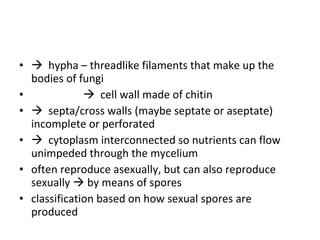
Fungi
1
Characteristics heterotrophic (saprobes or parasites; symbiotic with plants bacteria or algae) carry out extracellular digestion    secrete enzymes that digest food outside their bodies most are multicellular mass of branching filaments called  mycelium  
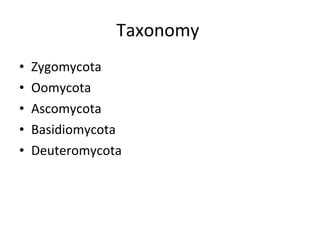
Mycelium
   hypha – threadlike filaments that make up the bodies of fungi    cell wall made of chitin     septa/cross walls (maybe septate or aseptate) incomplete or perforated    cytoplasm interconnected so nutrients can flow unimpeded through the mycelium often reproduce asexually, but can also reproduce sexually    by means of spores classification based on how sexual spores are produced
Taxonomy  Zygomycota Oomycota Ascomycota Basidiomycota Deuteromycota
Zygomycota zygomycetes/conjugation fungi  spores produced by zygosporangia (diploid) 1,050 spp. most are saprobic, but a few are parasites of insects, plants or other fungi hyphae aseptate
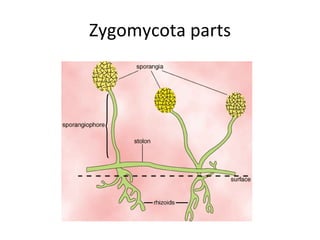
Zygomycota many are important symbionts of vascular plants asexual reproduction by spore formation; sexual reproduction by conjugation (+/- mating strains) Zygospore can resist harsh environmental conditions structure:  rhizoids, stolons, sporangiophores, spores
Zygomycota parts
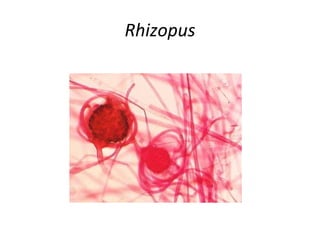
Rhizopus
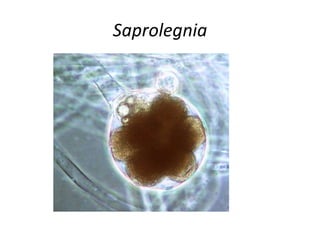
Oomycota oomycetes/water molds and downy mildews consists of finely branched, single-celled filaments cell wall not chitin (cellulose) protist-like fungi; sometimes classified as protista diploid stage is dominant e.g.  water molds (saprobes or parasites of fish) downy mildews (plant parasites – potato blight)
Oomycota Also termed as egg fungi from formation of a large oogonia Highly pathogenic to plants Is said to be more closely related to brown algae and diatoms
Saprolegnia
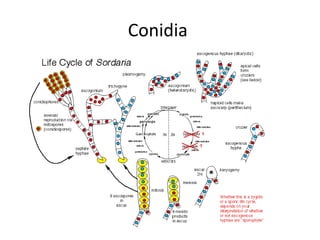
Ascomycota ascomycetes/sac fungi largest group of fungi (30,000 spp.) produces two kinds of spores: sexual spores    ascospores (inside the ascus) asexual spores    conidia
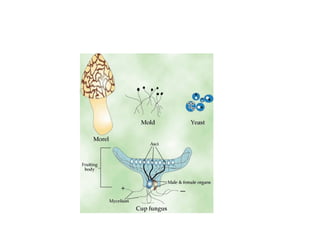
Ascomycota formation of asci (spore-containing sacs) contained within the fruiting body (ascocarp) hyphae septate, but cells may be multinucleate because are cross walls perforated most saprobic, growing on dead organic matter some pathogens of plants (Dutch elm disease, chestnut blight, ergot)
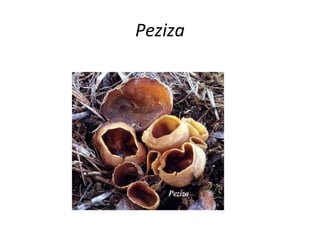
Ascomycota e.g.  yeasts (unicellular) reproduce by budding & spore formation cup fungi powdery mildews morels (sponge or honeycomb fungi) truffles blue and green molds Ophiostoma ulmi  (causes Dutch elm disease) Microsphaera  (powdery mildew)
 
Conidia
Peziza
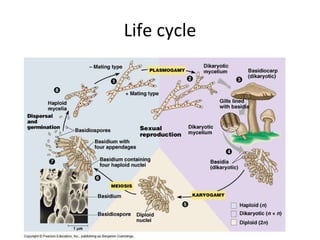
Basidiomycota basidiomycetes/club fungi 25,000 spp. sexual reproduction     basidiospores formed on club-shaped basidia some produce asexual spores    conidia hyphae septate, but divided by incomplete cross walls; cells may contain one or two nuclei fruiting body    basidiocarp
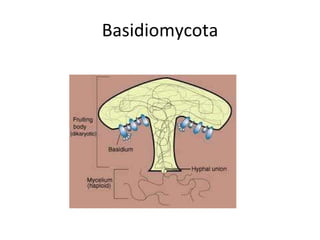
diverse in shape/structure e.g.  mushrooms toadstools puffballs bracket fungi/shelf fungi ( Ganoderma ) structure of a mushroom: stalk and cap annulus gills
Basidiomycota
Life cycle
Deuteromycota imperfect fungi not known to have a sexual reproductive phase e.g. Penicillium  (produces the antibiotic penicillin) ringworm athletes foot
Ecology: symbiosis lichen – composite organisms consisting of a fungus that encloses either green algae or cyanobacteria fungus (mycobiont) and a photosynthetic (photobiont) organism (either green algae or cyanobacteria) photobiont provides nutrients with mycobiont provides shelter mycobionts most are sac fungi crust-like (crustose), shrub-like (fruticose) and leaf like (foliose) reproduce asexually via dispersal fragments (includes both types of cells) which are dispersed by wind pioneers, can break down rock beginning soil formation
mycorrhizae – “fungus roots” hyphae or the fungus penetrate the roots of certain plants and become virtual extensions of them plant cannot take up enough nutrients without the fungal symbiont; fungus derives nourishment from the plant ectomycorrhizae (basidio) vs. endomycorrhizae (zygo)  

Fungi

  • 1.
  • 2.
  • 3.
    Characteristics heterotrophic (saprobesor parasites; symbiotic with plants bacteria or algae) carry out extracellular digestion  secrete enzymes that digest food outside their bodies most are multicellular mass of branching filaments called mycelium  
  • 4.
  • 5.
    hypha – threadlike filaments that make up the bodies of fungi  cell wall made of chitin  septa/cross walls (maybe septate or aseptate) incomplete or perforated  cytoplasm interconnected so nutrients can flow unimpeded through the mycelium often reproduce asexually, but can also reproduce sexually  by means of spores classification based on how sexual spores are produced
  • 6.
    Taxonomy ZygomycotaOomycota Ascomycota Basidiomycota Deuteromycota
  • 7.
    Zygomycota zygomycetes/conjugation fungi spores produced by zygosporangia (diploid) 1,050 spp. most are saprobic, but a few are parasites of insects, plants or other fungi hyphae aseptate
  • 8.
    Zygomycota many areimportant symbionts of vascular plants asexual reproduction by spore formation; sexual reproduction by conjugation (+/- mating strains) Zygospore can resist harsh environmental conditions structure: rhizoids, stolons, sporangiophores, spores
  • 9.
  • 10.
  • 11.
    Oomycota oomycetes/water moldsand downy mildews consists of finely branched, single-celled filaments cell wall not chitin (cellulose) protist-like fungi; sometimes classified as protista diploid stage is dominant e.g. water molds (saprobes or parasites of fish) downy mildews (plant parasites – potato blight)
  • 12.
    Oomycota Also termedas egg fungi from formation of a large oogonia Highly pathogenic to plants Is said to be more closely related to brown algae and diatoms
  • 13.
  • 14.
    Ascomycota ascomycetes/sac fungilargest group of fungi (30,000 spp.) produces two kinds of spores: sexual spores  ascospores (inside the ascus) asexual spores  conidia
  • 15.
    Ascomycota formation ofasci (spore-containing sacs) contained within the fruiting body (ascocarp) hyphae septate, but cells may be multinucleate because are cross walls perforated most saprobic, growing on dead organic matter some pathogens of plants (Dutch elm disease, chestnut blight, ergot)
  • 16.
    Ascomycota e.g. yeasts (unicellular) reproduce by budding & spore formation cup fungi powdery mildews morels (sponge or honeycomb fungi) truffles blue and green molds Ophiostoma ulmi (causes Dutch elm disease) Microsphaera (powdery mildew)
  • 17.
  • 18.
  • 19.
  • 20.
    Basidiomycota basidiomycetes/club fungi25,000 spp. sexual reproduction  basidiospores formed on club-shaped basidia some produce asexual spores  conidia hyphae septate, but divided by incomplete cross walls; cells may contain one or two nuclei fruiting body  basidiocarp
  • 21.
    diverse in shape/structuree.g. mushrooms toadstools puffballs bracket fungi/shelf fungi ( Ganoderma ) structure of a mushroom: stalk and cap annulus gills
  • 22.
  • 23.
  • 24.
    Deuteromycota imperfect funginot known to have a sexual reproductive phase e.g. Penicillium (produces the antibiotic penicillin) ringworm athletes foot
  • 25.
    Ecology: symbiosis lichen– composite organisms consisting of a fungus that encloses either green algae or cyanobacteria fungus (mycobiont) and a photosynthetic (photobiont) organism (either green algae or cyanobacteria) photobiont provides nutrients with mycobiont provides shelter mycobionts most are sac fungi crust-like (crustose), shrub-like (fruticose) and leaf like (foliose) reproduce asexually via dispersal fragments (includes both types of cells) which are dispersed by wind pioneers, can break down rock beginning soil formation
  • 26.
    mycorrhizae – “fungusroots” hyphae or the fungus penetrate the roots of certain plants and become virtual extensions of them plant cannot take up enough nutrients without the fungal symbiont; fungus derives nourishment from the plant ectomycorrhizae (basidio) vs. endomycorrhizae (zygo)