
MASTIGOMYCOTINA
UNIVERSITY OF ALLAHABAD
SUBMITTEDBY BHIMSEN
M.Sc 1st SEMESTER ROLLNO. 11
INTRODUCTION
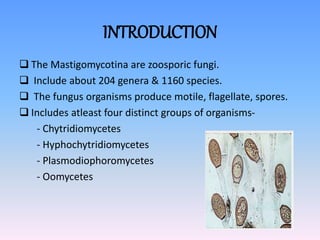
 The Mastigomycotina are zoosporic fungi.
 Include about 204 genera & 1160 species.
 The fungus organisms produce motile, flagellate, spores.
 Includes atleast four distinct groups of organisms-
- Chytridiomycetes
- Hyphochytridiomycetes
- Plasmodiophoromycetes
- Oomycetes
GENERAL CHARACTERS
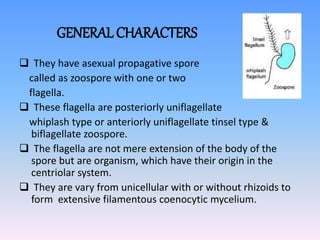
 They have asexual propagative spore
called as zoospore with one or two
flagella.
 These flagella are posteriorly uniflagellate
whiplash type or anteriorly uniflagellate tinsel type &
biflagellate zoospore.
 The flagella are not mere extension of the body of the
spore but are organism, which have their origin in the
centriolar system.
 They are vary from unicellular with or without rhizoids to
form extensive filamentous coenocytic mycelium.
CLASSIFICATION
 Based on the flagellation of zoospore
 Ainsworth (1973) & Hawksworth et al. (1983) have
recognized three classes-
- Chytridiomycetes
- Hyphochytridiomycetes
- Oomycetes
 Alexopolus & Mims included the
class ‘Plasmodiophoromycetes’ in
this subdivision.
CHYTRIDIOMYCETES
 Zoospore uniflagellate flagellum posterior, whiplash
type.
 Include 100 genera & 1000 species.
 They are mostly aquatic, growing as saprobes on
plant & animal, remains in water or as parasite.
 Nuclear division in the group are intranuclear &
centric.
 Cell walls of these fungi consist of chitin & glucan.
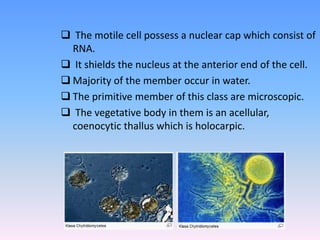
 The motile cell possess a nuclear cap which consist of
RNA.
 It shields the nucleus at the anterior end of the cell.
 Majority of the member occur in water.
 The primitive member of this class are microscopic.
 The vegetative body in them is an acellular,
coenocytic thallus which is holocarpic.
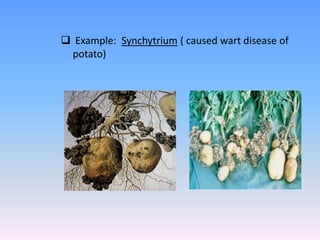
 Example: Synchytrium ( caused wart disease of
potato)
CLASSIFICATION OF CHYTRIDIOMYCETES
 On the basis of vegetative & reproductive structures, the
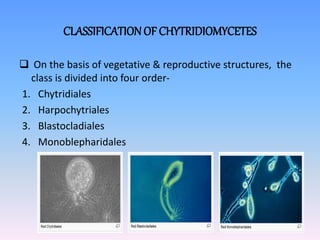
class is divided into four order-
1. Chytridiales
2. Harpochytriales
3. Blastocladiales
4. Monoblepharidales
HYPHOCHYTRIDIOMYCETES
 They are distinguished by an anterior tinsel flagellum on
their zoospores.
 Also they have a rhizoidal or hypha-like vegetative system.
 Cell wall made up of both chitin & cellulose.
 Thallus may consist either of a single reproductive organ
bearing a branched rhizoidal system or it may be
polycentric hyphae with septa.
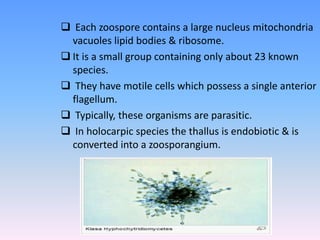
 Each zoospore contains a large nucleus mitochondria
vacuoles lipid bodies & ribosome.
 It is a small group containing only about 23 known
species.
 They have motile cells which possess a single anterior
flagellum.
 Typically, these organisms are parasitic.
 In holocarpic species the thallus is endobiotic & is
converted into a zoosporangium.
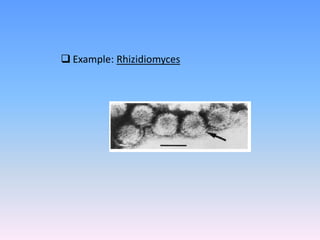
 Example: Rhizidiomyces
OOMYCETES
 The zoospore are biflagellate.
 They are reniform in shape.
 The flagella are inserted apically in the former & laterally in
the latter.
 Flagellum is of two type-
1. Tinsel type
2. Whiplash type
 The zoospore lack cell walls.
 The mycelium is extensive & coenocytic.
 The mycelium ranges from a simple, unicellular
thallus to an extensively developed filamentous
structure.
 Hyphal wall contains cellulose but no chytin.
 Most of the species are eucarpic.
 They reproduce both asexually & sexually.
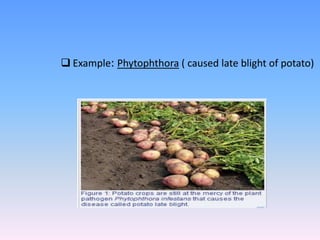
 Example: Phytophthora ( caused late blight of potato)
CLASSIFICATION OF OOMYCETES
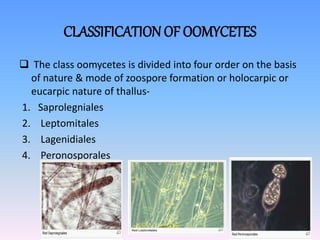
 The class oomycetes is divided into four order on the basis
of nature & mode of zoospore formation or holocarpic or
eucarpic nature of thallus-
1. Saprolegniales
2. Leptomitales
3. Lagenidiales
4. Peronosporales
PLASMODIOPHOROMYCETES
 They are obligate endoparasites of the seed plant.
 It grows within host cell & is holocarpic.
 Entire proto plasm of primary plasmodium divided to give
rise to thin wall gametangia.
 The gametangia contain single motile biflagellate
uninucleate structure, called as zoospore.
 The both flagella are whiplash type but of unequal length.
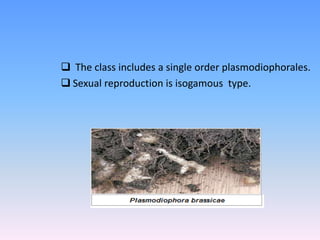
 The class includes a single order plasmodiophorales.
 Sexual reproduction is isogamous type.
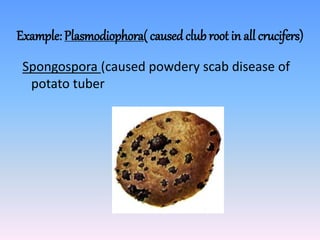
Example: Plasmodiophora( causedclub root in all crucifers)
Spongospora (caused powdery scab disease of
potato tuber
Questions
Difference between cell wall composition of
Oomycetes and Chytridiomycetes
What type of flagella found in Chytridiomycetes
zoospore
Refrences
• An Introduction to Mycology by R.S.Mehrotra
& K.R.Aneja (1999)
• Introduction to fungi by John webstor(1993)
• Introductry Mycology –C.J.Alexopolus
Bhimsen fungi