Wilderness First Aid
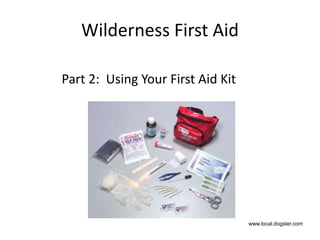
Part 2: Using Your First Aid Kit
www.local.dogster.com
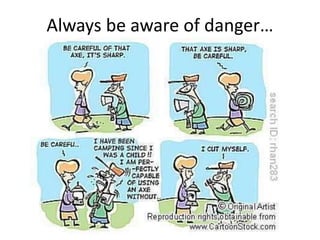
Always be aware of danger…
Common Issues:
• Insect bites and stings
• Blisters
• Skin reactions
• Dehydration
• Heat exhaustion
• Diarrhoea
• Burns
• Cuts and scrapes
• Broken bones
• Sprains
• Infections
www.brocku.ca
Severe Injuries
• Depending on your level of
medical expertise and the nature
of the injury, it may not be
possible or safe to treat or move
an injured person.
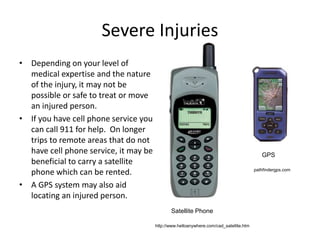
• If you have cell phone service you
can call 911 for help. On longer
trips to remote areas that do not
have cell phone service, it may be
beneficial to carry a satellite
phone which can be rented.
• A GPS system may also aid
locating an injured person.
http://www.helloanywhere.com/cad_satellite.htm
pathfindergps.com
Satellite Phone
GPS
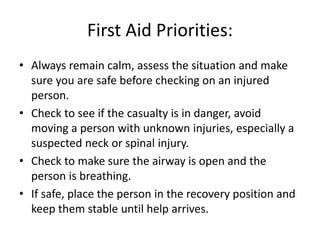
First Aid Priorities:
• Always remain calm, assess the situation and make
sure you are safe before checking on an injured
person.
• Check to see if the casualty is in danger, avoid
moving a person with unknown injuries, especially a
suspected neck or spinal injury.
• Check to make sure the airway is open and the
person is breathing.
• If safe, place the person in the recovery position and
keep them stable until help arrives.
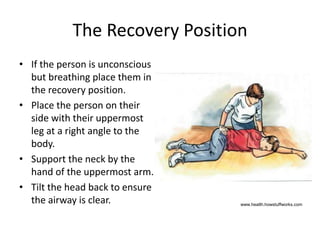
The Recovery Position
• If the person is unconscious
but breathing place them in
the recovery position.
• Place the person on their
side with their uppermost
leg at a right angle to the
body.
• Support the neck by the
hand of the uppermost arm.
• Tilt the head back to ensure
the airway is clear. www.health.howstuffworks.com
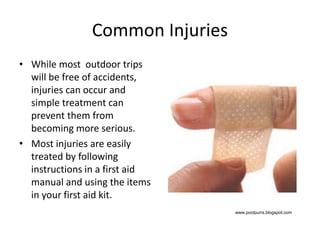
Common Injuries
• While most outdoor trips
will be free of accidents,
injuries can occur and
simple treatment can
prevent them from
becoming more serious.
• Most injuries are easily
treated by following
instructions in a first aid
manual and using the items
in your first aid kit.
www.poolpurrs.blogspot.com
Using Your First Aid Kit
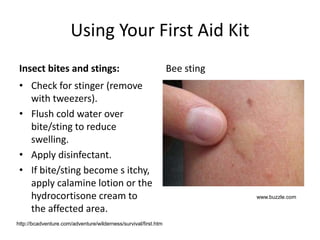
Insect bites and stings:
• Check for stinger (remove
with tweezers).
• Flush cold water over
bite/sting to reduce
swelling.
• Apply disinfectant.
• If bite/sting become s itchy,
apply calamine lotion or the
hydrocortisone cream to
the affected area.
Bee sting
http://bcadventure.com/adventure/wilderness/survival/first.htm
www.buzzle.com
Using Your First Aid Kit
Blisters:
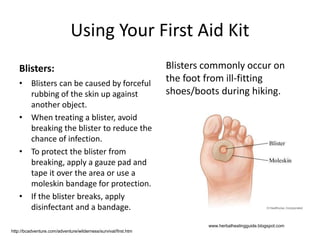
• Blisters can be caused by forceful
rubbing of the skin up against
another object.
• When treating a blister, avoid
breaking the blister to reduce the
chance of infection.
• To protect the blister from
breaking, apply a gauze pad and
tape it over the area or use a
moleskin bandage for protection.
• If the blister breaks, apply
disinfectant and a bandage.
Blisters commonly occur on
the foot from ill-fitting
shoes/boots during hiking.
www.herbalhealingguide.blogspot.com
http://bcadventure.com/adventure/wilderness/survival/first.htm
Using Your First Aid Kit
Skin Reactions: Sunburn
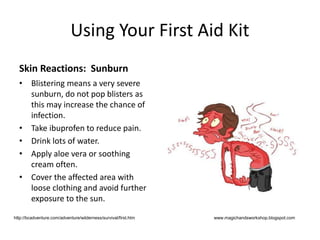
• Blistering means a very severe
sunburn, do not pop blisters as
this may increase the chance of
infection.
• Take ibuprofen to reduce pain.
• Drink lots of water.
• Apply aloe vera or soothing
cream often.
• Cover the affected area with
loose clothing and avoid further
exposure to the sun.
www.magichandsworkshop.blogspot.comhttp://bcadventure.com/adventure/wilderness/survival/first.htm
Using Your First Aid Kit
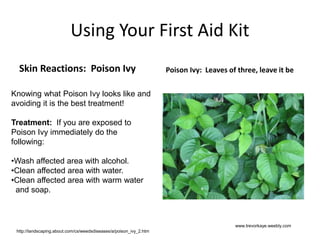
Skin Reactions: Poison Ivy Poison Ivy: Leaves of three, leave it be
www.trevorkaye.weebly.com
Knowing what Poison Ivy looks like and
avoiding it is the best treatment!
Treatment: If you are exposed to
Poison Ivy immediately do the
following:
•Wash affected area with alcohol.
•Clean affected area with water.
•Clean affected area with warm water
and soap.
http://landscaping.about.com/cs/weedsdiseases/a/poison_ivy_2.htm
Using Your First Aid Kit
Skin Reactions: Poison Ivy (continued)
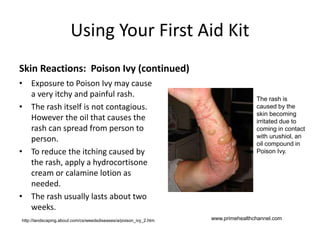
• Exposure to Poison Ivy may cause
a very itchy and painful rash.
• The rash itself is not contagious.
However the oil that causes the
rash can spread from person to
person.
• To reduce the itching caused by
the rash, apply a hydrocortisone
cream or calamine lotion as
needed.
• The rash usually lasts about two
weeks.
The rash is
caused by the
skin becoming
irritated due to
coming in contact
with urushiol, an
oil compound in
Poison Ivy.
www.primehealthchannel.comhttp://landscaping.about.com/cs/weedsdiseases/a/poison_ivy_2.htm
Using your First Aid Kit
Skin Reactions: Poison Ivy (continued)
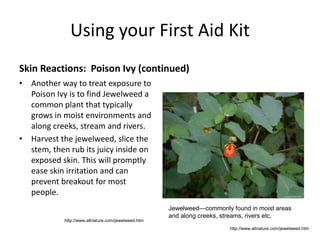
• Another way to treat exposure to
Poison Ivy is to find Jewelweed a
common plant that typically
grows in moist environments and
along creeks, stream and rivers.
• Harvest the jewelweed, slice the
stem, then rub its juicy inside on
exposed skin. This will promptly
ease skin irritation and can
prevent breakout for most
people.
http://www.altnature.com/jewelweed.htm
Jewelweed—commonly found in moist areas
and along creeks, streams, rivers etc.

ONTAP - Wilderness First Aid 2

  • 2.
    Wilderness First Aid Part2: Using Your First Aid Kit www.local.dogster.com
  • 3.
    Always be awareof danger…
  • 4.
    Common Issues: • Insectbites and stings • Blisters • Skin reactions • Dehydration • Heat exhaustion • Diarrhoea • Burns • Cuts and scrapes • Broken bones • Sprains • Infections www.brocku.ca
  • 5.
    Severe Injuries • Dependingon your level of medical expertise and the nature of the injury, it may not be possible or safe to treat or move an injured person. • If you have cell phone service you can call 911 for help. On longer trips to remote areas that do not have cell phone service, it may be beneficial to carry a satellite phone which can be rented. • A GPS system may also aid locating an injured person. http://www.helloanywhere.com/cad_satellite.htm pathfindergps.com Satellite Phone GPS
  • 6.
    First Aid Priorities: •Always remain calm, assess the situation and make sure you are safe before checking on an injured person. • Check to see if the casualty is in danger, avoid moving a person with unknown injuries, especially a suspected neck or spinal injury. • Check to make sure the airway is open and the person is breathing. • If safe, place the person in the recovery position and keep them stable until help arrives.
  • 7.
    The Recovery Position •If the person is unconscious but breathing place them in the recovery position. • Place the person on their side with their uppermost leg at a right angle to the body. • Support the neck by the hand of the uppermost arm. • Tilt the head back to ensure the airway is clear. www.health.howstuffworks.com
  • 8.
    Common Injuries • Whilemost outdoor trips will be free of accidents, injuries can occur and simple treatment can prevent them from becoming more serious. • Most injuries are easily treated by following instructions in a first aid manual and using the items in your first aid kit. www.poolpurrs.blogspot.com
  • 9.
    Using Your FirstAid Kit Insect bites and stings: • Check for stinger (remove with tweezers). • Flush cold water over bite/sting to reduce swelling. • Apply disinfectant. • If bite/sting become s itchy, apply calamine lotion or the hydrocortisone cream to the affected area. Bee sting http://bcadventure.com/adventure/wilderness/survival/first.htm www.buzzle.com
  • 10.
    Using Your FirstAid Kit Blisters: • Blisters can be caused by forceful rubbing of the skin up against another object. • When treating a blister, avoid breaking the blister to reduce the chance of infection. • To protect the blister from breaking, apply a gauze pad and tape it over the area or use a moleskin bandage for protection. • If the blister breaks, apply disinfectant and a bandage. Blisters commonly occur on the foot from ill-fitting shoes/boots during hiking. www.herbalhealingguide.blogspot.com http://bcadventure.com/adventure/wilderness/survival/first.htm
  • 11.
    Using Your FirstAid Kit Skin Reactions: Sunburn • Blistering means a very severe sunburn, do not pop blisters as this may increase the chance of infection. • Take ibuprofen to reduce pain. • Drink lots of water. • Apply aloe vera or soothing cream often. • Cover the affected area with loose clothing and avoid further exposure to the sun. www.magichandsworkshop.blogspot.comhttp://bcadventure.com/adventure/wilderness/survival/first.htm
  • 12.
    Using Your FirstAid Kit Skin Reactions: Poison Ivy Poison Ivy: Leaves of three, leave it be www.trevorkaye.weebly.com Knowing what Poison Ivy looks like and avoiding it is the best treatment! Treatment: If you are exposed to Poison Ivy immediately do the following: •Wash affected area with alcohol. •Clean affected area with water. •Clean affected area with warm water and soap. http://landscaping.about.com/cs/weedsdiseases/a/poison_ivy_2.htm
  • 13.
    Using Your FirstAid Kit Skin Reactions: Poison Ivy (continued) • Exposure to Poison Ivy may cause a very itchy and painful rash. • The rash itself is not contagious. However the oil that causes the rash can spread from person to person. • To reduce the itching caused by the rash, apply a hydrocortisone cream or calamine lotion as needed. • The rash usually lasts about two weeks. The rash is caused by the skin becoming irritated due to coming in contact with urushiol, an oil compound in Poison Ivy. www.primehealthchannel.comhttp://landscaping.about.com/cs/weedsdiseases/a/poison_ivy_2.htm
  • 14.
    Using your FirstAid Kit Skin Reactions: Poison Ivy (continued) • Another way to treat exposure to Poison Ivy is to find Jewelweed a common plant that typically grows in moist environments and along creeks, stream and rivers. • Harvest the jewelweed, slice the stem, then rub its juicy inside on exposed skin. This will promptly ease skin irritation and can prevent breakout for most people. http://www.altnature.com/jewelweed.htm http://www.altnature.com/jewelweed.htm Jewelweed—commonly found in moist areas and along creeks, streams, rivers etc.