Bites, Stings,
Rashes, Allergies
and Anaphylaxis
Covers Chapters 17, 18, 19, & 29
Plant-Induced Dermatitis
โ€ข About 85% of the population is sensitive to poison
ivy, poison oak, and poison sumac.
โ€ข The resin of these plants is a colorless or slightly
yellow, light oil.
โ€ข Not visible on human skin
โˆ’ Spreads by direct contact
โˆ’ Can stay active for months or years
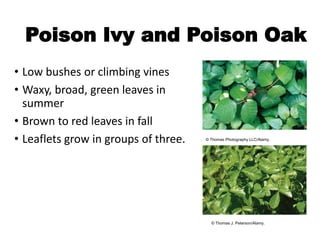
Poison Ivy and Poison Oak
โ€ข Low bushes or climbing vines
โ€ข Waxy, broad, green leaves in
summer
โ€ข Brown to red leaves in fall
โ€ข Leaflets grow in groups of three. ยฉ Thomas Photography LLC/Alamy.
ยฉ Thomas J. Peterson/Alamy.
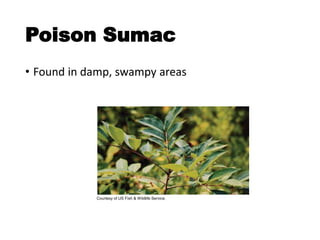
Poison Sumac
โ€ข Found in damp, swampy areas
Courtesy of US Fish & Wildlife Service.
Plant-Induced Dermatitis:
What to Look For
โ€ข Itching
โ€ข Mild dermatitis
โ€ข Itching and swelling
โ€ข Moderate dermatitis
โ€ข Itching, swelling, and blisters
โ€ข Severe dermatitis
Plant-Induced Dermatitis:
What to Do
(1 of 4)
โ€ข If within 1 hour of an exposure:
โˆ’ Gently wipe skin with rubbing alcohol. Do not use
packaged alcohol wipes.
โˆ’ Wash skin with soap and cold water. Rinse with cold water.
โˆ’ Do not use gasoline.
Plant-Induced Dermatitis:
What to Do
(2 of 4)
โ€ข For mild reaction (itching):
โˆ’ Apply any of the following:
โ€ข Colloidal oatmeal bath
โ€ข Baking soda paste
โ€ข Calamine lotion
โ€ข Aluminum acetate solution
โ€ข Physician-prescribed medication
โ€ข Over-the-counter hydrocortisone
Plant-Induced Dermatitis:
What to Do
(3 of 4)
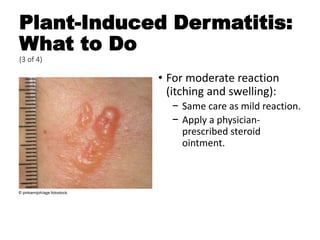
โ€ข For moderate reaction
(itching and swelling):
โˆ’ Same care as mild reaction.
โˆ’ Apply a physician-
prescribed steroid
ointment.
ยฉ pinkannjoh/age fotostock.
Plant-Induced Dermatitis:
What to Do
(4 of 4)
โ€ข For severe reaction (itching, swelling, and blisters):
โˆ’ Same care as mild reaction.
โˆ’ Apply physician-prescribed topical or oral steroid.
โˆ’ Evacuate if the person inhaled smoke from a burning plant
or if reaction involves face, eyes, genitals, or large area of
the body.
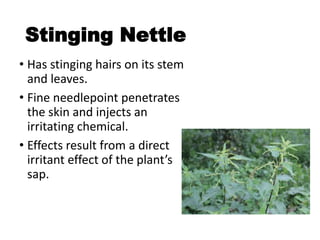
Stinging Nettle
โ€ข Has stinging hairs on its stem
and leaves.
โ€ข Fine needlepoint penetrates
the skin and injects an
irritating chemical.
โ€ข Effects result from a direct
irritant effect of the plantโ€™s
sap.
Stinging Nettle Poisoning:
What to Look For
โ€ข Effects are limited to exposed area.
โ€ข Response is usually immediate.
โ€ข Produces some degree of:
โˆ’ redness;
โˆ’ burning; and
โˆ’ itching.
Stinging Nettle Poisoning:
What to Do
โ€ข Wash area with soap and water.
โ€ข Apply cold, wet pack.
โ€ข Apply calamine lotion.
โ€ข Take an over-the-counter antihistamine.
Snake Bites
(1 of 6)
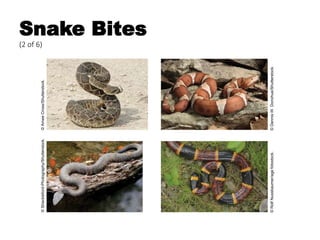
โ€ข In the United States, 7,000 to 8,000 people are bitten
by venomous snakes annually.
โ€ข There are four types of venomous snakes:
โ€ข Rattlesnake
โ€ข Copperhead
โ€ข Water moccasin (cottonmouth)
โ€ข Coral snake
Snake Bites
(2 of 6)
ยฉDennisW.Donohue/Shutterstock.ยฉRolfNussbaumer/agefotostock.
ยฉShackleford-Photography/Shutterstock.ยฉAmeeCross/Shutterstock.
Snake Bites
(3 of 6)
โ€ข Snake bites can be painful, costly, and potentially
deadly.
โ€ข Partial or complete loss of an extremity or finger or
loss of movement in a joint can occur.
โ€ข Most people recover.
Snake Bites
(4 of 6)
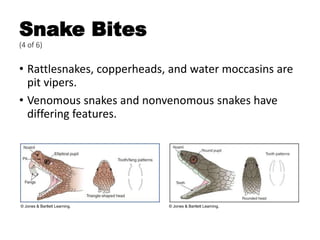
โ€ข Rattlesnakes, copperheads, and water moccasins are
pit vipers.
โ€ข Venomous snakes and nonvenomous snakes have
differing features.
ยฉ Jones & Bartlett Learning. ยฉ Jones & Bartlett Learning.
Snake Bites
(5 of 6)
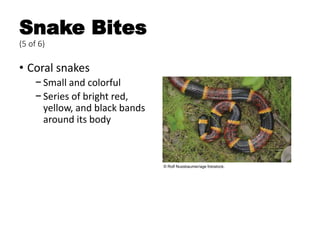
โ€ข Coral snakes
โˆ’ Small and colorful
โˆ’ Series of bright red,
yellow, and black bands
around its body
ยฉ Rolf Nussbaumer/age fotostock.
Snake Bites
(6 of 6)
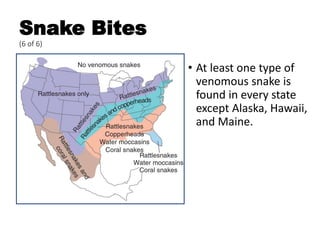
โ€ข At least one type of
venomous snake is
found in every state
except Alaska, Hawaii,
and Maine.
Pit Vipers
โ€ข Pit vipers are found in every state but Alaska,
Maine, and Hawaii.
โ€ข Rattlesnakes are the most widespread.
โ€ข Eastern and Western diamondback rattlesnakes
account for almost 95% of snakebite deaths.
Pit Viper Bites: What to
Look For
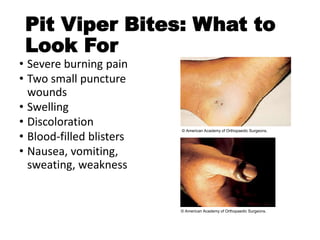
โ€ข Severe burning pain
โ€ข Two small puncture
wounds
โ€ข Swelling
โ€ข Discoloration
โ€ข Blood-filled blisters
โ€ข Nausea, vomiting,
sweating, weakness
ยฉ American Academy of Orthopaedic Surgeons.
Pit Viper Bites: What to Do
(1 of 2)
โ€ข Get the person and bystanders away from the snake.
โ€ข Do not try to capture or kill the snake.
โ€ข Encourage the person to rest, stay calm, and be still.
โ€ข Remove any rings, jewelry, or tight clothing from the
bitten body part.
Pit Viper Bites: What to Do
(2 of 2)
โ€ข Gently wash the bite with soap and running water.
โ€ข Apply a sterile dressing over the fang marks.
โ€ข Keep the bite area at the level of the heart.
โ€ข Evacuate immediately.
โ€ข When possible, carry the person
โ€ข Do not apply a pressure bandage.
Coral Snakes
โ€ข Found in Arizona, Texas, and Southeastern United
States.
โ€ข Americaโ€™s most venomous snake, but it rarely bites
people.
โ€ข Symptoms begin 1 to 5 hours after the bite.
Coral Snake Bites:
What to Look For
โ€ข Several hours may pass before the onset of:
โˆ’ minimal pain;
โˆ’ drowsiness;
โˆ’ weakness;
โˆ’ pricking, tingling of skin;
โˆ’ blurred vision;
โˆ’ difficulty swallowing;
โˆ’ sweating; and
โˆ’ mouth watering.
Coral Snake Bites:
What to Do
โ€ข Gently clean the bite with soap and water.
โ€ข Apply a wide elastic bandage using overlapping
turns and wrap upward from the end of bitten arm
or leg, covering the entire bite wound.
โ€ข Stabilize the bitten arm or leg as you would for a
broken bone. Keep it below heart level.
โ€ข Evacuate.
Nonvenomous Snakes
โ€ข Nonvenomous snakes inflict the most bites.
โ€ข Assume a snake is venomous if you donโ€™t know
what type it is.
Nonvenomous Snake Bites:
What to Look For
โ€ข Horseshoe shape of tooth marks on skin
โ€ข Bleeding
โ€ข Possible swelling, mild itching, and tenderness
Nonvenomous Snake Bites:
What to Do
โ€ข Gently clean with soap and water.
โ€ข Care for the bite as you would a shallow wound.
โ€ข Consult with a physician.
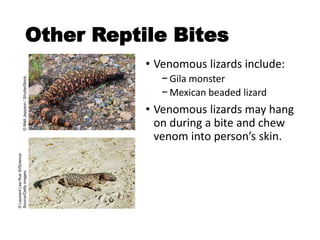
Other Reptile Bites
โ€ข Venomous lizards include:
โˆ’ Gila monster
โˆ’ Mexican beaded lizard
โ€ข Venomous lizards may hang
on during a bite and chew
venom into personโ€™s skin.
ยฉMattJeppson/ShutterStock.
ยฉLeonardLeeRueIII/Science
Source/Gettyimages.
Other Reptile Bites:
What to Look For
โ€ข Puncture wounds
โ€ข Swelling and pain
โ€ข Sweating
โ€ข Vomiting
โ€ข Increased heart rate
โ€ข Shortness of breath
Other Reptile Bites:
What to Do
โ€ข Give pain medication.
โ€ข Evacuate
โ€ข Treat bites the same as you would for a pit viper bite.
Treatment and Prevention
of Insect Bites
โ€ข Mosquitoes
โ€ข Avoid scratching to prevent open wounds
โ€ข Itching can be treated with topical agents
โ€ข Mosquitoes carry risk of many viruses/diseases
โ€ข Prevent mosquito bites at campsites with adequate
netting
โ€ข Set camps away from standing water, swamps, dense brush.
Treatment and Prevention
of Insect Bites
โ€ข Ticks
โ€ข Can carry 1 of at least 8 diseases.
โ€ข Repelled by many mosquito repellants.
โ€ข Perform body checks for ticks twice daily while
hiking/camping.
โ€ข Remove ticks immediately.
โ€ข Embedded ticks should be pulled slowly with tweezers.
General Information
โ€ข Immune system produces histamines in response to
foreign allergens.
โ€ข Allergic reaction is an overproduction of histamines.
โ€ข Allergens can be ingested, inhaled, or absorbed.
Hives:
What to Look For
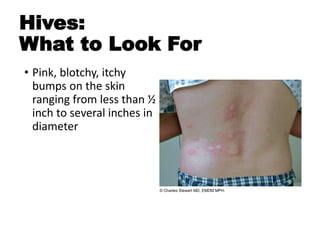
โ€ข Pink, blotchy, itchy
bumps on the skin
ranging from less than ยฝ
inch to several inches in
diameter
ยฉ Charles Stewart MD, EMDM MPH.
Assessment and Treatment of
Allergies and Anaphylaxis
โ€ข Allergic reactions can be non-life-threatening or
life-threatening.
โ€ข Non-life-threatening reactions can be treated with
antihistamines
โ€ข Anaphylaxis is severe and may produce shock
โ€ข Includes difficulty breathing, swelling of face, lips,
tongue
โ€ข Is lethal
โ€ข Reversible only by immediate injection of epinephrine
(adrenaline)
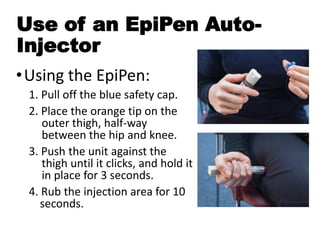
Use of an EpiPen Auto-
Injector
โ€ขUsing the EpiPen:
1. Pull off the blue safety cap.
2. Place the orange tip on the
outer thigh, half-way
between the hip and knee.
3. Push the unit against the
thigh until it clicks, and hold it
in place for 3 seconds.
4. Rub the injection area for 10
seconds.
Prevention of Allergies
and Anaphylaxis
โ€ข Trip leaders who know of anyone in their party
susceptible to severe reactions should avoid taking
known allergens on the trip.
โ€ข Individuals on trips who are susceptible to
anaphylaxis should carry at least three injections of
epinephrine.
Evacuation Guidelines
โ€ข Mild to moderate reactions can be managed in the
field and do not require evacuation.
โ€ข Anyone treated for anaphylaxis should be
evacuated rapidly.
โ€ข During evacuation, the patient should be well-
hydrated and kept on a regimen of oral
antihistamines.

7 wfa bites, stings, allergies and anaphylaxis

  • 1.
    Bites, Stings, Rashes, Allergies andAnaphylaxis Covers Chapters 17, 18, 19, & 29
  • 2.
    Plant-Induced Dermatitis โ€ข About85% of the population is sensitive to poison ivy, poison oak, and poison sumac. โ€ข The resin of these plants is a colorless or slightly yellow, light oil. โ€ข Not visible on human skin โˆ’ Spreads by direct contact โˆ’ Can stay active for months or years
  • 3.
    Poison Ivy andPoison Oak โ€ข Low bushes or climbing vines โ€ข Waxy, broad, green leaves in summer โ€ข Brown to red leaves in fall โ€ข Leaflets grow in groups of three. ยฉ Thomas Photography LLC/Alamy. ยฉ Thomas J. Peterson/Alamy.
  • 4.
    Poison Sumac โ€ข Foundin damp, swampy areas Courtesy of US Fish & Wildlife Service.
  • 5.
    Plant-Induced Dermatitis: What toLook For โ€ข Itching โ€ข Mild dermatitis โ€ข Itching and swelling โ€ข Moderate dermatitis โ€ข Itching, swelling, and blisters โ€ข Severe dermatitis
  • 6.
    Plant-Induced Dermatitis: What toDo (1 of 4) โ€ข If within 1 hour of an exposure: โˆ’ Gently wipe skin with rubbing alcohol. Do not use packaged alcohol wipes. โˆ’ Wash skin with soap and cold water. Rinse with cold water. โˆ’ Do not use gasoline.
  • 7.
    Plant-Induced Dermatitis: What toDo (2 of 4) โ€ข For mild reaction (itching): โˆ’ Apply any of the following: โ€ข Colloidal oatmeal bath โ€ข Baking soda paste โ€ข Calamine lotion โ€ข Aluminum acetate solution โ€ข Physician-prescribed medication โ€ข Over-the-counter hydrocortisone
  • 8.
    Plant-Induced Dermatitis: What toDo (3 of 4) โ€ข For moderate reaction (itching and swelling): โˆ’ Same care as mild reaction. โˆ’ Apply a physician- prescribed steroid ointment. ยฉ pinkannjoh/age fotostock.
  • 9.
    Plant-Induced Dermatitis: What toDo (4 of 4) โ€ข For severe reaction (itching, swelling, and blisters): โˆ’ Same care as mild reaction. โˆ’ Apply physician-prescribed topical or oral steroid. โˆ’ Evacuate if the person inhaled smoke from a burning plant or if reaction involves face, eyes, genitals, or large area of the body.
  • 10.
    Stinging Nettle โ€ข Hasstinging hairs on its stem and leaves. โ€ข Fine needlepoint penetrates the skin and injects an irritating chemical. โ€ข Effects result from a direct irritant effect of the plantโ€™s sap.
  • 11.
    Stinging Nettle Poisoning: Whatto Look For โ€ข Effects are limited to exposed area. โ€ข Response is usually immediate. โ€ข Produces some degree of: โˆ’ redness; โˆ’ burning; and โˆ’ itching.
  • 12.
    Stinging Nettle Poisoning: Whatto Do โ€ข Wash area with soap and water. โ€ข Apply cold, wet pack. โ€ข Apply calamine lotion. โ€ข Take an over-the-counter antihistamine.
  • 13.
    Snake Bites (1 of6) โ€ข In the United States, 7,000 to 8,000 people are bitten by venomous snakes annually. โ€ข There are four types of venomous snakes: โ€ข Rattlesnake โ€ข Copperhead โ€ข Water moccasin (cottonmouth) โ€ข Coral snake
  • 14.
    Snake Bites (2 of6) ยฉDennisW.Donohue/Shutterstock.ยฉRolfNussbaumer/agefotostock. ยฉShackleford-Photography/Shutterstock.ยฉAmeeCross/Shutterstock.
  • 15.
    Snake Bites (3 of6) โ€ข Snake bites can be painful, costly, and potentially deadly. โ€ข Partial or complete loss of an extremity or finger or loss of movement in a joint can occur. โ€ข Most people recover.
  • 16.
    Snake Bites (4 of6) โ€ข Rattlesnakes, copperheads, and water moccasins are pit vipers. โ€ข Venomous snakes and nonvenomous snakes have differing features. ยฉ Jones & Bartlett Learning. ยฉ Jones & Bartlett Learning.
  • 17.
    Snake Bites (5 of6) โ€ข Coral snakes โˆ’ Small and colorful โˆ’ Series of bright red, yellow, and black bands around its body ยฉ Rolf Nussbaumer/age fotostock.
  • 18.
    Snake Bites (6 of6) โ€ข At least one type of venomous snake is found in every state except Alaska, Hawaii, and Maine.
  • 19.
    Pit Vipers โ€ข Pitvipers are found in every state but Alaska, Maine, and Hawaii. โ€ข Rattlesnakes are the most widespread. โ€ข Eastern and Western diamondback rattlesnakes account for almost 95% of snakebite deaths.
  • 20.
    Pit Viper Bites:What to Look For โ€ข Severe burning pain โ€ข Two small puncture wounds โ€ข Swelling โ€ข Discoloration โ€ข Blood-filled blisters โ€ข Nausea, vomiting, sweating, weakness ยฉ American Academy of Orthopaedic Surgeons. ยฉ American Academy of Orthopaedic Surgeons.
  • 21.
    Pit Viper Bites:What to Do (1 of 2) โ€ข Get the person and bystanders away from the snake. โ€ข Do not try to capture or kill the snake. โ€ข Encourage the person to rest, stay calm, and be still. โ€ข Remove any rings, jewelry, or tight clothing from the bitten body part.
  • 22.
    Pit Viper Bites:What to Do (2 of 2) โ€ข Gently wash the bite with soap and running water. โ€ข Apply a sterile dressing over the fang marks. โ€ข Keep the bite area at the level of the heart. โ€ข Evacuate immediately. โ€ข When possible, carry the person โ€ข Do not apply a pressure bandage.
  • 23.
    Coral Snakes โ€ข Foundin Arizona, Texas, and Southeastern United States. โ€ข Americaโ€™s most venomous snake, but it rarely bites people. โ€ข Symptoms begin 1 to 5 hours after the bite.
  • 24.
    Coral Snake Bites: Whatto Look For โ€ข Several hours may pass before the onset of: โˆ’ minimal pain; โˆ’ drowsiness; โˆ’ weakness; โˆ’ pricking, tingling of skin; โˆ’ blurred vision; โˆ’ difficulty swallowing; โˆ’ sweating; and โˆ’ mouth watering.
  • 25.
    Coral Snake Bites: Whatto Do โ€ข Gently clean the bite with soap and water. โ€ข Apply a wide elastic bandage using overlapping turns and wrap upward from the end of bitten arm or leg, covering the entire bite wound. โ€ข Stabilize the bitten arm or leg as you would for a broken bone. Keep it below heart level. โ€ข Evacuate.
  • 26.
    Nonvenomous Snakes โ€ข Nonvenomoussnakes inflict the most bites. โ€ข Assume a snake is venomous if you donโ€™t know what type it is.
  • 27.
    Nonvenomous Snake Bites: Whatto Look For โ€ข Horseshoe shape of tooth marks on skin โ€ข Bleeding โ€ข Possible swelling, mild itching, and tenderness
  • 28.
    Nonvenomous Snake Bites: Whatto Do โ€ข Gently clean with soap and water. โ€ข Care for the bite as you would a shallow wound. โ€ข Consult with a physician.
  • 29.
    Other Reptile Bites โ€ขVenomous lizards include: โˆ’ Gila monster โˆ’ Mexican beaded lizard โ€ข Venomous lizards may hang on during a bite and chew venom into personโ€™s skin. ยฉMattJeppson/ShutterStock. ยฉLeonardLeeRueIII/Science Source/Gettyimages.
  • 30.
    Other Reptile Bites: Whatto Look For โ€ข Puncture wounds โ€ข Swelling and pain โ€ข Sweating โ€ข Vomiting โ€ข Increased heart rate โ€ข Shortness of breath
  • 31.
    Other Reptile Bites: Whatto Do โ€ข Give pain medication. โ€ข Evacuate โ€ข Treat bites the same as you would for a pit viper bite.
  • 32.
    Treatment and Prevention ofInsect Bites โ€ข Mosquitoes โ€ข Avoid scratching to prevent open wounds โ€ข Itching can be treated with topical agents โ€ข Mosquitoes carry risk of many viruses/diseases โ€ข Prevent mosquito bites at campsites with adequate netting โ€ข Set camps away from standing water, swamps, dense brush.
  • 33.
    Treatment and Prevention ofInsect Bites โ€ข Ticks โ€ข Can carry 1 of at least 8 diseases. โ€ข Repelled by many mosquito repellants. โ€ข Perform body checks for ticks twice daily while hiking/camping. โ€ข Remove ticks immediately. โ€ข Embedded ticks should be pulled slowly with tweezers.
  • 34.
    General Information โ€ข Immunesystem produces histamines in response to foreign allergens. โ€ข Allergic reaction is an overproduction of histamines. โ€ข Allergens can be ingested, inhaled, or absorbed.
  • 35.
    Hives: What to LookFor โ€ข Pink, blotchy, itchy bumps on the skin ranging from less than ยฝ inch to several inches in diameter ยฉ Charles Stewart MD, EMDM MPH.
  • 36.
    Assessment and Treatmentof Allergies and Anaphylaxis โ€ข Allergic reactions can be non-life-threatening or life-threatening. โ€ข Non-life-threatening reactions can be treated with antihistamines โ€ข Anaphylaxis is severe and may produce shock โ€ข Includes difficulty breathing, swelling of face, lips, tongue โ€ข Is lethal โ€ข Reversible only by immediate injection of epinephrine (adrenaline)
  • 37.
    Use of anEpiPen Auto- Injector โ€ขUsing the EpiPen: 1. Pull off the blue safety cap. 2. Place the orange tip on the outer thigh, half-way between the hip and knee. 3. Push the unit against the thigh until it clicks, and hold it in place for 3 seconds. 4. Rub the injection area for 10 seconds.
  • 38.
    Prevention of Allergies andAnaphylaxis โ€ข Trip leaders who know of anyone in their party susceptible to severe reactions should avoid taking known allergens on the trip. โ€ข Individuals on trips who are susceptible to anaphylaxis should carry at least three injections of epinephrine.
  • 39.
    Evacuation Guidelines โ€ข Mildto moderate reactions can be managed in the field and do not require evacuation. โ€ข Anyone treated for anaphylaxis should be evacuated rapidly. โ€ข During evacuation, the patient should be well- hydrated and kept on a regimen of oral antihistamines.

Editor's Notes

  • #2ย 30 minutes Reference Chapter 29, Allergies and Anaphylaxis
  • #37ย Injectable epinephrine is available commercially, and by prescription only, in spring-loaded syringes that function when pressed into the thigh. You may need to assist someone with the injection. Injections can be repeated if the first one fails or a relapse occurs.
  • #38ย After injection of epinephrine, and when the patient can breathe and swallow easily, an oral antihistamine should be given, following the directions on the label, to continue suppressing the overproduction of histamines. Keep the patient well-hydrated.