SAFETY IN
THE FIELD
SCHOOL OF FOREST RESOURCES & CONSERVATION
SAFETY IS IMPORTANT
Before you go out into the woods, you should be aware of
the following:
Personal Protective Equipment
Weather Precautions
Poisonous Plants
Insects and Disease
Venomous Snakes
What to do if someone is hurt
PERSONAL PROTECTIVE
EQUIPMENT
Safety Glasses
Gloves
Eyewear
Head Protection
Boots
Snake Chaps
Remember your orange vests
during hunting season!
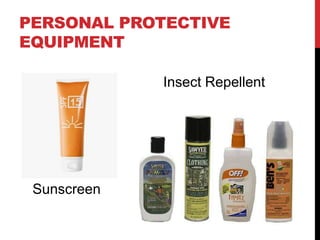
PERSONAL PROTECTIVE
EQUIPMENT
Sunscreen
Insect Repellent
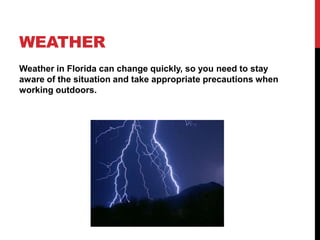
WEATHER
Weather in Florida can change quickly, so you need to stay
aware of the situation and take appropriate precautions when
working outdoors.
WEATHER: LIGHTNING
Beyond Thunder Dumb
Florida is the lightning capital of the world!
Most fatal strikes occur BEFORE the storm begins.
Lightning usually strikes the tallest object IF that object is a good conductor of
electricity. Human bodies are good conductors.
If you are caught in a storm, remember:
1) Remove all metal from your person and place it away from you
2) Crouch low where you are not the tallest or near the tallest object.
3) Do not crowd together with anyone else, and do not lie down!
WEATHER: RAIN
Storms don’t only bring lightning: Heavy rain can cause
danger of impassable (muddy) roads, or falling trees
Trees: https://www.youtube.com/watch?v=Pg-BoChR2xE
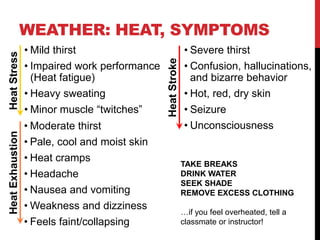
WEATHER: HEAT
Three levels of heat illness:
Stress, Exhaustion, Stroke
Medical emergency!
• Mild thirst
• Impaired work performance
(Heat fatigue)
• Heavy sweating
• Minor muscle “twitches”
• Severe thirst
• Confusion, hallucinations,
and bizarre behavior
• Hot, red, dry skin
• Seizure
• Unconsciousness
Heat
Stress
Heat
Exhaustion
Heat
Stroke
• Moderate thirst
• Pale, cool and moist skin
• Heat cramps
• Headache
• Nausea and vomiting
• Weakness and dizziness
• Feels faint/collapsing
WEATHER: HEAT, SYMPTOMS
TAKE BREAKS
DRINK WATER
SEEK SHADE
REMOVE EXCESS CLOTHING
…if you feel overheated, tell a
classmate or instructor!
POISONOUS PLANTS
Poison Ivy
Poison Oak
Poison Sumac
LEAVES OF THREE, LET IT BE!
POISONOUS PLANTS
How to avoid regret? Wear long pants, sleeves, and gloves!
What to do if you can’t avoid it, or you forgot the cute slogan:
• Rinse off the oil with COLD running water as soon as you
can
• Clean exposed skin with rubbing alcohol
• Apply a treatment cream
Video: http://www.youtube.com/watch?v=1pIspD66ZZw
Good read: http://gizmodo.com/5906128/why-poison-oak-is-the-fing-
worst
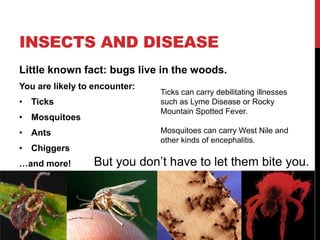
INSECTS AND DISEASE
Little known fact: bugs live in the woods.
You are likely to encounter:
• Ticks
• Mosquitoes
• Ants
• Chiggers
…and more!
Ticks can carry debilitating illnesses
such as Lyme Disease or Rocky
Mountain Spotted Fever.
Mosquitoes can carry West Nile and
other kinds of encephalitis.
But you don’t have to let them bite you.
INSECTS AND DISEASE
Tick video – Bloodsucking Ninjas of Summer
Prevention of ticks and bug bites:
• Use repellent! (but ticks may still bite)
• Wear light colors and long sleeves/pants
• Inspect yourself after field work, especially
“creased areas” of the body
If you are allergic, tell your instructor before you
go into the field.
What should you do if you find one that has bitten you?
INSECTS: TICKS
Dealing with a “bite incident”
Immediately remove attached ticks using tweezers, grasping as close to the skin as
possible
• Keep the detached tick, record date, work location, and bite location
in your tick log, and verified by supervisor.
• Disinfect the bitten area immediately and wash your hands
• If a bull’s eye rash or any other symptoms develop, seek medical
attention promptly.
• Lyme disease: tiredness, stiff neck, fever, muscle aches, joint pain
• RMSF: sudden fever, headaches, possible rash around ankles/wrists
VENOMOUS SNAKES
Florida has several important species of venomous
snakes
• Pit vipers: rattlesnakes, cottonmouths,
copperheads
• Hemotoxins in venom cause bleeding, intense
pain, and muscle symptoms
• Coral snakes
• Neurotoxin in venom causes minimal pain, and
late onset of abdominal pains, breathing
difficulties, mental symptoms
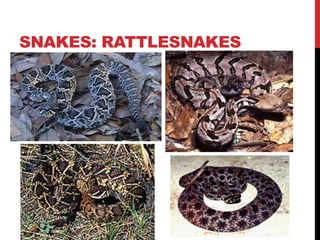
SNAKES: RATTLESNAKES
SNAKES:
COTTONMOUTH/COPPERHEADS
SNAKES: CORAL SNAKES
NOT coral snakes:
Red and yellow will kill a fellow!
SNAKES: IF YOU ARE BITTEN
• No ice or other cooling agent on the bite.
• No tourniquets.
• No incisions in the wound.
• Suction devices are not recommended.
• No eating, drinking, especially alcohol.
• No running or engaging in strenuous activities.
An increase in heart rate will move the venom
through your bloodstream faster.
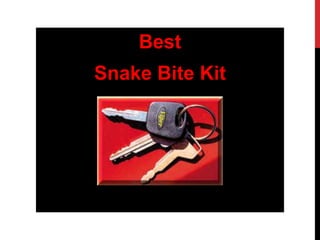
Best
Snake Bite Kit
SNAKES: GENERAL RULES
#1 Rule: LEAVE SNAKES ALONE
• Wear snake leggings
• Watch where you put your hands and feet.
• Exercise good judgment.
• Don’t bother them, even if they are “dead.”
–Two-thirds of people bitten in the US saw the snake
before being bitten but attempted to kill, collect, or
harass it.
–Don’t kill snakes. People are bitten by snakes while
trying to kill them.
FIRST AID GUIDELINES
#1 Rule: If it seems serious, CALL 911 FIRST!
Assess scene and victim
Alert (call 911)
Attend to the Airway, Breathing, and Circulation
Report any injuries to your instructor promptly.
Burns: cool the area, cover with moist sterile gauze ONLY.
Wounds or cuts: apply pressure until bleeding stops or you are at the
hospital.
Puncture wounds: do not remove object from wound.
Eye injury: seek medical attention – leave it alone!
Snake bite: identify snake, stay calm/don’t move, get to hospital.
DON’T BE DUMB
Staying safe is easy: USE COMMON SENSE.
Dealing with injuries and accidents in the field is
complicated, but prevention is simple!
Stay close to your group or partner, stay aware of your
surroundings, and use precaution in the form of PPE,
repellents, don’t work outdoors in a storm, etc.

safety.pptx

  • 1.
    SAFETY IN THE FIELD SCHOOLOF FOREST RESOURCES & CONSERVATION
  • 2.
    SAFETY IS IMPORTANT Beforeyou go out into the woods, you should be aware of the following: Personal Protective Equipment Weather Precautions Poisonous Plants Insects and Disease Venomous Snakes What to do if someone is hurt
  • 3.
    PERSONAL PROTECTIVE EQUIPMENT Safety Glasses Gloves Eyewear HeadProtection Boots Snake Chaps Remember your orange vests during hunting season!
  • 4.
  • 5.
    WEATHER Weather in Floridacan change quickly, so you need to stay aware of the situation and take appropriate precautions when working outdoors.
  • 6.
    WEATHER: LIGHTNING Beyond ThunderDumb Florida is the lightning capital of the world! Most fatal strikes occur BEFORE the storm begins. Lightning usually strikes the tallest object IF that object is a good conductor of electricity. Human bodies are good conductors. If you are caught in a storm, remember: 1) Remove all metal from your person and place it away from you 2) Crouch low where you are not the tallest or near the tallest object. 3) Do not crowd together with anyone else, and do not lie down!
  • 7.
    WEATHER: RAIN Storms don’tonly bring lightning: Heavy rain can cause danger of impassable (muddy) roads, or falling trees Trees: https://www.youtube.com/watch?v=Pg-BoChR2xE
  • 8.
    WEATHER: HEAT Three levelsof heat illness: Stress, Exhaustion, Stroke Medical emergency!
  • 9.
    • Mild thirst •Impaired work performance (Heat fatigue) • Heavy sweating • Minor muscle “twitches” • Severe thirst • Confusion, hallucinations, and bizarre behavior • Hot, red, dry skin • Seizure • Unconsciousness Heat Stress Heat Exhaustion Heat Stroke • Moderate thirst • Pale, cool and moist skin • Heat cramps • Headache • Nausea and vomiting • Weakness and dizziness • Feels faint/collapsing WEATHER: HEAT, SYMPTOMS TAKE BREAKS DRINK WATER SEEK SHADE REMOVE EXCESS CLOTHING …if you feel overheated, tell a classmate or instructor!
  • 10.
    POISONOUS PLANTS Poison Ivy PoisonOak Poison Sumac LEAVES OF THREE, LET IT BE!
  • 12.
    POISONOUS PLANTS How toavoid regret? Wear long pants, sleeves, and gloves! What to do if you can’t avoid it, or you forgot the cute slogan: • Rinse off the oil with COLD running water as soon as you can • Clean exposed skin with rubbing alcohol • Apply a treatment cream Video: http://www.youtube.com/watch?v=1pIspD66ZZw Good read: http://gizmodo.com/5906128/why-poison-oak-is-the-fing- worst
  • 13.
    INSECTS AND DISEASE Littleknown fact: bugs live in the woods. You are likely to encounter: • Ticks • Mosquitoes • Ants • Chiggers …and more! Ticks can carry debilitating illnesses such as Lyme Disease or Rocky Mountain Spotted Fever. Mosquitoes can carry West Nile and other kinds of encephalitis. But you don’t have to let them bite you.
  • 14.
    INSECTS AND DISEASE Tickvideo – Bloodsucking Ninjas of Summer Prevention of ticks and bug bites: • Use repellent! (but ticks may still bite) • Wear light colors and long sleeves/pants • Inspect yourself after field work, especially “creased areas” of the body If you are allergic, tell your instructor before you go into the field. What should you do if you find one that has bitten you?
  • 15.
    INSECTS: TICKS Dealing witha “bite incident” Immediately remove attached ticks using tweezers, grasping as close to the skin as possible • Keep the detached tick, record date, work location, and bite location in your tick log, and verified by supervisor. • Disinfect the bitten area immediately and wash your hands • If a bull’s eye rash or any other symptoms develop, seek medical attention promptly. • Lyme disease: tiredness, stiff neck, fever, muscle aches, joint pain • RMSF: sudden fever, headaches, possible rash around ankles/wrists
  • 16.
    VENOMOUS SNAKES Florida hasseveral important species of venomous snakes • Pit vipers: rattlesnakes, cottonmouths, copperheads • Hemotoxins in venom cause bleeding, intense pain, and muscle symptoms • Coral snakes • Neurotoxin in venom causes minimal pain, and late onset of abdominal pains, breathing difficulties, mental symptoms
  • 17.
  • 18.
  • 19.
    SNAKES: CORAL SNAKES NOTcoral snakes: Red and yellow will kill a fellow!
  • 20.
    SNAKES: IF YOUARE BITTEN • No ice or other cooling agent on the bite. • No tourniquets. • No incisions in the wound. • Suction devices are not recommended. • No eating, drinking, especially alcohol. • No running or engaging in strenuous activities. An increase in heart rate will move the venom through your bloodstream faster.
  • 21.
  • 22.
    SNAKES: GENERAL RULES #1Rule: LEAVE SNAKES ALONE • Wear snake leggings • Watch where you put your hands and feet. • Exercise good judgment. • Don’t bother them, even if they are “dead.” –Two-thirds of people bitten in the US saw the snake before being bitten but attempted to kill, collect, or harass it. –Don’t kill snakes. People are bitten by snakes while trying to kill them.
  • 23.
    FIRST AID GUIDELINES #1Rule: If it seems serious, CALL 911 FIRST! Assess scene and victim Alert (call 911) Attend to the Airway, Breathing, and Circulation Report any injuries to your instructor promptly. Burns: cool the area, cover with moist sterile gauze ONLY. Wounds or cuts: apply pressure until bleeding stops or you are at the hospital. Puncture wounds: do not remove object from wound. Eye injury: seek medical attention – leave it alone! Snake bite: identify snake, stay calm/don’t move, get to hospital.
  • 24.
    DON’T BE DUMB Stayingsafe is easy: USE COMMON SENSE. Dealing with injuries and accidents in the field is complicated, but prevention is simple! Stay close to your group or partner, stay aware of your surroundings, and use precaution in the form of PPE, repellents, don’t work outdoors in a storm, etc.