BEE STING
MANAGEMENT
By
NIDHIL NARAYANAN
TBILISI STATE MEDICAL UNIVERSITY
INTRODUCTION
• A bee sting is a wound caused by the stinger from a bee (honey
bee, bumblebee, sweat bee, etc.) being injected into one's flesh. The
stings of most of these species can be quite painful, and are therefore
keenly avoided by many people.
• Bee stings differ from insect bites, and the venom or toxin of
stinging insects is quite different. Therefore, the body's reaction to a
bee sting may differ significantly from one species to another. In
particular, bee stings are acidic, whereas wasp stings are alkaline, so
the body's reaction to a bee sting may be very different from its
reaction to a wasp sting.
Reactions to Bee Stings
Three major types of reactions:
Fortunately, bee keepers tend to become less reactive with the passage of time if
they receive stings intermittently.
Mild local reactions.
Strong local reactions.
Allergic reactions.
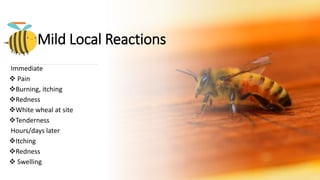
Mild Local Reactions
Immediate
 Pain
Burning, itching
Redness
White wheal at site
Tenderness
Hours/days later
Itching
Redness
 Swelling
Strong Local Reactions
1. Massive swelling around the site of the sting.
2. Increasing swelling with passage of time.
3. Can last up to a week without treatment.
Allergic
Reactions
Three Types:
I. Cutaneous allergic reactions
II. Non-life-threatening systemic allergic
reactions
III. Life-threatening allergic reactions
All forms of allergic reactions should be
taken very seriously.
Cutaneous Allergic
Reactions
Hives or nettle rash
anywhere on body.
Massive swelling remote
from sting site.
Generalized itching of the
skin.
Generalized redness of skin
away from sting.
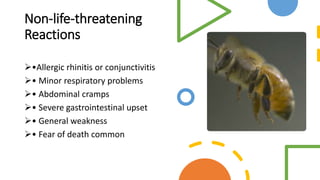
Non-life-threatening
Reactions
•Allergic rhinitis or conjunctivitis
• Minor respiratory problems
• Abdominal cramps
• Severe gastrointestinal upset
• General weakness
• Fear of death common
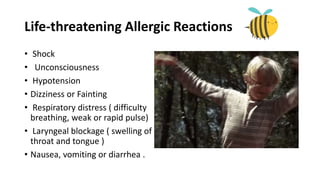
Life-threatening Allergic Reactions
• Shock
• Unconsciousness
• Hypotension
• Dizziness or Fainting
• Respiratory distress ( difficulty
breathing, weak or rapid pulse)
• Laryngeal blockage ( swelling of
throat and tongue )
• Nausea, vomiting or diarrhea .
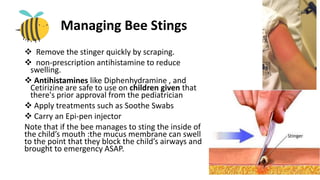
Managing Bee Stings
 Remove the stinger quickly by scraping.
 non-prescription antihistamine to reduce
swelling.
 Antihistamines like Diphenhydramine , and
Cetirizine are safe to use on children given that
there's prior approval from the pediatrician
 Apply treatments such as Soothe Swabs
 Carry an Epi-pen injector
Note that if the bee manages to sting the inside of
the child’s mouth :the mucus membrane can swell
to the point that they block the child’s airways and
brought to emergency ASAP.
Treatment for minor reactions
• If you can, remove the stinger as soon as possible, such as by
scraping it off with a fingernail.
• Don't try to remove a stinger below the skin surface.
• A stinger may not be present, as only bees leave their
stingers. Other stinging insects, such as wasps, do not.
• Wash the sting area with soap and water.
• Apply a cold compress.
Treatment
for moderate
reactions
• The following steps may help ease the swelling and itching often
associated with large local reactions:
• If you can, remove the stinger as soon as possible, such as by
scraping it off with a fingernail.
• Wash the affected area with soap and water.
• Apply a cold compress.
• Take an over-the-counter pain reliever as needed. You might try
ibuprofen (Advil, Motrin IB, others) to help ease discomfort.
• If the sting is on an arm or leg, elevate it.
• Apply hydrocortisone cream or calamine lotion to ease redness,
itching or swelling.
• If itching or swelling is bothersome, take an oral antihistamine
that contains diphenhydramine (Benadryl) or chlorpheniramine.
• Avoid scratching the sting area. This will worsen itching and
swelling and increase your risk of infection.
Cold Pack for Pain:
• Do this for 20 minutes.
Pain Medicine:
• To help with the pain, give an acetaminophen product (such as Tylenol).
• Another choice is an ibuprofen (should not be given to children less than 6 months) product.
• Use as needed.
Steroid Cream for Itching:
• For itching or swelling, put 1% hydrocortisone cream or calamine lotion on the sting.
• Its important deal with any itchiness so the child isn’t tempted to scratch . Beestings are an open
wound – an invitation for infection causing bacteria to sneak in .
• No prescription is needed.
• Use 3 times per day.
Allergy Medicine for Itching:
severe itching, give a dose of Benadryl.
What to Expect:
• Severe pain or burning at the site lasts 1 to 2 hours.
• Normal swelling from venom can increase for 48 hours after the sting.
• The redness can last 3 days.
• The swelling can last 7 days.
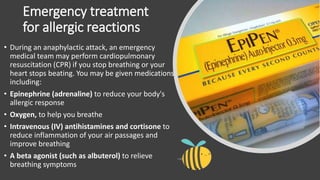
Emergency treatment
for allergic reactions
• During an anaphylactic attack, an emergency
medical team may perform cardiopulmonary
resuscitation (CPR) if you stop breathing or your
heart stops beating. You may be given medications
including:
• Epinephrine (adrenaline) to reduce your body's
allergic response
• Oxygen, to help you breathe
• Intravenous (IV) antihistamines and cortisone to
reduce inflammation of your air passages and
improve breathing
• A beta agonist (such as albuterol) to relieve
breathing symptoms
Avoiding Bee Stings
 Don't give you child sweets when he/ she is out
side
 Teach your tot don’t to swat at bees and other
bugs : some will sting they fell threatened –
even by a pint - sized palm
 If you have to be in an area where bees abound
, dress your child in long sleevs , pants , shoes
and a hat .
 If you know that your child is allergic to bees ,
keep and epi-pen handy all times .
 Steer clear of area where bee might gather ,
such as around garbage , trees with lots of
fallen fruit underneath them or a dog
poop.( the flies that flit around feces can
attract wasps.)
MCQs
• All of the following include emergency treatment for allergic reation
after a bee sting except
a) IV antihistamines and cortisone
b) Beta agonist (albuterol)
c) Acetoamenophen
d) Oxygen
e) Epinephrin
• If a bee stings you, leave the stinger alone and don't try to remove it.
A. True
B. False
• A paste of baking soda and water applied to the site of the sting may
help relieve the pain.
A. True
B. False
• One effective way to prevent bee stings is to use an insect spray or
repellent.
A. True
B. False
Bee sting MANAGEMENT

Bee sting MANAGEMENT

  • 1.
  • 2.
    INTRODUCTION • A beesting is a wound caused by the stinger from a bee (honey bee, bumblebee, sweat bee, etc.) being injected into one's flesh. The stings of most of these species can be quite painful, and are therefore keenly avoided by many people. • Bee stings differ from insect bites, and the venom or toxin of stinging insects is quite different. Therefore, the body's reaction to a bee sting may differ significantly from one species to another. In particular, bee stings are acidic, whereas wasp stings are alkaline, so the body's reaction to a bee sting may be very different from its reaction to a wasp sting.
  • 4.
    Reactions to BeeStings Three major types of reactions: Fortunately, bee keepers tend to become less reactive with the passage of time if they receive stings intermittently. Mild local reactions. Strong local reactions. Allergic reactions.
  • 5.
    Mild Local Reactions Immediate Pain Burning, itching Redness White wheal at site Tenderness Hours/days later Itching Redness  Swelling
  • 6.
    Strong Local Reactions 1.Massive swelling around the site of the sting. 2. Increasing swelling with passage of time. 3. Can last up to a week without treatment.
  • 7.
    Allergic Reactions Three Types: I. Cutaneousallergic reactions II. Non-life-threatening systemic allergic reactions III. Life-threatening allergic reactions All forms of allergic reactions should be taken very seriously.
  • 8.
    Cutaneous Allergic Reactions Hives ornettle rash anywhere on body. Massive swelling remote from sting site. Generalized itching of the skin. Generalized redness of skin away from sting.
  • 9.
    Non-life-threatening Reactions •Allergic rhinitis orconjunctivitis • Minor respiratory problems • Abdominal cramps • Severe gastrointestinal upset • General weakness • Fear of death common
  • 10.
    Life-threatening Allergic Reactions •Shock • Unconsciousness • Hypotension • Dizziness or Fainting • Respiratory distress ( difficulty breathing, weak or rapid pulse) • Laryngeal blockage ( swelling of throat and tongue ) • Nausea, vomiting or diarrhea .
  • 11.
    Managing Bee Stings Remove the stinger quickly by scraping.  non-prescription antihistamine to reduce swelling.  Antihistamines like Diphenhydramine , and Cetirizine are safe to use on children given that there's prior approval from the pediatrician  Apply treatments such as Soothe Swabs  Carry an Epi-pen injector Note that if the bee manages to sting the inside of the child’s mouth :the mucus membrane can swell to the point that they block the child’s airways and brought to emergency ASAP.
  • 12.
    Treatment for minorreactions • If you can, remove the stinger as soon as possible, such as by scraping it off with a fingernail. • Don't try to remove a stinger below the skin surface. • A stinger may not be present, as only bees leave their stingers. Other stinging insects, such as wasps, do not. • Wash the sting area with soap and water. • Apply a cold compress.
  • 13.
    Treatment for moderate reactions • Thefollowing steps may help ease the swelling and itching often associated with large local reactions: • If you can, remove the stinger as soon as possible, such as by scraping it off with a fingernail. • Wash the affected area with soap and water. • Apply a cold compress. • Take an over-the-counter pain reliever as needed. You might try ibuprofen (Advil, Motrin IB, others) to help ease discomfort. • If the sting is on an arm or leg, elevate it. • Apply hydrocortisone cream or calamine lotion to ease redness, itching or swelling. • If itching or swelling is bothersome, take an oral antihistamine that contains diphenhydramine (Benadryl) or chlorpheniramine. • Avoid scratching the sting area. This will worsen itching and swelling and increase your risk of infection.
  • 14.
    Cold Pack forPain: • Do this for 20 minutes. Pain Medicine: • To help with the pain, give an acetaminophen product (such as Tylenol). • Another choice is an ibuprofen (should not be given to children less than 6 months) product. • Use as needed. Steroid Cream for Itching: • For itching or swelling, put 1% hydrocortisone cream or calamine lotion on the sting. • Its important deal with any itchiness so the child isn’t tempted to scratch . Beestings are an open wound – an invitation for infection causing bacteria to sneak in . • No prescription is needed. • Use 3 times per day. Allergy Medicine for Itching: severe itching, give a dose of Benadryl. What to Expect: • Severe pain or burning at the site lasts 1 to 2 hours. • Normal swelling from venom can increase for 48 hours after the sting. • The redness can last 3 days. • The swelling can last 7 days.
  • 15.
    Emergency treatment for allergicreactions • During an anaphylactic attack, an emergency medical team may perform cardiopulmonary resuscitation (CPR) if you stop breathing or your heart stops beating. You may be given medications including: • Epinephrine (adrenaline) to reduce your body's allergic response • Oxygen, to help you breathe • Intravenous (IV) antihistamines and cortisone to reduce inflammation of your air passages and improve breathing • A beta agonist (such as albuterol) to relieve breathing symptoms
  • 16.
    Avoiding Bee Stings Don't give you child sweets when he/ she is out side  Teach your tot don’t to swat at bees and other bugs : some will sting they fell threatened – even by a pint - sized palm  If you have to be in an area where bees abound , dress your child in long sleevs , pants , shoes and a hat .  If you know that your child is allergic to bees , keep and epi-pen handy all times .  Steer clear of area where bee might gather , such as around garbage , trees with lots of fallen fruit underneath them or a dog poop.( the flies that flit around feces can attract wasps.)
  • 17.
    MCQs • All ofthe following include emergency treatment for allergic reation after a bee sting except a) IV antihistamines and cortisone b) Beta agonist (albuterol) c) Acetoamenophen d) Oxygen e) Epinephrin
  • 18.
    • If abee stings you, leave the stinger alone and don't try to remove it. A. True B. False • A paste of baking soda and water applied to the site of the sting may help relieve the pain. A. True B. False • One effective way to prevent bee stings is to use an insect spray or repellent. A. True B. False