Survival First Aid Awareness Survival Advanced CUO Tonya Gentry-Brown Mar 2011
Objectives Describe the symptoms and basic treatment for: Common injuries, cuts, bruises and sprains Stings and bites Broken bones Bleeding Burns Snake bite Hyperthermia and frostbite Heat stress and sunstroke Dehydration, and Shock
Introduction Extra care to avoid injury and illness Learn to improvise when applying First Aid Methods can be varied based on different circumstances Need to use initiative to make the treatment suit
Minor Injuries Cuts, bruising and sprains Must not be taken lightly Broken skin (cuts and lacerations) can easily become infected causing secondary problems Open wounds must: Thoroughly cleaned (boiled and salted water) Disinfected ( applied around wound) covered
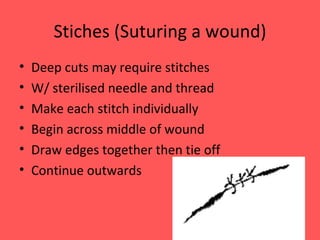
Stiches (Suturing a wound) Deep cuts may require stitches W/ sterilised needle and thread Make each stitch individually Begin across middle of wound Draw edges together then tie off Continue outwards
Bruises Caused by blow or fall against hard object Causing bleeding into deep tissue Can be known as closed tissue wound Bad bruising treatment is cold compress Ice (if available) for 15-20mins Rest and if on limb, elevate
Sprains Usually wrist, fingers or ankle When joint is forced into an unusual position Treat as you would bruising Apply firm bandage at joint Ice over bandage for 20 mins Injury recovery usually 24-28 hours Raise injured part to reduce swelling
Blisters Leave alone Prevention is best (e.g. Break boots in prior to camp) If inside shoe  Prevent further rubbing w/ sticking plaster Change socks daily Beware of hot spots
Bleeding Effects of serious blood loss almost simultaneous Cause shock very quickly In Young Adults the loss of 0.5L (dizziness) 1L (faintness) 1.5L (collapse) 2.2L (possible fatality)
Main Types of Bleeding Arterial Venous Capillary Internal
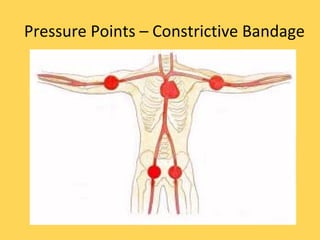
Arterial Bleeding Pumps out in powerful spurts In time w/ victim’s pulse rate Most serious type Must be treated promptly Controlling Bleeding Apply pressure to points of artery Or use a constrictive bandage
Using Constrictive Bandage Strip of firm cloth (7.5cm wide, 75cm long) Improvise with clothing or triangular bandage Bind firmly above bleeding point until pulse can’t be felt beyond bandage. Tie Firmly. Note time of application After 30mins release bandage No bleeding – remove Bleeding reapply check every 30 mins Ensure bandage is visible and inform medical aid of location and time of application
Venous Bleeding Blood darker, flow slower Bit more time to treat Apply pressure directly over Use padded bandage Or shell dressing When bleeding under control Bind firmly in place Later, when bleeding stopped Clean, sterilise and dress
Capillary Bleeding Only appears in drops from small blood vessels near surface Usually clot fairly quickly Should be dressed and treated as for a minor cut
Internal Bleeding Occurs as a result of a deep wound, violent blow to body and from fractures to bones Symptoms Bruising of skin Blood in urine/faeces Vomiting or coughing up blood Treatment Constant nursing attention Lay down, legs slightly raised, loosen tight clothing Do not give anything by mouth
Treatment for External Bleeding Pick off any foreign bodies and wipe off with dressing Wash wound and area around it Press sides of wound together Place sterile pad or adhesive dressing Apply pressure by hand or bandage Clean folded handkerchief sterilised w/ boiling water or alcohol Don’t give patient any stimulant until bleeding has stopped, keep them quiet and reassured
Pressure Points – Constrictive Bandage
Snake Bite All bites should be taken seriously Prevention is best defence If in known snake country - dress accordingly Protect legs and feet (especially if moving through shrubs or long grass) Snakes are masters of camouflage – often very hard to detect
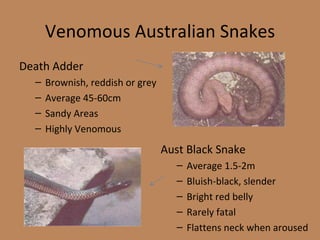
Venomous Australian Snakes Death Adder Brownish, reddish or grey Average 45-60cm Sandy Areas Highly Venomous Aust Black Snake Average 1.5-2m Bluish-black, slender Bright red belly Rarely fatal Flattens neck when aroused
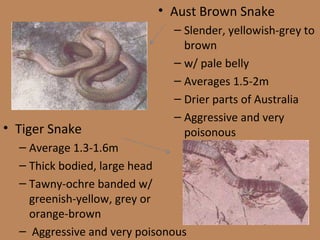
Aust Brown Snake Slender, yellowish-grey to brown w/ pale belly Averages 1.5-2m Drier parts of Australia Aggressive and very poisonous Tiger Snake Average 1.3-1.6m Thick bodied, large head Tawny-ochre banded w/ greenish-yellow, grey or orange-brown Aggressive and very poisonous
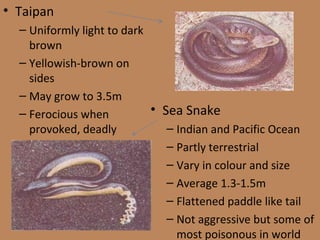
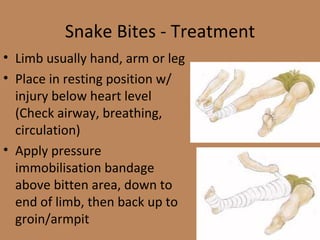
Taipan Uniformly light to dark brown Yellowish-brown on sides May grow to 3.5m Ferocious when provoked, deadly Sea Snake Indian and Pacific Ocean Partly terrestrial Vary in colour and size Average 1.3-1.5m Flattened paddle like tail Not aggressive but some of most poisonous in world
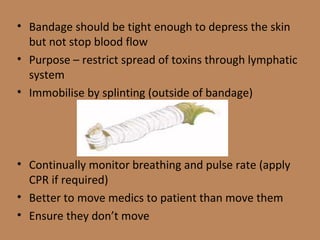
Snake Bites - Treatment Limb usually hand, arm or leg Place in resting position w/ injury below heart level (Check airway, breathing, circulation) Apply pressure immobilisation bandage above bitten area, down to end of limb, then back up to groin/armpit
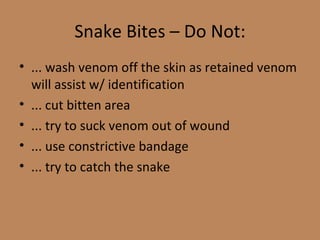
Bandage should be tight enough to depress the skin but not stop blood flow Purpose – restrict spread of toxins through lymphatic system Immobilise by splinting (outside of bandage) Continually monitor breathing and pulse rate (apply CPR if required) Better to move medics to patient than move them Ensure they don’t move
... wash venom off the skin as retained venom will assist w/ identification ... cut bitten area ... try to suck venom out of wound ... use constrictive bandage ... try to catch the snake Snake Bites – Do Not:
Sting and Bites Most insect bites painful but not life threatening (w/ exception or Funnel Web and Red Back) Symptoms and treatment for 5 most common
Bee Stings barbed end, usually left behind in flesh w/ venom sac attached Sting – immediate pain, causes area to become red and puffy Avoid injecting more venom – scrape sting sideways w/ knife blade (DON’T PINCH OUT) After sting is removed Wipe area clean Apply cold compress and/or pain relief agent (‘Stingoes’)
Bee – In case of allergic reaction If has history or shows following reactions Rash, lumps on skin, swelling of throat or wheezing Treat as follows Check responses, airway, breathing, circulation Apply pressure bandage and immobilise Attempt evacuation Periodically observe and record pulse and breathing Medication administered immediately Carry out CR if breathing/circulation stops
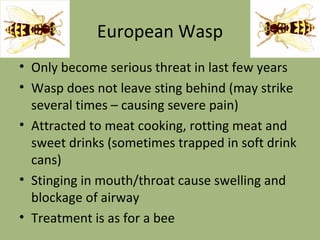
European Wasp Only become serious threat in last few years Wasp does not leave sting behind (may strike several times – causing severe pain) Attracted to meat cooking, rotting meat and sweet drinks (sometimes trapped in soft drink cans) Stinging in mouth/throat cause swelling and blockage of airway Treatment is as for a bee
Tick Prevalent in most parts of Australia (species that causes paralysis - mainly eastern coastal) Usually attach in folds of skin or body crevices Most human cases bite causes discomfort or local irritation of skin Can cause paralysis (especially in small children) Symptoms of serious tick bite Weakness of upper face and eyelids Weakness in upper limbs Weakness of muscles which aid breathing
Ticks – Bite Management If in ear cavity kill tick and seek medical aid Drop of turpentine/kerosene/methylated spirits directly on body Removing tick Do not squeeze body Slide pair of scissors/tweezers either side of head and draw out Do not leave mouth parts in victim Search for more ticks (pay attn to hair, ears, under arms and other crevices) Do not apply pressure immobilisation
Scorpion Australian species usually not life threatening but do cause severe pain Symptoms Immediate sense of burning pain Throbbing and later numbness Treatment Apply cold pack or compress Seek medical Aid
Funnel Web Spider Mainly Sydney and coastal areas of NSW Inhabits rock crevices, burrows, under houses, bushes/trees Symptoms Intense pain around area Nausea, abdominal pain, breathing difficulty, numbness, muscular weakness Excessive saliva, noisy breathing, weeping from eyes,  cold skin, shivering Treatment as for snake bite
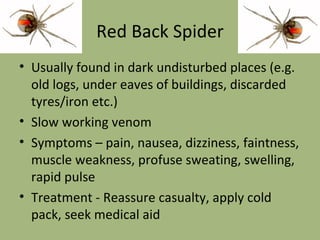
Red Back Spider Usually found in dark undisturbed places (e.g. old logs, under eaves of buildings, discarded tyres/iron etc.) Slow working venom Symptoms – pain, nausea, dizziness,  faintness, muscle weakness, profuse sweating, swelling, rapid pulse Treatment - Reassure casualty, apply cold pack, seek medical aid
Fractures Types, causes, symptoms and treatment concerning fractures are many and varied Three common types Closed Fracture (broken through but not penetrated) Open Fracture (broken bone protruded through) Complicated Fracture (w/ associated injury to major nerve, blood vessels or vital organ) No attempt should be made to force fracture back in place
Fractures - Symptoms Pain Swelling Deformity in area Loss of Function Bleeding (if open) Possible shock
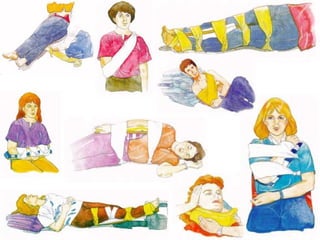
Fracture - Treatment Should be evacuated In survival situation – nursing care probably best Make casualty comfortable Check pulse and circulation of injured limb Stop bleeding (if wound or open) Splint and immobilise Treat for shock
 
Burns 3 stages of burns will have varying effects Deep burns - contact w/ flame - causes charring and destruction of tissue/bone Little initial pain – often due to nerve endings being seared Superficial Burns – flesh not destroyed but will redden and possibly blister Usually very painful, may cause shock Scalds – caused by hot liquid, similar symptoms as superficial
Burns - Treatment Remove from further danger Quickly extinguish burning matter on victim (remove any hot, smouldering clothing) If not stuck to the skin cut it away Ensure airway is clear (if to face or neck) Cool the burn area by holding under cold water (usually 10-20mins or when pain no longer felt)
When burn is cooled should be left open If risk of infection – apply dry, non stick, sterile dressing If injury to feet/hands place dry padding between to prevent from sticking together Give patient frequent small amounts of water to drink – fluids will need to be replaced
Heat Stress When the body’s cooling system fails to function properly Through effects of Exposure to a hot/humid environment  and/or Excessive physical exertion  Three conditions of heat stress may occur (from least to most serious) Heat Cramp, Exhaustion, Stroke
Heat Cramp Signs and Symptoms Nausea (possible vomiting), dizziness Cramps in stomach, arms, legs Muscle twitching Feeling of weakness Should be taken as warning that a more serious condition may develop if not treated
Heat Cramp - Treatment Rest in cool shady area (at least cover from direct sunlight) Replace fluids (small, frequent drinks of water) Place cold compress over affected muscles Keep at rest In survival situation – may be caused by over exertion, employ on light duties until recovered
Heat Exhaustion Body gaining more heat than it’s losing (temperature regulating system is starting to break down) Signs and Symptoms Feeling of weakness and exhaustion Feeling hot and tired Excessive sweating Cramps, rapid pulse/breathing Suffer a lack of coordination and mental confusion
Heat Exhaustion - Treatment Lay in cool shaded place (preferably good air circulation) Remove excess clothing Gradually cool by sponging w/ water Relace fluid loss Rest patient (as for heat cramp) If patient doesn’t respond seek medical aid – treat for heat stroke
Heat Stroke Medical Emergency Temperature regulating system has failed and body cannot cope w/ any more heat gain Signs and Symptoms Pounding and rapid pulse Skin flushed but dry  (cease to sweat) Sharp rise in temperature Nausea and vomiting Headache, disorientation, seizures and unconsciousness
Heat Stroke - Treatment Remove to shaded location Douse w/ cold water If unconscious, place in recovery position Loosen and/or remove any tight or excess clothing Fan to increase air flow Apply cold packs to groin/armpits/neck When fully conscious give fluid and continue cooling (until body feels cool to touch)
Dehydration Caused by loss of water from body due to persistent vomiting, diarrhoea, excessive sweating, severe burns or increased urination Or less than required water intake Symptoms Dry skin, tongue and lining of mouth becomes dry, eyes sunken, urine dark, confusion Treatment Sit in shade, loosen clothing, give small sips of water
Hypothermia and Frost Bite Failure of body’s temperature regulating  system – through extreme/prolonged exposure to cold Body loses all surface heat (therefore deeper tissues and internal organs can cool more rapidly) Can happen through immersion in very cold water, trapped in snow or severe wind chill
Hypothermia - Symptoms Severe drop in temperature Lack of coordination Slow pulse Confusion Increasing slowness in mental/physical responses Cramps Faintness and unconsciousness
Hypothermia - Treatment If unconscious, place in recovery position and check breathing and pulse Body must be dried (if wet) Place in warm dry place, wrap in blankets (possibly w/ another person beside) If conscious, give warm sweet drinks (not alcohol) and monitor progress
Frost Bite Result of severe freezing of tissue (usually effecting extremities of body) Serious injury – may effect blood circulation to limbs resulting in amputation May be detected by Sudden whiteness, numbness/tingling of skin, area firm to touch, waxy appearance, bistered Deep frost bite white, hard to touch, painless until warmed (and then pain may be intense)
Frost Bite - Treatment Remove constrictive clothing Warm area gradually using body heat only NEVER apply direct heat, massage or rub with either water or snow Give warm sweet drinks (not alcohol) Seek medical aid
Shock Serious, life threatening condition Usually result of serious injury/illness from either burns, severe blood/fluid loss or pain Usually does not occur immediately upon injury – gradually develops Signs and Symptoms Rapid breathing, weak and rapid pulse, pale and clammy skin, nausea and vomiting, faintness and dizziness
Shock - Treatment Lay patient down Elevate feet (do not elevate if legs fractured) Treat fractures and external injuries Stop bleeding and cover burns Cover w/ blanket and continually monitor Try ease pain Reassure (if conscious) If sure of no internal injuries give warm sweet drinks to assist replacement of fluid
Conclusion Cadets should now be able to describe the symptoms and identify the treatment required for the scenarios.
AUSTRALIAN AIR FORCE CADETS 715 (City of Belmont) Squadron Join as a Cadet Aged 13 – 16 year old Join as an Adult Instructor Aged 19 years and above Friday Nights (in the school term) 1815h – 2200h Palmer Barracks, Barker Road, South Guildford

Survival - First Aid Awareness - 715Squadron

  • 1.
    Survival First AidAwareness Survival Advanced CUO Tonya Gentry-Brown Mar 2011
  • 2.
    Objectives Describe thesymptoms and basic treatment for: Common injuries, cuts, bruises and sprains Stings and bites Broken bones Bleeding Burns Snake bite Hyperthermia and frostbite Heat stress and sunstroke Dehydration, and Shock
  • 3.
    Introduction Extra careto avoid injury and illness Learn to improvise when applying First Aid Methods can be varied based on different circumstances Need to use initiative to make the treatment suit
  • 4.
    Minor Injuries Cuts,bruising and sprains Must not be taken lightly Broken skin (cuts and lacerations) can easily become infected causing secondary problems Open wounds must: Thoroughly cleaned (boiled and salted water) Disinfected ( applied around wound) covered
  • 5.
    Stiches (Suturing awound) Deep cuts may require stitches W/ sterilised needle and thread Make each stitch individually Begin across middle of wound Draw edges together then tie off Continue outwards
  • 6.
    Bruises Caused byblow or fall against hard object Causing bleeding into deep tissue Can be known as closed tissue wound Bad bruising treatment is cold compress Ice (if available) for 15-20mins Rest and if on limb, elevate
  • 7.
    Sprains Usually wrist,fingers or ankle When joint is forced into an unusual position Treat as you would bruising Apply firm bandage at joint Ice over bandage for 20 mins Injury recovery usually 24-28 hours Raise injured part to reduce swelling
  • 8.
    Blisters Leave alonePrevention is best (e.g. Break boots in prior to camp) If inside shoe Prevent further rubbing w/ sticking plaster Change socks daily Beware of hot spots
  • 9.
    Bleeding Effects ofserious blood loss almost simultaneous Cause shock very quickly In Young Adults the loss of 0.5L (dizziness) 1L (faintness) 1.5L (collapse) 2.2L (possible fatality)
  • 10.
    Main Types ofBleeding Arterial Venous Capillary Internal
  • 11.
    Arterial Bleeding Pumpsout in powerful spurts In time w/ victim’s pulse rate Most serious type Must be treated promptly Controlling Bleeding Apply pressure to points of artery Or use a constrictive bandage
  • 12.
    Using Constrictive BandageStrip of firm cloth (7.5cm wide, 75cm long) Improvise with clothing or triangular bandage Bind firmly above bleeding point until pulse can’t be felt beyond bandage. Tie Firmly. Note time of application After 30mins release bandage No bleeding – remove Bleeding reapply check every 30 mins Ensure bandage is visible and inform medical aid of location and time of application
  • 13.
    Venous Bleeding Blooddarker, flow slower Bit more time to treat Apply pressure directly over Use padded bandage Or shell dressing When bleeding under control Bind firmly in place Later, when bleeding stopped Clean, sterilise and dress
  • 14.
    Capillary Bleeding Onlyappears in drops from small blood vessels near surface Usually clot fairly quickly Should be dressed and treated as for a minor cut
  • 15.
    Internal Bleeding Occursas a result of a deep wound, violent blow to body and from fractures to bones Symptoms Bruising of skin Blood in urine/faeces Vomiting or coughing up blood Treatment Constant nursing attention Lay down, legs slightly raised, loosen tight clothing Do not give anything by mouth
  • 16.
    Treatment for ExternalBleeding Pick off any foreign bodies and wipe off with dressing Wash wound and area around it Press sides of wound together Place sterile pad or adhesive dressing Apply pressure by hand or bandage Clean folded handkerchief sterilised w/ boiling water or alcohol Don’t give patient any stimulant until bleeding has stopped, keep them quiet and reassured
  • 17.
    Pressure Points –Constrictive Bandage
  • 18.
    Snake Bite Allbites should be taken seriously Prevention is best defence If in known snake country - dress accordingly Protect legs and feet (especially if moving through shrubs or long grass) Snakes are masters of camouflage – often very hard to detect
  • 19.
    Venomous Australian SnakesDeath Adder Brownish, reddish or grey Average 45-60cm Sandy Areas Highly Venomous Aust Black Snake Average 1.5-2m Bluish-black, slender Bright red belly Rarely fatal Flattens neck when aroused
  • 20.
    Aust Brown SnakeSlender, yellowish-grey to brown w/ pale belly Averages 1.5-2m Drier parts of Australia Aggressive and very poisonous Tiger Snake Average 1.3-1.6m Thick bodied, large head Tawny-ochre banded w/ greenish-yellow, grey or orange-brown Aggressive and very poisonous
  • 21.
    Taipan Uniformly lightto dark brown Yellowish-brown on sides May grow to 3.5m Ferocious when provoked, deadly Sea Snake Indian and Pacific Ocean Partly terrestrial Vary in colour and size Average 1.3-1.5m Flattened paddle like tail Not aggressive but some of most poisonous in world
  • 22.
    Snake Bites -Treatment Limb usually hand, arm or leg Place in resting position w/ injury below heart level (Check airway, breathing, circulation) Apply pressure immobilisation bandage above bitten area, down to end of limb, then back up to groin/armpit
  • 23.
    Bandage should betight enough to depress the skin but not stop blood flow Purpose – restrict spread of toxins through lymphatic system Immobilise by splinting (outside of bandage) Continually monitor breathing and pulse rate (apply CPR if required) Better to move medics to patient than move them Ensure they don’t move
  • 24.
    ... wash venomoff the skin as retained venom will assist w/ identification ... cut bitten area ... try to suck venom out of wound ... use constrictive bandage ... try to catch the snake Snake Bites – Do Not:
  • 25.
    Sting and BitesMost insect bites painful but not life threatening (w/ exception or Funnel Web and Red Back) Symptoms and treatment for 5 most common
  • 26.
    Bee Stings barbedend, usually left behind in flesh w/ venom sac attached Sting – immediate pain, causes area to become red and puffy Avoid injecting more venom – scrape sting sideways w/ knife blade (DON’T PINCH OUT) After sting is removed Wipe area clean Apply cold compress and/or pain relief agent (‘Stingoes’)
  • 27.
    Bee – Incase of allergic reaction If has history or shows following reactions Rash, lumps on skin, swelling of throat or wheezing Treat as follows Check responses, airway, breathing, circulation Apply pressure bandage and immobilise Attempt evacuation Periodically observe and record pulse and breathing Medication administered immediately Carry out CR if breathing/circulation stops
  • 28.
    European Wasp Onlybecome serious threat in last few years Wasp does not leave sting behind (may strike several times – causing severe pain) Attracted to meat cooking, rotting meat and sweet drinks (sometimes trapped in soft drink cans) Stinging in mouth/throat cause swelling and blockage of airway Treatment is as for a bee
  • 29.
    Tick Prevalent inmost parts of Australia (species that causes paralysis - mainly eastern coastal) Usually attach in folds of skin or body crevices Most human cases bite causes discomfort or local irritation of skin Can cause paralysis (especially in small children) Symptoms of serious tick bite Weakness of upper face and eyelids Weakness in upper limbs Weakness of muscles which aid breathing
  • 30.
    Ticks – BiteManagement If in ear cavity kill tick and seek medical aid Drop of turpentine/kerosene/methylated spirits directly on body Removing tick Do not squeeze body Slide pair of scissors/tweezers either side of head and draw out Do not leave mouth parts in victim Search for more ticks (pay attn to hair, ears, under arms and other crevices) Do not apply pressure immobilisation
  • 31.
    Scorpion Australian speciesusually not life threatening but do cause severe pain Symptoms Immediate sense of burning pain Throbbing and later numbness Treatment Apply cold pack or compress Seek medical Aid
  • 32.
    Funnel Web SpiderMainly Sydney and coastal areas of NSW Inhabits rock crevices, burrows, under houses, bushes/trees Symptoms Intense pain around area Nausea, abdominal pain, breathing difficulty, numbness, muscular weakness Excessive saliva, noisy breathing, weeping from eyes, cold skin, shivering Treatment as for snake bite
  • 33.
    Red Back SpiderUsually found in dark undisturbed places (e.g. old logs, under eaves of buildings, discarded tyres/iron etc.) Slow working venom Symptoms – pain, nausea, dizziness, faintness, muscle weakness, profuse sweating, swelling, rapid pulse Treatment - Reassure casualty, apply cold pack, seek medical aid
  • 34.
    Fractures Types, causes,symptoms and treatment concerning fractures are many and varied Three common types Closed Fracture (broken through but not penetrated) Open Fracture (broken bone protruded through) Complicated Fracture (w/ associated injury to major nerve, blood vessels or vital organ) No attempt should be made to force fracture back in place
  • 35.
    Fractures - SymptomsPain Swelling Deformity in area Loss of Function Bleeding (if open) Possible shock
  • 36.
    Fracture - TreatmentShould be evacuated In survival situation – nursing care probably best Make casualty comfortable Check pulse and circulation of injured limb Stop bleeding (if wound or open) Splint and immobilise Treat for shock
  • 37.
  • 38.
    Burns 3 stagesof burns will have varying effects Deep burns - contact w/ flame - causes charring and destruction of tissue/bone Little initial pain – often due to nerve endings being seared Superficial Burns – flesh not destroyed but will redden and possibly blister Usually very painful, may cause shock Scalds – caused by hot liquid, similar symptoms as superficial
  • 39.
    Burns - TreatmentRemove from further danger Quickly extinguish burning matter on victim (remove any hot, smouldering clothing) If not stuck to the skin cut it away Ensure airway is clear (if to face or neck) Cool the burn area by holding under cold water (usually 10-20mins or when pain no longer felt)
  • 40.
    When burn iscooled should be left open If risk of infection – apply dry, non stick, sterile dressing If injury to feet/hands place dry padding between to prevent from sticking together Give patient frequent small amounts of water to drink – fluids will need to be replaced
  • 41.
    Heat Stress Whenthe body’s cooling system fails to function properly Through effects of Exposure to a hot/humid environment and/or Excessive physical exertion Three conditions of heat stress may occur (from least to most serious) Heat Cramp, Exhaustion, Stroke
  • 42.
    Heat Cramp Signsand Symptoms Nausea (possible vomiting), dizziness Cramps in stomach, arms, legs Muscle twitching Feeling of weakness Should be taken as warning that a more serious condition may develop if not treated
  • 43.
    Heat Cramp -Treatment Rest in cool shady area (at least cover from direct sunlight) Replace fluids (small, frequent drinks of water) Place cold compress over affected muscles Keep at rest In survival situation – may be caused by over exertion, employ on light duties until recovered
  • 44.
    Heat Exhaustion Bodygaining more heat than it’s losing (temperature regulating system is starting to break down) Signs and Symptoms Feeling of weakness and exhaustion Feeling hot and tired Excessive sweating Cramps, rapid pulse/breathing Suffer a lack of coordination and mental confusion
  • 45.
    Heat Exhaustion -Treatment Lay in cool shaded place (preferably good air circulation) Remove excess clothing Gradually cool by sponging w/ water Relace fluid loss Rest patient (as for heat cramp) If patient doesn’t respond seek medical aid – treat for heat stroke
  • 46.
    Heat Stroke MedicalEmergency Temperature regulating system has failed and body cannot cope w/ any more heat gain Signs and Symptoms Pounding and rapid pulse Skin flushed but dry (cease to sweat) Sharp rise in temperature Nausea and vomiting Headache, disorientation, seizures and unconsciousness
  • 47.
    Heat Stroke -Treatment Remove to shaded location Douse w/ cold water If unconscious, place in recovery position Loosen and/or remove any tight or excess clothing Fan to increase air flow Apply cold packs to groin/armpits/neck When fully conscious give fluid and continue cooling (until body feels cool to touch)
  • 48.
    Dehydration Caused byloss of water from body due to persistent vomiting, diarrhoea, excessive sweating, severe burns or increased urination Or less than required water intake Symptoms Dry skin, tongue and lining of mouth becomes dry, eyes sunken, urine dark, confusion Treatment Sit in shade, loosen clothing, give small sips of water
  • 49.
    Hypothermia and FrostBite Failure of body’s temperature regulating system – through extreme/prolonged exposure to cold Body loses all surface heat (therefore deeper tissues and internal organs can cool more rapidly) Can happen through immersion in very cold water, trapped in snow or severe wind chill
  • 50.
    Hypothermia - SymptomsSevere drop in temperature Lack of coordination Slow pulse Confusion Increasing slowness in mental/physical responses Cramps Faintness and unconsciousness
  • 51.
    Hypothermia - TreatmentIf unconscious, place in recovery position and check breathing and pulse Body must be dried (if wet) Place in warm dry place, wrap in blankets (possibly w/ another person beside) If conscious, give warm sweet drinks (not alcohol) and monitor progress
  • 52.
    Frost Bite Resultof severe freezing of tissue (usually effecting extremities of body) Serious injury – may effect blood circulation to limbs resulting in amputation May be detected by Sudden whiteness, numbness/tingling of skin, area firm to touch, waxy appearance, bistered Deep frost bite white, hard to touch, painless until warmed (and then pain may be intense)
  • 53.
    Frost Bite -Treatment Remove constrictive clothing Warm area gradually using body heat only NEVER apply direct heat, massage or rub with either water or snow Give warm sweet drinks (not alcohol) Seek medical aid
  • 54.
    Shock Serious, lifethreatening condition Usually result of serious injury/illness from either burns, severe blood/fluid loss or pain Usually does not occur immediately upon injury – gradually develops Signs and Symptoms Rapid breathing, weak and rapid pulse, pale and clammy skin, nausea and vomiting, faintness and dizziness
  • 55.
    Shock - TreatmentLay patient down Elevate feet (do not elevate if legs fractured) Treat fractures and external injuries Stop bleeding and cover burns Cover w/ blanket and continually monitor Try ease pain Reassure (if conscious) If sure of no internal injuries give warm sweet drinks to assist replacement of fluid
  • 56.
    Conclusion Cadets shouldnow be able to describe the symptoms and identify the treatment required for the scenarios.
  • 57.
    AUSTRALIAN AIR FORCECADETS 715 (City of Belmont) Squadron Join as a Cadet Aged 13 – 16 year old Join as an Adult Instructor Aged 19 years and above Friday Nights (in the school term) 1815h – 2200h Palmer Barracks, Barker Road, South Guildford