BASELIOS MARTHOMA MATHEWS 11 
TRAINING COLLEGE KOTTARAKARA 
NAME OF THE CANDIDATE : BIJI K 
OPTIONAL SUBJECT : NATURAL SCIENCE 
CANDIDATE CODE : 13350009
ASSIGNMENT 
TOPIC : A STUDY OF NATIONAL COUNCIL 
FOR EDUCATION RESERCH AND TRAINING
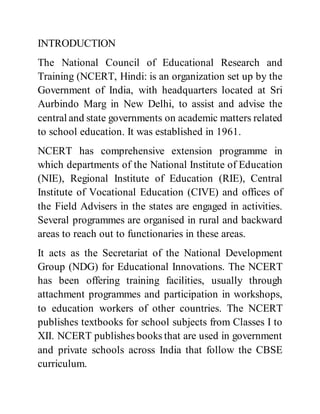
INTRODUCTION 
The National Council of Educational Research and 
Training (NCERT, Hindi: is an organization set up by the 
Government of India, with headquarters located at Sri 
Aurbindo Marg in New Delhi, to assist and advise the 
central and state governments on academic matters related 
to school education. It was established in 1961. 
NCERT has comprehensive extension programme in 
which departments of the National Institute of Education 
(NIE), Regional Institute of Education (RIE), Central 
Institute of Vocational Education (CIVE) and offices of 
the Field Advisers in the states are engaged in activities. 
Several programmes are organised in rural and backward 
areas to reach out to functionaries in these areas. 
It acts as the Secretariat of the National Development 
Group (NDG) for Educational Innovations. The NCERT 
has been offering training facilities, usually through 
attachment programmes and participation in workshops, 
to education workers of other countries. The NCERT 
publishes textbooks for school subjects from Classes I to 
XII. NCERT publishes books that are used in government 
and private schools across India that follow the CBSE 
curriculum.
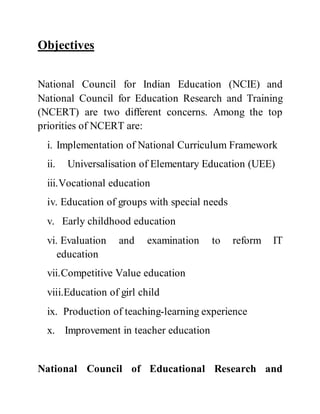
Objectives 
National Council for Indian Education (NCIE) and 
National Council for Education Research and Training 
(NCERT) are two different concerns. Among the top 
priorities of NCERT are: 
i. Implementation of National Curriculum Framework 
ii. Universalisation of Elementary Education (UEE) 
iii.Vocational education 
iv. Education of groups with special needs 
v. Early childhood education 
vi. Evaluation and examination to reform IT 
education 
vii.Competitive Value education 
viii.Education of girl child 
ix. Production of teaching-learning experience 
x. Improvement in teacher education 
National Council of Educational Research and
Training 
National Council of Educational Research and Training 
(NCERT) is an autonomous organization set up in 1961 
by the Government of India to assist and advise the 
Central and State Governments on policies and 
programmes for qualitative improvement in school 
education. Major objectives of the NCERT and its 
constituent units are to: 
Undertake, aid, promote and coordinate 
research in areas related to school education;Prepare and 
publish model textbooks, supplementary material, 
newsletters, journals and other related literature; Organize 
pre-service and in-service training of teachers;Develop 
and disseminate innovative educational techniques and 
practices; Collaborate and network with state educational 
departments, universities, NGOs and other educational 
institutions; Act as a clearing house for ideas and 
information in matters related to school education; andAct 
as a nodal agency for achieving goals of universalisation 
of elementary education. 
In addition to research, development, 
training, extension, publication and dissemination 
activities, the NCERT is an implementation agency for
bilateral cultural exchange programmes with other 
countries in the field of school education 
The NCERT also interacts and works in 
collaboration with the international organizations, visiting 
foreign delegations and offers various training facilities to 
educational personnel from developing countries. The 
major Constituent Units of the NCERT which are located 
in different regions of the country are: 
ADVANTAGES 
· availability of necessary pieces of apparatus/ items at 
one place. 
· multipurpose use of each piece of apparatus. 
· economy of time in setting up of experiments. 
· portability from one place to another. 
· provision for teacher’s innovation. 
· low cost and use of indigenous resources 
CONCLUSION 
NCERT has comprehensive extension programme in 
which departments of the National Institute of Education 
(NIE), Regional Institute of Education (RIE), Central 
Institute of Vocational Education (CIVE) and offices of 
the Field Advisers in the states are engaged in activities. 
Several programmes are organised in rural and backward
areas to reach out to functionaries in these areas.It acts as 
the Secretariat of the National Development Group 
(NDG) for Educational Innovations. The NCERT has 
been offering training facilities, usually through 
attachment programmes and participation in workshops, 
to education workers of other countries. The NCERT 
publishes textbooks for school subjects from Classes I to 
XII. NCERT publishes books that are used in government 
and private schools across India that follow the CBSE 
curriculum.
REFERANCE 
i. "Public Information Services." National Council of 
Educational Research and Training. Retrieved on 25 
August 2012. "National Council of Educational 
Research and Training," Sri Aurbindo Marg, New 
Delhi-110016" 
1. Cossette, Andre Humanism and Libraries: An Essay on the 
Philosophy of Librarianship. Duluth, MN: Library Juice 
Press, 2009. Print. 
"Gabriel Naude". Retrieved 20 December 2012. 
3. 
http://books.google.no/books/about/Code_for_classifiers.ht 
ml?id=9sCdQ9JBxQQC&redir_esc=y 
4. Panjab Library Primer full text 
http://www.archive.org/details/punjablibrarypri00dickuoft 
5. Rubin, Richard E. (2010). Foundations of Library and 
Information Science. New York: Neal-Schuman Publishers.

Online assignment

  • 1.
    BASELIOS MARTHOMA MATHEWS11 TRAINING COLLEGE KOTTARAKARA NAME OF THE CANDIDATE : BIJI K OPTIONAL SUBJECT : NATURAL SCIENCE CANDIDATE CODE : 13350009
  • 2.
    ASSIGNMENT TOPIC :A STUDY OF NATIONAL COUNCIL FOR EDUCATION RESERCH AND TRAINING
  • 3.
    INTRODUCTION The NationalCouncil of Educational Research and Training (NCERT, Hindi: is an organization set up by the Government of India, with headquarters located at Sri Aurbindo Marg in New Delhi, to assist and advise the central and state governments on academic matters related to school education. It was established in 1961. NCERT has comprehensive extension programme in which departments of the National Institute of Education (NIE), Regional Institute of Education (RIE), Central Institute of Vocational Education (CIVE) and offices of the Field Advisers in the states are engaged in activities. Several programmes are organised in rural and backward areas to reach out to functionaries in these areas. It acts as the Secretariat of the National Development Group (NDG) for Educational Innovations. The NCERT has been offering training facilities, usually through attachment programmes and participation in workshops, to education workers of other countries. The NCERT publishes textbooks for school subjects from Classes I to XII. NCERT publishes books that are used in government and private schools across India that follow the CBSE curriculum.
  • 4.
    Objectives National Councilfor Indian Education (NCIE) and National Council for Education Research and Training (NCERT) are two different concerns. Among the top priorities of NCERT are: i. Implementation of National Curriculum Framework ii. Universalisation of Elementary Education (UEE) iii.Vocational education iv. Education of groups with special needs v. Early childhood education vi. Evaluation and examination to reform IT education vii.Competitive Value education viii.Education of girl child ix. Production of teaching-learning experience x. Improvement in teacher education National Council of Educational Research and
  • 5.
    Training National Councilof Educational Research and Training (NCERT) is an autonomous organization set up in 1961 by the Government of India to assist and advise the Central and State Governments on policies and programmes for qualitative improvement in school education. Major objectives of the NCERT and its constituent units are to: Undertake, aid, promote and coordinate research in areas related to school education;Prepare and publish model textbooks, supplementary material, newsletters, journals and other related literature; Organize pre-service and in-service training of teachers;Develop and disseminate innovative educational techniques and practices; Collaborate and network with state educational departments, universities, NGOs and other educational institutions; Act as a clearing house for ideas and information in matters related to school education; andAct as a nodal agency for achieving goals of universalisation of elementary education. In addition to research, development, training, extension, publication and dissemination activities, the NCERT is an implementation agency for
  • 6.
    bilateral cultural exchangeprogrammes with other countries in the field of school education The NCERT also interacts and works in collaboration with the international organizations, visiting foreign delegations and offers various training facilities to educational personnel from developing countries. The major Constituent Units of the NCERT which are located in different regions of the country are: ADVANTAGES · availability of necessary pieces of apparatus/ items at one place. · multipurpose use of each piece of apparatus. · economy of time in setting up of experiments. · portability from one place to another. · provision for teacher’s innovation. · low cost and use of indigenous resources CONCLUSION NCERT has comprehensive extension programme in which departments of the National Institute of Education (NIE), Regional Institute of Education (RIE), Central Institute of Vocational Education (CIVE) and offices of the Field Advisers in the states are engaged in activities. Several programmes are organised in rural and backward
  • 7.
    areas to reachout to functionaries in these areas.It acts as the Secretariat of the National Development Group (NDG) for Educational Innovations. The NCERT has been offering training facilities, usually through attachment programmes and participation in workshops, to education workers of other countries. The NCERT publishes textbooks for school subjects from Classes I to XII. NCERT publishes books that are used in government and private schools across India that follow the CBSE curriculum.
  • 8.
    REFERANCE i. "PublicInformation Services." National Council of Educational Research and Training. Retrieved on 25 August 2012. "National Council of Educational Research and Training," Sri Aurbindo Marg, New Delhi-110016" 1. Cossette, Andre Humanism and Libraries: An Essay on the Philosophy of Librarianship. Duluth, MN: Library Juice Press, 2009. Print. "Gabriel Naude". Retrieved 20 December 2012. 3. http://books.google.no/books/about/Code_for_classifiers.ht ml?id=9sCdQ9JBxQQC&redir_esc=y 4. Panjab Library Primer full text http://www.archive.org/details/punjablibrarypri00dickuoft 5. Rubin, Richard E. (2010). Foundations of Library and Information Science. New York: Neal-Schuman Publishers.