National Knowledge
Commission
By : Hemlata Shinde
D .Y. Patil School of Education
M.A Education –Sem III (2016-17)
Contents
 Introduction
 Objectives
 Organizational Structure
 Commission Members
 Methodology
 Recommendations
Controversies
 Follow Up Actions
Introduction
The NKC was constituted on 13th June 2005 with
a time-frame of three years, from 2nd October
2005 to 2nd October 2008. As a high-level advisory
body to the Prime Minister of India, the National
Knowledge Commission has been given a mandate
to guide policy and direct reforms, focusing on
certain key areas such as education, science and
technology, agriculture, industry, e-governance
etc. Easy access to knowledge, creation and
preservation of knowledge systems, dissemination
of knowledge and better knowledge services are
• The overarching aim of the National Knowledge Commission is to
enable the development of a vibrant knowledge based society. This
entails both a radical improvement in existing systems of knowledge,
and creating avenues for generating new forms of knowledge.
• Greater participation and more equitable access to knowledge across
all sections of society are of vital importance in achieving these goals.
In view of the above, the NKC seeks to develop appropriate institutional
frameworks to:
• Strengthen the education system, promote domestic research and
innovation, facilitate knowledge application in sectors like health,
agriculture, and industry.
• Leverage information and communication technologies to enhance
governance and improve connectivity.
• Devise mechanisms for exchange and interaction between knowledge
systems in the global arena.
Objectives
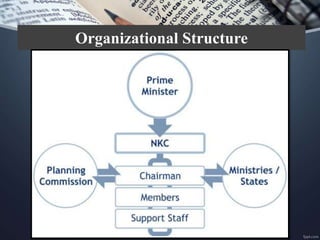
Organizational Structure
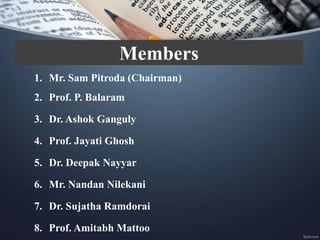
Members
1. Mr. Sam Pitroda (Chairman)
2. Prof. P. Balaram
3. Dr. Ashok Ganguly
4. Prof. Jayati Ghosh
5. Dr. Deepak Nayyar
6. Mr. Nandan Nilekani
7. Dr. Sujatha Ramdorai
8. Prof. Amitabh Mattoo
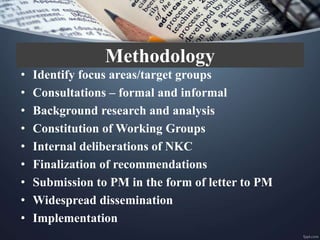
Methodology
• Identify focus areas/target groups
• Consultations – formal and informal
• Background research and analysis
• Constitution of Working Groups
• Internal deliberations of NKC
• Finalization of recommendations
• Submission to PM in the form of letter to PM
• Widespread dissemination
• Implementation
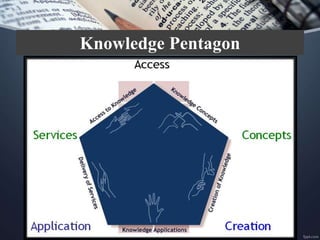
Knowledge Pentagon
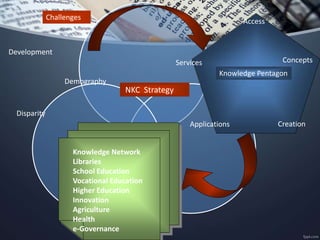
Development
Demography
Disparity
Access
Concepts
CreationApplications
Services
Knowledge Network
Libraries
School Education
Vocational Education
Higher Education
Innovation
Agriculture
Health
e-Governance
NKC Strategy
Knowledge Pentagon
Challenges
 Setting up a National Commission
on libraries
Provide impetus for developing
translation as an industry
 Teaching of English as a language
should be introduced, along with the
first language, starting from class I in
school
Recommendations
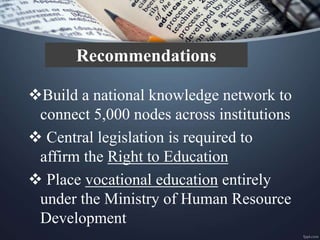
Build a national knowledge network to
connect 5,000 nodes across institutions
 Central legislation is required to
affirm the Right to Education
 Place vocational education entirely
under the Ministry of Human Resource
Development
Recommendations
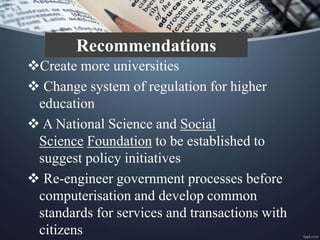
Create more universities
 Change system of regulation for higher
education
 A National Science and Social
Science Foundation to be established to
suggest policy initiatives
 Re-engineer government processes before
computerisation and develop common
standards for services and transactions with
citizens
Recommendations
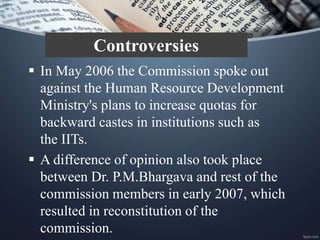
 In May 2006 the Commission spoke out
against the Human Resource Development
Ministry's plans to increase quotas for
backward castes in institutions such as
the IITs.
 A difference of opinion also took place
between Dr. P.M.Bhargava and rest of the
commission members in early 2007, which
resulted in reconstitution of the
commission.
Controversies
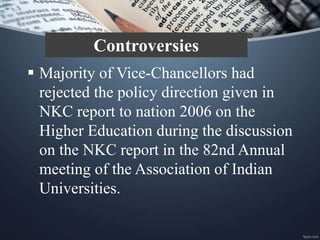
 Majority of Vice-Chancellors had
rejected the policy direction given in
NKC report to nation 2006 on the
Higher Education during the discussion
on the NKC report in the 82nd Annual
meeting of the Association of Indian
Universities.
Controversies
 Libraries
Based on the recommendations of NKC, the
Department of Culture (DoC) proposed setting up a
National Mission for Libraries (NML) in the XI Plan
as a Central Sector Scheme. The EFC memo is under
revision by the DoC and is being restricted to Rs.
180 crore earmarked for the same during the XI
Plan. The NML will cover libraries under the DoC
and the activities under it will include: National
Census of Libraries; Modernisation including
networking of Libraries under DoC; establishing
Knowledge Centres and Digital Libraries.
Follow Up Actions
Translation
The Government has approved the setting up of a
National Translation Mission (NTM) with an
outlay of Rs. 75 crore. The CIIL, Mysore is the
nodal agency implementing the Mission.
English language teaching
Twenty five states have already introduced
English as a subject from Class I. With the help of
NCERT and CIEFL, the MHRD is guiding
English Teaching in schools in the states/UTs by
developing appropriate curriculum, materials and
training of teachers with skills in English.
Follow Up Actions
 Integrated national knowledge network
During 2008-09 Rs. 100 crores has been allocated for the
National Knowledge Network (NKN) which proposes
interconnecting all knowledge institutions in the country with
gigabit capabilities, for sharing resources and research. A high
level committee (HLC) constituted by the Department of
Information and Technology (DIT), under the chairmanship of
the Principal Scientific Adviser, was set up to operationalise the
network. The design of NKN was prepared by a Technical
Advisory Committee set up by the HLC, and the initial
implementation is being managed by NIC (under DIT).
 The network is ready for roll out and is awaiting a formal
launch. The network would be operationalised in two phases.
The core and distribution network covering 1000 nodes with
gigabit capacity would be set up in the first phase and this
process has already started. The network is scalable and
coverage can grow up to 10,000 nodes/institutions.
Follow Up Actions
Right to education
The Right of Children to Free and
Compulsory Education Bill, 2008 has been
introduced in the Parliament.
Vocational Education and Training
(VET)
For expansion, redesign and quality
enhancement of VET in the country a three
tier structure has been constituted in July
2008 under the National Skill Development
Follow Up Actions
 Higher and technical education
To expand capacity and improve quality of
higher education, the Government has
sanctioned the setting up of 15 new Central
Universities and 14 new Universities based on
world-class standards.
The Committee for Rejuvenation and
Renovation of Higher Education has been set
up for the review of UGC/AICTE.
The Science and Engineering Research Board
Bill 2008 has been introduced in the
Parliament.
Follow Up Actions
 E-governance
The XI Plan envisages the creation of core infrastructure
such as SWAN (State Wide Area Network), Common
Service Centres (CSCs) and State Data Centres (SDCs) for
creation of a common service delivery platform
SWAN has been implemented in 6 states/ UTs till date and
in 18 states implementation is in process.
Till date SDCs have been approved for 26 states by the
Government.
Under the approved CSC scheme which envisages
establishing over 100000 CSCs across India, 20,558 CSCs
have been rolled out. The process for roll out for another
250968 CSCs has also been initiated.
Follow Up Actions
National knowledge Commission

National knowledge Commission

  • 1.
    National Knowledge Commission By :Hemlata Shinde D .Y. Patil School of Education M.A Education –Sem III (2016-17)
  • 2.
    Contents  Introduction  Objectives Organizational Structure  Commission Members  Methodology  Recommendations Controversies  Follow Up Actions
  • 3.
    Introduction The NKC wasconstituted on 13th June 2005 with a time-frame of three years, from 2nd October 2005 to 2nd October 2008. As a high-level advisory body to the Prime Minister of India, the National Knowledge Commission has been given a mandate to guide policy and direct reforms, focusing on certain key areas such as education, science and technology, agriculture, industry, e-governance etc. Easy access to knowledge, creation and preservation of knowledge systems, dissemination of knowledge and better knowledge services are
  • 4.
    • The overarchingaim of the National Knowledge Commission is to enable the development of a vibrant knowledge based society. This entails both a radical improvement in existing systems of knowledge, and creating avenues for generating new forms of knowledge. • Greater participation and more equitable access to knowledge across all sections of society are of vital importance in achieving these goals. In view of the above, the NKC seeks to develop appropriate institutional frameworks to: • Strengthen the education system, promote domestic research and innovation, facilitate knowledge application in sectors like health, agriculture, and industry. • Leverage information and communication technologies to enhance governance and improve connectivity. • Devise mechanisms for exchange and interaction between knowledge systems in the global arena. Objectives
  • 5.
  • 6.
    Members 1. Mr. SamPitroda (Chairman) 2. Prof. P. Balaram 3. Dr. Ashok Ganguly 4. Prof. Jayati Ghosh 5. Dr. Deepak Nayyar 6. Mr. Nandan Nilekani 7. Dr. Sujatha Ramdorai 8. Prof. Amitabh Mattoo
  • 7.
    Methodology • Identify focusareas/target groups • Consultations – formal and informal • Background research and analysis • Constitution of Working Groups • Internal deliberations of NKC • Finalization of recommendations • Submission to PM in the form of letter to PM • Widespread dissemination • Implementation
  • 8.
  • 9.
    Development Demography Disparity Access Concepts CreationApplications Services Knowledge Network Libraries School Education VocationalEducation Higher Education Innovation Agriculture Health e-Governance NKC Strategy Knowledge Pentagon Challenges
  • 10.
     Setting upa National Commission on libraries Provide impetus for developing translation as an industry  Teaching of English as a language should be introduced, along with the first language, starting from class I in school Recommendations
  • 11.
    Build a nationalknowledge network to connect 5,000 nodes across institutions  Central legislation is required to affirm the Right to Education  Place vocational education entirely under the Ministry of Human Resource Development Recommendations
  • 12.
    Create more universities Change system of regulation for higher education  A National Science and Social Science Foundation to be established to suggest policy initiatives  Re-engineer government processes before computerisation and develop common standards for services and transactions with citizens Recommendations
  • 13.
     In May2006 the Commission spoke out against the Human Resource Development Ministry's plans to increase quotas for backward castes in institutions such as the IITs.  A difference of opinion also took place between Dr. P.M.Bhargava and rest of the commission members in early 2007, which resulted in reconstitution of the commission. Controversies
  • 14.
     Majority ofVice-Chancellors had rejected the policy direction given in NKC report to nation 2006 on the Higher Education during the discussion on the NKC report in the 82nd Annual meeting of the Association of Indian Universities. Controversies
  • 15.
     Libraries Based onthe recommendations of NKC, the Department of Culture (DoC) proposed setting up a National Mission for Libraries (NML) in the XI Plan as a Central Sector Scheme. The EFC memo is under revision by the DoC and is being restricted to Rs. 180 crore earmarked for the same during the XI Plan. The NML will cover libraries under the DoC and the activities under it will include: National Census of Libraries; Modernisation including networking of Libraries under DoC; establishing Knowledge Centres and Digital Libraries. Follow Up Actions
  • 16.
    Translation The Government hasapproved the setting up of a National Translation Mission (NTM) with an outlay of Rs. 75 crore. The CIIL, Mysore is the nodal agency implementing the Mission. English language teaching Twenty five states have already introduced English as a subject from Class I. With the help of NCERT and CIEFL, the MHRD is guiding English Teaching in schools in the states/UTs by developing appropriate curriculum, materials and training of teachers with skills in English. Follow Up Actions
  • 17.
     Integrated nationalknowledge network During 2008-09 Rs. 100 crores has been allocated for the National Knowledge Network (NKN) which proposes interconnecting all knowledge institutions in the country with gigabit capabilities, for sharing resources and research. A high level committee (HLC) constituted by the Department of Information and Technology (DIT), under the chairmanship of the Principal Scientific Adviser, was set up to operationalise the network. The design of NKN was prepared by a Technical Advisory Committee set up by the HLC, and the initial implementation is being managed by NIC (under DIT).  The network is ready for roll out and is awaiting a formal launch. The network would be operationalised in two phases. The core and distribution network covering 1000 nodes with gigabit capacity would be set up in the first phase and this process has already started. The network is scalable and coverage can grow up to 10,000 nodes/institutions. Follow Up Actions
  • 18.
    Right to education TheRight of Children to Free and Compulsory Education Bill, 2008 has been introduced in the Parliament. Vocational Education and Training (VET) For expansion, redesign and quality enhancement of VET in the country a three tier structure has been constituted in July 2008 under the National Skill Development Follow Up Actions
  • 19.
     Higher andtechnical education To expand capacity and improve quality of higher education, the Government has sanctioned the setting up of 15 new Central Universities and 14 new Universities based on world-class standards. The Committee for Rejuvenation and Renovation of Higher Education has been set up for the review of UGC/AICTE. The Science and Engineering Research Board Bill 2008 has been introduced in the Parliament. Follow Up Actions
  • 20.
     E-governance The XIPlan envisages the creation of core infrastructure such as SWAN (State Wide Area Network), Common Service Centres (CSCs) and State Data Centres (SDCs) for creation of a common service delivery platform SWAN has been implemented in 6 states/ UTs till date and in 18 states implementation is in process. Till date SDCs have been approved for 26 states by the Government. Under the approved CSC scheme which envisages establishing over 100000 CSCs across India, 20,558 CSCs have been rolled out. The process for roll out for another 250968 CSCs has also been initiated. Follow Up Actions