INNOVATION IN TEACHER
EDUCATION THE ROLE OF
NCERT, NCTE, IASE AND CTE
FOR STRENTHENING
TEACHER EDUCATION
 NCTE being a supreme body of Teacher education,
should play some proactive role in curriculum
designing and evaluation. It sets the norms and
standards for infrastructure, and specifies the
required qualifications of teacher educators, for all
teacher education colleges. But without effective
monitoring by the Council, which lacks the
manpower, resources, and capacity for this purpose,
teacher training colleges tend to depart from these
norms, with potentially serious implications for the
quality of teacher preparation and thus for the
professional skills of the teachers and teacher
educators.
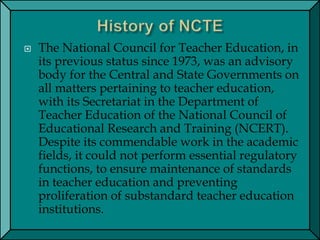
 The National Council for Teacher Education, in
its previous status since 1973, was an advisory
body for the Central and State Governments on
all matters pertaining to teacher education,
with its Secretariat in the Department of
Teacher Education of the National Council of
Educational Research and Training (NCERT).
Despite its commendable work in the academic
fields, it could not perform essential regulatory
functions, to ensure maintenance of standards
in teacher education and preventing
proliferation of substandard teacher education
institutions.
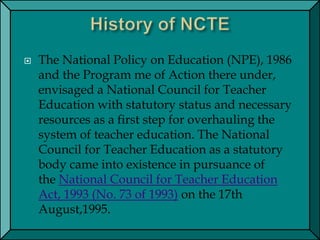
 The National Policy on Education (NPE), 1986
and the Program me of Action there under,
envisaged a National Council for Teacher
Education with statutory status and necessary
resources as a first step for overhauling the
system of teacher education. The National
Council for Teacher Education as a statutory
body came into existence in pursuance of
the National Council for Teacher Education
Act, 1993 (No. 73 of 1993) on the 17th
August,1995.
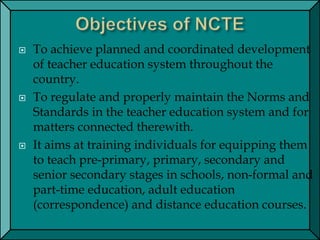
 To achieve planned and coordinated development
of teacher education system throughout the
country.
 To regulate and properly maintain the Norms and
Standards in the teacher education system and for
matters connected therewith.
 It aims at training individuals for equipping them
to teach pre-primary, primary, secondary and
senior secondary stages in schools, non-formal and
part-time education, adult education
(correspondence) and distance education courses.
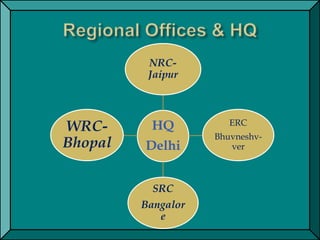
HQ
Delhi
NRC-
Jaipur
ERC
Bhuvneshv-
ver
SRC
Bangalor
e
WRC-
Bhopal
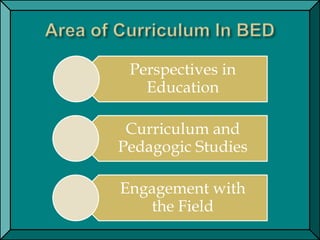
Perspectives in
Education
Curriculum and
Pedagogic Studies
Engagement with
the Field
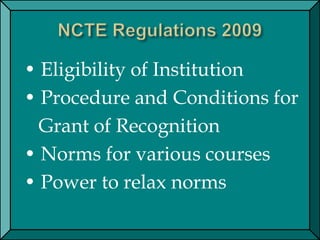
• Eligibility of Institution
• Procedure and Conditions for
Grant of Recognition
• Norms for various courses
• Power to relax norms
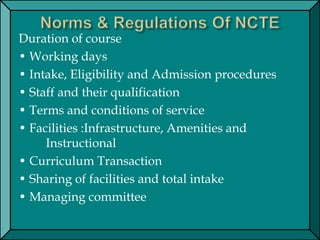
Duration of course
• Working days
• Intake, Eligibility and Admission procedures
• Staff and their qualification
• Terms and conditions of service
• Facilities :Infrastructure, Amenities and
Instructional
• Curriculum Transaction
• Sharing of facilities and total intake
• Managing committee
• The Council
• The Executive Committee
• Regional Committees
• Appeal Committee
• Inspection Team
• Visiting Team
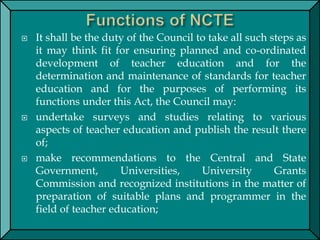
 It shall be the duty of the Council to take all such steps as
it may think fit for ensuring planned and co-ordinated
development of teacher education and for the
determination and maintenance of standards for teacher
education and for the purposes of performing its
functions under this Act, the Council may:
 undertake surveys and studies relating to various
aspects of teacher education and publish the result there
of;
 make recommendations to the Central and State
Government, Universities, University Grants
Commission and recognized institutions in the matter of
preparation of suitable plans and programmer in the
field of teacher education;
 co-ordinate and monitor teacher education and its
development in the country;
 lay down guidelines in respect of minimum
qualifications for a person to be employed as a
teacher in schools or in recognized institutions;
 lay down norms for any specified category of
courses or trainings in teacher education, including
the minimum eligibility criteria for admission
thereof, and the method of selection of candidates,
duration of the course, course contents and mode
of curriculum;
 lay down guidelines for compliance by recognized
institutions, for starting new courses or training,
and for providing physical and instructional
facilities, staffing pattern and staff qualification;
 lay down standards in respect of examinations
leading to teacher education qualifications, criteria
for admission to such examinations and schemes of
courses or training;
 lay down guidelines regarding tuition fees and other
fees chargeable by recognized institutions;
 promote and conduct innovation and research in
various areas of teacher education and disseminate
the results thereof;
 examine and review periodically the implementation
of the norms, guidelines and standards laid down by
the Council, and to suitably advise the recognized
institution;
 evolve suitable performance appraisal system,
norms and mechanism for enforcing
accountability on recognized institutions;
 formulate schemes for various levels of teacher
education and identify recognized institutions
and set up new institutions for teacher
development program mes;
 take all necessary steps to prevent
commercialization of teacher education; and
 perform such other functions as may be
entrusted to it by the Central Government.
 Diploma in early childhood education programme leading to
Diploma in Preschool Education (DPSE).
 Elementary teacher education programme leading to Diploma in
Elementary Education (D.El.Ed.).
 Bachelor of elementary teacher education programme leading to
Bachelor of Elementary Education (B.El.Ed.) degree.
 Bachelor of education programme leading to Bachelor of
Education (B.Ed.) degree.
 Master of education programme leading to Master of Education
(M.Ed.) degree.
 Diploma in physical education programme leading to Diploma
in Physical Education (D.P.Ed.).
 Bachelor of physical education programme leading to Bachelor
of Physical Education (B.P.Ed.) degree.
 Master of physical education programme leading to
Master of Physical Education (M. P. Ed.) degree.
 Diploma in elementary education program me
through Open and Distance Learning System leading
to Diploma in Elementary Education (D. El. Ed.).
 Bachelor of education program me through Open and
Distance Learning System leading to Bachelor of
Education (B.Ed.) degree.
 Diploma in arts education (Visual Arts) program me
leading to Diploma in Arts Education (Visual Arts).
 Diploma in arts education (Performing Arts) program
me leading to Diploma in Arts Education (Performing
Arts).
The Regional Institutes of Education (RIEs) of
NCERT also have ET cells. Further, even in higher
education, it is recommended that teacher
training in Educational Technology should form a
part of their programme. The aim was to bring
about qualitative development in the field of
education. Through the various constituent units
NCERT takes charge of training of teachers in
different activities at both pre-service and in-
service levels.
 In pre-service teacher education:
 Introduces teachers to flexible models of
reaching curriculum goals.
 Introduces use of media and technology
enabled methods of learning, making it
inherent and embedded in the teaching-
learning process of teachers.
 Train teachers to evaluate and integrate
available materials into the learning process.
 Enable trainee teachers to access sources of
knowledge and to create knowledge.
 prepares the teachers at the school level for
teaching different subjects.
 In ‘in-service’ teacher education:
 Creates a system of lifelong professional
development and support, especially of
educational leaders and managers such as
headmasters and principals.
 Encourages ICT literacy for official and
personal use to increase comfort and later
Enhances creativity in educational work.
 Supports the development of and nurture
teachers’ self-help groups / professional
development groups on the ground as well as
online.
 The creation of Institutes of Advanced Studies in
Education (IASEs) came about as a result of the
National Policy on Education (NPE) 1986 which states
that teacher Education is a continuous process and its
pre-service and in-service components are in-separable
 There are 31 IASEs at present in the country but these
have not been set up uniformly and none of the union
territories and a few of the states (Goa, Chattisgarh,
Himachal Pradesh, Jammu Kashmir to name a few) do
not have IASEs (NCERT Report Aug. 2009).
 The vision of IASE should be to improve the quality of
teacher education at the secondary, elementary and
primary level.
IASE Roles and Functions
 Organize pre-service Teacher Education Courses;
 Organize subject-oriented & theme-specific in-service
programmes;
 Provide extension & resource support to schools,
school comp lexes and individual teachers;
 Organize pre-service Teacher Education Courses;
 Organize subject-oriented & theme-specific in-service
programmes;
 Provide extension & resource support to schools,
school complexes and individual teachers;
 Conduct experimentation and innovation in school
education ;
 Provide training and resource support for the new
areas of educational concern;
 Provide support to professional bodies;
 Conduct programmes in elementary teacher-education;
 Conduct regular M.Ed., M.Phil. and Ph.D.
programmes;
 Conduct advanced level fundamental & applied
research;
 Conduct training programmes for preparation of non-
print software and use of ICT;
 Provide academic guidance to DIETs & resource
support to CTEs;
 Monitor & provide academic support to Schools for
Excellence;
CTE Roles and Functions
 College of Teacher’s Education not only expand the
quantity and quality of secondary school teachers but
also reinvent themselves to proactively integrate with
the larger state teacher education system
 . It is envisioned that CTEs play the major role in the
field of secondary teacher education and development,
also guiding the various secondary teacher education
institutions in the districts under them.
 They have to see themselves as Centre’s for developing
excellence in secondary teacher education and in
secondary classrooms at school.
 They shall prepare context specific teacher handbooks
and training modules for quality training
 The CTEs, in order to improve the quality of
secondary education, shall conduct training
need analysis and base line surveys for
organizing training programs.
 They should design a training program that is
open-ended, leaving more scope for the trainee
for self-learning and to equip himself/herself
to meet the challenging needs and demands of
the profession.
 Another point to be examined is whether it is
possible and desirable to have an omnibus type of
teacher training which would equip the teacher at
different levels.
 teachers are the guiding stars in every child's
life. Teachers play a unique role in students'
academic, personal, and social development.
They help to shape the future of students by
dedicating their own time and effort to ensure
that each individual reaches their full potential.
With limitless patience, teachers can make a
world of difference in their student's lives.
 NCTE, Discussion Document on Curriculum
Framework (1998) competency based and
commitment oriented teacher education for
quality school education YOJANA, September
2005
 https://www.google.com
 WWW. Slide share . com
Innovation in teacher education in the role of NCTE