Submitted by,
RESHMA. M. S.
B. Ed. Natural Science
Exam Code: 18113102
Candidate Code:18114386012
St. Thomas Training College
Mukkolakkal
Thiruvananthapuram.
ONLINE ASSIGNMENT
THE NCERT – NCF (2005)
and
THE SCERT – KCF (2007)
Sl
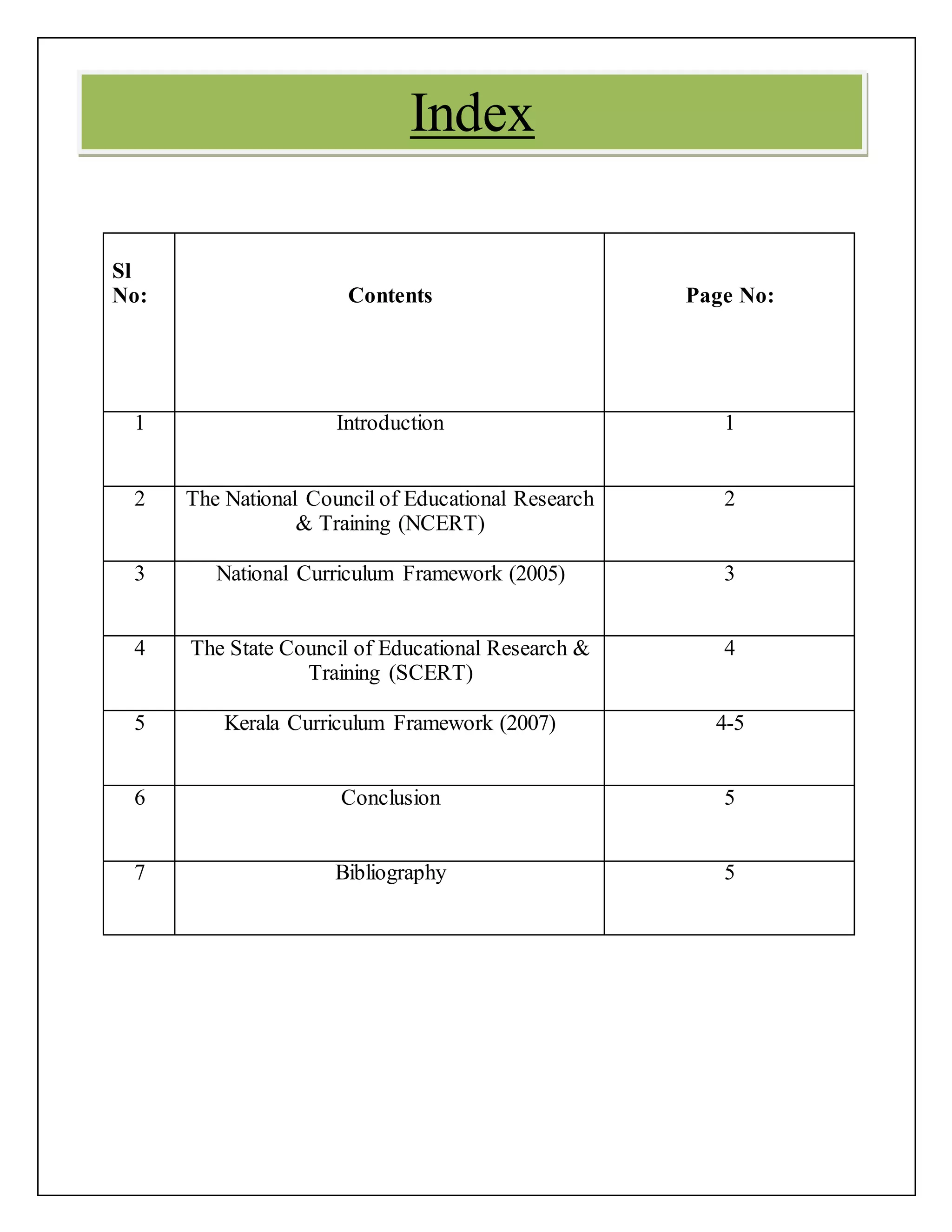
No: Contents Page No:
1 Introduction 1
2 The National Council of Educational Research
& Training (NCERT)
2
3 National Curriculum Framework (2005) 3
4 The State Council of Educational Research &
Training (SCERT)
4
5 Kerala Curriculum Framework (2007) 4-5
6 Conclusion 5
7 Bibliography 5
Index
INTRODUCTION
A range of issues emanating from dehumanization of society, religious
intolerance, indifference towards democratic process, increasing inequalities, growing
violence, market oriented approach, disintegrating family ties, deteriorating gender
relations, desire to accumulate wealth, craze for drugs among youths and tendency to
commercialize and communalize education and culture pose serious threats to a
democratic society. A curriculum that doesn’t address these issues can never lead us
forward. On deeper analysis, the wide range of issues we confront can be identified as:
• Absence of a vision of universal humanism
• Lack of human resource development
• Lack of understanding of the specificities of cultural identity and its need to develop
freely
• Inability to see agriculture as a part of culture
• Lack of a scientific approach to health and public health lack of due consideration
towards marginalized groups
• Lack of scientific management of land and water
• Lack of eco-friendly industrialization and urbanization
Education in its general sense is a form of learning in which the knowledge,
skills, and habits of a group of people are transferred from one generation to the next
through teaching, training, or research. Education frequently takes place under the
guidance of others, but may also be autodidactic. Any experience that has a formative
effect on the way one thinks, feels, or acts may be considered educational. Education is
commonly divided into stages such as pre- school, primary school, secondary school, and
then the college, university or apprenticeship.
Therefore there is a general demand to explain the social aims of a curriculum. A
student who completes his/ her school education is expected to be able to face any real
life situation boldly and should be equipped to get employed at the time of completion of
his course. This is the purpose of general education and not a mere internalization of
academic subjects. In order to plan, implement, monitor, supervise, control and evaluate
the various educational programmes we have certain bodies at the national and state
level. Of these, the roles of NCERT and SCERT are briefly described below:
1
The NCERT (National Council of Educational Research and Training)
The National Council of Educational Research and Training (NCERT) is an apex
resource organization established in September 1961 by the Government of India, with
headquarters at New Delhi, to assist and advise the Central and State governments on
academic matters related to school education. It acts as the principle academic advisor to
the ministry of education on all matters pertaining to school education. For the
improvement of school education, the council undertakes the following activities:
i. To undertake, promote and co-ordinate research in all branches of education.
ii. To organize pre-service and in-service training mainly at an advanced level.
iii. To organize extension service for such institutions in the country which are
engaged in educational research, training of teachers or provision of extension
service at school.
The council works in co-operation with the state education departments and
universities and other institutions for promoting school education. The council has
National Institution of Education (NIE) and Centres for Educational Technology (CET)
at New Delhi. The Council runs Regional Colleges of Education (RCE) at Ajmer,
Bhopal, Bhubaneswar and Mysore. The State level education has been taken up by the
State Institute of Education (SIE), State Council of Educational Research and Training
(SCERT) and All India Council for Technical Education. This was formed in the year
1964 at a conference by the Boards of Education.
The Conference recommended:
 To start four technical institutions.
 Greater emphasis to be given to technical education.
The first higher technical institution was established at Kharagpur, Calcutta in
1956. Today, we have three more institutes. One was started at Bombay with the help of
UNESCO and the West German Government and the second at Kanpur with the help of
the U.S.A. An Engineering College at New Delhi with all modern equipments has been
started with the assistance of the British Government.
2
NATIONAL CURRICULUM FRAMEWORK (NCF – 2005)
The National Curriculum Framework (NCF 2005) is one of four National
Curriculum Frameworks published in 1975, 1988, 2000 and 2005 by the National
Council of Educational Research and Training (NCERT) in India. The document
provides the framework for making syllabi, textbooks and teaching practices within the
school education programmes in India.
The NCF 2005 document draws its policy basis from earlier Government reports
on education as Learning without Burden and National Policy of Education 1986-1992
and focus group discussion. The State of art position papers provided inputs for
formulation of NCF-2005. The document and its offshoot textbooks have come under
different forms of reviews in the press. Its draft document came under the criticism from
the Central Advisory Board of Education (CABE).
The approach and recommendations of NCF-2005 are for the entire educational
system. The syllabus and textbooks based on it are being used by all the CBSE schools,
but NCF-based material is also being used in many State Schools. NCF 2005 has been
translated into 22 languages and has influenced the syllabi in 17 States. The NCEFT
gave a grant of Rs.10 lakh to each State to promote NCF in the language of the State and
to compare its current syllabus with the syllabus proposed, so that a plan for future
reforms coluld be made. Several States have taken up this challenge. This exercise is
being carried out with the involvement of State Councils for Educational Research and
Training (SCERT) and District Institutes of Educational and Training (DIET).
Main Features of the NCF 2005
* Perspective
* Learning and Knowledge.
* Curriculum Areas, School Stages and Assessment
* School and Classroom Environment.
* Systemic Reforms.
* Mother tongue as a medium of instructions.
* Free development.
* Availability of resources.
3
The SCERT (State Council of Educational Research and Training)
The SCERT is the parallel organization to NCERT that looks after the quality of
education at the State level, for which they receive the guidelines of the NCERT. The
council designs programmes for updating knowledge and skills in various aspects of
education for the Secondary School Teachers and teacher educators in the TTI’s and
provides guidelines for the programmes to be organized by the DIET’s. For the
improvement of education, research and training in the different states, SCERT
undertakes the following activities:
i. To undertake, promote and co-ordinate research at different stages of
education.
ii. To look to the improvement of teacher education and non-formal education in
the country.
iii. To act as an agent for the advancement of school education.
iv. To supervise the academic activities in the secondary training school, DIET’s
Colleges of Teacher Education and Institutes of Advanced Study in Education.
v. To organize pre-service and in-service training for the teachers, teacher
educators and inspecting officers.
vi. The SCERT plays a vital role in organizing some special educational projects
sponsored by the NCERT and UNICEF for the progress and development of
school education.
vii. To produce instructional materials for elementary school teachers and for
teacher educations.
viii. To undertake investigations on different problems of school education and to
develop and prescribe curriculum for the school education.
ix. To develop a Programme of Co-ordination with the Department of Science and
Technology, and the Department of Environment, etc.
x. The SCERT controls and manages the State Institute of Educational
Technology (SIET) for the utilization of educational technology at School level
in the State.
KERALA CURRICULUM FRAMEWORK – 2007
The curriculum revision programme in Kerala was conceptualized on the basis of
the recommendations of the National Curriculum Framework (NCF-2005). The
curriculum revision initiated in 1996 in Kerala had a strong influence in the formation
of National Curriculum Framework. Kerala could display the active working model of
a learning process that has its foundation in the principles of Constructivism and a
learner-centered, activity-based and process-oriented pedagogy.
Our classrooms in the past reflected the features of an undemocratic power
structure. They were dominated by the voice of the teacher and the learners did not
have an opportunity to raise questions or enquire. On the other hand, the new
curriculum gives the learner more space than ever before for co-operative and
collaborative learning. The rights of the learners have been recognized and the crucial
role of learners in a acquiring knowledge has been established.
Objectives:
 At the primary stage: Develop the basic languages to nurture the curiosity of the
child.
 Upper primary stage: During this stage, the student begins to study the law and
theories of science.
 Secondary stage: Working on logical significance, theoretical principles,
projects, etc.
 Higher Secondary Stage: In this stage, the students can choose their own subject
of interest.
CONCLUSION
The NCERT and SCERT perform their functions and duties to enhance the
higher education. They critically examine the traditional culture and provide leadership
for bringing up cultural renaissance through education.
BIBLIOGRAPHY
1. Syllabus I-XII, National Council of Educational Research and Training,
2015-04-14.
2. NationalCurriculum Framework 2005,National Council of Educational
Research and Training, 2015-04-14.
3. “NationalPolicyon Education, 1985”(PDF). National Council of
Educational.
4. www.scert.kerala.gov.in
5. teachereducationindia.blogspot.com
6. http://en.wikipedia.org/wike/Curriculum_framework
7. http://en.wikipedia.org/wiki/Education#Curriculum
5

Submitted by reshma. m. s.

  • 1.
    Submitted by, RESHMA. M.S. B. Ed. Natural Science Exam Code: 18113102 Candidate Code:18114386012 St. Thomas Training College Mukkolakkal Thiruvananthapuram. ONLINE ASSIGNMENT
  • 2.
    THE NCERT –NCF (2005) and THE SCERT – KCF (2007)
  • 3.
    Sl No: Contents PageNo: 1 Introduction 1 2 The National Council of Educational Research & Training (NCERT) 2 3 National Curriculum Framework (2005) 3 4 The State Council of Educational Research & Training (SCERT) 4 5 Kerala Curriculum Framework (2007) 4-5 6 Conclusion 5 7 Bibliography 5 Index
  • 4.
    INTRODUCTION A range ofissues emanating from dehumanization of society, religious intolerance, indifference towards democratic process, increasing inequalities, growing violence, market oriented approach, disintegrating family ties, deteriorating gender relations, desire to accumulate wealth, craze for drugs among youths and tendency to commercialize and communalize education and culture pose serious threats to a democratic society. A curriculum that doesn’t address these issues can never lead us forward. On deeper analysis, the wide range of issues we confront can be identified as: • Absence of a vision of universal humanism • Lack of human resource development • Lack of understanding of the specificities of cultural identity and its need to develop freely • Inability to see agriculture as a part of culture • Lack of a scientific approach to health and public health lack of due consideration towards marginalized groups • Lack of scientific management of land and water • Lack of eco-friendly industrialization and urbanization Education in its general sense is a form of learning in which the knowledge, skills, and habits of a group of people are transferred from one generation to the next through teaching, training, or research. Education frequently takes place under the guidance of others, but may also be autodidactic. Any experience that has a formative effect on the way one thinks, feels, or acts may be considered educational. Education is commonly divided into stages such as pre- school, primary school, secondary school, and then the college, university or apprenticeship. Therefore there is a general demand to explain the social aims of a curriculum. A student who completes his/ her school education is expected to be able to face any real life situation boldly and should be equipped to get employed at the time of completion of his course. This is the purpose of general education and not a mere internalization of academic subjects. In order to plan, implement, monitor, supervise, control and evaluate the various educational programmes we have certain bodies at the national and state level. Of these, the roles of NCERT and SCERT are briefly described below: 1
  • 5.
    The NCERT (NationalCouncil of Educational Research and Training) The National Council of Educational Research and Training (NCERT) is an apex resource organization established in September 1961 by the Government of India, with headquarters at New Delhi, to assist and advise the Central and State governments on academic matters related to school education. It acts as the principle academic advisor to the ministry of education on all matters pertaining to school education. For the improvement of school education, the council undertakes the following activities: i. To undertake, promote and co-ordinate research in all branches of education. ii. To organize pre-service and in-service training mainly at an advanced level. iii. To organize extension service for such institutions in the country which are engaged in educational research, training of teachers or provision of extension service at school. The council works in co-operation with the state education departments and universities and other institutions for promoting school education. The council has National Institution of Education (NIE) and Centres for Educational Technology (CET) at New Delhi. The Council runs Regional Colleges of Education (RCE) at Ajmer, Bhopal, Bhubaneswar and Mysore. The State level education has been taken up by the State Institute of Education (SIE), State Council of Educational Research and Training (SCERT) and All India Council for Technical Education. This was formed in the year 1964 at a conference by the Boards of Education. The Conference recommended:  To start four technical institutions.  Greater emphasis to be given to technical education. The first higher technical institution was established at Kharagpur, Calcutta in 1956. Today, we have three more institutes. One was started at Bombay with the help of UNESCO and the West German Government and the second at Kanpur with the help of the U.S.A. An Engineering College at New Delhi with all modern equipments has been started with the assistance of the British Government. 2
  • 6.
    NATIONAL CURRICULUM FRAMEWORK(NCF – 2005) The National Curriculum Framework (NCF 2005) is one of four National Curriculum Frameworks published in 1975, 1988, 2000 and 2005 by the National Council of Educational Research and Training (NCERT) in India. The document provides the framework for making syllabi, textbooks and teaching practices within the school education programmes in India. The NCF 2005 document draws its policy basis from earlier Government reports on education as Learning without Burden and National Policy of Education 1986-1992 and focus group discussion. The State of art position papers provided inputs for formulation of NCF-2005. The document and its offshoot textbooks have come under different forms of reviews in the press. Its draft document came under the criticism from the Central Advisory Board of Education (CABE). The approach and recommendations of NCF-2005 are for the entire educational system. The syllabus and textbooks based on it are being used by all the CBSE schools, but NCF-based material is also being used in many State Schools. NCF 2005 has been translated into 22 languages and has influenced the syllabi in 17 States. The NCEFT gave a grant of Rs.10 lakh to each State to promote NCF in the language of the State and to compare its current syllabus with the syllabus proposed, so that a plan for future reforms coluld be made. Several States have taken up this challenge. This exercise is being carried out with the involvement of State Councils for Educational Research and Training (SCERT) and District Institutes of Educational and Training (DIET). Main Features of the NCF 2005 * Perspective * Learning and Knowledge. * Curriculum Areas, School Stages and Assessment * School and Classroom Environment. * Systemic Reforms. * Mother tongue as a medium of instructions. * Free development. * Availability of resources. 3
  • 7.
    The SCERT (StateCouncil of Educational Research and Training) The SCERT is the parallel organization to NCERT that looks after the quality of education at the State level, for which they receive the guidelines of the NCERT. The council designs programmes for updating knowledge and skills in various aspects of education for the Secondary School Teachers and teacher educators in the TTI’s and provides guidelines for the programmes to be organized by the DIET’s. For the improvement of education, research and training in the different states, SCERT undertakes the following activities: i. To undertake, promote and co-ordinate research at different stages of education. ii. To look to the improvement of teacher education and non-formal education in the country. iii. To act as an agent for the advancement of school education. iv. To supervise the academic activities in the secondary training school, DIET’s Colleges of Teacher Education and Institutes of Advanced Study in Education. v. To organize pre-service and in-service training for the teachers, teacher educators and inspecting officers. vi. The SCERT plays a vital role in organizing some special educational projects sponsored by the NCERT and UNICEF for the progress and development of school education. vii. To produce instructional materials for elementary school teachers and for teacher educations. viii. To undertake investigations on different problems of school education and to develop and prescribe curriculum for the school education. ix. To develop a Programme of Co-ordination with the Department of Science and Technology, and the Department of Environment, etc. x. The SCERT controls and manages the State Institute of Educational Technology (SIET) for the utilization of educational technology at School level in the State. KERALA CURRICULUM FRAMEWORK – 2007 The curriculum revision programme in Kerala was conceptualized on the basis of the recommendations of the National Curriculum Framework (NCF-2005). The curriculum revision initiated in 1996 in Kerala had a strong influence in the formation of National Curriculum Framework. Kerala could display the active working model of a learning process that has its foundation in the principles of Constructivism and a learner-centered, activity-based and process-oriented pedagogy. Our classrooms in the past reflected the features of an undemocratic power structure. They were dominated by the voice of the teacher and the learners did not
  • 8.
    have an opportunityto raise questions or enquire. On the other hand, the new curriculum gives the learner more space than ever before for co-operative and collaborative learning. The rights of the learners have been recognized and the crucial role of learners in a acquiring knowledge has been established. Objectives:  At the primary stage: Develop the basic languages to nurture the curiosity of the child.  Upper primary stage: During this stage, the student begins to study the law and theories of science.  Secondary stage: Working on logical significance, theoretical principles, projects, etc.  Higher Secondary Stage: In this stage, the students can choose their own subject of interest. CONCLUSION The NCERT and SCERT perform their functions and duties to enhance the higher education. They critically examine the traditional culture and provide leadership for bringing up cultural renaissance through education. BIBLIOGRAPHY 1. Syllabus I-XII, National Council of Educational Research and Training, 2015-04-14. 2. NationalCurriculum Framework 2005,National Council of Educational Research and Training, 2015-04-14. 3. “NationalPolicyon Education, 1985”(PDF). National Council of Educational. 4. www.scert.kerala.gov.in 5. teachereducationindia.blogspot.com 6. http://en.wikipedia.org/wike/Curriculum_framework 7. http://en.wikipedia.org/wiki/Education#Curriculum 5