MOUNT TABOR TRAINING COLLEGE
PATHANAPURAM
PAPER - EDU 06: EDUCATION IN INDIAN SOCIETY
TOPIC - NCERT
Submitted to,
Dr.George Varghese
Assistant Professor
MTTC Pathanapuram
z
1. DILJA DILLAN
2. JISSY ABRAHAM
3. MEDHA RANI S
4. RAZEENA N
MEMBERS OF THE GROUP
z
NATIONAL COUNCIL OF
EDUCATIONAL RESEARCH
AND TRAINING
(NCERT)
 NCERT is an autonomous organization set up in
1961 by the Government of India.
 The main work of NCERT is to assist and advise the
Central and State Governments on qualitative
improvement in school education.
 NCERT is concerned with all problems of school
education in the country and endeavors to improve
school education through developing various
programmes of research,publication and extension
training.
z
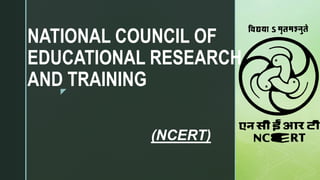
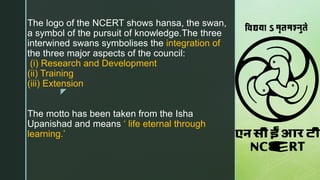
The logo of the NCERT shows hansa, the swan,
a symbol of the pursuit of knowledge.The three
interwined swans symbolises the integration of
the three major aspects of the council:
(i) Research and Development
(ii) Training
(iii) Extension
The motto has been taken from the Isha
Upanishad and means ‘ life eternal through
learning.’
z
Major objectives of NCERT
 To undertake, promote and coordinate research in areas related
to school education.
 To prepare and publish model textbooks, supplementary
material, newsletters, journals and develops educational kits,
multimedia digital materials, etc.
 To organise pre-service and in-service training of teachers.
 To develop and disseminate innovative educational techniques
and practices.
To collaborate and network with state educational departments,
universities, NGOs and other educational institution
To act as a clearing house for ideas and information in matters
related to school education.
To act as a nodal agency for achieving the goals of
Universalisation of Elementary Education.
To maintain cooperation with international agencies and
organisations such as UNESCO, UNISEF, UNDP, NFPA and the
World Bank etc. In educational matters
Functions of NCERT
•It investigates problems pertaining to in service training
educational planning and administration at different centers
located at states.
•It takes up the responsibility for the preparation, development
and publication of textbooks.
•It prepares charts, models, film strips and audio visual material
for science and other subjects.
•It promotes computer education in schools and training
institutions.
•It analyses the problem of basic education and implement the
programme of adult education.
•It assists and advises the state regarding in-service teacher
education programmes.
•It conducts National Science Talent Search(NSTS) examination
for students.
•It conducts All India Educational Surveys once in 5 years and
publishes the survey reports.
z
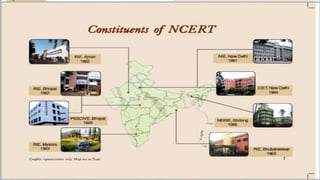
The major constituent units of NCERT

 National Institute of Education (NIE), New Delhi.
 Central Institute of Educational Technology (CIET), New Delhi.
 Pandit Sundarlal Sharma Central Institute of Vocational Education
(PSSCIVE), Bhopal.
 Regional Institute of Education (RIE), Ajmer
 Regional Institute of Education (RIE), Bhopal
 Regional Institute of Education (RIE), Bhubaneswar
 Regional Institute of Education (RIE), Mysore
 North-East Regional Institute of Education (NERIE), Shillong
NCERT Offers easy access to the NCERT
textbooks.
NCERT publishes all the books of class 1 to
12 online and the entire book or individual
chapters can be downloaded.
NCERT brings out a wide variety of
publications such as (a) research
literature, (b) school textbooks including
workbooks and teachers guides, (c)
general books for children of different age
groups, and (d) educational journals
Importance of NCERT Textbooks
 Authentic Information
- All NCERT books are written by experts after an extensive research on
topics.
 Clean and strong basis
- NCERT books cover basics and fundamentals on all topics for
students.
 Easy language
 Standard Questions
- A number of questions in JEE-Main are directly picked from NCERT
books.
Ncert

Ncert

  • 1.
    MOUNT TABOR TRAININGCOLLEGE PATHANAPURAM PAPER - EDU 06: EDUCATION IN INDIAN SOCIETY TOPIC - NCERT Submitted to, Dr.George Varghese Assistant Professor MTTC Pathanapuram
  • 2.
    z 1. DILJA DILLAN 2.JISSY ABRAHAM 3. MEDHA RANI S 4. RAZEENA N MEMBERS OF THE GROUP
  • 4.
    z NATIONAL COUNCIL OF EDUCATIONALRESEARCH AND TRAINING (NCERT)
  • 5.
     NCERT isan autonomous organization set up in 1961 by the Government of India.  The main work of NCERT is to assist and advise the Central and State Governments on qualitative improvement in school education.  NCERT is concerned with all problems of school education in the country and endeavors to improve school education through developing various programmes of research,publication and extension training.
  • 6.
    z The logo ofthe NCERT shows hansa, the swan, a symbol of the pursuit of knowledge.The three interwined swans symbolises the integration of the three major aspects of the council: (i) Research and Development (ii) Training (iii) Extension The motto has been taken from the Isha Upanishad and means ‘ life eternal through learning.’
  • 7.
    z Major objectives ofNCERT  To undertake, promote and coordinate research in areas related to school education.  To prepare and publish model textbooks, supplementary material, newsletters, journals and develops educational kits, multimedia digital materials, etc.  To organise pre-service and in-service training of teachers.  To develop and disseminate innovative educational techniques and practices.
  • 8.
    To collaborate andnetwork with state educational departments, universities, NGOs and other educational institution To act as a clearing house for ideas and information in matters related to school education. To act as a nodal agency for achieving the goals of Universalisation of Elementary Education. To maintain cooperation with international agencies and organisations such as UNESCO, UNISEF, UNDP, NFPA and the World Bank etc. In educational matters
  • 9.
    Functions of NCERT •Itinvestigates problems pertaining to in service training educational planning and administration at different centers located at states. •It takes up the responsibility for the preparation, development and publication of textbooks. •It prepares charts, models, film strips and audio visual material for science and other subjects. •It promotes computer education in schools and training institutions.
  • 10.
    •It analyses theproblem of basic education and implement the programme of adult education. •It assists and advises the state regarding in-service teacher education programmes. •It conducts National Science Talent Search(NSTS) examination for students. •It conducts All India Educational Surveys once in 5 years and publishes the survey reports.
  • 11.
    z The major constituentunits of NCERT   National Institute of Education (NIE), New Delhi.  Central Institute of Educational Technology (CIET), New Delhi.  Pandit Sundarlal Sharma Central Institute of Vocational Education (PSSCIVE), Bhopal.  Regional Institute of Education (RIE), Ajmer  Regional Institute of Education (RIE), Bhopal  Regional Institute of Education (RIE), Bhubaneswar  Regional Institute of Education (RIE), Mysore  North-East Regional Institute of Education (NERIE), Shillong
  • 14.
    NCERT Offers easyaccess to the NCERT textbooks. NCERT publishes all the books of class 1 to 12 online and the entire book or individual chapters can be downloaded. NCERT brings out a wide variety of publications such as (a) research literature, (b) school textbooks including workbooks and teachers guides, (c) general books for children of different age groups, and (d) educational journals
  • 15.
    Importance of NCERTTextbooks  Authentic Information - All NCERT books are written by experts after an extensive research on topics.  Clean and strong basis - NCERT books cover basics and fundamentals on all topics for students.  Easy language  Standard Questions - A number of questions in JEE-Main are directly picked from NCERT books.