N CERT
    In 1961, the Government of India established the National Council of
    Educational Research and Training (NCERT) as an autonomous
    organization to assist and advise the governments at the Centre and
    in States in the implementation of their policies for education,
    especially to bring about qualitative changes in school education and
    teacher preparation. Over the years, he Council has evolved into a
    unique organization, with its increasing range of activities that has
    influenced school education in India.
    Governance
    The Council is governed by five statutory committees, viz. Governing
    Council, Executive Committee (chaired by the Union Minister of
    Education), Finance Committee, Establishment Committee and


                                                                              1
    Programme Advisory Committee. Several other committees like
    Academic Committee, Departmental Advisory Boards/Institutional Advisory
    Committees, Building and Works Committee, Educational Research and
    Innovations Committee and National Monitoring Committee for Textbook
    Development advise the Council on specific activities.
ts
Constituent Uni
            National Institute of Education (NIE), located in Delhi, comprises
            Departments, Divisions, Groups, Cells and Constituent Units (see
            appendix). These pursue academic programmes that include educational
            research, development of textbooks and other material in-service training
            of teachers and extension and dissemination through various modes. NIE
            is also the administrative nerve centre of the Council.
                   Diploma courses in Guidance and Counselling, Early Childhood
            Care and Educational and a certificate course in Peace Education are
            among the major training courses offered currently by NIE departments.
                   The NIE contributes to established areas of school education such
            as elementary education, science and mathematics, social science and
            humanities, language and art, education of children with special needs
            and computer education. In addition, it also encompasses population


                                                                                        2
            education, environmental education, curriculum studies, spreading a
            culture of 'reading' among children, educational measurement and
            evaluation, educational research, national talent search, women's
            studies and educational survey. Thursday Lecture Series and other fora
            as well as the film club activities involving faculty members and
participants from outside the Council           campus in Delhi, is the hub of activities in the
promote healthy debate and intellectual         area of educational technology. Audio, video
discussion. Revival of heritage schools of      and multimedia programmes for children are
national importance has been a significant      developed at CIET. Much of this software is
programme adopted in recent times. For          disseminated in transmission mode as TV and
publication of textbooks and other print        radio programmes, Gyandarshan and
materials, the Council has a well-              Gyanvani, meant especially for children.
established Publication Department located      CIET also has the leadership role in the
on NIE campus.                                  functioning of State Institutes of Educational
      The Council's five Regional Institutes    Technology (SIETs). In the mid-nineteen
of Education (RIEs) located at Ajmer, Bhopal,   seventies in collaboration with Indian Space
Bhubaneswar, Mysore and Shillong offer          Research Organziation (ISRO), CIET had
various programmes for teachers-in-the-         launched SITE programme for schools. In
making.      At present, the pre-service        recent times, India's educational satellite
programmes at RIEs are 4-year integrated        (EDUSAT) technology has helped reach


                                                                                                   3
B.Sc-B.Ed., 2-year B.Ed., 1-year M.Ed.          out to thousands of teachers through
(elementary education) and 1-year diploma       teleconferencing.
course in guidance and counselling.             Pandit Sunderlal Sharma Central Institute of
      The Central Institute of Educational      Vocational Education (PSSCIVE) which is
Technology (CIET), located on the NIE           located in Bhopal organizes research,
development, training and training and                  talent search scheme to identify, support
extension programmes in the area of work                and nurture talented students.
education and vocational education.                     Comprehensive survey of schools, initiation
                                                        of vocational education, nationwide
Over the years                                          orientation of pre-service functionaries,
The Council was constituted with the                    activities such as Comprehensive Access to
objectives of promoting educational research,           Primary Education in collaboration with
developing model textbooks, conducting pre-             international agencies. Science Education
service and in-service training of teachers,            Project, work on Environmental Education
n e t w o r k i n g w i t h Sta t e E d u c a t i o n   and Nutrition Education have also made
Departments, universities and NGOs and                  significant impact on different aspects of
functioning as a clearinghouse of ideas.                school education.
        Over the years, nurturing innovations                  Educational journals published in
and bringing about qualitative change in                NCERT, namely, Indian Educational
school education have been the guiding                  Review, Journal of Indian Education,


                                                                                                      4
principles of the Council. Substantial work             Bhartiya Adhunik Shiksha, Primary
has been done on early childhood education,             Teacher, Primary Shikshak, School
research-based interventions, institutional             Science, Indian Journal of Vocational
planning, Sarva Shiksha Abhiyan,                        Education, present the views, opinions and
development of textbooks and national                   trends of school education in India.
lum
                    ol curricu
       nd   the scho
NCERT a          After the adoption of a common school (10+2) structure in the country,
                 the Council brought out two documents titled 'The Ten Year Curriculum
                 - A Framework' (1975), Higher Secondary Education and its
                 Vocationalisation' (1976).
                        The Council has developed curriculum frameworks in 1988,
                 2000 & 2005, based on the recommendations of NPE (1986)
                 regarding revision of school curricula every five years. The National
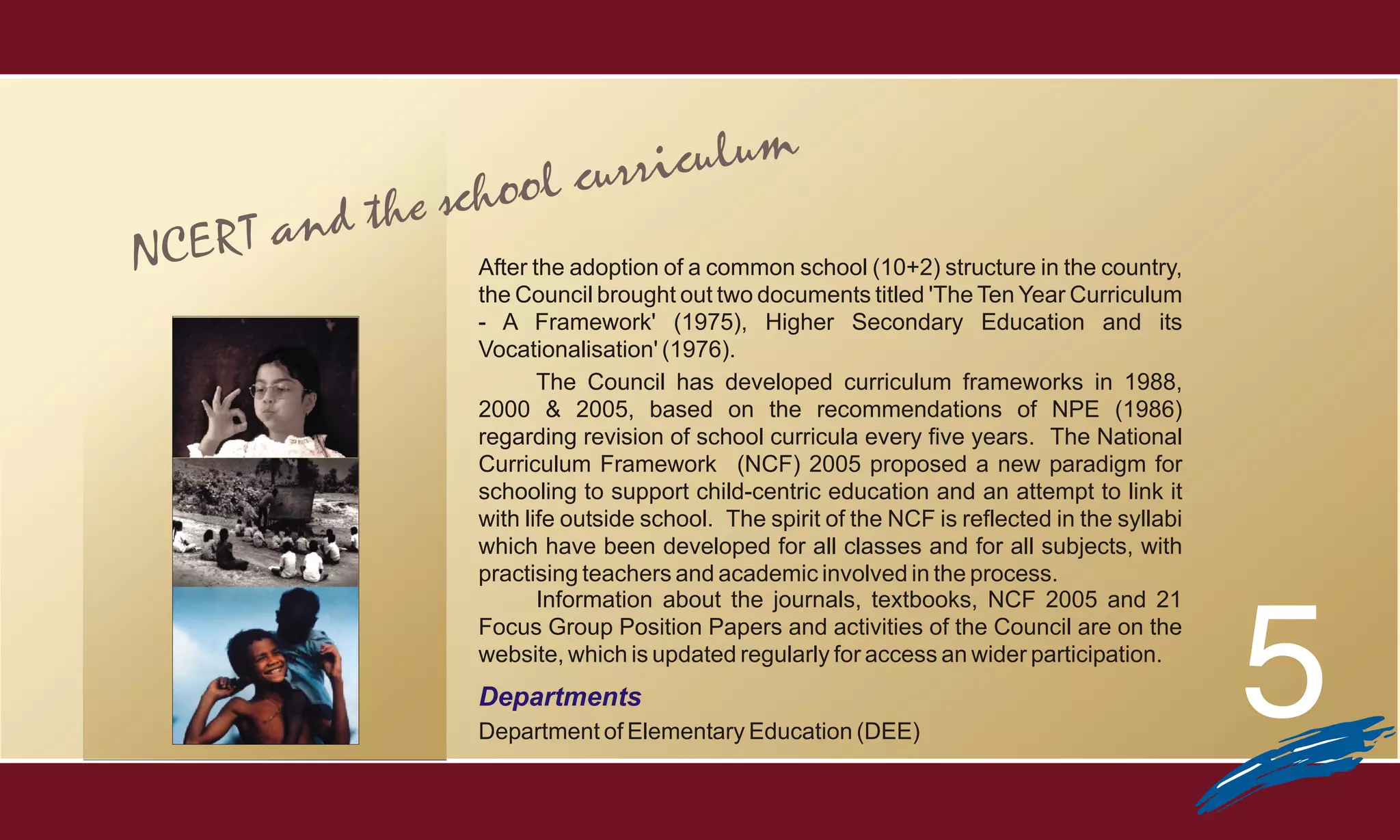
                 Curriculum Framework (NCF) 2005 proposed a new paradigm for
                 schooling to support child-centric education and an attempt to link it
                 with life outside school. The spirit of the NCF is reflected in the syllabi
                 which have been developed for all classes and for all subjects, with
                 practising teachers and academic involved in the process.
                        Information about the journals, textbooks, NCF 2005 and 21


                                                                                               5
                 Focus Group Position Papers and activities of the Council are on the
                 website, which is updated regularly for access an wider participation.
                 Departments
                 Department of Elementary Education (DEE)
Department of Teacher Education and Extension (DTEE)
Department of Languages (DoL)
Department of Education in Science and Mathematics (DESM)
Department of Educational Surveys and Data Processing (DES&DP)
Department of educational research and Policy Perspectives (DERPP)
Department of Education in Social Sciences and Humanities (DESSH)
Department of Education in Arts and Aesthetics (DEAA)
Department of Educational Psychology and Foundations of Education (DEPFE)
Department of Education of Groups with Special Needs (DEGSN)
Department of Computer Education and Technological Aids (DCETA)
Publication Department (PD)
Department of Women's Studies (DWS)
Divisions
Planning, Programming, Monitoring and Evaluation Division (PPMED)
International Relations Division (IRD)
Division of Library, Documentation and Information (DLDI)                   6
Groups
Curriculum Group
Cells & Units
Hindi Cell
Reading Cell
Mathematics Cell
Internal Works Study Unit
Public Relations Unit
Constituent Units
Central Institute of Educational Technology (CIET)
Regional Institute of Education (RIE), Ajmer
Regional Institute of Education (RIE), Bhopal
Regional Institute of Education (RIE), Bhubaneswar
Regional Institute of Education (RIE), Shillong
Regional Institute of Education (RIE), Mysore

 Postal Address: Sri Aurobindo Marg, New Delhi 110 016, India, Website: www.ncert.nic.in,

Ncert profile9

  • 1.
    N CERT In 1961, the Government of India established the National Council of Educational Research and Training (NCERT) as an autonomous organization to assist and advise the governments at the Centre and in States in the implementation of their policies for education, especially to bring about qualitative changes in school education and teacher preparation. Over the years, he Council has evolved into a unique organization, with its increasing range of activities that has influenced school education in India. Governance The Council is governed by five statutory committees, viz. Governing Council, Executive Committee (chaired by the Union Minister of Education), Finance Committee, Establishment Committee and 1 Programme Advisory Committee. Several other committees like Academic Committee, Departmental Advisory Boards/Institutional Advisory Committees, Building and Works Committee, Educational Research and Innovations Committee and National Monitoring Committee for Textbook Development advise the Council on specific activities.
  • 2.
    ts Constituent Uni National Institute of Education (NIE), located in Delhi, comprises Departments, Divisions, Groups, Cells and Constituent Units (see appendix). These pursue academic programmes that include educational research, development of textbooks and other material in-service training of teachers and extension and dissemination through various modes. NIE is also the administrative nerve centre of the Council. Diploma courses in Guidance and Counselling, Early Childhood Care and Educational and a certificate course in Peace Education are among the major training courses offered currently by NIE departments. The NIE contributes to established areas of school education such as elementary education, science and mathematics, social science and humanities, language and art, education of children with special needs and computer education. In addition, it also encompasses population 2 education, environmental education, curriculum studies, spreading a culture of 'reading' among children, educational measurement and evaluation, educational research, national talent search, women's studies and educational survey. Thursday Lecture Series and other fora as well as the film club activities involving faculty members and
  • 3.
    participants from outsidethe Council campus in Delhi, is the hub of activities in the promote healthy debate and intellectual area of educational technology. Audio, video discussion. Revival of heritage schools of and multimedia programmes for children are national importance has been a significant developed at CIET. Much of this software is programme adopted in recent times. For disseminated in transmission mode as TV and publication of textbooks and other print radio programmes, Gyandarshan and materials, the Council has a well- Gyanvani, meant especially for children. established Publication Department located CIET also has the leadership role in the on NIE campus. functioning of State Institutes of Educational The Council's five Regional Institutes Technology (SIETs). In the mid-nineteen of Education (RIEs) located at Ajmer, Bhopal, seventies in collaboration with Indian Space Bhubaneswar, Mysore and Shillong offer Research Organziation (ISRO), CIET had various programmes for teachers-in-the- launched SITE programme for schools. In making. At present, the pre-service recent times, India's educational satellite programmes at RIEs are 4-year integrated (EDUSAT) technology has helped reach 3 B.Sc-B.Ed., 2-year B.Ed., 1-year M.Ed. out to thousands of teachers through (elementary education) and 1-year diploma teleconferencing. course in guidance and counselling. Pandit Sunderlal Sharma Central Institute of The Central Institute of Educational Vocational Education (PSSCIVE) which is Technology (CIET), located on the NIE located in Bhopal organizes research,
  • 4.
    development, training andtraining and talent search scheme to identify, support extension programmes in the area of work and nurture talented students. education and vocational education. Comprehensive survey of schools, initiation of vocational education, nationwide Over the years orientation of pre-service functionaries, The Council was constituted with the activities such as Comprehensive Access to objectives of promoting educational research, Primary Education in collaboration with developing model textbooks, conducting pre- international agencies. Science Education service and in-service training of teachers, Project, work on Environmental Education n e t w o r k i n g w i t h Sta t e E d u c a t i o n and Nutrition Education have also made Departments, universities and NGOs and significant impact on different aspects of functioning as a clearinghouse of ideas. school education. Over the years, nurturing innovations Educational journals published in and bringing about qualitative change in NCERT, namely, Indian Educational school education have been the guiding Review, Journal of Indian Education, 4 principles of the Council. Substantial work Bhartiya Adhunik Shiksha, Primary has been done on early childhood education, Teacher, Primary Shikshak, School research-based interventions, institutional Science, Indian Journal of Vocational planning, Sarva Shiksha Abhiyan, Education, present the views, opinions and development of textbooks and national trends of school education in India.
  • 5.
    lum ol curricu nd the scho NCERT a After the adoption of a common school (10+2) structure in the country, the Council brought out two documents titled 'The Ten Year Curriculum - A Framework' (1975), Higher Secondary Education and its Vocationalisation' (1976). The Council has developed curriculum frameworks in 1988, 2000 & 2005, based on the recommendations of NPE (1986) regarding revision of school curricula every five years. The National Curriculum Framework (NCF) 2005 proposed a new paradigm for schooling to support child-centric education and an attempt to link it with life outside school. The spirit of the NCF is reflected in the syllabi which have been developed for all classes and for all subjects, with practising teachers and academic involved in the process. Information about the journals, textbooks, NCF 2005 and 21 5 Focus Group Position Papers and activities of the Council are on the website, which is updated regularly for access an wider participation. Departments Department of Elementary Education (DEE)
  • 6.
    Department of TeacherEducation and Extension (DTEE) Department of Languages (DoL) Department of Education in Science and Mathematics (DESM) Department of Educational Surveys and Data Processing (DES&DP) Department of educational research and Policy Perspectives (DERPP) Department of Education in Social Sciences and Humanities (DESSH) Department of Education in Arts and Aesthetics (DEAA) Department of Educational Psychology and Foundations of Education (DEPFE) Department of Education of Groups with Special Needs (DEGSN) Department of Computer Education and Technological Aids (DCETA) Publication Department (PD) Department of Women's Studies (DWS) Divisions Planning, Programming, Monitoring and Evaluation Division (PPMED) International Relations Division (IRD) Division of Library, Documentation and Information (DLDI) 6
  • 7.
    Groups Curriculum Group Cells &Units Hindi Cell Reading Cell Mathematics Cell Internal Works Study Unit Public Relations Unit Constituent Units Central Institute of Educational Technology (CIET) Regional Institute of Education (RIE), Ajmer Regional Institute of Education (RIE), Bhopal Regional Institute of Education (RIE), Bhubaneswar Regional Institute of Education (RIE), Shillong Regional Institute of Education (RIE), Mysore Postal Address: Sri Aurobindo Marg, New Delhi 110 016, India, Website: www.ncert.nic.in,