Groups Members
OLAP, OLTP and  Data Mining Title Data Warehouse DW Diagram OLTP OLAP Data Mining Data Mining goal Data Mining Elements  Data Mining Application DW VS Data Mining Thanks  
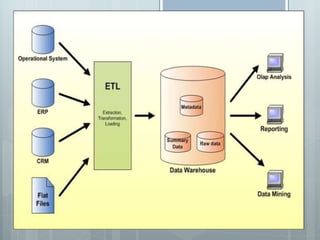
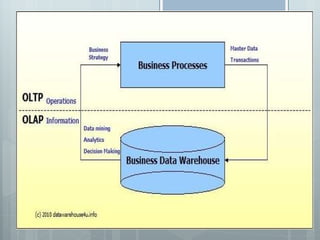
Data Warehouses Repository is a key data warehouse component Data warehouses provide access to data for complex analysis, knowledge discovery, and decision making. Data warehousing more generally as a collection of  decision support technologies , aimed at enabling the knowledge worker (executive, manager, analyst) to make better and faster decisions.
 
Extract, Transform and Load Pulling data out of the source system and placing it into a data warehouse Cleaning Filtering Splitting a column into multiple columns Joining together.   loading the data  into a data warehouse
 
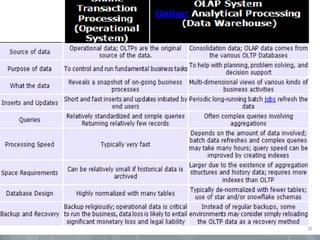
On-line Transaction Processing Use in Traditional databases Includes insertions, updates, and deletions, while also supporting information query requirements
On-line Analytical Processing To describe the analysis of complex data from the data warehouse ROLAP (relational OLAP) and MOLAP (multidimensional OLAP) functions
 
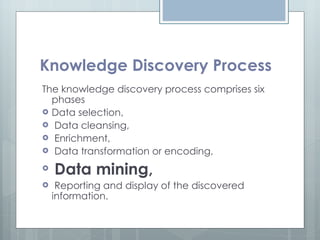
Knowledge Discovery Process The knowledge discovery process comprises six phases  Data selection, Data cleansing, Enrichment,  Data transformation or encoding, Data mining,  Reporting and display of the discovered information.
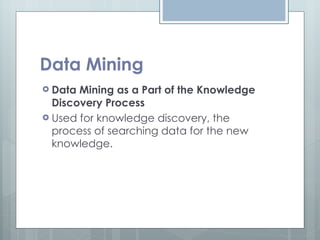
Data Mining Data Mining as a Part of the Knowledge Discovery Process Used for knowledge discovery, the process of searching data for the new knowledge.
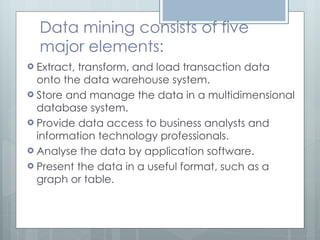
Data mining consists of five major elements: Extract, transform, and load transaction data onto the data warehouse system. Store and manage the data in a multidimensional database system. Provide data access to business analysts and information technology professionals. Analyse the data by application software. Present the data in a useful format, such as a graph or table.
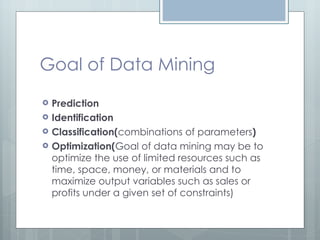
Goal of Data Mining Prediction Identification Classification( combinations of parameters ) Optimization( Goal of data mining may be to optimize the use of limited resources such as time, space, money, or materials and to maximize output variables such as sales or profits under a given set of constraints)
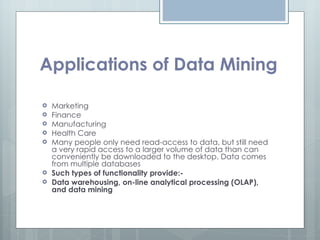
Applications of Data Mining Marketing Finance Manufacturing Health Care Many people only need read-access to data, but still need a very rapid access to a larger volume of data than can conveniently be downloaded to the desktop. Data comes from multiple databases  Such types of functionality provide:- Data warehousing, on-line analytical processing (OLAP), and data mining
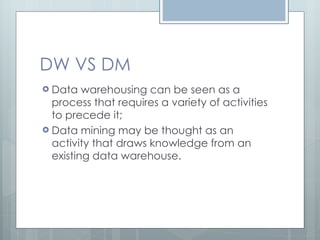
DW VS DM Data warehousing can be seen as a process that requires a variety of activities to precede it; Data mining may be thought as an activity that draws knowledge from an existing data warehouse.
 

Olap, oltp and data mining

  • 1.
  • 2.
  • 3.
    OLAP, OLTP and Data Mining Title Data Warehouse DW Diagram OLTP OLAP Data Mining Data Mining goal Data Mining Elements Data Mining Application DW VS Data Mining Thanks  
  • 4.
    Data Warehouses Repositoryis a key data warehouse component Data warehouses provide access to data for complex analysis, knowledge discovery, and decision making. Data warehousing more generally as a collection of decision support technologies , aimed at enabling the knowledge worker (executive, manager, analyst) to make better and faster decisions.
  • 5.
  • 6.
    Extract, Transform andLoad Pulling data out of the source system and placing it into a data warehouse Cleaning Filtering Splitting a column into multiple columns Joining together.   loading the data  into a data warehouse
  • 7.
  • 8.
    On-line Transaction ProcessingUse in Traditional databases Includes insertions, updates, and deletions, while also supporting information query requirements
  • 9.
    On-line Analytical ProcessingTo describe the analysis of complex data from the data warehouse ROLAP (relational OLAP) and MOLAP (multidimensional OLAP) functions
  • 10.
  • 11.
    Knowledge Discovery ProcessThe knowledge discovery process comprises six phases Data selection, Data cleansing, Enrichment, Data transformation or encoding, Data mining, Reporting and display of the discovered information.
  • 12.
    Data Mining DataMining as a Part of the Knowledge Discovery Process Used for knowledge discovery, the process of searching data for the new knowledge.
  • 13.
    Data mining consistsof five major elements: Extract, transform, and load transaction data onto the data warehouse system. Store and manage the data in a multidimensional database system. Provide data access to business analysts and information technology professionals. Analyse the data by application software. Present the data in a useful format, such as a graph or table.
  • 14.
    Goal of DataMining Prediction Identification Classification( combinations of parameters ) Optimization( Goal of data mining may be to optimize the use of limited resources such as time, space, money, or materials and to maximize output variables such as sales or profits under a given set of constraints)
  • 15.
    Applications of DataMining Marketing Finance Manufacturing Health Care Many people only need read-access to data, but still need a very rapid access to a larger volume of data than can conveniently be downloaded to the desktop. Data comes from multiple databases Such types of functionality provide:- Data warehousing, on-line analytical processing (OLAP), and data mining
  • 16.
    DW VS DMData warehousing can be seen as a process that requires a variety of activities to precede it; Data mining may be thought as an activity that draws knowledge from an existing data warehouse.
  • 17.

Editor's Notes