PRESENTED BY,
T.JANANI
I-MSC(CS&IT)
NADAR SARASWATHI COLLEGE OF
ARTS & SCIENCE THENI.
The business analyst get the information from the data
warehouses to measure the performance and make critical
adjustments in order to win over other business holders in
the market.
Advantages:
1. Since a data warehouse can gather
information quickly and efficiently, it can enhance
business productivity.
2. A data warehouse provides us a consistent
view of customers and items, hence, it helps us manage
customer relationship.
3. A data warehouse also helps in bringing
down the costs by tracking trends, patterns over a
The top-down view - This view allows the
selection of relevant information needed for a data
warehouse.
The data source view - This view presents the
information being captured, stored, and managed by the
operational system.
The data warehouse view - This view
includes the fact tables and dimension tables. It represents
the information stored inside the data warehouse.
The business query view - It is the view of the
data from the viewpoint of the end-user.
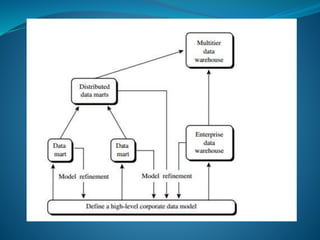
A data warehouse can be built using a top-down approach,
a bottom-up approach, or a combination of both.
The top-down approach: Starts with the
overall design and planning. It is useful in cases where the
technology is mature and well known, and where the
business problems that must be solved are clear and well
understood.
The bottom-up approach: Starts with
experiments and prototypes. It allows an organization to
move forward at considerably less expense and to evaluate
the benefits of the technology before making significant
commitments.
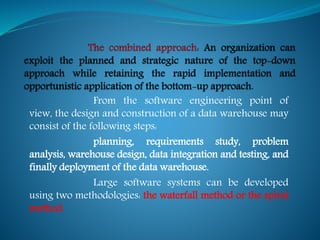
From the software engineering point of
view, the design and construction of a data warehouse may
consist of the following steps:
planning, requirements study, problem
analysis, warehouse design, data integration and testing, and
finally deployment of the data warehouse.
Large software systems can be developed
using two methodologies: the waterfall method or the spiral
method.
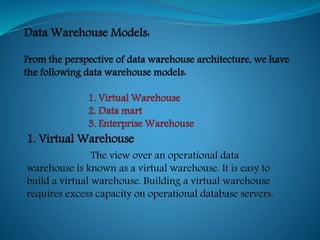
1. Virtual Warehouse
The view over an operational data
warehouse is known as a virtual warehouse. It is easy to
build a virtual warehouse. Building a virtual warehouse
requires excess capacity on operational database servers.
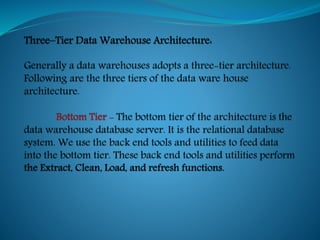
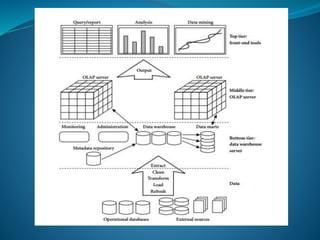
Data warehouse systems use back-end tools and utilities to
populate and refresh their data. These tools and utilities include
the following functions:
Data extraction: which typically gathers data
from multiple, heterogeneous, and external sources
Data cleaning: which detects errors in the data
and rectifies them when possible
Data transformation: which converts data from
legacy or host format to warehouse format
Load: which sorts, summarizes, consolidates,
computes views, checks integrity, and builds indices and
partitions
Refresh: which propagates the updates from the
data sources to the warehouse
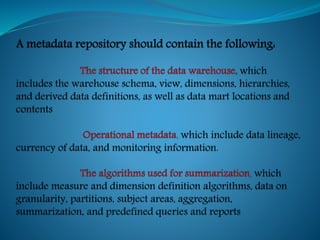
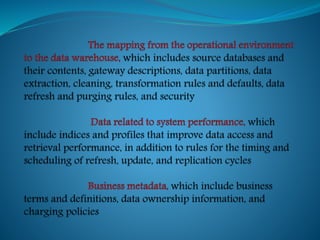
Metadata are data about data. When used in a
data warehouse, metadata are the data that define warehouse
objects.
Metadata are created for the data names and
definitions of the given warehouse.
Additional metadata are created and captured
for time stamping any extracted data, the source of the
extracted data, and missing fields that have been added by
data cleaning or integration processes.
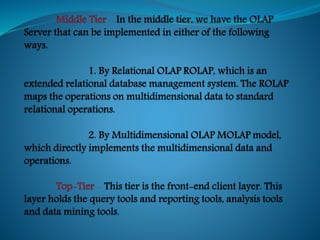
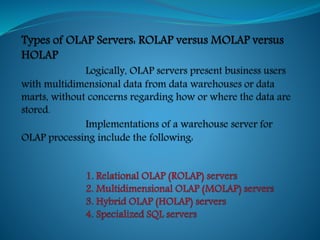
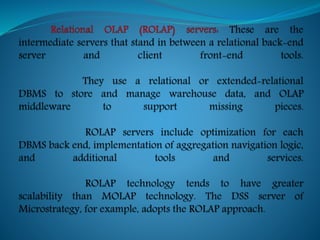
Hybrid OLAP (HOLAP) servers: The hybrid OLAP
approach combines ROLAP and MOLAP technology,
benefiting from the greater scalability of ROLAP and the
faster computation of MOLAP.
For example, a HOLAP server may allow
large volumes of detail data to be stored in a relational
database, while aggregations are kept in a separate MOLAP
store. The Microsoft SQL Server 2000 supports a hybrid
OLAP server.
Data warehouse architecture

Data warehouse architecture

  • 1.
  • 2.
    The business analystget the information from the data warehouses to measure the performance and make critical adjustments in order to win over other business holders in the market. Advantages: 1. Since a data warehouse can gather information quickly and efficiently, it can enhance business productivity. 2. A data warehouse provides us a consistent view of customers and items, hence, it helps us manage customer relationship. 3. A data warehouse also helps in bringing down the costs by tracking trends, patterns over a
  • 3.
    The top-down view- This view allows the selection of relevant information needed for a data warehouse. The data source view - This view presents the information being captured, stored, and managed by the operational system. The data warehouse view - This view includes the fact tables and dimension tables. It represents the information stored inside the data warehouse. The business query view - It is the view of the data from the viewpoint of the end-user.
  • 4.
    A data warehousecan be built using a top-down approach, a bottom-up approach, or a combination of both. The top-down approach: Starts with the overall design and planning. It is useful in cases where the technology is mature and well known, and where the business problems that must be solved are clear and well understood. The bottom-up approach: Starts with experiments and prototypes. It allows an organization to move forward at considerably less expense and to evaluate the benefits of the technology before making significant commitments.
  • 5.
    From the softwareengineering point of view, the design and construction of a data warehouse may consist of the following steps: planning, requirements study, problem analysis, warehouse design, data integration and testing, and finally deployment of the data warehouse. Large software systems can be developed using two methodologies: the waterfall method or the spiral method.
  • 9.
    1. Virtual Warehouse Theview over an operational data warehouse is known as a virtual warehouse. It is easy to build a virtual warehouse. Building a virtual warehouse requires excess capacity on operational database servers.
  • 13.
    Data warehouse systemsuse back-end tools and utilities to populate and refresh their data. These tools and utilities include the following functions: Data extraction: which typically gathers data from multiple, heterogeneous, and external sources Data cleaning: which detects errors in the data and rectifies them when possible Data transformation: which converts data from legacy or host format to warehouse format Load: which sorts, summarizes, consolidates, computes views, checks integrity, and builds indices and partitions Refresh: which propagates the updates from the data sources to the warehouse
  • 14.
    Metadata are dataabout data. When used in a data warehouse, metadata are the data that define warehouse objects. Metadata are created for the data names and definitions of the given warehouse. Additional metadata are created and captured for time stamping any extracted data, the source of the extracted data, and missing fields that have been added by data cleaning or integration processes.
  • 20.
    Hybrid OLAP (HOLAP)servers: The hybrid OLAP approach combines ROLAP and MOLAP technology, benefiting from the greater scalability of ROLAP and the faster computation of MOLAP. For example, a HOLAP server may allow large volumes of detail data to be stored in a relational database, while aggregations are kept in a separate MOLAP store. The Microsoft SQL Server 2000 supports a hybrid OLAP server.