DATA
WAREHOUSING
PRESENTED BY:-
SHRUTI DALELA
MCA V SEM
OUTLINES:-
 WHAT IS A DATA WAREHOUSING
 DATA WAREHOUSING DEFINITION
 HISTORY OF DATA WAREHOUSING
 FACTS ABOUT DATA WAREHOUSING
 CHARACTERISTICS OF DATA
WAREHOUSING
 USAGE AND TRENDS
 ARCHITECTURE OF DATA WAREHOUSE
 DBMS VS DATA WAREHOUSE
What Is A Data Warehouse?
A data warehouse is a powerful database
model
that significantly enhances the user’s ability
to
quickly analyze large, multidimensional data
sets.
It cleanses and organizes data to allow users
to
make business decisions based on facts.
Hence,
the data in the data warehouse must have
Data Warehousing Definition:-
 Date warehousing is an aspect to gather data
from multiple sources into central
repository,called Data warehouse.
 According to William H.Inmon,a leading
architect in the construction of data warehouse
systems,”A data warehouse is a subject –
oriented ,integrated ,time variant and non-
volatile collection of data in support of
management’s decision making process.
 “A data warehouse is simply a single complete,
and consistent store of data obtained from a
variety of sources and made available to end
users in a way they can understand and use it
in a business context.”
-----Barry Devlin,IBM consultant
DATA WAREHOUSES
Data Warehouses:
 Data spread in several databases –
physically located at numerous sites
 Data warehouse – repository of multiple
DBs in single schema; resides at single site.
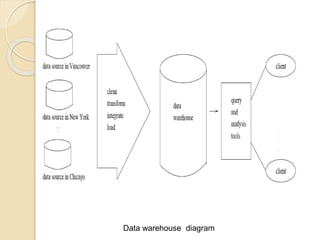
 Data warehousing processes
1. Data Cleaning 2. Data Integration 3. Data
Transformation
4. Data Loading 5. Periodic data refreshing
Data warehouse diagram
 Data cleaning:-Data Cleaning includes,
filling in missing values, smoothing noisy
data, identifying or removing outliers, and
resolving inconsistencies.
 Data integration:-Data Integration includes
integration of multiple databases, data
cubes, or files.
 Data transformation:-Convert data from
legacy or host format to warehouse format.
 Load :-sort;summarize,consolidate;compute
views; check integrity.Build indices and
partitions.
 Refresh:-Propagates the update from data
sources to the warehouse.
 Data in a data warehouse are organized
around major subjects.
 Data provide information on historical
perspective – summarized on periodic
dimension.
 Eg. Sales of an item for a region in a period
 Data warehouse model – multidimensional
database structure / data cube
 Dimensions – Attributes / set of attributes
 Facts – Aggregated measures (Count /
Sales amount)
History of data warehousing
 The concept of data warehousing
dates back to the late 1980s when
IBM researcher Barry davlin and paul
murphy developed the “the business
data warehouse”.
 In essence, the data warehousing
concept was intended to provide an
architectural model for the flow of data
from opeational systems to decision
support environments.
Facts about data
warehousing:-
 Issues involved in warehousing include
techniques for dealing with errors and
techniques for efficient storage and
indexing of large volumes of data.
 This system is used for reporting and data
analysis.
 It usually contains historical data derived
from transaction data.
 Data warehousing is not meant for current
“live”data.
Components of a data
warehouse
• Sources –Data source interaction
• Data Transformation
• Data warehouse (data storage )
• Reporting (Data presentation )
• Metadata
Complete control over the four main
areas
of data management systems: -
 Clean data
 Query processing: multiple options
 Indexes: multiple types
 Security: data and access
Data Warehouse Advantages
Data Warehousing
Disadvantages
 Adding new data sources takes time and
associated high cost.
 Data owners lose control over their data,
raising ownership, security and privacy
issues.
 Long initial implementation time and
associated high cost.
 Difficult to accommodate changes in data
types and ranges, data source schema,
indexes and queries.
Characteristics of Data
Warehousing:-
 Subject –Oriented:-A data warehouse can
be used to analyze a particular subject
area.
For example:-”sales” can be a particular
subject.
 Integrated:-A data warehouse integrates
data from multiple data sources.
For example:-Source A and source B may
have different ways of identifying a product,
but in a data warehouse,there will be only
a single way of identifying a product.
 Time Variant :-Historical data is kept in a
data warehouse.
For example:-One can retrieve data from 3
months ,6months, 12 months ,or even older
data from a data warehouse.
 Non volatile:-Once data is in the data
warehouse,it will not change.So,historical
data in a data warehouse should never be
altered.
 It must be optimized for access to very
large amount of data.
 It is based on client server architecture.
 It is capable of handling dynamic matrices.
 It maintains transparency.
 It is consitent and flexible.
DATA WAREHOUSE
USAGE:-
• Three kinds of data warehouse
applications
1)Information processing:-Supports querying, basic
statistical analysis, and reporting using crosstabs, tables,
charts and graphs.
2)Analytical processing:-
• Multidimensional analysis of data warehouse data
• Supports basic OLAP operations, slice-dice, drilling,
pivoting
3)Data mining:-
• Knowledge discovery from hidden patterns
• Supports associations, constructing analytical models,
performing classification and prediction, and presenting
the mining results using visualization tools.
 Differences among the three tasks
TRENDS IN DATA
WAREHOUSING
 In the next few years, data warehousing is
expected make big strides in software,
especially for optimizing queries:-
o indexing very large tables
o enhancing SQL
o improving data compression
o expanding dimensional modeling
 Real-Time Data Warehousing
 Multiple Data Types
 Adding Unstructured Data
 Searching Unstructured Data
 Spatial Data
 Data Visualization
 Major Visualization Trends
 Visualization Types
 Advanced Visualization TechniquesChart
Manipulation.
 Drill Down.
 Advanced Interaction
Architecture of data warehouse
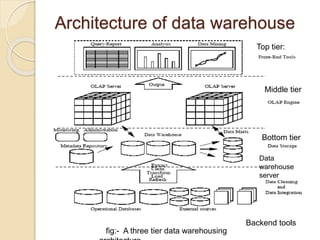
fig:- A three tier data warehousing
Top tier:
Middle tier
Bottom tier
Data
warehouse
server
Backend tools
1)Bottom tier:-The bottom tier is a warehouse
database server that is always a relational
database system.
 Back-end tools and utilities are used to feed data
into the bottom tier from operational databases or
other external sources. These tools and utilities
perform data extraction,cleaning and
transformation as well as load and refresh
functions to update the data warehouse.
 The date extracted using application program
interfaces known as gateways.
 Example of gateways are ODBC(open database
connection)and OLEDB(Open Linking and
embedding for database) by microsoft and
jdbc(java database connecton).
 This tier also contains a metadata repository, which
stores information about the data warehouse and
its contents.
2.)Middle tier:- The middle tier is an OLAP
server that is typically implemented using
either:-
a) A relational OLAP (ROLAP) model that
is,an extended relation DBMS that maps
operations.Intermediate server b/w
relational back-end server and client front
end tools.
b) A multidimentional OLAP (MOLAP) model
that is, a special purpose server that
directly implements multidimentional data
and operations. Supports multidimention
views.
3.)Top tier:-The top tier is a front –end client
layer ,which contains query and reporting
tools ,analysis tools,and or data mining
tools.
 Note:-
OLAP – Online Analytical Processing:
 This is the major task of Data Warehousing
System.
 Useful for complex data analysis and
decision making.
 Market oriented –used by
managers,executives and data analyst.
DBMS VS Data
Warehousing
In today’s corporate world ,every
business enterprise ,no matter how
big or small requires a database. The
more the business grows, the more
urgent is the requirement of a
database .The database is required to
keep a check on the growth of a
business in a specific period.
DBMS:-DBMS is at times known as the
database manager although it is the
abbreviated form of database
management system.
 It is basically a repertoire of computer
programs that devoted for the
management of the database of an
organization .
 It is a complete and comprehensive
methodology in use for specific purposes
 Like overall management of digital data-
bases,creation and maintenance of
data,searching and serving other
operations relating to the database.
DATA WAREHOUSE:- A data warehouse
is usually a place where various types’
data -bases are stored mainly for
purpose of security ,archival analysis
and storage.
 The data warehouse consists of either
one or several computer systems that
are networked together form a single
computer system.
 The data warehouse is a database of a
different kind: an OLAP (online analytical
processing) database. A data warehouse
exists as a layer on top of another database
or databases (usually OLTP databases).
 In DBMS,there is OLTP(online
transaction processing )is used.Here we
cannot analysis because data changes
day by day.
 In data warehousing there is
OLAP(online analytical processing .It
maintain historical data.It collects data
from different databases like oracle and
so on.It is used to find analysis and
generate reports.
 The key difference between DBMS and
data warehouse is the fact that a data
warehouse can be treated as a type of
database or a kind of database which
provides special facilities for analysis
and reporting while DBMS is the overall
system which manages a certain
for your attention!

Data warehousing

  • 1.
  • 2.
    OUTLINES:-  WHAT ISA DATA WAREHOUSING  DATA WAREHOUSING DEFINITION  HISTORY OF DATA WAREHOUSING  FACTS ABOUT DATA WAREHOUSING  CHARACTERISTICS OF DATA WAREHOUSING  USAGE AND TRENDS  ARCHITECTURE OF DATA WAREHOUSE  DBMS VS DATA WAREHOUSE
  • 3.
    What Is AData Warehouse? A data warehouse is a powerful database model that significantly enhances the user’s ability to quickly analyze large, multidimensional data sets. It cleanses and organizes data to allow users to make business decisions based on facts. Hence, the data in the data warehouse must have
  • 4.
    Data Warehousing Definition:- Date warehousing is an aspect to gather data from multiple sources into central repository,called Data warehouse.  According to William H.Inmon,a leading architect in the construction of data warehouse systems,”A data warehouse is a subject – oriented ,integrated ,time variant and non- volatile collection of data in support of management’s decision making process.  “A data warehouse is simply a single complete, and consistent store of data obtained from a variety of sources and made available to end users in a way they can understand and use it in a business context.” -----Barry Devlin,IBM consultant
  • 5.
    DATA WAREHOUSES Data Warehouses: Data spread in several databases – physically located at numerous sites  Data warehouse – repository of multiple DBs in single schema; resides at single site.  Data warehousing processes 1. Data Cleaning 2. Data Integration 3. Data Transformation 4. Data Loading 5. Periodic data refreshing
  • 6.
  • 7.
     Data cleaning:-DataCleaning includes, filling in missing values, smoothing noisy data, identifying or removing outliers, and resolving inconsistencies.  Data integration:-Data Integration includes integration of multiple databases, data cubes, or files.  Data transformation:-Convert data from legacy or host format to warehouse format.  Load :-sort;summarize,consolidate;compute views; check integrity.Build indices and partitions.  Refresh:-Propagates the update from data sources to the warehouse.
  • 9.
     Data ina data warehouse are organized around major subjects.  Data provide information on historical perspective – summarized on periodic dimension.  Eg. Sales of an item for a region in a period  Data warehouse model – multidimensional database structure / data cube  Dimensions – Attributes / set of attributes  Facts – Aggregated measures (Count / Sales amount)
  • 10.
    History of datawarehousing  The concept of data warehousing dates back to the late 1980s when IBM researcher Barry davlin and paul murphy developed the “the business data warehouse”.  In essence, the data warehousing concept was intended to provide an architectural model for the flow of data from opeational systems to decision support environments.
  • 11.
    Facts about data warehousing:- Issues involved in warehousing include techniques for dealing with errors and techniques for efficient storage and indexing of large volumes of data.  This system is used for reporting and data analysis.  It usually contains historical data derived from transaction data.  Data warehousing is not meant for current “live”data.
  • 12.
    Components of adata warehouse • Sources –Data source interaction • Data Transformation • Data warehouse (data storage ) • Reporting (Data presentation ) • Metadata
  • 14.
    Complete control overthe four main areas of data management systems: -  Clean data  Query processing: multiple options  Indexes: multiple types  Security: data and access Data Warehouse Advantages
  • 15.
    Data Warehousing Disadvantages  Addingnew data sources takes time and associated high cost.  Data owners lose control over their data, raising ownership, security and privacy issues.  Long initial implementation time and associated high cost.  Difficult to accommodate changes in data types and ranges, data source schema, indexes and queries.
  • 16.
    Characteristics of Data Warehousing:- Subject –Oriented:-A data warehouse can be used to analyze a particular subject area. For example:-”sales” can be a particular subject.  Integrated:-A data warehouse integrates data from multiple data sources. For example:-Source A and source B may have different ways of identifying a product, but in a data warehouse,there will be only a single way of identifying a product.  Time Variant :-Historical data is kept in a data warehouse.
  • 17.
    For example:-One canretrieve data from 3 months ,6months, 12 months ,or even older data from a data warehouse.  Non volatile:-Once data is in the data warehouse,it will not change.So,historical data in a data warehouse should never be altered.  It must be optimized for access to very large amount of data.  It is based on client server architecture.  It is capable of handling dynamic matrices.  It maintains transparency.  It is consitent and flexible.
  • 18.
    DATA WAREHOUSE USAGE:- • Threekinds of data warehouse applications 1)Information processing:-Supports querying, basic statistical analysis, and reporting using crosstabs, tables, charts and graphs. 2)Analytical processing:- • Multidimensional analysis of data warehouse data • Supports basic OLAP operations, slice-dice, drilling, pivoting 3)Data mining:- • Knowledge discovery from hidden patterns • Supports associations, constructing analytical models, performing classification and prediction, and presenting the mining results using visualization tools.  Differences among the three tasks
  • 19.
    TRENDS IN DATA WAREHOUSING In the next few years, data warehousing is expected make big strides in software, especially for optimizing queries:- o indexing very large tables o enhancing SQL o improving data compression o expanding dimensional modeling
  • 20.
     Real-Time DataWarehousing  Multiple Data Types  Adding Unstructured Data  Searching Unstructured Data  Spatial Data  Data Visualization  Major Visualization Trends  Visualization Types  Advanced Visualization TechniquesChart Manipulation.  Drill Down.  Advanced Interaction
  • 21.
    Architecture of datawarehouse fig:- A three tier data warehousing Top tier: Middle tier Bottom tier Data warehouse server Backend tools
  • 22.
    1)Bottom tier:-The bottomtier is a warehouse database server that is always a relational database system.  Back-end tools and utilities are used to feed data into the bottom tier from operational databases or other external sources. These tools and utilities perform data extraction,cleaning and transformation as well as load and refresh functions to update the data warehouse.  The date extracted using application program interfaces known as gateways.  Example of gateways are ODBC(open database connection)and OLEDB(Open Linking and embedding for database) by microsoft and jdbc(java database connecton).  This tier also contains a metadata repository, which stores information about the data warehouse and its contents.
  • 23.
    2.)Middle tier:- Themiddle tier is an OLAP server that is typically implemented using either:- a) A relational OLAP (ROLAP) model that is,an extended relation DBMS that maps operations.Intermediate server b/w relational back-end server and client front end tools. b) A multidimentional OLAP (MOLAP) model that is, a special purpose server that directly implements multidimentional data and operations. Supports multidimention views.
  • 24.
    3.)Top tier:-The toptier is a front –end client layer ,which contains query and reporting tools ,analysis tools,and or data mining tools.  Note:- OLAP – Online Analytical Processing:  This is the major task of Data Warehousing System.  Useful for complex data analysis and decision making.  Market oriented –used by managers,executives and data analyst.
  • 25.
    DBMS VS Data Warehousing Intoday’s corporate world ,every business enterprise ,no matter how big or small requires a database. The more the business grows, the more urgent is the requirement of a database .The database is required to keep a check on the growth of a business in a specific period.
  • 26.
    DBMS:-DBMS is attimes known as the database manager although it is the abbreviated form of database management system.  It is basically a repertoire of computer programs that devoted for the management of the database of an organization .  It is a complete and comprehensive methodology in use for specific purposes  Like overall management of digital data- bases,creation and maintenance of data,searching and serving other operations relating to the database.
  • 27.
    DATA WAREHOUSE:- Adata warehouse is usually a place where various types’ data -bases are stored mainly for purpose of security ,archival analysis and storage.  The data warehouse consists of either one or several computer systems that are networked together form a single computer system.  The data warehouse is a database of a different kind: an OLAP (online analytical processing) database. A data warehouse exists as a layer on top of another database or databases (usually OLTP databases).
  • 28.
     In DBMS,thereis OLTP(online transaction processing )is used.Here we cannot analysis because data changes day by day.  In data warehousing there is OLAP(online analytical processing .It maintain historical data.It collects data from different databases like oracle and so on.It is used to find analysis and generate reports.  The key difference between DBMS and data warehouse is the fact that a data warehouse can be treated as a type of database or a kind of database which provides special facilities for analysis and reporting while DBMS is the overall system which manages a certain
  • 29.