1
Data Warehouse
2
Data Warehouse
 Definition
 A decision support database that is maintained separately from
the organization’s operational database
 Support information processing by providing a solid platform of
consolidated, historical data for analysis.
 “A data warehouse is a subject-oriented, integrated, time-
variant, and nonvolatile collection of data in support of
management’s decision-making process.”—W. H. Inmon
 Data warehousing:
 The process of constructing and using data warehouses
3
Data Warehouse—Subject-Oriented
 Organized around major subjects, such as
customer, product, sales
 Focusing on the modeling and analysis of data for
decision makers, not on daily operations or
transaction processing
 Provide a simple and concise view around
particular subject issues by excluding data that are
not useful in the decision support process
4
Data Warehouse—Integrated
 Constructed by integrating multiple, heterogeneous
data sources
 relational databases, flat files, on-line transaction records
 Data cleaning and data integration techniques are
applied.
 Ensure consistency in naming conventions, encoding
structures, attribute measures, etc. among different data
sources
 E.g., Hotel price: currency, tax, breakfast covered, etc.
 When data is moved to the warehouse, it is converted.
5
Data Warehouse—Time Variant
 The time horizon for the data warehouse is
significantly longer than that of operational systems
 Operational database: current value data
 Data warehouse data: provide information from a historical
perspective (e.g., past 5-10 years)
 Every key structure in the data warehouse
 Contains an element of time, explicitly or implicitly
 But the key of operational data may or may not contain
“time element”
6
Data Warehouse—Nonvolatile
 A physically separate store of data transformed from
the operational environment
 Does not require transaction processing, recovery,
and concurrency control mechanisms
 Major operations:
 initial loading of data
 access of data
 Periodic updates
7
Data Warehouse vs. Heterogeneous
DBMS
 Traditional heterogeneous DB integration: A query driven
approach
 Build wrappers/mediators on top of heterogeneous databases
 When a query is posed to a client site, a meta-dictionary is used
to translate the query into queries appropriate for individual
heterogeneous sites involved, and the results are integrated into a
global answer set
 Data warehouse: update-driven, high performance
 Information from heterogeneous sources is integrated in advance
and stored in warehouses for direct query and analysis
8
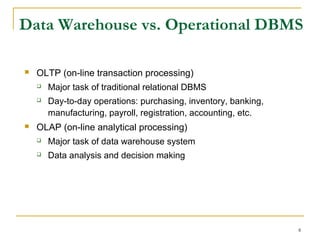
Data Warehouse vs. Operational DBMS
 OLTP (on-line transaction processing)
 Major task of traditional relational DBMS
 Day-to-day operations: purchasing, inventory, banking,
manufacturing, payroll, registration, accounting, etc.
 OLAP (on-line analytical processing)
 Major task of data warehouse system
 Data analysis and decision making
9
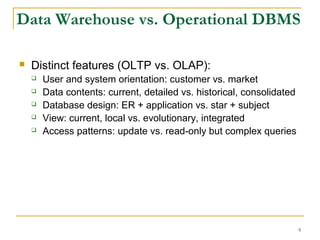
 Distinct features (OLTP vs. OLAP):
 User and system orientation: customer vs. market
 Data contents: current, detailed vs. historical, consolidated
 Database design: ER + application vs. star + subject
 View: current, local vs. evolutionary, integrated
 Access patterns: update vs. read-only but complex queries
Data Warehouse vs. Operational DBMS
10
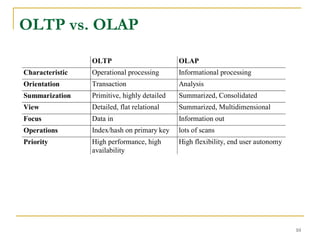
OLTP vs. OLAP
OLTP OLAP
Characteristic Operational processing Informational processing
Orientation Transaction Analysis
Summarization Primitive, highly detailed Summarized, Consolidated
View Detailed, flat relational Summarized, Multidimensional
Focus Data in Information out
Operations Index/hash on primary key lots of scans
Priority High performance, high
availability
High flexibility, end user autonomy
11
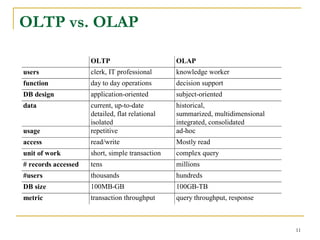
OLTP vs. OLAP
OLTP OLAP
users clerk, IT professional knowledge worker
function day to day operations decision support
DB design application-oriented subject-oriented
data current, up-to-date
detailed, flat relational
isolated
historical,
summarized, multidimensional
integrated, consolidated
usage repetitive ad-hoc
access read/write Mostly read
unit of work short, simple transaction complex query
# records accessed tens millions
#users thousands hundreds
DB size 100MB-GB 100GB-TB
metric transaction throughput query throughput, response
12
Need for Separate Data Warehouse
 High performance for both systems
 DBMS— tuned for OLTP: access methods, indexing, concurrency
control, recovery
 Warehouse—tuned for OLAP: complex OLAP queries,
multidimensional view, consolidation
 Different functions and different data:
 missing data: Decision support requires historical data which
operational DBs do not typically maintain
 data consolidation: DS requires consolidation (aggregation,
summarization) of data from heterogeneous sources
 data quality: different sources typically use inconsistent data
representations, codes and formats which have to be reconciled
13
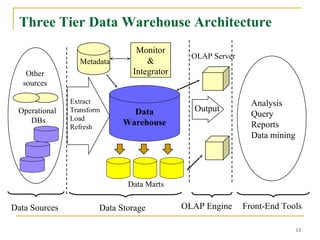
Data
Warehouse
Extract
Transform
Load
Refresh
OLAP Engine
Analysis
Query
Reports
Data mining
Monitor
&
Integrator
Metadata
Data Sources Front-End Tools
Output
Data Marts
Operational
DBs
Other
sources
Data Storage
OLAP Server
Three Tier Data Warehouse Architecture
14
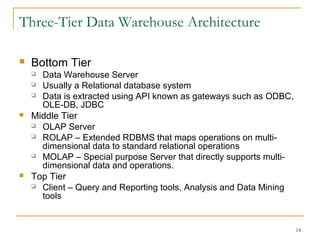
Three-Tier Data Warehouse Architecture
 Bottom Tier
 Data Warehouse Server
 Usually a Relational database system
 Data is extracted using API known as gateways such as ODBC,
OLE-DB, JDBC
 Middle Tier
 OLAP Server
 ROLAP – Extended RDBMS that maps operations on multi-
dimensional data to standard relational operations
 MOLAP – Special purpose Server that directly supports multi-
dimensional data and operations.
 Top Tier
 Client – Query and Reporting tools, Analysis and Data Mining
tools
15
Three Data Warehouse Models
 Enterprise warehouse
 Collects all of the information about subjects spanning the entire organization
 Contains detailed and summarized data
 Can be implemented on Mainframes -years
 Data Mart
 a subset of corporate-wide data that is of value to a specific groups of users. Its
scope is confined to specific, selected groups, such as marketing data mart
 Independent vs. dependent (directly from warehouse) data mart
 Implemented on Departmental Servers - weeks
 Virtual warehouse
 A set of views over operational databases
 Only some of the possible summary views may be materialized
16
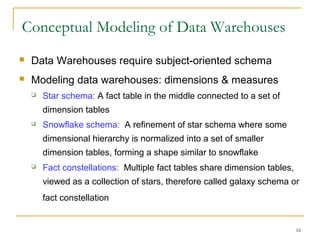
Conceptual Modeling of Data Warehouses
 Data Warehouses require subject-oriented schema
 Modeling data warehouses: dimensions & measures
 Star schema: A fact table in the middle connected to a set of
dimension tables
 Snowflake schema: A refinement of star schema where some
dimensional hierarchy is normalized into a set of smaller
dimension tables, forming a shape similar to snowflake
 Fact constellations: Multiple fact tables share dimension tables,
viewed as a collection of stars, therefore called galaxy schema or
fact constellation
17
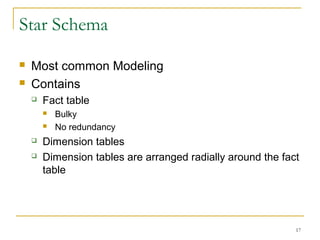
Star Schema
 Most common Modeling
 Contains
 Fact table
 Bulky
 No redundancy
 Dimension tables
 Dimension tables are arranged radially around the fact
table
18
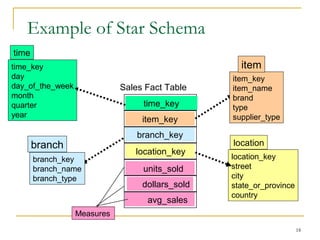
Example of Star Schema
time_key
day
day_of_the_week
month
quarter
year
time
location_key
street
city
state_or_province
country
location
Sales Fact Table
time_key
item_key
branch_key
location_key
units_sold
dollars_sold
avg_sales
Measures
item_key
item_name
brand
type
supplier_type
item
branch_key
branch_name
branch_type
branch
19
Defining Star Schema in DMQL
define cube sales_star [time, item, branch, location]:
dollars_sold = sum(sales_in_dollars), avg_sales =
avg(sales_in_dollars), units_sold = count(*)
define dimension time as (time_key, day, day_of_week, month,
quarter, year)
define dimension item as (item_key, item_name, brand, type,
supplier_type)
define dimension branch as (branch_key, branch_name,
branch_type)
define dimension location as (location_key, street, city,
province_or_state, country)
20
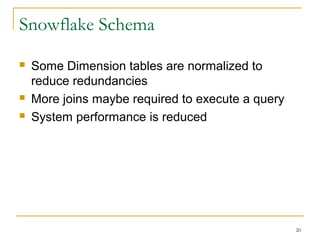
Snowflake Schema
 Some Dimension tables are normalized to
reduce redundancies
 More joins maybe required to execute a query
 System performance is reduced
21
Example of Snowflake Schema
time_key
day
day_of_the_week
month
quarter
year
time
location_key
street
city_key
location
Sales Fact Table
time_key
item_key
branch_key
location_key
units_sold
dollars_sold
avg_sales
Measures
item_key
item_name
brand
type
supplier_key
item
branch_key
branch_name
branch_type
branch
supplier_key
supplier_type
supplier
city_key
city
state_or_province
country
city
22
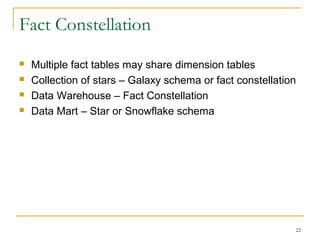
Fact Constellation
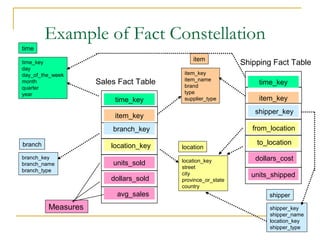
 Multiple fact tables may share dimension tables
 Collection of stars – Galaxy schema or fact constellation
 Data Warehouse – Fact Constellation
 Data Mart – Star or Snowflake schema
23
Example of Fact Constellation
time_key
day
day_of_the_week
month
quarter
year
time
location_key
street
city
province_or_state
country
location
Sales Fact Table
time_key
item_key
branch_key
location_key
units_sold
dollars_sold
avg_sales
Measures
item_key
item_name
brand
type
supplier_type
item
branch_key
branch_name
branch_type
branch
Shipping Fact Table
time_key
item_key
shipper_key
from_location
to_location
dollars_cost
units_shipped
shipper_key
shipper_name
location_key
shipper_type
shipper

1.4 data warehouse

  • 1.
  • 2.
    2 Data Warehouse  Definition A decision support database that is maintained separately from the organization’s operational database  Support information processing by providing a solid platform of consolidated, historical data for analysis.  “A data warehouse is a subject-oriented, integrated, time- variant, and nonvolatile collection of data in support of management’s decision-making process.”—W. H. Inmon  Data warehousing:  The process of constructing and using data warehouses
  • 3.
    3 Data Warehouse—Subject-Oriented  Organizedaround major subjects, such as customer, product, sales  Focusing on the modeling and analysis of data for decision makers, not on daily operations or transaction processing  Provide a simple and concise view around particular subject issues by excluding data that are not useful in the decision support process
  • 4.
    4 Data Warehouse—Integrated  Constructedby integrating multiple, heterogeneous data sources  relational databases, flat files, on-line transaction records  Data cleaning and data integration techniques are applied.  Ensure consistency in naming conventions, encoding structures, attribute measures, etc. among different data sources  E.g., Hotel price: currency, tax, breakfast covered, etc.  When data is moved to the warehouse, it is converted.
  • 5.
    5 Data Warehouse—Time Variant The time horizon for the data warehouse is significantly longer than that of operational systems  Operational database: current value data  Data warehouse data: provide information from a historical perspective (e.g., past 5-10 years)  Every key structure in the data warehouse  Contains an element of time, explicitly or implicitly  But the key of operational data may or may not contain “time element”
  • 6.
    6 Data Warehouse—Nonvolatile  Aphysically separate store of data transformed from the operational environment  Does not require transaction processing, recovery, and concurrency control mechanisms  Major operations:  initial loading of data  access of data  Periodic updates
  • 7.
    7 Data Warehouse vs.Heterogeneous DBMS  Traditional heterogeneous DB integration: A query driven approach  Build wrappers/mediators on top of heterogeneous databases  When a query is posed to a client site, a meta-dictionary is used to translate the query into queries appropriate for individual heterogeneous sites involved, and the results are integrated into a global answer set  Data warehouse: update-driven, high performance  Information from heterogeneous sources is integrated in advance and stored in warehouses for direct query and analysis
  • 8.
    8 Data Warehouse vs.Operational DBMS  OLTP (on-line transaction processing)  Major task of traditional relational DBMS  Day-to-day operations: purchasing, inventory, banking, manufacturing, payroll, registration, accounting, etc.  OLAP (on-line analytical processing)  Major task of data warehouse system  Data analysis and decision making
  • 9.
    9  Distinct features(OLTP vs. OLAP):  User and system orientation: customer vs. market  Data contents: current, detailed vs. historical, consolidated  Database design: ER + application vs. star + subject  View: current, local vs. evolutionary, integrated  Access patterns: update vs. read-only but complex queries Data Warehouse vs. Operational DBMS
  • 10.
    10 OLTP vs. OLAP OLTPOLAP Characteristic Operational processing Informational processing Orientation Transaction Analysis Summarization Primitive, highly detailed Summarized, Consolidated View Detailed, flat relational Summarized, Multidimensional Focus Data in Information out Operations Index/hash on primary key lots of scans Priority High performance, high availability High flexibility, end user autonomy
  • 11.
    11 OLTP vs. OLAP OLTPOLAP users clerk, IT professional knowledge worker function day to day operations decision support DB design application-oriented subject-oriented data current, up-to-date detailed, flat relational isolated historical, summarized, multidimensional integrated, consolidated usage repetitive ad-hoc access read/write Mostly read unit of work short, simple transaction complex query # records accessed tens millions #users thousands hundreds DB size 100MB-GB 100GB-TB metric transaction throughput query throughput, response
  • 12.
    12 Need for SeparateData Warehouse  High performance for both systems  DBMS— tuned for OLTP: access methods, indexing, concurrency control, recovery  Warehouse—tuned for OLAP: complex OLAP queries, multidimensional view, consolidation  Different functions and different data:  missing data: Decision support requires historical data which operational DBs do not typically maintain  data consolidation: DS requires consolidation (aggregation, summarization) of data from heterogeneous sources  data quality: different sources typically use inconsistent data representations, codes and formats which have to be reconciled
  • 13.
    13 Data Warehouse Extract Transform Load Refresh OLAP Engine Analysis Query Reports Data mining Monitor & Integrator Metadata DataSources Front-End Tools Output Data Marts Operational DBs Other sources Data Storage OLAP Server Three Tier Data Warehouse Architecture
  • 14.
    14 Three-Tier Data WarehouseArchitecture  Bottom Tier  Data Warehouse Server  Usually a Relational database system  Data is extracted using API known as gateways such as ODBC, OLE-DB, JDBC  Middle Tier  OLAP Server  ROLAP – Extended RDBMS that maps operations on multi- dimensional data to standard relational operations  MOLAP – Special purpose Server that directly supports multi- dimensional data and operations.  Top Tier  Client – Query and Reporting tools, Analysis and Data Mining tools
  • 15.
    15 Three Data WarehouseModels  Enterprise warehouse  Collects all of the information about subjects spanning the entire organization  Contains detailed and summarized data  Can be implemented on Mainframes -years  Data Mart  a subset of corporate-wide data that is of value to a specific groups of users. Its scope is confined to specific, selected groups, such as marketing data mart  Independent vs. dependent (directly from warehouse) data mart  Implemented on Departmental Servers - weeks  Virtual warehouse  A set of views over operational databases  Only some of the possible summary views may be materialized
  • 16.
    16 Conceptual Modeling ofData Warehouses  Data Warehouses require subject-oriented schema  Modeling data warehouses: dimensions & measures  Star schema: A fact table in the middle connected to a set of dimension tables  Snowflake schema: A refinement of star schema where some dimensional hierarchy is normalized into a set of smaller dimension tables, forming a shape similar to snowflake  Fact constellations: Multiple fact tables share dimension tables, viewed as a collection of stars, therefore called galaxy schema or fact constellation
  • 17.
    17 Star Schema  Mostcommon Modeling  Contains  Fact table  Bulky  No redundancy  Dimension tables  Dimension tables are arranged radially around the fact table
  • 18.
    18 Example of StarSchema time_key day day_of_the_week month quarter year time location_key street city state_or_province country location Sales Fact Table time_key item_key branch_key location_key units_sold dollars_sold avg_sales Measures item_key item_name brand type supplier_type item branch_key branch_name branch_type branch
  • 19.
    19 Defining Star Schemain DMQL define cube sales_star [time, item, branch, location]: dollars_sold = sum(sales_in_dollars), avg_sales = avg(sales_in_dollars), units_sold = count(*) define dimension time as (time_key, day, day_of_week, month, quarter, year) define dimension item as (item_key, item_name, brand, type, supplier_type) define dimension branch as (branch_key, branch_name, branch_type) define dimension location as (location_key, street, city, province_or_state, country)
  • 20.
    20 Snowflake Schema  SomeDimension tables are normalized to reduce redundancies  More joins maybe required to execute a query  System performance is reduced
  • 21.
    21 Example of SnowflakeSchema time_key day day_of_the_week month quarter year time location_key street city_key location Sales Fact Table time_key item_key branch_key location_key units_sold dollars_sold avg_sales Measures item_key item_name brand type supplier_key item branch_key branch_name branch_type branch supplier_key supplier_type supplier city_key city state_or_province country city
  • 22.
    22 Fact Constellation  Multiplefact tables may share dimension tables  Collection of stars – Galaxy schema or fact constellation  Data Warehouse – Fact Constellation  Data Mart – Star or Snowflake schema
  • 23.
    23 Example of FactConstellation time_key day day_of_the_week month quarter year time location_key street city province_or_state country location Sales Fact Table time_key item_key branch_key location_key units_sold dollars_sold avg_sales Measures item_key item_name brand type supplier_type item branch_key branch_name branch_type branch Shipping Fact Table time_key item_key shipper_key from_location to_location dollars_cost units_shipped shipper_key shipper_name location_key shipper_type shipper