The issus I’ll make focus 
on… 
 What is data ware house? 
 Architecture of data ware house? 
 Olap server and its various types and 
their working? 
 Data marts?
What is this 
dataware 
house all 
about ??
A data warehouse is a 
Subject-oriented ->DATABASE AND DATAWARE HOUSE ARE 2 
DIFFERENT THINGS SO DIFFERENT APPROACH S OF STORING DATA INTO THEM . 
Integrated -> BRINGING INTO A COMMON FORMAT 
Time-varying ->HISTORICAL DATA ,DATE ASSOCIATED WITH TIME 
Non-volatile -> UNDELETABLE AND NON UPDATABLE FORMAT 
collection of data that is used 
primarily in organizational decision 
making.
Subject oriented?? 
5 
Operational Database 
Application -orientation 
Order 
processing 
Saving account 
Data ware house 
Subject-orientation 
sales 
account 
Stock mgmt 
Billing 
Current account 
Loan account 
Business 
Bank
Explanation 
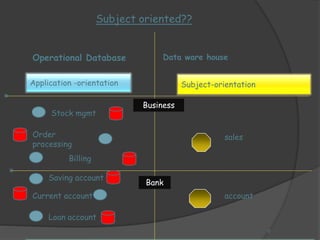
 As we can see in both business and bank example the 
databases store the data application wise . It simply 
means that for every operational application of the 
organization there is a storage associated in which 
that application specific data are stored. These 
storages are called database. 
 But in the case of data ware house of the organization 
the data are stored subject wise , this subject is most 
important aspect of the organization . for bank 
account is important for business sale is important
Integrated ?? 
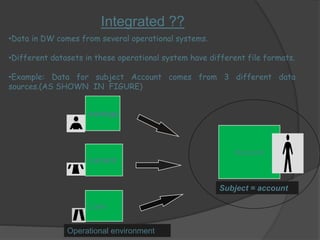
•Data in DW comes from several operational systems. 
•Different datasets in these operational system have different file formats. 
•Example: Data for subject Account comes from 3 different data 
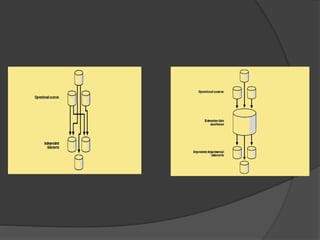
sources.(AS SHOWN IN FIGURE) 
Account 
savings 

current 
Loan 
Subject = account 
Operational environment
o So variations could be there, like: 
1. Naming conventions could be different. 
Example: Saving account no. could be of 8 bytes long but only 6 bytes for 
checking accounts. 
1. Number of total Attributes for data items could be different. 
Example :saving account can have 5 attribute while checking account can 
have 7 attribute associated with it.
Time variant?? 
Data warehouse 
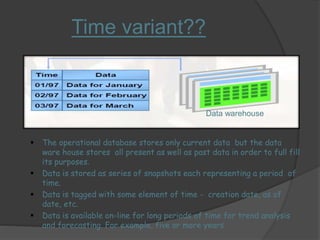
 The operational database stores only current data but the data 
ware house stores all present as well as past data in order to full fill 
its purposes. 
 Data is stored as series of snapshots each representing a period of 
time. 
 Data is tagged with some element of time - creation date, as of 
date, etc. 
 Data is available on-line for long periods of time for trend analysis 
and forecasting. For example, five or more years
Non-volatile?? 
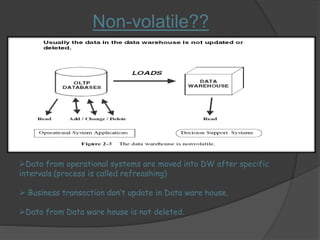
Data from operational systems are moved into DW after specific 
intervals.(process is called refreashing) 
 Business transaction don’t update in Data ware house. 
Data from Data ware house is not deleted.
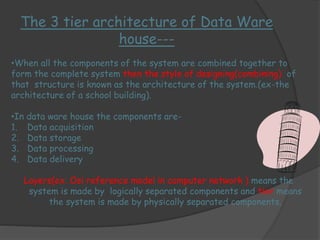
The 3 tier architecture of Data Ware 
house--- 
•When all the components of the system are combined together to 
form the complete system then the style of designing(combining) of 
that structure is known as the architecture of the system.(ex-the 
architecture of a school building). 
•In data ware house the components are- 
1. Data acquisition 
2. Data storage 
3. Data processing 
4. Data delivery 
Layers(ex. Osi reference model in computer network ) means the 
system is made by logically separated components and tier means 
the system is made by physically separated components.
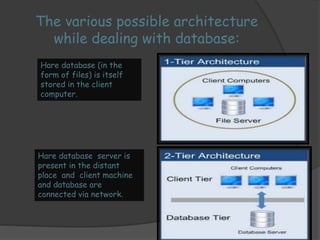
The various possible architecture 
while dealing with database: 
Hare database (in the 
form of files) is itself 
stored in the client 
computer. 
Hare database server is 
present in the distant 
place and client machine 
and database are 
connected via network.
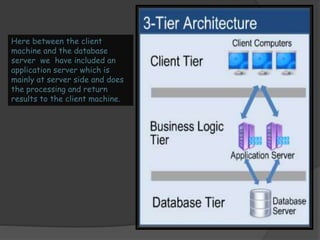
Here between the client 
machine and the database 
server we have included an 
application server which is 
mainly at server side and does 
the processing and return 
results to the client machine.
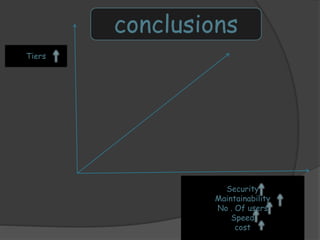
conclusions 
Tiers 
Security 
Maintainability 
No . Of users 
Speed 
cost
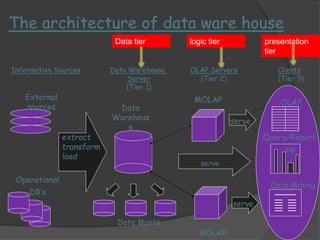
The architecture of data ware house 
Data tier logic tier presentation 
Information Sources Data Warehouse 
Server 
(Tier 1) 
OLAP Servers 
(Tier 2) 
Clients 
(Tier 3) 
External 
sources 
Operational 
DB’s 
extract 
transform 
load 
Data 
Warehous 
e 
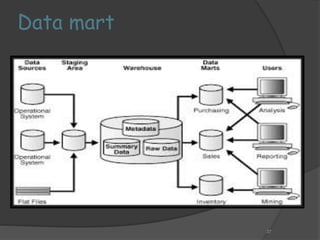
Data Marts 
MOLAP 
serve 
ROLAP 
OLAP 
Query/Report 
ing 
Data Mining 
serve 
serve 
tier
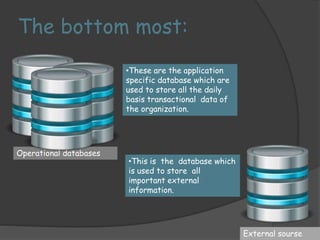
The bottom most: 
Operational databases 
External sourse 
•These are the application 
specific database which are 
used to store all the daily 
basis transactional data of 
the organization. 
•This is the database which 
is used to store all 
important external 
information.
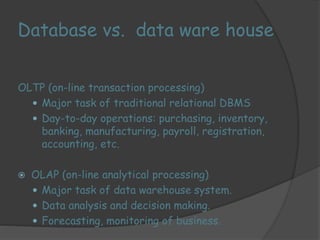
Database vs. data ware house 
OLTP (on-line transaction processing) 
 Major task of traditional relational DBMS 
 Day-to-day operations: purchasing, inventory, 
banking, manufacturing, payroll, registration, 
accounting, etc. 
 OLAP (on-line analytical processing) 
 Major task of data warehouse system. 
 Data analysis and decision making. 
 Forecasting, monitoring of business.
How loading is done of the 
Warehouse?? 
This is done using back end tools. To 
know about back end tools go to the next 
page.
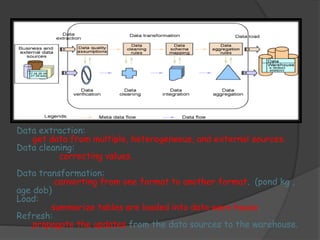
Data extraction: 
get data from multiple, heterogeneous, and external sources. 
Data cleaning: 
correcting values. 
Data transformation: 
converting from one format to another format. (pond kg , 
age dob) 
Load: 
summarize tables are loaded into data ware house. 
Refresh: 
propagate the updates from the data sources to the warehouse.
Tier 1 :data ware house 
 It is the data ware house that is 
loaded with strategy making 
information. 
 This tier also consists of data marts.
Tier 2 
 This tier consists of Olap server which 
are used for the processing purposes. Here 
the following issues are also handled— 
 Security of data.(you are not letting user directly communicate 
with data base) 
 Business logic(here you can decide what kind of information to be 
shown to a particular kind of query ). 
 Translation(users high level query are converted into low level sql 
query). 
 Intermediate calculations(removes burden from user 
interface and database )
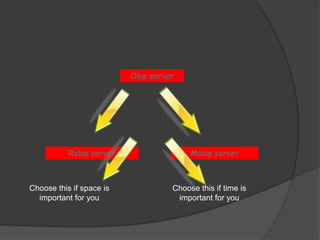
Olap server 
Rolap server Molap server 
Choose this if space is 
important for you 
Choose this if time is 
important for you
HOW DOES ROLAP 
WORK??
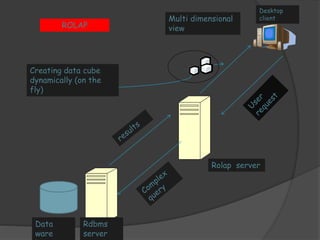
Multi dimensional 
view 
Desktop 
client 
Rolap server 
Creating data cube 
dynamically (on the 
fly) 
Rdbms 
server 
Data 
ware 
house 
ROLAP
DETAILS 
 Relational online analytical processing (ROLAP) is a 
form of online analytical processing (olap) that 
performs multidimensional analysis of data which is 
stored in a relational database rather than in 
a multidimensional database. 
 In a three-tiered architecture, the user submits a 
request for multidimensional analysis and the ROLAP 
engine converts the request to SQL for submission to 
the relational database. Then the operation is 
performed in reverse: the engine converts the 
resulting data from SQL to a multidimensional 
format(on the fly) before it is returned to the client 
for viewing.
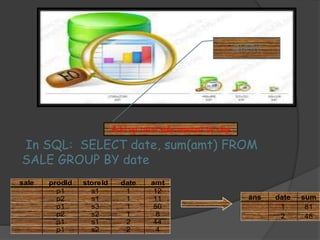
Add up total sale amount by day 
In SQL: SELECT date, sum(amt) FROM 
SALE GROUP BY date 
ans date sum 
1 81 
2 48 
sale prodId storeId date amt 
p1 s1 1 12 
p2 s1 1 11 
p1 s3 1 50 
p2 s2 1 8 
p1 s1 2 44 
p1 s2 2 4 
QUERY
HOW DOES MOLAP 
WORK??
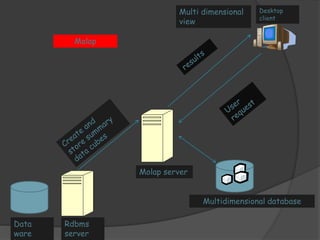
Multi dimensional 
view 
Desktop 
client 
Molap server 
Rdbms 
server 
Data 
ware 
house 
Multidimensional database 
Molap
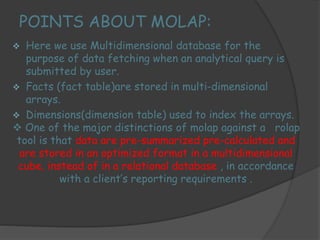
POINTS ABOUT MOLAP: 
 Here we use Multidimensional database for the 
purpose of data fetching when an analytical query is 
submitted by user. 
 Facts (fact table)are stored in multi-dimensional 
arrays. 
 Dimensions(dimension table) used to index the arrays. 
 One of the major distinctions of molap against a rolap 
tool is that data are pre-summarized pre-calculated and 
are stored in an optimized format in a multidimensional 
cube, instead of in a relational database , in accordance 
with a client’s reporting requirements .
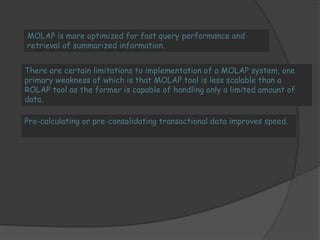
MOLAP is more optimized for fast query performance and 
retrieval of summarized information. 
There are certain limitations to implementation of a MOLAP system, one 
primary weakness of which is that MOLAP tool is less scalable than a 
ROLAP tool as the former is capable of handling only a limited amount of 
data. 
Pre-calculating or pre-consolidating transactional data improves speed.
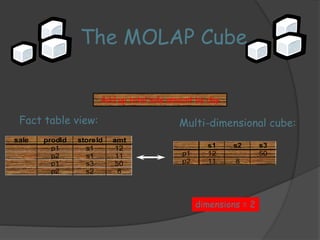
The MOLAP Cube 
Add up total sale amount by day 
Fact table view: Multi-dimensional cube: 
sale prodId storeId amt 
p1 s1 12 
p2 s1 11 
p1 s3 50 
p2 s2 8 
s1 s2 s3 
p1 12 50 
p2 11 8 
dimensions = 2
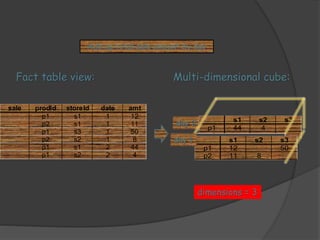
Add up total sale amount by day 
Fact table view: Multi-dimensional cube: 
dimensions = 3 
sale prodId storeId date amt 
p1 s1 1 12 
p2 s1 1 11 
p1 s3 1 50 
p2 s2 1 8 
p1 s1 2 44 
p1 s2 2 4 
day 2 s1 s2 s3 
p1 44 4 
p2 
s1 s2 s3 
p1 12 50 
p2 11 8 
day 1
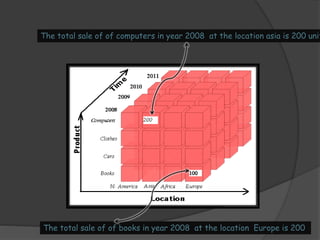
The total sale of of computers in year 2008 at the location asia is 200 unit 
The total sale of of books in year 2008 at the location Europe is 200
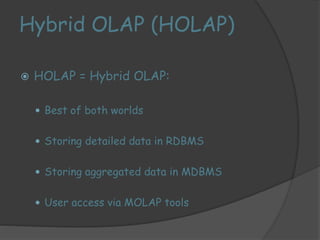
Hybrid OLAP (HOLAP) 
 HOLAP = Hybrid OLAP: 
 Best of both worlds 
 Storing detailed data in RDBMS 
 Storing aggregated data in MDBMS 
 User access via MOLAP tools
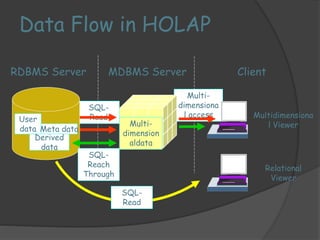
Data Flow in HOLAP 
MDBMS Server Client 
Multi-dimensiona 
l access Multidimensiona 
l Viewer 
Relational 
Viewer 
Multi-dimension 
aldata 
SQL-Read 
RDBMS Server 
User 
data Meta data 
Derived 
data 
SQL-Reach 
Through 
SQL-Read
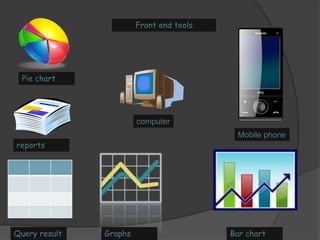
Pie chart 
reports 
Front end tools 
Mobile phone 
computer 
Query result Graphs Bar chart
Data mart 
37
THANK 
YOU

Data ware house architecture

  • 2.
    The issus I’llmake focus on…  What is data ware house?  Architecture of data ware house?  Olap server and its various types and their working?  Data marts?
  • 3.
    What is this dataware house all about ??
  • 4.
    A data warehouseis a Subject-oriented ->DATABASE AND DATAWARE HOUSE ARE 2 DIFFERENT THINGS SO DIFFERENT APPROACH S OF STORING DATA INTO THEM . Integrated -> BRINGING INTO A COMMON FORMAT Time-varying ->HISTORICAL DATA ,DATE ASSOCIATED WITH TIME Non-volatile -> UNDELETABLE AND NON UPDATABLE FORMAT collection of data that is used primarily in organizational decision making.
  • 5.
    Subject oriented?? 5 Operational Database Application -orientation Order processing Saving account Data ware house Subject-orientation sales account Stock mgmt Billing Current account Loan account Business Bank
  • 6.
    Explanation  Aswe can see in both business and bank example the databases store the data application wise . It simply means that for every operational application of the organization there is a storage associated in which that application specific data are stored. These storages are called database.  But in the case of data ware house of the organization the data are stored subject wise , this subject is most important aspect of the organization . for bank account is important for business sale is important
  • 7.
    Integrated ?? •Datain DW comes from several operational systems. •Different datasets in these operational system have different file formats. •Example: Data for subject Account comes from 3 different data sources.(AS SHOWN IN FIGURE) Account savings current Loan Subject = account Operational environment
  • 8.
    o So variationscould be there, like: 1. Naming conventions could be different. Example: Saving account no. could be of 8 bytes long but only 6 bytes for checking accounts. 1. Number of total Attributes for data items could be different. Example :saving account can have 5 attribute while checking account can have 7 attribute associated with it.
  • 9.
    Time variant?? Datawarehouse  The operational database stores only current data but the data ware house stores all present as well as past data in order to full fill its purposes.  Data is stored as series of snapshots each representing a period of time.  Data is tagged with some element of time - creation date, as of date, etc.  Data is available on-line for long periods of time for trend analysis and forecasting. For example, five or more years
  • 10.
    Non-volatile?? Data fromoperational systems are moved into DW after specific intervals.(process is called refreashing)  Business transaction don’t update in Data ware house. Data from Data ware house is not deleted.
  • 11.
    The 3 tierarchitecture of Data Ware house--- •When all the components of the system are combined together to form the complete system then the style of designing(combining) of that structure is known as the architecture of the system.(ex-the architecture of a school building). •In data ware house the components are- 1. Data acquisition 2. Data storage 3. Data processing 4. Data delivery Layers(ex. Osi reference model in computer network ) means the system is made by logically separated components and tier means the system is made by physically separated components.
  • 12.
    The various possiblearchitecture while dealing with database: Hare database (in the form of files) is itself stored in the client computer. Hare database server is present in the distant place and client machine and database are connected via network.
  • 13.
    Here between theclient machine and the database server we have included an application server which is mainly at server side and does the processing and return results to the client machine.
  • 14.
    conclusions Tiers Security Maintainability No . Of users Speed cost
  • 15.
    The architecture ofdata ware house Data tier logic tier presentation Information Sources Data Warehouse Server (Tier 1) OLAP Servers (Tier 2) Clients (Tier 3) External sources Operational DB’s extract transform load Data Warehous e Data Marts MOLAP serve ROLAP OLAP Query/Report ing Data Mining serve serve tier
  • 16.
    The bottom most: Operational databases External sourse •These are the application specific database which are used to store all the daily basis transactional data of the organization. •This is the database which is used to store all important external information.
  • 17.
    Database vs. dataware house OLTP (on-line transaction processing)  Major task of traditional relational DBMS  Day-to-day operations: purchasing, inventory, banking, manufacturing, payroll, registration, accounting, etc.  OLAP (on-line analytical processing)  Major task of data warehouse system.  Data analysis and decision making.  Forecasting, monitoring of business.
  • 18.
    How loading isdone of the Warehouse?? This is done using back end tools. To know about back end tools go to the next page.
  • 19.
    Data extraction: getdata from multiple, heterogeneous, and external sources. Data cleaning: correcting values. Data transformation: converting from one format to another format. (pond kg , age dob) Load: summarize tables are loaded into data ware house. Refresh: propagate the updates from the data sources to the warehouse.
  • 20.
    Tier 1 :dataware house  It is the data ware house that is loaded with strategy making information.  This tier also consists of data marts.
  • 21.
    Tier 2 This tier consists of Olap server which are used for the processing purposes. Here the following issues are also handled—  Security of data.(you are not letting user directly communicate with data base)  Business logic(here you can decide what kind of information to be shown to a particular kind of query ).  Translation(users high level query are converted into low level sql query).  Intermediate calculations(removes burden from user interface and database )
  • 22.
    Olap server Rolapserver Molap server Choose this if space is important for you Choose this if time is important for you
  • 23.
  • 24.
    Multi dimensional view Desktop client Rolap server Creating data cube dynamically (on the fly) Rdbms server Data ware house ROLAP
  • 25.
    DETAILS  Relationalonline analytical processing (ROLAP) is a form of online analytical processing (olap) that performs multidimensional analysis of data which is stored in a relational database rather than in a multidimensional database.  In a three-tiered architecture, the user submits a request for multidimensional analysis and the ROLAP engine converts the request to SQL for submission to the relational database. Then the operation is performed in reverse: the engine converts the resulting data from SQL to a multidimensional format(on the fly) before it is returned to the client for viewing.
  • 26.
    Add up totalsale amount by day In SQL: SELECT date, sum(amt) FROM SALE GROUP BY date ans date sum 1 81 2 48 sale prodId storeId date amt p1 s1 1 12 p2 s1 1 11 p1 s3 1 50 p2 s2 1 8 p1 s1 2 44 p1 s2 2 4 QUERY
  • 27.
  • 28.
    Multi dimensional view Desktop client Molap server Rdbms server Data ware house Multidimensional database Molap
  • 29.
    POINTS ABOUT MOLAP:  Here we use Multidimensional database for the purpose of data fetching when an analytical query is submitted by user.  Facts (fact table)are stored in multi-dimensional arrays.  Dimensions(dimension table) used to index the arrays.  One of the major distinctions of molap against a rolap tool is that data are pre-summarized pre-calculated and are stored in an optimized format in a multidimensional cube, instead of in a relational database , in accordance with a client’s reporting requirements .
  • 30.
    MOLAP is moreoptimized for fast query performance and retrieval of summarized information. There are certain limitations to implementation of a MOLAP system, one primary weakness of which is that MOLAP tool is less scalable than a ROLAP tool as the former is capable of handling only a limited amount of data. Pre-calculating or pre-consolidating transactional data improves speed.
  • 31.
    The MOLAP Cube Add up total sale amount by day Fact table view: Multi-dimensional cube: sale prodId storeId amt p1 s1 12 p2 s1 11 p1 s3 50 p2 s2 8 s1 s2 s3 p1 12 50 p2 11 8 dimensions = 2
  • 32.
    Add up totalsale amount by day Fact table view: Multi-dimensional cube: dimensions = 3 sale prodId storeId date amt p1 s1 1 12 p2 s1 1 11 p1 s3 1 50 p2 s2 1 8 p1 s1 2 44 p1 s2 2 4 day 2 s1 s2 s3 p1 44 4 p2 s1 s2 s3 p1 12 50 p2 11 8 day 1
  • 33.
    The total saleof of computers in year 2008 at the location asia is 200 unit The total sale of of books in year 2008 at the location Europe is 200
  • 34.
    Hybrid OLAP (HOLAP)  HOLAP = Hybrid OLAP:  Best of both worlds  Storing detailed data in RDBMS  Storing aggregated data in MDBMS  User access via MOLAP tools
  • 35.
    Data Flow inHOLAP MDBMS Server Client Multi-dimensiona l access Multidimensiona l Viewer Relational Viewer Multi-dimension aldata SQL-Read RDBMS Server User data Meta data Derived data SQL-Reach Through SQL-Read
  • 36.
    Pie chart reports Front end tools Mobile phone computer Query result Graphs Bar chart
  • 37.
  • 39.