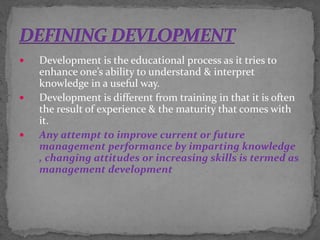
 Development is the educational process as it tries to
enhance one’s ability to understand & interpret
knowledge in a useful way.
 Development is different from training in that it is often
the result of experience & the maturity that comes with
it.
 Any attempt to improve current or future
management performance by imparting knowledge
, changing attitudes or increasing skills is termed as
management development
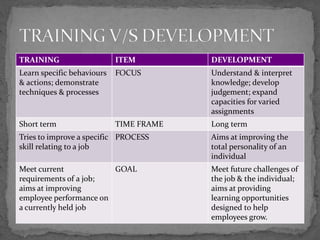
TRAINING ITEM DEVELOPMENT
Learn specific behaviours
& actions; demonstrate
techniques & processes
FOCUS Understand & interpret
knowledge; develop
judgement; expand
capacities for varied
assignments
Short term TIME FRAME Long term
Tries to improve a specific
skill relating to a job
PROCESS Aims at improving the
total personality of an
individual
Meet current
requirements of a job;
aims at improving
employee performance on
a currently held job
GOAL Meet future challenges of
the job & the individual;
aims at providing
learning opportunities
designed to help
employees grow.
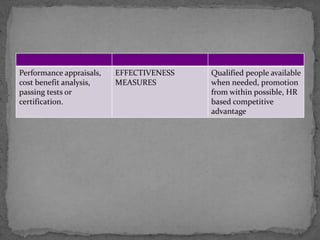
Performance appraisals,
cost benefit analysis,
passing tests or
certification.
EFFECTIVENESS
MEASURES
Qualified people available
when needed, promotion
from within possible, HR
based competitive
advantage
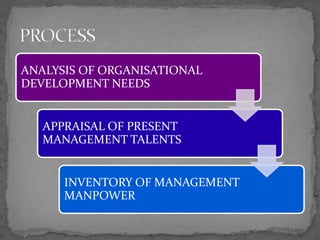
ANALYSIS OF ORGANISATIONAL
DEVELOPMENT NEEDS
APPRAISAL OF PRESENT
MANAGEMENT TALENTS
INVENTORY OF MANAGEMENT
MANPOWER
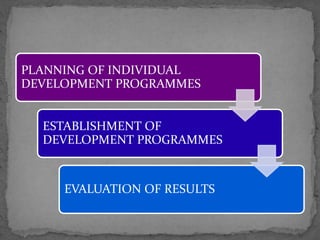
PLANNING OF INDIVIDUAL
DEVELOPMENT PROGRAMMES
ESTABLISHMENT OF
DEVELOPMENT PROGRAMMES
EVALUATION OF RESULTS
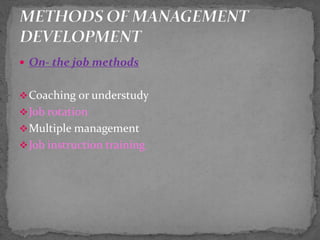
 On- the job methods
Coaching or understudy
Job rotation
Multiple management
Job instruction training
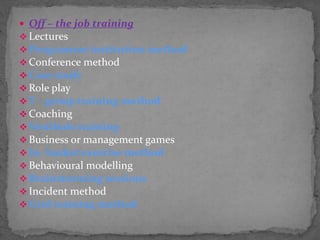
 Off – the job training
 Lectures
 Programme institution method
 Conference method
 Case study
 Role play
 T – group training method
 Coaching
 Vestibule training
 Business or management games
 In- basket exercise method
 Behavioural modelling
 Brainstorming sessions
 Incident method
 Grid training method
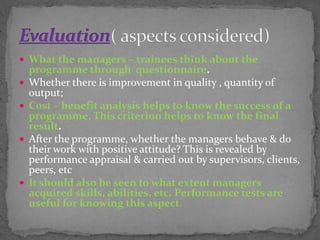
 What the managers – trainees think about the
programme through questionnaire.
 Whether there is improvement in quality , quantity of
output;
 Cost – benefit analysis helps to know the success of a
programme. This criterion helps to know the final
result.
 After the programme, whether the managers behave & do
their work with positive attitude? This is revealed by
performance appraisal & carried out by supervisors, clients,
peers, etc
 It should also be seen to what extent managers
acquired skills, abilities, etc. Performance tests are
useful for knowing this aspect.

Management development programs 6

  • 2.
     Development isthe educational process as it tries to enhance one’s ability to understand & interpret knowledge in a useful way.  Development is different from training in that it is often the result of experience & the maturity that comes with it.  Any attempt to improve current or future management performance by imparting knowledge , changing attitudes or increasing skills is termed as management development
  • 3.
    TRAINING ITEM DEVELOPMENT Learnspecific behaviours & actions; demonstrate techniques & processes FOCUS Understand & interpret knowledge; develop judgement; expand capacities for varied assignments Short term TIME FRAME Long term Tries to improve a specific skill relating to a job PROCESS Aims at improving the total personality of an individual Meet current requirements of a job; aims at improving employee performance on a currently held job GOAL Meet future challenges of the job & the individual; aims at providing learning opportunities designed to help employees grow.
  • 4.
    Performance appraisals, cost benefitanalysis, passing tests or certification. EFFECTIVENESS MEASURES Qualified people available when needed, promotion from within possible, HR based competitive advantage
  • 6.
    ANALYSIS OF ORGANISATIONAL DEVELOPMENTNEEDS APPRAISAL OF PRESENT MANAGEMENT TALENTS INVENTORY OF MANAGEMENT MANPOWER
  • 7.
    PLANNING OF INDIVIDUAL DEVELOPMENTPROGRAMMES ESTABLISHMENT OF DEVELOPMENT PROGRAMMES EVALUATION OF RESULTS
  • 8.
     On- thejob methods Coaching or understudy Job rotation Multiple management Job instruction training
  • 9.
     Off –the job training  Lectures  Programme institution method  Conference method  Case study  Role play  T – group training method  Coaching  Vestibule training  Business or management games  In- basket exercise method  Behavioural modelling  Brainstorming sessions  Incident method  Grid training method
  • 10.
     What themanagers – trainees think about the programme through questionnaire.  Whether there is improvement in quality , quantity of output;  Cost – benefit analysis helps to know the success of a programme. This criterion helps to know the final result.  After the programme, whether the managers behave & do their work with positive attitude? This is revealed by performance appraisal & carried out by supervisors, clients, peers, etc  It should also be seen to what extent managers acquired skills, abilities, etc. Performance tests are useful for knowing this aspect.