SUBMITTED TO :
AR. ABHISHEK SHRIVASTAV
AR. ADITI KAPOOR
EARLY CHRISTIAN
ARCHITECTURE
AND
ROMANSEQUE ARCHITECTURE
SUMBITTED BY :
KSHITIJA KAPOOR
NIKITA BHURARIA
DUVISH DEV
LAKSHAY JANGIR
AADITYA SHARMA
PARIDHI PAL
ANUBHAV SINGH
CONTENTS
EARLY CHRISTIAN
ARCHITECTURE
Christianity was born in Judea – a place in eastern province of the
Roman empire, which spread towards the north & west even against
the backdrop of great opposition & ultimately accepted as state religion.
• The formulation phase of Christianity & its architecture can be
considered from Constantine period (300 AD) to Charlemagne (800 AD
– French ruler).
• The development of Christian Architecture thus can be divided into the
following phases:
EARLY CHRISTIAN & BYZANTINE
ROMANESQUE
GOTHIC
RENAISSANCE
The development of Christian architecture in general proved beneficial
in establishing new norms, new construction features, new materials,
Geography
Christianity had its birth in Judaea, an eastern province of the
Roman Empire, spread and carried by St. Peter, St. Paul, and
other missionaries to Rome, as the centre of the World-Empire.
Early Christian architecture at Rome was influenced by, and was
the logical outcome of;
 Existing Roman architecture
 modified in other parts of the Empire according to the
type already recognized as suitable for the geographical
situation of those countries, such as Syria, Asia Minor,
North Africa, and Egypt.
Climatic conditions
• North Italy has the climate of the temperate region of Europe
• Central Italy is genial and sunny
• Southern Italy is almost tropical.
 This variety of climatic conditions is sufficient to account for
diversity of architectural features and treatment in the
peninsula itself.
 The climatic conditions in Roman provinces as Egypt, Syria,
and North Africa where Christianity was established were
varied, and naturally modified the style in those countries
where the fiercer sun and hotter climate necessitated small
windows and other Eastern features.
Historical Background….
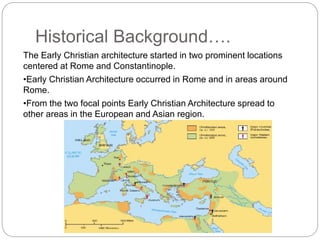
The Early Christian architecture started in two prominent locations
centered at Rome and Constantinople.
•Early Christian Architecture occurred in Rome and in areas around
Rome.
•From the two focal points Early Christian Architecture spread to
other areas in the European and Asian region.
Social Characteristics & Beliefs….
 The single most important social phenomenon of the Early
Christian period was the spread and acceptance of the Christian
religion.
 During the period from the first century to the third century after
the death of Jesus, Christianity was a secret society.
 It was considered dangerous and subversive by the government
Christians met secretly in tombs and private houses.
 Gradually, however, it spread and became widely accepted in
Asia minor and in Rome itself.
 By the third century, Rome had a population of 50,000
Christians.
 The religion was tolerated but it was still illegal.
Architectural Characteristics….
 With Christianity widely accepted as a state religion in Rome it was
necessary for architecture to respond to the demands of the religion
for worship space.
 Mode of worship was the most important determinant of the form of
the church.
The requirements include:-
 A path for processional entry and exit of the clergy
 An altar area, where the clergy celebrate mass
 A space for the segregation of the clergy from the congregation
during procession and communion
 Burial space.
 This is further divided into two types; the basilica church and the
alternative church plans.
 A building used for Christian worship had to provide a path for
the processional entry and exit of the clergy, an alter area, where
the clergy celebrated mass, a space for the segregation of the
clergy from congregation during the procession and communion.
Basilica Church Type
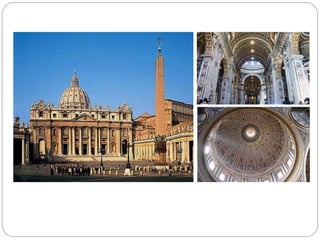
 Present day St. Peters in Vatican City – a rebuilding of a
totally different design & on a substantially enlarged
scale.
 Dimensions: 110.0m long x 64.0m wide with double
aisles on both sides.
 The nave was divided from aisles by 22 varied (size &
colour), huge & antique marble columns with equally
varied capitals supporting the nave walls on a horizontal
entablature, while similar numbers of shorter columns
carrying arcades divided aisle from aisle.
 It was built in the shape of Latin cross, with a gable roof,
timbered on inside & at 30.0m high at centre.
 An atrium known as Garden of Paradise stood at the
entrance with 5 doors.
 The nave ended with an arch & the walls had parallel
windows each with frescos.
Basilica Church Type
 The early churches were generally simple and functional in their design.
 The emphasis was centered on the act of Christian worship.
 The architecture of the church that developed was not a completely new
style, but the use of available Roman forms to satisfy a new program
need.
 The form chosen for the early church was the Roman basilica.
 It was suitable for use as a church with no serious modification and it
could be easily and rapidly built at low cost.
 The Basilica was also preferred because of the emphasis on
participation in mass.
 The most common form of the early churches had a rectangular hall with
a timber trussed roof.
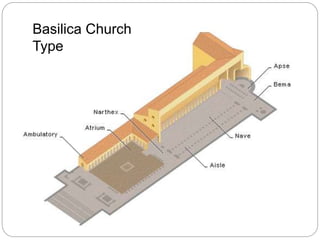
 It also had one or two isles on each side of a central nave and an apse
at one end facing the principal entrance located at the other end.
• Basilican churches had either closely spaced columns carrying the entablature,
or more widely spaced columns carrying semicircular arches.
 It s long perspective of oft-repeated columns which carry the eye along to the
Basilica Church
Type
Commonest form of the early church.
Unlike the earlier Roman phase, the interiors were give more importance than exterior.
 Rectangular hall, timber-roofed with coffers & richly glided ceiling (hiding the roof truss) on
nave.
Usually with one or two aisles to each side of the central nave separated by rows of rustic marble
columns, sometimes carrying flat entablatures & sometimes, rows of arches.
 The width of aisles was half that of the central nave.
 Apse at one end facing the principal entrances at the other end.
 Bema / Transept – a raised platform where altar was placed & from where the clergy
officiated.
 A courtyard (atrium) having a central fountain for ablutions & surrounded by colonnaded
ambulatory.
 A narthex – corresponding to entrance foyer, preceding the nave.
 The nave & bema received light from clerestory above the aisles & were pierced with windows.
 Above aisles & between clerestory windows, the walls may be faced with marble, or mosaics
made up from small tesserae of coloured glass.
 The nave terminates into a ‘triumphal arch’, perhaps having iridescent (brightly coloured &
changing) mosaics.
 The semicircular walls of the apse ended into a dome, whose interiors had mosaics depicting
narrative scenes from Bible or single figures seen against stylised landscapes or plain gold
grounds.
 The flooring was of grey-white & black marble, inlaid with geometric patterns of coloured
marble.
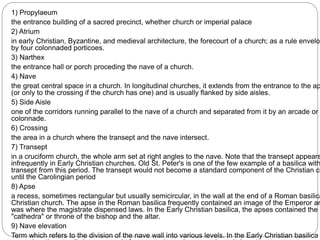
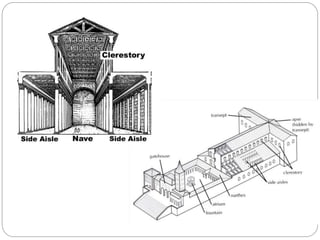
1) Propylaeum
the entrance building of a sacred precinct, whether church or imperial palace
2) Atrium
in early Christian, Byzantine, and medieval architecture, the forecourt of a church; as a rule envelop
by four colonnaded porticoes.
3) Narthex
the entrance hall or porch proceding the nave of a church.
4) Nave
the great central space in a church. In longitudinal churches, it extends from the entrance to the ap
(or only to the crossing if the church has one) and is usually flanked by side aisles.
5) Side Aisle
one of the corridors running parallel to the nave of a church and separated from it by an arcade or
colonnade.
6) Crossing
the area in a church where the transept and the nave intersect.
7) Transept
in a cruciform church, the whole arm set at right angles to the nave. Note that the transept appears
infrequently in Early Christian churches. Old St. Peter's is one of the few example of a basilica with
transept from this period. The transept would not become a standard component of the Christian ch
until the Carolingian period
8) Apse
a recess, sometimes rectangular but usually semicircular, in the wall at the end of a Roman basilica
Christian church. The apse in the Roman basilica frequently contained an image of the Emperor an
was where the magistrate dispensed laws. In the Early Christian basilica, the apses contained the
"cathedra" or throne of the bishop and the altar.
9) Nave elevation
Term which refers to the division of the nave wall into various levels. In the Early Christian basilica
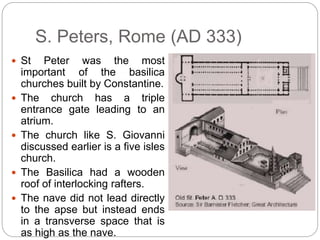
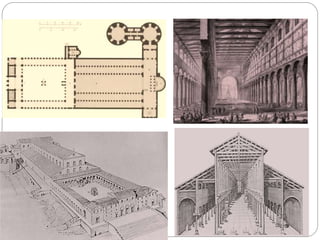
S. Peters, Rome (AD 333)
 St Peter was the most
important of the basilica
churches built by Constantine.
 The church has a triple
entrance gate leading to an
atrium.
 The church like S. Giovanni
discussed earlier is a five isles
church.
 The Basilica had a wooden
roof of interlocking rafters.
 The nave did not lead directly
to the apse but instead ends
in a transverse space that is
as high as the nave.
Alternative Church Form
•Alternative more centralized plans, with a focus on a
central vertical axis rather than a longitudinal horizontal
one were also adopted occasionally.
•The centralized churches were of two broad types.
•There were the completely circular church.
•These had a circular or octagonal space surrounded by
an ambulatory
Examples of these include Saint Constanza Rome, the
Lateran Baptistery Rome and Saint Stefano Rotondo.
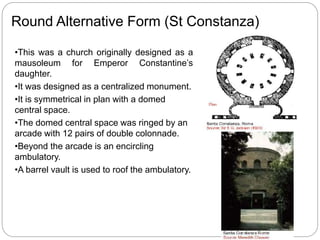
•This was a church originally designed as a
mausoleum for Emperor Constantine’s
daughter.
•It was designed as a centralized monument.
•It is symmetrical in plan with a domed
central space.
•The domed central space was ringed by an
arcade with 12 pairs of double colonnade.
•Beyond the arcade is an encircling
ambulatory.
•A barrel vault is used to roof the ambulatory.
Round Alternative Form (St Constanza)
Baptistery Church Form
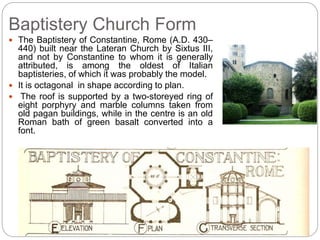
 The Baptistery of Constantine, Rome (A.D. 430–
440) built near the Lateran Church by Sixtus III,
and not by Constantine to whom it is generally
attributed, is among the oldest of Italian
baptisteries, of which it was probably the model.
 It is octagonal in shape according to plan.
 The roof is supported by a two-storeyed ring of
eight porphyry and marble columns taken from
old pagan buildings, while in the centre is an old
Roman bath of green basalt converted into a
font.
ROMANSEQUE ARCHITECTURE
WHAT IS ROMANESQUE ?
 Romanesque = “Roman- like” "descended from
Roman"
 This style grew in those countries of Western Europe
which had been under the rule of Rome.
 With the church as the unifying force, this period was
devoted to the glorification of Christianity and the
church was the predominant building type.
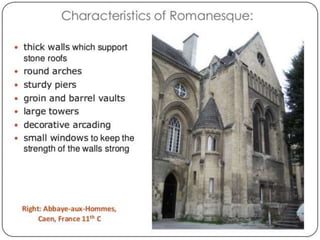
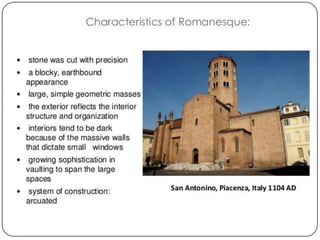
 Romanesque architecture is known by its massive
quality, thick walls, round arches, sturdy pillars, groin
vaults, large towers and decorative arcading. Each
building has clearly defined forms, frequently of very
regular, symmetrical plan; the overall appearance is
one of simplicity when compared with the Gothic
buildings that were to follow.
DIFFERENCE BETWEEN ROMAN
AND ROMANESQUE
 Generally Roman architecture is characterized by a strong
Greek influence (columns using the classical orders and
pediments, for example) combined with Roman
innovations in arches, barrel vaults, and free standing
domes. A lot of Roman architecture relies on concrete.

 ‘Romanesque’ architecture is a descendant of later Roman
architecture.
 Most of the Greek ornamentation is lost, and there’s a
stronger emphasis on arched vaults and more solid forms.
As time goes on Romanesque gets to be more vertical
than most Roman architecture as well. There’s very little
concrete construction: masonry and brick are the dominant
materials.
 Usually “Roman” architecture fades into “Romanesque”
sometime between the years 500 and 1000. Because
Romanesque is a continuation of Roman - like Italian is a
continuation of Latin — there’s no single hard dividing line.
CLIMATE AND MATERIALS
 Use of Local materials:
 Stone
 Brick
 Marble
 Terra-cotta
 Ready- made columns
 Climactic conditions contribute to differences of treatment north
and south of the Alps & Pyrenees.
North – Window openings were enlarged
- High pitched roofs
South – small window openings
- Flat Roofs
MAJOR ELEMENTS WERE
 Latin cross plan
 Use of local stone
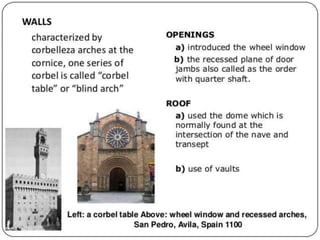
 Use of round arches, buttressed barrel vaulting and groin
vaulting
 Towers engaged to façade and large transept towers
 Dome often over apse
 Recessed doorways ornamented with sculpture
 Harmonious proportions
 Thick and heavy walls and pillars
 Small windows
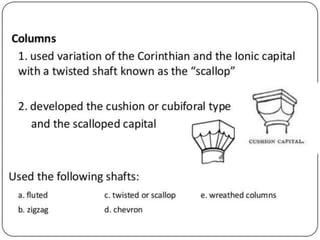
 Sculptured decoration on portals, capitals and other surfaces
 Painted decoration throughout the interior
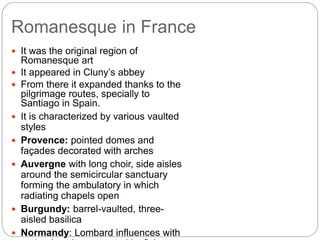
Romanesque in France
 It was the original region of
Romanesque art
 It appeared in Cluny’s abbey
 From there it expanded thanks to the
pilgrimage routes, specially to
Santiago in Spain.
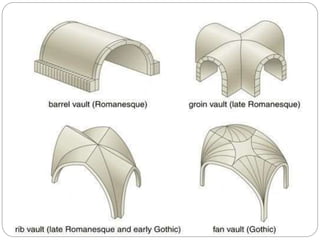
 It is characterized by various vaulted
styles
 Provence: pointed domes and
façades decorated with arches
 Auvergne with long choir, side aisles
around the semicircular sanctuary
forming the ambulatory in which
radiating chapels open
 Burgundy: barrel-vaulted, three-
aisled basilica
 Normandy: Lombard influences with
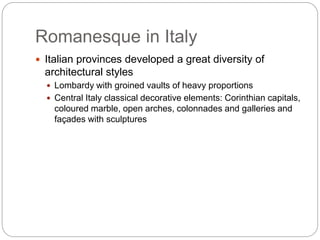
Romanesque in Italy
 Italian provinces developed a great diversity of
architectural styles
 Lombardy with groined vaults of heavy proportions
 Central Italy classical decorative elements: Corinthian capitals,
coloured marble, open arches, colonnades and galleries and
façades with sculptures
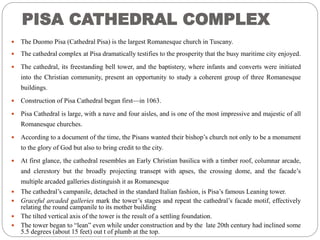
PISA CATHEDRAL COMPLEX
 The Duomo Pisa (Cathedral Pisa) is the largest Romanesque church in Tuscany.
 The cathedral complex at Pisa dramatically testifies to the prosperity that the busy maritime city enjoyed.
 The cathedral, its freestanding bell tower, and the baptistery, where infants and converts were initiated
into the Christian community, present an opportunity to study a coherent group of three Romanesque
buildings.
 Construction of Pisa Cathedral began first—in 1063.
 Pisa Cathedral is large, with a nave and four aisles, and is one of the most impressive and majestic of all
Romanesque churches.
 According to a document of the time, the Pisans wanted their bishop’s church not only to be a monument
to the glory of God but also to bring credit to the city.
 At first glance, the cathedral resembles an Early Christian basilica with a timber roof, columnar arcade,
and clerestory but the broadly projecting transept with apses, the crossing dome, and the facade’s
multiple arcaded galleries distinguish it as Romanesque
 The cathedral’s campanile, detached in the standard Italian fashion, is Pisa’s famous Leaning tower.
 Graceful arcaded galleries mark the tower’s stages and repeat the cathedral’s facade motif, effectively
relating the round campanile to its mother building
 The tilted vertical axis of the tower is the result of a settling foundation.
 The tower began to “lean” even while under construction and by the late 20th century had inclined some
5.5 degrees (about 15 feet) out t of plumb at the top.
Romanesque in Spain
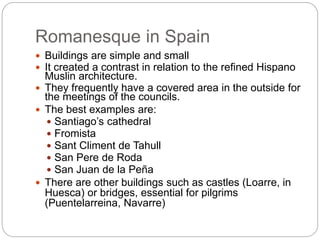
 Buildings are simple and small
 It created a contrast in relation to the refined Hispano
Muslin architecture.
 They frequently have a covered area in the outside for
the meetings of the councils.
 The best examples are:
 Santiago’s cathedral
 Fromista
 Sant Climent de Tahull
 San Pere de Roda
 San Juan de la Peña
 There are other buildings such as castles (Loarre, in
Huesca) or bridges, essential for pilgrims
(Puentelarreina, Navarre)
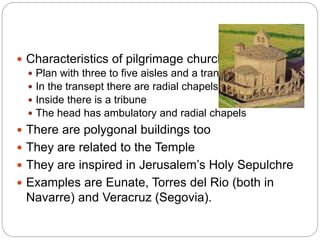
 Characteristics of pilgrimage churches:
 Plan with three to five aisles and a transept
 In the transept there are radial chapels
 Inside there is a tribune
 The head has ambulatory and radial chapels
 There are polygonal buildings too
 They are related to the Temple
 They are inspired in Jerusalem’s Holy Sepulchre
 Examples are Eunate, Torres del Rio (both in
Navarre) and Veracruz (Segovia).
Romanesque in England
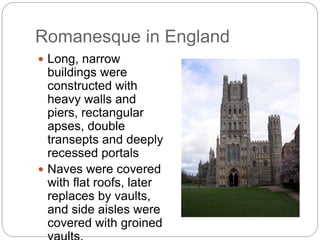
 Long, narrow
buildings were
constructed with
heavy walls and
piers, rectangular
apses, double
transepts and deeply
recessed portals
 Naves were covered
with flat roofs, later
replaces by vaults,
and side aisles were
covered with groined
Romanesque in Germany
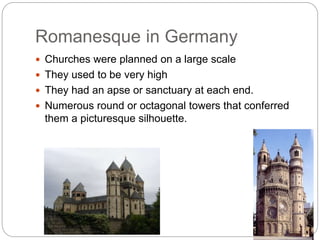
 Churches were planned on a large scale
 They used to be very high
 They had an apse or sanctuary at each end.
 Numerous round or octagonal towers that conferred
them a picturesque silhouette.
EARLY CHRISTIAN ARCHITECTURE.pptx

EARLY CHRISTIAN ARCHITECTURE.pptx

  • 1.
    SUBMITTED TO : AR.ABHISHEK SHRIVASTAV AR. ADITI KAPOOR EARLY CHRISTIAN ARCHITECTURE AND ROMANSEQUE ARCHITECTURE SUMBITTED BY : KSHITIJA KAPOOR NIKITA BHURARIA DUVISH DEV LAKSHAY JANGIR AADITYA SHARMA PARIDHI PAL ANUBHAV SINGH
  • 2.
  • 3.
    EARLY CHRISTIAN ARCHITECTURE Christianity wasborn in Judea – a place in eastern province of the Roman empire, which spread towards the north & west even against the backdrop of great opposition & ultimately accepted as state religion. • The formulation phase of Christianity & its architecture can be considered from Constantine period (300 AD) to Charlemagne (800 AD – French ruler). • The development of Christian Architecture thus can be divided into the following phases: EARLY CHRISTIAN & BYZANTINE ROMANESQUE GOTHIC RENAISSANCE The development of Christian architecture in general proved beneficial in establishing new norms, new construction features, new materials,
  • 4.
    Geography Christianity had itsbirth in Judaea, an eastern province of the Roman Empire, spread and carried by St. Peter, St. Paul, and other missionaries to Rome, as the centre of the World-Empire. Early Christian architecture at Rome was influenced by, and was the logical outcome of;  Existing Roman architecture  modified in other parts of the Empire according to the type already recognized as suitable for the geographical situation of those countries, such as Syria, Asia Minor, North Africa, and Egypt.
  • 5.
    Climatic conditions • NorthItaly has the climate of the temperate region of Europe • Central Italy is genial and sunny • Southern Italy is almost tropical.  This variety of climatic conditions is sufficient to account for diversity of architectural features and treatment in the peninsula itself.  The climatic conditions in Roman provinces as Egypt, Syria, and North Africa where Christianity was established were varied, and naturally modified the style in those countries where the fiercer sun and hotter climate necessitated small windows and other Eastern features.
  • 6.
    Historical Background…. The EarlyChristian architecture started in two prominent locations centered at Rome and Constantinople. •Early Christian Architecture occurred in Rome and in areas around Rome. •From the two focal points Early Christian Architecture spread to other areas in the European and Asian region.
  • 7.
    Social Characteristics &Beliefs….  The single most important social phenomenon of the Early Christian period was the spread and acceptance of the Christian religion.  During the period from the first century to the third century after the death of Jesus, Christianity was a secret society.  It was considered dangerous and subversive by the government Christians met secretly in tombs and private houses.  Gradually, however, it spread and became widely accepted in Asia minor and in Rome itself.  By the third century, Rome had a population of 50,000 Christians.  The religion was tolerated but it was still illegal.
  • 8.
    Architectural Characteristics….  WithChristianity widely accepted as a state religion in Rome it was necessary for architecture to respond to the demands of the religion for worship space.  Mode of worship was the most important determinant of the form of the church. The requirements include:-  A path for processional entry and exit of the clergy  An altar area, where the clergy celebrate mass  A space for the segregation of the clergy from the congregation during procession and communion  Burial space.
  • 9.
     This isfurther divided into two types; the basilica church and the alternative church plans.  A building used for Christian worship had to provide a path for the processional entry and exit of the clergy, an alter area, where the clergy celebrated mass, a space for the segregation of the clergy from congregation during the procession and communion.
  • 10.
    Basilica Church Type Present day St. Peters in Vatican City – a rebuilding of a totally different design & on a substantially enlarged scale.  Dimensions: 110.0m long x 64.0m wide with double aisles on both sides.  The nave was divided from aisles by 22 varied (size & colour), huge & antique marble columns with equally varied capitals supporting the nave walls on a horizontal entablature, while similar numbers of shorter columns carrying arcades divided aisle from aisle.  It was built in the shape of Latin cross, with a gable roof, timbered on inside & at 30.0m high at centre.  An atrium known as Garden of Paradise stood at the entrance with 5 doors.  The nave ended with an arch & the walls had parallel windows each with frescos.
  • 11.
    Basilica Church Type The early churches were generally simple and functional in their design.  The emphasis was centered on the act of Christian worship.  The architecture of the church that developed was not a completely new style, but the use of available Roman forms to satisfy a new program need.  The form chosen for the early church was the Roman basilica.  It was suitable for use as a church with no serious modification and it could be easily and rapidly built at low cost.  The Basilica was also preferred because of the emphasis on participation in mass.  The most common form of the early churches had a rectangular hall with a timber trussed roof.  It also had one or two isles on each side of a central nave and an apse at one end facing the principal entrance located at the other end. • Basilican churches had either closely spaced columns carrying the entablature, or more widely spaced columns carrying semicircular arches.  It s long perspective of oft-repeated columns which carry the eye along to the
  • 12.
  • 13.
    Commonest form ofthe early church. Unlike the earlier Roman phase, the interiors were give more importance than exterior.  Rectangular hall, timber-roofed with coffers & richly glided ceiling (hiding the roof truss) on nave. Usually with one or two aisles to each side of the central nave separated by rows of rustic marble columns, sometimes carrying flat entablatures & sometimes, rows of arches.  The width of aisles was half that of the central nave.  Apse at one end facing the principal entrances at the other end.  Bema / Transept – a raised platform where altar was placed & from where the clergy officiated.  A courtyard (atrium) having a central fountain for ablutions & surrounded by colonnaded ambulatory.  A narthex – corresponding to entrance foyer, preceding the nave.  The nave & bema received light from clerestory above the aisles & were pierced with windows.  Above aisles & between clerestory windows, the walls may be faced with marble, or mosaics made up from small tesserae of coloured glass.  The nave terminates into a ‘triumphal arch’, perhaps having iridescent (brightly coloured & changing) mosaics.  The semicircular walls of the apse ended into a dome, whose interiors had mosaics depicting narrative scenes from Bible or single figures seen against stylised landscapes or plain gold grounds.  The flooring was of grey-white & black marble, inlaid with geometric patterns of coloured marble.
  • 14.
    1) Propylaeum the entrancebuilding of a sacred precinct, whether church or imperial palace 2) Atrium in early Christian, Byzantine, and medieval architecture, the forecourt of a church; as a rule envelop by four colonnaded porticoes. 3) Narthex the entrance hall or porch proceding the nave of a church. 4) Nave the great central space in a church. In longitudinal churches, it extends from the entrance to the ap (or only to the crossing if the church has one) and is usually flanked by side aisles. 5) Side Aisle one of the corridors running parallel to the nave of a church and separated from it by an arcade or colonnade. 6) Crossing the area in a church where the transept and the nave intersect. 7) Transept in a cruciform church, the whole arm set at right angles to the nave. Note that the transept appears infrequently in Early Christian churches. Old St. Peter's is one of the few example of a basilica with transept from this period. The transept would not become a standard component of the Christian ch until the Carolingian period 8) Apse a recess, sometimes rectangular but usually semicircular, in the wall at the end of a Roman basilica Christian church. The apse in the Roman basilica frequently contained an image of the Emperor an was where the magistrate dispensed laws. In the Early Christian basilica, the apses contained the "cathedra" or throne of the bishop and the altar. 9) Nave elevation Term which refers to the division of the nave wall into various levels. In the Early Christian basilica
  • 16.
    S. Peters, Rome(AD 333)  St Peter was the most important of the basilica churches built by Constantine.  The church has a triple entrance gate leading to an atrium.  The church like S. Giovanni discussed earlier is a five isles church.  The Basilica had a wooden roof of interlocking rafters.  The nave did not lead directly to the apse but instead ends in a transverse space that is as high as the nave.
  • 19.
    Alternative Church Form •Alternativemore centralized plans, with a focus on a central vertical axis rather than a longitudinal horizontal one were also adopted occasionally. •The centralized churches were of two broad types. •There were the completely circular church. •These had a circular or octagonal space surrounded by an ambulatory Examples of these include Saint Constanza Rome, the Lateran Baptistery Rome and Saint Stefano Rotondo.
  • 20.
    •This was achurch originally designed as a mausoleum for Emperor Constantine’s daughter. •It was designed as a centralized monument. •It is symmetrical in plan with a domed central space. •The domed central space was ringed by an arcade with 12 pairs of double colonnade. •Beyond the arcade is an encircling ambulatory. •A barrel vault is used to roof the ambulatory. Round Alternative Form (St Constanza)
  • 21.
    Baptistery Church Form The Baptistery of Constantine, Rome (A.D. 430– 440) built near the Lateran Church by Sixtus III, and not by Constantine to whom it is generally attributed, is among the oldest of Italian baptisteries, of which it was probably the model.  It is octagonal in shape according to plan.  The roof is supported by a two-storeyed ring of eight porphyry and marble columns taken from old pagan buildings, while in the centre is an old Roman bath of green basalt converted into a font.
  • 22.
    ROMANSEQUE ARCHITECTURE WHAT ISROMANESQUE ?  Romanesque = “Roman- like” "descended from Roman"  This style grew in those countries of Western Europe which had been under the rule of Rome.  With the church as the unifying force, this period was devoted to the glorification of Christianity and the church was the predominant building type.  Romanesque architecture is known by its massive quality, thick walls, round arches, sturdy pillars, groin vaults, large towers and decorative arcading. Each building has clearly defined forms, frequently of very regular, symmetrical plan; the overall appearance is one of simplicity when compared with the Gothic buildings that were to follow.
  • 23.
    DIFFERENCE BETWEEN ROMAN ANDROMANESQUE  Generally Roman architecture is characterized by a strong Greek influence (columns using the classical orders and pediments, for example) combined with Roman innovations in arches, barrel vaults, and free standing domes. A lot of Roman architecture relies on concrete.  ‘Romanesque’ architecture is a descendant of later Roman architecture.  Most of the Greek ornamentation is lost, and there’s a stronger emphasis on arched vaults and more solid forms. As time goes on Romanesque gets to be more vertical than most Roman architecture as well. There’s very little concrete construction: masonry and brick are the dominant materials.  Usually “Roman” architecture fades into “Romanesque” sometime between the years 500 and 1000. Because Romanesque is a continuation of Roman - like Italian is a continuation of Latin — there’s no single hard dividing line.
  • 24.
    CLIMATE AND MATERIALS Use of Local materials:  Stone  Brick  Marble  Terra-cotta  Ready- made columns  Climactic conditions contribute to differences of treatment north and south of the Alps & Pyrenees. North – Window openings were enlarged - High pitched roofs South – small window openings - Flat Roofs
  • 25.
    MAJOR ELEMENTS WERE Latin cross plan  Use of local stone  Use of round arches, buttressed barrel vaulting and groin vaulting  Towers engaged to façade and large transept towers  Dome often over apse  Recessed doorways ornamented with sculpture  Harmonious proportions  Thick and heavy walls and pillars  Small windows  Sculptured decoration on portals, capitals and other surfaces  Painted decoration throughout the interior
  • 31.
    Romanesque in France It was the original region of Romanesque art  It appeared in Cluny’s abbey  From there it expanded thanks to the pilgrimage routes, specially to Santiago in Spain.  It is characterized by various vaulted styles  Provence: pointed domes and façades decorated with arches  Auvergne with long choir, side aisles around the semicircular sanctuary forming the ambulatory in which radiating chapels open  Burgundy: barrel-vaulted, three- aisled basilica  Normandy: Lombard influences with
  • 32.
    Romanesque in Italy Italian provinces developed a great diversity of architectural styles  Lombardy with groined vaults of heavy proportions  Central Italy classical decorative elements: Corinthian capitals, coloured marble, open arches, colonnades and galleries and façades with sculptures
  • 33.
    PISA CATHEDRAL COMPLEX The Duomo Pisa (Cathedral Pisa) is the largest Romanesque church in Tuscany.  The cathedral complex at Pisa dramatically testifies to the prosperity that the busy maritime city enjoyed.  The cathedral, its freestanding bell tower, and the baptistery, where infants and converts were initiated into the Christian community, present an opportunity to study a coherent group of three Romanesque buildings.  Construction of Pisa Cathedral began first—in 1063.  Pisa Cathedral is large, with a nave and four aisles, and is one of the most impressive and majestic of all Romanesque churches.  According to a document of the time, the Pisans wanted their bishop’s church not only to be a monument to the glory of God but also to bring credit to the city.  At first glance, the cathedral resembles an Early Christian basilica with a timber roof, columnar arcade, and clerestory but the broadly projecting transept with apses, the crossing dome, and the facade’s multiple arcaded galleries distinguish it as Romanesque  The cathedral’s campanile, detached in the standard Italian fashion, is Pisa’s famous Leaning tower.  Graceful arcaded galleries mark the tower’s stages and repeat the cathedral’s facade motif, effectively relating the round campanile to its mother building  The tilted vertical axis of the tower is the result of a settling foundation.  The tower began to “lean” even while under construction and by the late 20th century had inclined some 5.5 degrees (about 15 feet) out t of plumb at the top.
  • 34.
    Romanesque in Spain Buildings are simple and small  It created a contrast in relation to the refined Hispano Muslin architecture.  They frequently have a covered area in the outside for the meetings of the councils.  The best examples are:  Santiago’s cathedral  Fromista  Sant Climent de Tahull  San Pere de Roda  San Juan de la Peña  There are other buildings such as castles (Loarre, in Huesca) or bridges, essential for pilgrims (Puentelarreina, Navarre)
  • 35.
     Characteristics ofpilgrimage churches:  Plan with three to five aisles and a transept  In the transept there are radial chapels  Inside there is a tribune  The head has ambulatory and radial chapels  There are polygonal buildings too  They are related to the Temple  They are inspired in Jerusalem’s Holy Sepulchre  Examples are Eunate, Torres del Rio (both in Navarre) and Veracruz (Segovia).
  • 36.
    Romanesque in England Long, narrow buildings were constructed with heavy walls and piers, rectangular apses, double transepts and deeply recessed portals  Naves were covered with flat roofs, later replaces by vaults, and side aisles were covered with groined
  • 37.
    Romanesque in Germany Churches were planned on a large scale  They used to be very high  They had an apse or sanctuary at each end.  Numerous round or octagonal towers that conferred them a picturesque silhouette.