Pre-Historic Architecture
Mesopotamian Architecture
Egyptian Architecture
Greek Architecture
Etruscan Architecture
Roman Architecture
Early Christian Architecture
Byzantine Architecture
Romanesque Architecture
Gothic Architecture
Renaissance
Baroque Architecture
Rococo
WESTERN HISTORY
OF
ARCHITECTURE
__ VJ 4__
TODAY'S LECTURE DESCRIPTION
EARLY CHRISTIAN PERIOD
• Development of Church plan
• Functional components, construction and architectural character
• Examples of basilican and centralized churches
EARLY CHRISTIAN ARCHITECTURE
The Early Christian architecture started in two prominent locations centered at Rome and
Constantinople. Early Christian Architecture occurred in Rome and in areas around Rome.
From the two focal points Early Christian Architecture spread to other areas in the European
and Asian region. The single most important social phenomenon of the Early Christian period
was the spread and acceptance of the Christian religion. During the period from the first
century to the third century after the death of Jesus, Christianity was a secret society. It was
considered dangerous and subversive by the government Christians met secretly in tombs and
private houses. Gradually, however, it spread and became widely accepted in Asia minor and
in Rome itself. By the third century, Rome had a population of 50,000 Christians. Religion was
tolerated but it was still illegal.
The term early Christian architecture refers to the architecture of the early Christian churches
of the roman era. This is further divided into two types: the basilica church and the
alternative church plans. With Christianity accepted as a state religion in Rome and expanding
in influence, it became necessary for architecture to respond to the space demands of the
new religion. A building used for Christian worship had to provide a path for the processional
entry and exit of the clergy, an alter area, where the clergy celebrated mass, a space for the
segregation of the clergy from congregation during the procession and communion.
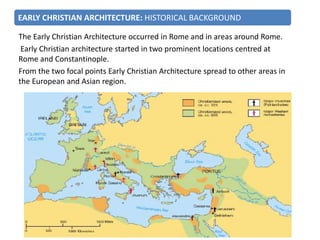
The Early Christian Architecture occurred in Rome and in areas around Rome.
Early Christian architecture started in two prominent locations centred at
Rome and Constantinople.
From the two focal points Early Christian Architecture spread to other areas in
the European and Asian region.
EARLY CHRISTIAN ARCHITECTURE: HISTORICAL BACKGROUND
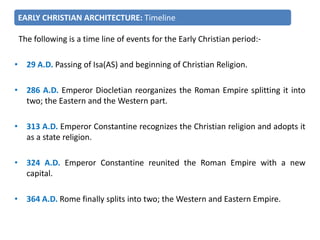
The following is a time line of events for the Early Christian period:-
• 29 A.D. Passing of Isa(AS) and beginning of Christian Religion.
• 286 A.D. Emperor Diocletian reorganizes the Roman Empire splitting it into
two; the Eastern and the Western part.
• 313 A.D. Emperor Constantine recognizes the Christian religion and adopts it
as a state religion.
• 324 A.D. Emperor Constantine reunited the Roman Empire with a new
capital.
• 364 A.D. Rome finally splits into two; the Western and Eastern Empire.
EARLY CHRISTIAN ARCHITECTURE: Timeline
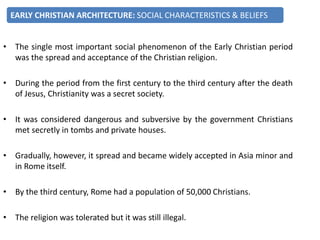
• The single most important social phenomenon of the Early Christian period
was the spread and acceptance of the Christian religion.
• During the period from the first century to the third century after the death
of Jesus, Christianity was a secret society.
• It was considered dangerous and subversive by the government Christians
met secretly in tombs and private houses.
• Gradually, however, it spread and became widely accepted in Asia minor and
in Rome itself.
• By the third century, Rome had a population of 50,000 Christians.
• The religion was tolerated but it was still illegal.
EARLY CHRISTIAN ARCHITECTURE: SOCIAL CHARACTERISTICS & BELIEFS
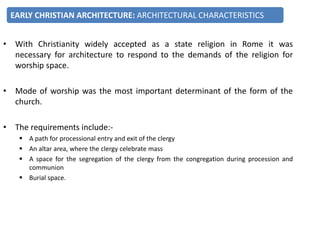
• With Christianity widely accepted as a state religion in Rome it was
necessary for architecture to respond to the demands of the religion for
worship space.
• Mode of worship was the most important determinant of the form of the
church.
• The requirements include:-
 A path for processional entry and exit of the clergy
 An altar area, where the clergy celebrate mass
 A space for the segregation of the clergy from the congregation during procession and
communion
 Burial space.
EARLY CHRISTIAN ARCHITECTURE: ARCHITECTURAL CHARACTERISTICS
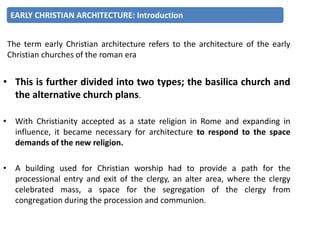
The term early Christian architecture refers to the architecture of the early
Christian churches of the roman era
• This is further divided into two types; the basilica church and
the alternative church plans.
• With Christianity accepted as a state religion in Rome and expanding in
influence, it became necessary for architecture to respond to the space
demands of the new religion.
• A building used for Christian worship had to provide a path for the
processional entry and exit of the clergy, an alter area, where the clergy
celebrated mass, a space for the segregation of the clergy from
congregation during the procession and communion.
EARLY CHRISTIAN ARCHITECTURE: Introduction
• The early churches were generally simple and functional in their design.
• The emphasis was centered on the act of Christian worship.
• The architecture of the church that developed was not a completely new style,
but the use of available Roman forms to satisfy a new program need.
• The form chosen for the early church was the Roman basilica.
• It was suitable for use as a church with no serious modification and it could be
easily and rapidly built at low cost.
• The Basilica was also preferred because of the emphasis on participation in
mass.
• The most common form of the early churches had a rectangular hall with a
timber trussed roof.
• It also had one or two isles on each side of a central nave and an apse at one
end facing the principal entrance located at the other end.
BASILICA CHURCH TYPE
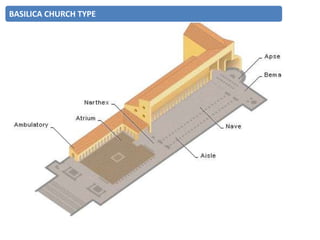
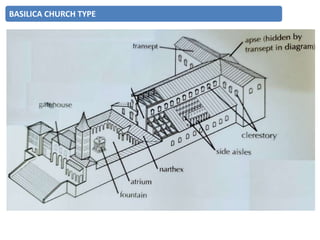
Nave: The central part of the basilica, where the congregation would gather for worship. The nave is usually flanked
by aisles on either side.
Aisles: These are the narrower passages on either side of the nave. They often contain rows of columns or pillars
supporting the upper levels of the building.
Apse: Located at one end of the basilica, usually the eastern end, the apse is a semi-circular or polygonal space. It
often contains the altar and is where the clergy would preside over religious ceremonies.
Transept: In some basilicas, particularly those with a cruciform (cross-shaped) plan, there is a transept that intersects
the nave, creating a cross-shaped layout. This transept may be as long as the nave or shorter.
Atrium: Some basilicas feature an atrium, an open courtyard or entrance hall located at the front of the church. The
atrium served as a gathering space for the congregation before entering the main worship area.
Narthex: In addition to or instead of an atrium, some basilicas have a narthex, an enclosed vestibule or entrance hall
at the western end of the church. The narthex often contained entrances, or portals, leading into the nave.
Ambulatory: In larger basilicas, especially those associated with pilgrimage sites or major churches in urban centers,
an ambulatory might be present. This is a passageway that encircles the apse or choir area, allowing for processions
and providing access to chapels or shrines located behind the main altar.
Chapels and Shrines: Within the basilica, there may be smaller chapels or shrines dedicated to specific saints or
events. These areas allowed for private prayer and devotion.
Dome or Vaulted Ceiling: Many basilicas featured a dome or a vaulted ceiling over the central nave, providing
structural support and often adorned with decorative artwork or mosaics.
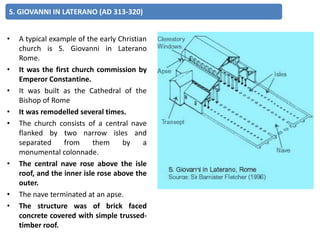
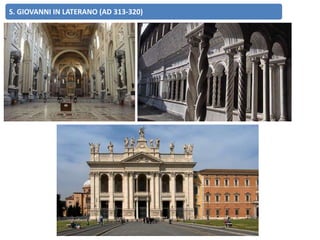
• A typical example of the early Christian
church is S. Giovanni in Laterano
Rome.
• It was the first church commission by
Emperor Constantine.
• It was built as the Cathedral of the
Bishop of Rome
• It was remodelled several times.
• The church consists of a central nave
flanked by two narrow isles and
separated from them by a
monumental colonnade.
• The central nave rose above the isle
roof, and the inner isle rose above the
outer.
• The nave terminated at an apse.
• The structure was of brick faced
concrete covered with simple trussed-
timber roof.
S. GIOVANNI IN LATERANO (AD 313-320)
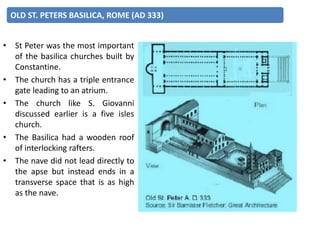
• St Peter was the most important
of the basilica churches built by
Constantine.
• The church has a triple entrance
gate leading to an atrium.
• The church like S. Giovanni
discussed earlier is a five isles
church.
• The Basilica had a wooden roof
of interlocking rafters.
• The nave did not lead directly to
the apse but instead ends in a
transverse space that is as high
as the nave.
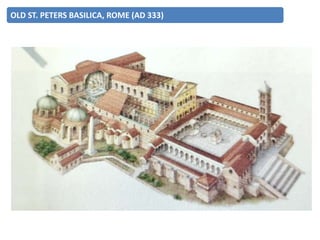
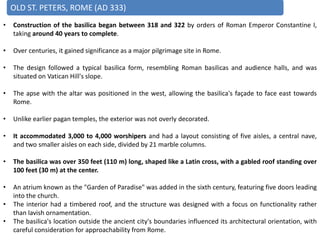
OLD ST. PETERS BASILICA, ROME (AD 333)
• Construction of the basilica began between 318 and 322 by orders of Roman Emperor Constantine I,
taking around 40 years to complete.
• Over centuries, it gained significance as a major pilgrimage site in Rome.
• The design followed a typical basilica form, resembling Roman basilicas and audience halls, and was
situated on Vatican Hill's slope.
• The apse with the altar was positioned in the west, allowing the basilica's façade to face east towards
Rome.
• Unlike earlier pagan temples, the exterior was not overly decorated.
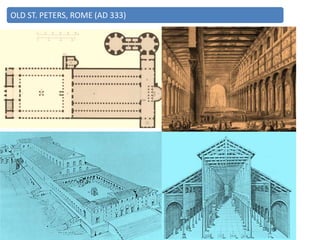
• It accommodated 3,000 to 4,000 worshipers and had a layout consisting of five aisles, a central nave,
and two smaller aisles on each side, divided by 21 marble columns.
• The basilica was over 350 feet (110 m) long, shaped like a Latin cross, with a gabled roof standing over
100 feet (30 m) at the center.
• An atrium known as the "Garden of Paradise" was added in the sixth century, featuring five doors leading
into the church.
• The interior had a timbered roof, and the structure was designed with a focus on functionality rather
than lavish ornamentation.
• The basilica's location outside the ancient city's boundaries influenced its architectural orientation, with
careful consideration for approachability from Rome.
OLD ST. PETERS, ROME (AD 333)
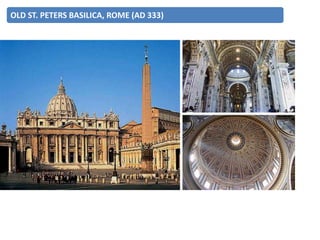
OLD ST. PETERS BASILICA, ROME (AD 333)
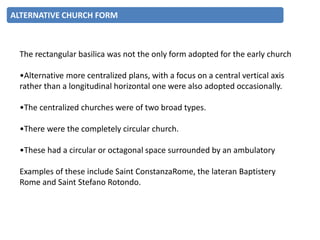
The rectangular basilica was not the only form adopted for the early church
•Alternative more centralized plans, with a focus on a central vertical axis
rather than a longitudinal horizontal one were also adopted occasionally.
•The centralized churches were of two broad types.
•There were the completely circular church.
•These had a circular or octagonal space surrounded by an ambulatory
Examples of these include Saint ConstanzaRome, the lateran Baptistery
Rome and Saint Stefano Rotondo.
ALTERNATIVE CHURCH FORM
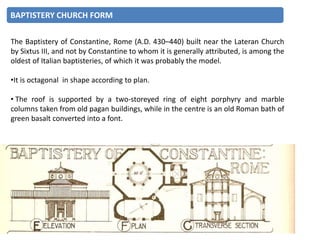
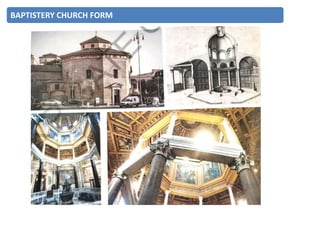
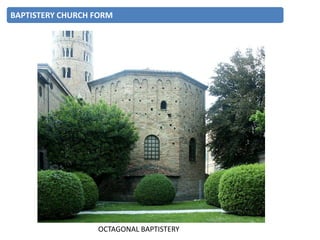
The Baptistery of Constantine, Rome (A.D. 430–440) built near the Lateran Church
by Sixtus III, and not by Constantine to whom it is generally attributed, is among the
oldest of Italian baptisteries, of which it was probably the model.
•It is octagonal in shape according to plan.
• The roof is supported by a two-storeyed ring of eight porphyry and marble
columns taken from old pagan buildings, while in the centre is an old Roman bath of
green basalt converted into a font.
BAPTISTERY CHURCH FORM
Baptistery Church Form
OCTAGONAL BAPTISTERY
BAPTISTERY CHURCH FORM
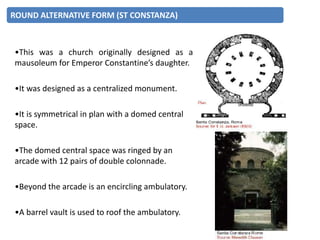
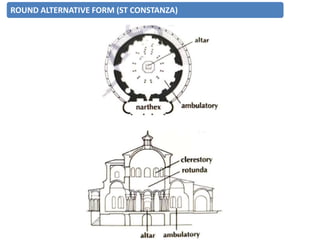
•This was a church originally designed as a
mausoleum for Emperor Constantine’s daughter.
•It was designed as a centralized monument.
•It is symmetrical in plan with a domed central
space.
•The domed central space was ringed by an
arcade with 12 pairs of double colonnade.
•Beyond the arcade is an encircling ambulatory.
•A barrel vault is used to roof the ambulatory.
ROUND ALTERNATIVE FORM (ST CONSTANZA)
THANK YOU
To be continue……..

EARLY CHRISTIAN ARCHITECTURE.........ppt

  • 1.
    Pre-Historic Architecture Mesopotamian Architecture EgyptianArchitecture Greek Architecture Etruscan Architecture Roman Architecture Early Christian Architecture Byzantine Architecture Romanesque Architecture Gothic Architecture Renaissance Baroque Architecture Rococo WESTERN HISTORY OF ARCHITECTURE __ VJ 4__
  • 2.
    TODAY'S LECTURE DESCRIPTION EARLYCHRISTIAN PERIOD • Development of Church plan • Functional components, construction and architectural character • Examples of basilican and centralized churches
  • 3.
    EARLY CHRISTIAN ARCHITECTURE TheEarly Christian architecture started in two prominent locations centered at Rome and Constantinople. Early Christian Architecture occurred in Rome and in areas around Rome. From the two focal points Early Christian Architecture spread to other areas in the European and Asian region. The single most important social phenomenon of the Early Christian period was the spread and acceptance of the Christian religion. During the period from the first century to the third century after the death of Jesus, Christianity was a secret society. It was considered dangerous and subversive by the government Christians met secretly in tombs and private houses. Gradually, however, it spread and became widely accepted in Asia minor and in Rome itself. By the third century, Rome had a population of 50,000 Christians. Religion was tolerated but it was still illegal. The term early Christian architecture refers to the architecture of the early Christian churches of the roman era. This is further divided into two types: the basilica church and the alternative church plans. With Christianity accepted as a state religion in Rome and expanding in influence, it became necessary for architecture to respond to the space demands of the new religion. A building used for Christian worship had to provide a path for the processional entry and exit of the clergy, an alter area, where the clergy celebrated mass, a space for the segregation of the clergy from congregation during the procession and communion.
  • 4.
    The Early ChristianArchitecture occurred in Rome and in areas around Rome. Early Christian architecture started in two prominent locations centred at Rome and Constantinople. From the two focal points Early Christian Architecture spread to other areas in the European and Asian region. EARLY CHRISTIAN ARCHITECTURE: HISTORICAL BACKGROUND
  • 5.
    The following isa time line of events for the Early Christian period:- • 29 A.D. Passing of Isa(AS) and beginning of Christian Religion. • 286 A.D. Emperor Diocletian reorganizes the Roman Empire splitting it into two; the Eastern and the Western part. • 313 A.D. Emperor Constantine recognizes the Christian religion and adopts it as a state religion. • 324 A.D. Emperor Constantine reunited the Roman Empire with a new capital. • 364 A.D. Rome finally splits into two; the Western and Eastern Empire. EARLY CHRISTIAN ARCHITECTURE: Timeline
  • 6.
    • The singlemost important social phenomenon of the Early Christian period was the spread and acceptance of the Christian religion. • During the period from the first century to the third century after the death of Jesus, Christianity was a secret society. • It was considered dangerous and subversive by the government Christians met secretly in tombs and private houses. • Gradually, however, it spread and became widely accepted in Asia minor and in Rome itself. • By the third century, Rome had a population of 50,000 Christians. • The religion was tolerated but it was still illegal. EARLY CHRISTIAN ARCHITECTURE: SOCIAL CHARACTERISTICS & BELIEFS
  • 7.
    • With Christianitywidely accepted as a state religion in Rome it was necessary for architecture to respond to the demands of the religion for worship space. • Mode of worship was the most important determinant of the form of the church. • The requirements include:-  A path for processional entry and exit of the clergy  An altar area, where the clergy celebrate mass  A space for the segregation of the clergy from the congregation during procession and communion  Burial space. EARLY CHRISTIAN ARCHITECTURE: ARCHITECTURAL CHARACTERISTICS
  • 8.
    The term earlyChristian architecture refers to the architecture of the early Christian churches of the roman era • This is further divided into two types; the basilica church and the alternative church plans. • With Christianity accepted as a state religion in Rome and expanding in influence, it became necessary for architecture to respond to the space demands of the new religion. • A building used for Christian worship had to provide a path for the processional entry and exit of the clergy, an alter area, where the clergy celebrated mass, a space for the segregation of the clergy from congregation during the procession and communion. EARLY CHRISTIAN ARCHITECTURE: Introduction
  • 9.
    • The earlychurches were generally simple and functional in their design. • The emphasis was centered on the act of Christian worship. • The architecture of the church that developed was not a completely new style, but the use of available Roman forms to satisfy a new program need. • The form chosen for the early church was the Roman basilica. • It was suitable for use as a church with no serious modification and it could be easily and rapidly built at low cost. • The Basilica was also preferred because of the emphasis on participation in mass. • The most common form of the early churches had a rectangular hall with a timber trussed roof. • It also had one or two isles on each side of a central nave and an apse at one end facing the principal entrance located at the other end. BASILICA CHURCH TYPE
  • 10.
  • 11.
  • 12.
    Nave: The centralpart of the basilica, where the congregation would gather for worship. The nave is usually flanked by aisles on either side. Aisles: These are the narrower passages on either side of the nave. They often contain rows of columns or pillars supporting the upper levels of the building. Apse: Located at one end of the basilica, usually the eastern end, the apse is a semi-circular or polygonal space. It often contains the altar and is where the clergy would preside over religious ceremonies. Transept: In some basilicas, particularly those with a cruciform (cross-shaped) plan, there is a transept that intersects the nave, creating a cross-shaped layout. This transept may be as long as the nave or shorter. Atrium: Some basilicas feature an atrium, an open courtyard or entrance hall located at the front of the church. The atrium served as a gathering space for the congregation before entering the main worship area. Narthex: In addition to or instead of an atrium, some basilicas have a narthex, an enclosed vestibule or entrance hall at the western end of the church. The narthex often contained entrances, or portals, leading into the nave. Ambulatory: In larger basilicas, especially those associated with pilgrimage sites or major churches in urban centers, an ambulatory might be present. This is a passageway that encircles the apse or choir area, allowing for processions and providing access to chapels or shrines located behind the main altar. Chapels and Shrines: Within the basilica, there may be smaller chapels or shrines dedicated to specific saints or events. These areas allowed for private prayer and devotion. Dome or Vaulted Ceiling: Many basilicas featured a dome or a vaulted ceiling over the central nave, providing structural support and often adorned with decorative artwork or mosaics.
  • 13.
    • A typicalexample of the early Christian church is S. Giovanni in Laterano Rome. • It was the first church commission by Emperor Constantine. • It was built as the Cathedral of the Bishop of Rome • It was remodelled several times. • The church consists of a central nave flanked by two narrow isles and separated from them by a monumental colonnade. • The central nave rose above the isle roof, and the inner isle rose above the outer. • The nave terminated at an apse. • The structure was of brick faced concrete covered with simple trussed- timber roof. S. GIOVANNI IN LATERANO (AD 313-320)
  • 14.
    S. GIOVANNI INLATERANO (AD 313-320)
  • 15.
    • St Peterwas the most important of the basilica churches built by Constantine. • The church has a triple entrance gate leading to an atrium. • The church like S. Giovanni discussed earlier is a five isles church. • The Basilica had a wooden roof of interlocking rafters. • The nave did not lead directly to the apse but instead ends in a transverse space that is as high as the nave. OLD ST. PETERS BASILICA, ROME (AD 333)
  • 16.
    OLD ST. PETERSBASILICA, ROME (AD 333)
  • 17.
    • Construction ofthe basilica began between 318 and 322 by orders of Roman Emperor Constantine I, taking around 40 years to complete. • Over centuries, it gained significance as a major pilgrimage site in Rome. • The design followed a typical basilica form, resembling Roman basilicas and audience halls, and was situated on Vatican Hill's slope. • The apse with the altar was positioned in the west, allowing the basilica's façade to face east towards Rome. • Unlike earlier pagan temples, the exterior was not overly decorated. • It accommodated 3,000 to 4,000 worshipers and had a layout consisting of five aisles, a central nave, and two smaller aisles on each side, divided by 21 marble columns. • The basilica was over 350 feet (110 m) long, shaped like a Latin cross, with a gabled roof standing over 100 feet (30 m) at the center. • An atrium known as the "Garden of Paradise" was added in the sixth century, featuring five doors leading into the church. • The interior had a timbered roof, and the structure was designed with a focus on functionality rather than lavish ornamentation. • The basilica's location outside the ancient city's boundaries influenced its architectural orientation, with careful consideration for approachability from Rome. OLD ST. PETERS, ROME (AD 333)
  • 18.
    OLD ST. PETERS,ROME (AD 333)
  • 19.
    OLD ST. PETERSBASILICA, ROME (AD 333)
  • 20.
    The rectangular basilicawas not the only form adopted for the early church •Alternative more centralized plans, with a focus on a central vertical axis rather than a longitudinal horizontal one were also adopted occasionally. •The centralized churches were of two broad types. •There were the completely circular church. •These had a circular or octagonal space surrounded by an ambulatory Examples of these include Saint ConstanzaRome, the lateran Baptistery Rome and Saint Stefano Rotondo. ALTERNATIVE CHURCH FORM
  • 21.
    The Baptistery ofConstantine, Rome (A.D. 430–440) built near the Lateran Church by Sixtus III, and not by Constantine to whom it is generally attributed, is among the oldest of Italian baptisteries, of which it was probably the model. •It is octagonal in shape according to plan. • The roof is supported by a two-storeyed ring of eight porphyry and marble columns taken from old pagan buildings, while in the centre is an old Roman bath of green basalt converted into a font. BAPTISTERY CHURCH FORM
  • 22.
  • 23.
    Baptistery Church Form OCTAGONALBAPTISTERY BAPTISTERY CHURCH FORM
  • 24.
    •This was achurch originally designed as a mausoleum for Emperor Constantine’s daughter. •It was designed as a centralized monument. •It is symmetrical in plan with a domed central space. •The domed central space was ringed by an arcade with 12 pairs of double colonnade. •Beyond the arcade is an encircling ambulatory. •A barrel vault is used to roof the ambulatory. ROUND ALTERNATIVE FORM (ST CONSTANZA)
  • 25.
    ROUND ALTERNATIVE FORM(ST CONSTANZA)
  • 26.
    THANK YOU To becontinue……..