Bellwork: Write the meaning of each term (IN YOUR
OWN WORDS!) and write it’s unit:
Voltage
Current
Resistor
Voltage, Current and Resistance
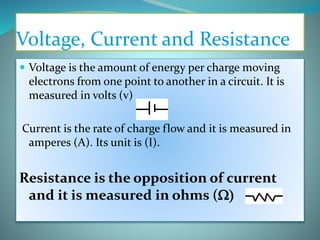
 Voltage is the amount of energy per charge moving
electrons from one point to another in a circuit. It is
measured in volts (v)
Current is the rate of charge flow and it is measured in
amperes (A). Its unit is (I).
Resistance is the opposition of current
and it is measured in ohms (W)
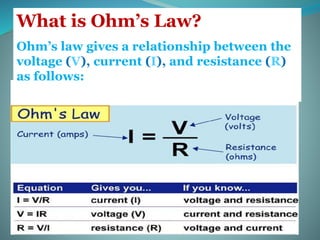
What is Ohm’s Law?
Ohm’s law gives a relationship between the
voltage (V), current (I), and resistance (R)
as follows:
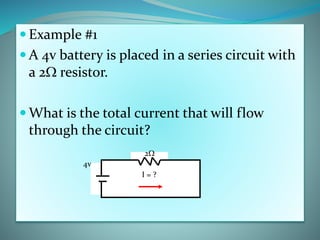
 Example #1
 A 4v battery is placed in a series circuit with
a 2W resistor.
 What is the total current that will flow
through the circuit?
I = ?
2W
4v
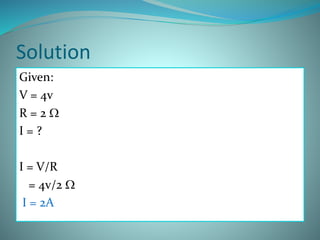
Solution
Given:
V = 4v
R = 2 W
I = ?
I = V/R
= 4v/2 W
I = 2A
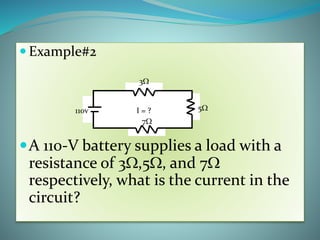
 Example#2
A 110-V battery supplies a load with a
resistance of 3W,5W, and 7W
respectively, what is the current in the
circuit?
I = ?110v
3W
7W
5W
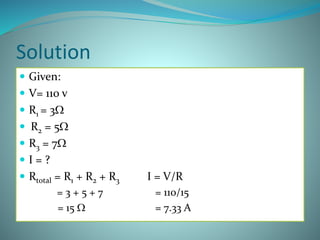
Solution
 Given:
 V= 110 v
 R1 = 3W
 R2 = 5W
 R3 = 7W
 I = ?
 Rtotal = R1 + R2 + R3 I = V/R
= 3 + 5 + 7 = 110/15
= 15 W = 7.33 A
How do we measure power in
electric circuits?
One watt is a pretty small amount of
power.
We often use kilowatts = 1000 watts
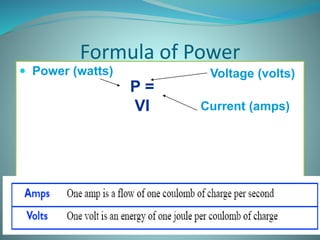
Formula of Power
 Power (watts)
P =
VI
Voltage (volts)
Current (amps)
Solution
 Given:
 V = 1.5v
 R = 3 W
 I =V / R P = V I
= 1.5 / 3 = 1.5 x 0.5
= 0.5 A = 0.75 watts
More Practice Problems
Page 841 #2-4
Page 853 # 3-4
More Practice
Read Pages 829-830
Do 1-4 on page 830
SC.912.P.10.15 - investigate and explain the relationships
among current, voltage, resistance, and power.
Unit Scale:
4 I can generate and test ways in which Ohm’s
law can help an electrician build more
energy efficient homes.
3 I can explain the relationships among
current, voltage, resistance, and power.
2 I can compare the differences between
current and voltage.
1 I can define these words using a dictionary
Agenda: Circuit Stations

Ohmslaw power (002)

  • 1.
    Bellwork: Write themeaning of each term (IN YOUR OWN WORDS!) and write it’s unit: Voltage Current Resistor
  • 2.
    Voltage, Current andResistance  Voltage is the amount of energy per charge moving electrons from one point to another in a circuit. It is measured in volts (v) Current is the rate of charge flow and it is measured in amperes (A). Its unit is (I). Resistance is the opposition of current and it is measured in ohms (W)
  • 3.
    What is Ohm’sLaw? Ohm’s law gives a relationship between the voltage (V), current (I), and resistance (R) as follows:
  • 4.
     Example #1 A 4v battery is placed in a series circuit with a 2W resistor.  What is the total current that will flow through the circuit? I = ? 2W 4v
  • 5.
    Solution Given: V = 4v R= 2 W I = ? I = V/R = 4v/2 W I = 2A
  • 6.
     Example#2 A 110-Vbattery supplies a load with a resistance of 3W,5W, and 7W respectively, what is the current in the circuit? I = ?110v 3W 7W 5W
  • 7.
    Solution  Given:  V=110 v  R1 = 3W  R2 = 5W  R3 = 7W  I = ?  Rtotal = R1 + R2 + R3 I = V/R = 3 + 5 + 7 = 110/15 = 15 W = 7.33 A
  • 8.
    How do wemeasure power in electric circuits? One watt is a pretty small amount of power. We often use kilowatts = 1000 watts
  • 9.
    Formula of Power Power (watts) P = VI Voltage (volts) Current (amps)
  • 10.
    Solution  Given:  V= 1.5v  R = 3 W  I =V / R P = V I = 1.5 / 3 = 1.5 x 0.5 = 0.5 A = 0.75 watts
  • 11.
    More Practice Problems Page841 #2-4 Page 853 # 3-4
  • 12.
    More Practice Read Pages829-830 Do 1-4 on page 830
  • 13.
    SC.912.P.10.15 - investigateand explain the relationships among current, voltage, resistance, and power. Unit Scale: 4 I can generate and test ways in which Ohm’s law can help an electrician build more energy efficient homes. 3 I can explain the relationships among current, voltage, resistance, and power. 2 I can compare the differences between current and voltage. 1 I can define these words using a dictionary Agenda: Circuit Stations