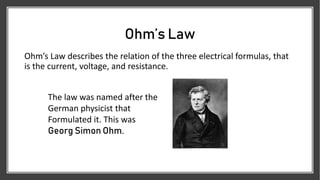
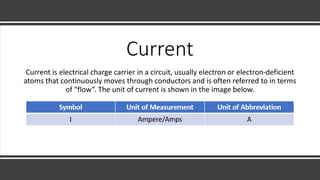
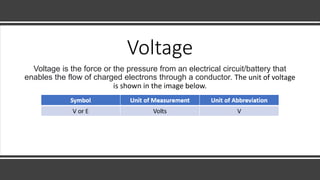
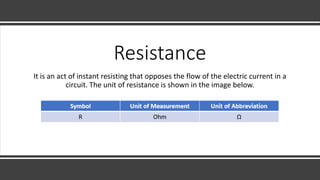
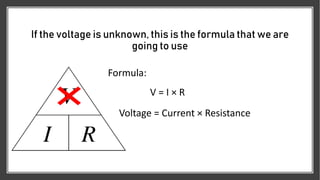
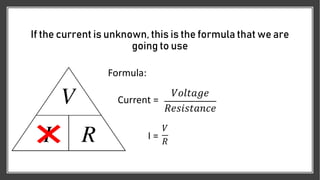
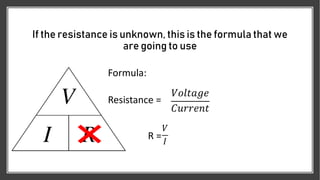
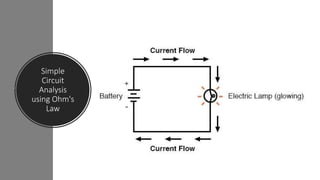
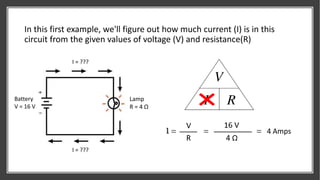
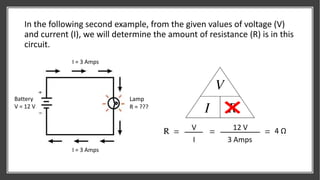
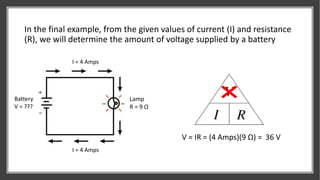
Ohm's law describes the relationship between current, voltage, and resistance in an electrical circuit. It states that current is directly proportional to voltage and inversely proportional to resistance. The law was formulated by German physicist Georg Simon Ohm. Current refers to the flow of electric charge, usually electrons, through a conductor. Voltage is the force that enables the flow of electrons. Resistance opposes the flow of current. Ohm's law can be used to calculate any one of the three variables if the other two are known using the formulas V=IR, I=V/R, and R=V/I.



![ANIMAL_CELL_,_TISSUE_AND_ORGAN_CULTURE[1].pptx](https://cdn.slidesharecdn.com/ss_thumbnails/animalcelltissueandorganculture1-260204172026-4462b440-thumbnail.jpg?width=640&height=640&fit=bounds)


