Current, Resistance,
Voltage and Electric
Power
GEMALYN O. MARIANO
Have you ever wondered
how your phone charges
when you plug it into a socket?
e
electrons
wire
When a charger is plugged in,
negatively charged particles called
electrons, which are already present
inside the wires, start moving in the
same net direction.
This flow of electrons is what we call
electric current. The voltage, or
electrical pressure pushes these
electrons along the wires.
e
e
e e
e
electric current
electrons
wire
Free electrons move along a zigzag
path, colliding with each other and
with fixed atoms within the material,
creating resistance.
This resistance makes the wire and any
connected devices, like your phone
charger, heat up.
e
electric current
Define current, voltage,
resistance and electric power.
Today, we’ll be
able to:
Explain the relationship of
current and charge.
Explain the relationship between
current, voltage and resistance
through Ohm’s law
Discuss the basic concepts of
electricity such as voltage, current,
resistance and electric power.
ELECTRICITY
It is one of the most
incredible inventions
in human history.
What is
electricity?
Electrons
Movement of these
charged particles
can be harnessed
to do work.
Water
Analogy
BULB
EVTLOGA
BATTERY
A
M
M
E
T
E
R
S
W
I
T
C
H
VOLTMETER
BULB
VOLTAGE
BATTERY
A
M
M
E
T
E
R
S
W
I
T
C
H
VOLTMETER
 Voltage (measured in volts, V) is
the pressure or push behind the
flow of current. It is also referred to
as potential difference.
 A voltmeter is used to measure
voltage. It is placed parallel to the
component(s) to measure the
voltage in a circuit.
BULB
RTNRCEU
BATTERY
A
M
M
E
T
E
R
BULB
Current
Current (measured in amps or
amperes, A) is the rate of flow of
charge in a circuit.
An ammeter is used to measure
current. It is always connected in
series with the circuit.
The type, length and thickness
of wire will affect how much
current flows in a circuit.
BATTERY
A
M
M
E
T
E
R
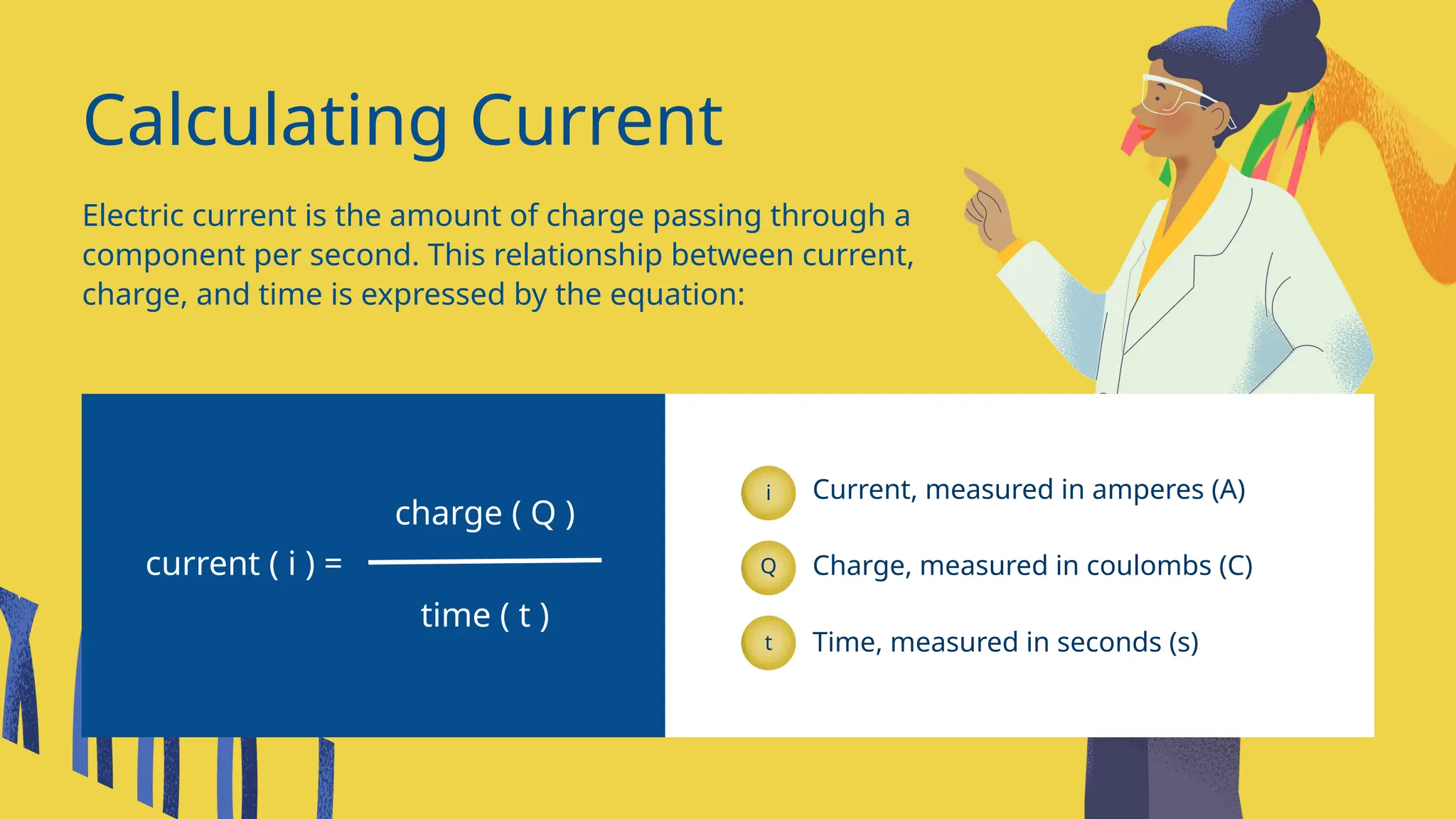
Calculating Current
Electric current is the amount of charge passing through a
component per second. This relationship between current,
charge, and time is expressed by the equation:
i
Q
t
Current, measured in amperes (A)
Charge, measured in coulombs (C)
Time, measured in seconds (s)
current ( i ) =
charge ( Q )
time ( t )
ESRSCNAITE
RESISTOR
OHMMETER
Ω
Resistance
Resistance (measured in ohms, Ω) is a
measure of how much a material opposes
the flow of electric current going through
it.
The greater the resistance, the more
energy is needed to push the current
through the component, which can affect
the overall performance of electrical
circuits.
An ohmmeter is used to measure the
amount of resistance present when a
current is passed through a particular
component.
RESISTOR
OHMMETER
Ω
Ohm’s Law
Ohm's Law states that the current through a
conductor is directly proportional to the
potential difference across it, provided the
temperature remains constant.
current ( i ) =
Voltage ( Q )
Resistance ( Ω )
Electric
Power
It is a measure of how much
energy is used in a span of
time.
Electric power is commonly
supplied by electric
batteries and produced by
electric generators
Summary
Current Voltage Resistance
Current is the rate of flow
of charge in a circuit. This
flow is in the form of
electrons flowing through
a circuit.
Current is measured in
amperes (A) using an
ammeter.
Voltage is the pressure or
push behind the flow of
current. It is measured in
volts (V) using a voltmeter.
Voltage is also referred to
as potential difference.
Resistance opposes
current flow and is
measured in ohms (Ω). It
can be calculated by
dividing the voltage by the
current.
WATER TANK ANALOGY
THANK
YOU!

Current, resistance, voltage and electric powerT.pptx

  • 1.
    Current, Resistance, Voltage andElectric Power GEMALYN O. MARIANO
  • 2.
    Have you everwondered how your phone charges when you plug it into a socket?
  • 3.
    e electrons wire When a chargeris plugged in, negatively charged particles called electrons, which are already present inside the wires, start moving in the same net direction. This flow of electrons is what we call electric current. The voltage, or electrical pressure pushes these electrons along the wires. e e e e e electric current
  • 4.
    electrons wire Free electrons movealong a zigzag path, colliding with each other and with fixed atoms within the material, creating resistance. This resistance makes the wire and any connected devices, like your phone charger, heat up. e electric current
  • 5.
    Define current, voltage, resistanceand electric power. Today, we’ll be able to: Explain the relationship of current and charge. Explain the relationship between current, voltage and resistance through Ohm’s law Discuss the basic concepts of electricity such as voltage, current, resistance and electric power.
  • 6.
    ELECTRICITY It is oneof the most incredible inventions in human history.
  • 7.
  • 8.
    Electrons Movement of these chargedparticles can be harnessed to do work.
  • 9.
  • 10.
  • 11.
    BULB VOLTAGE BATTERY A M M E T E R S W I T C H VOLTMETER  Voltage (measuredin volts, V) is the pressure or push behind the flow of current. It is also referred to as potential difference.  A voltmeter is used to measure voltage. It is placed parallel to the component(s) to measure the voltage in a circuit.
  • 12.
  • 13.
    BULB Current Current (measured inamps or amperes, A) is the rate of flow of charge in a circuit. An ammeter is used to measure current. It is always connected in series with the circuit. The type, length and thickness of wire will affect how much current flows in a circuit. BATTERY A M M E T E R
  • 14.
    Calculating Current Electric currentis the amount of charge passing through a component per second. This relationship between current, charge, and time is expressed by the equation: i Q t Current, measured in amperes (A) Charge, measured in coulombs (C) Time, measured in seconds (s) current ( i ) = charge ( Q ) time ( t )
  • 15.
  • 16.
    Resistance Resistance (measured inohms, Ω) is a measure of how much a material opposes the flow of electric current going through it. The greater the resistance, the more energy is needed to push the current through the component, which can affect the overall performance of electrical circuits. An ohmmeter is used to measure the amount of resistance present when a current is passed through a particular component. RESISTOR OHMMETER Ω
  • 17.
    Ohm’s Law Ohm's Lawstates that the current through a conductor is directly proportional to the potential difference across it, provided the temperature remains constant. current ( i ) = Voltage ( Q ) Resistance ( Ω )
  • 18.
    Electric Power It is ameasure of how much energy is used in a span of time. Electric power is commonly supplied by electric batteries and produced by electric generators
  • 19.
    Summary Current Voltage Resistance Currentis the rate of flow of charge in a circuit. This flow is in the form of electrons flowing through a circuit. Current is measured in amperes (A) using an ammeter. Voltage is the pressure or push behind the flow of current. It is measured in volts (V) using a voltmeter. Voltage is also referred to as potential difference. Resistance opposes current flow and is measured in ohms (Ω). It can be calculated by dividing the voltage by the current.
  • 20.
  • 21.