Fawzia Abo ali
Prof. of Medicine, Allergy &Immunology
Ain Shams Faculty of Medicine
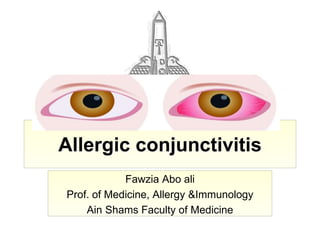
Allergic conjunctivitis
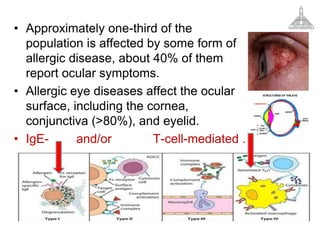
• Approximately one-third of the
population is affected by some form of
allergic disease, about 40% of them
report ocular symptoms.
• Allergic eye diseases affect the ocular
surface, including the cornea,
conjunctiva (>80%), and eyelid.
• IgE- and/or T-cell-mediated .
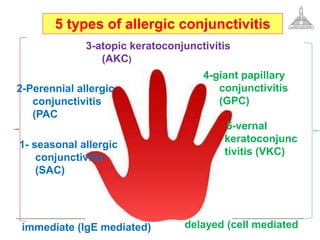
1- seasonal allergic
conjunctivitis
(SAC)
2-Perennial allergic
conjunctivitis
(PAC
3-atopic keratoconjunctivitis
(AKC)
4-giant papillary
conjunctivitis
(GPC)
5-vernal
keratoconjunc
tivitis (VKC)
5 types of allergic conjunctivitis
immediate (IgE mediated) delayed (cell mediated
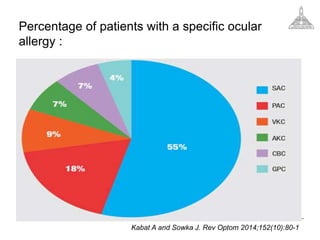
Percentage of patients with a specific ocular
allergy :
Kabat A and Sowka J. Rev Optom 2014;152(10):80-1
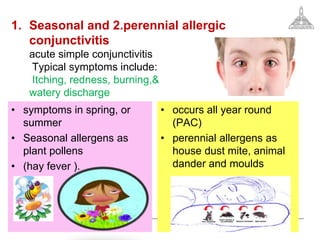
1. Seasonal and 2.perennial allergic
conjunctivitis
acute simple conjunctivitis
Typical symptoms include:
Itching, redness, burning,&
watery discharge
• symptoms in spring, or
summer
• Seasonal allergens as
plant pollens
• (hay fever ).
• occurs all year round
(PAC)
• perennial allergens as
house dust mite, animal
dander and moulds
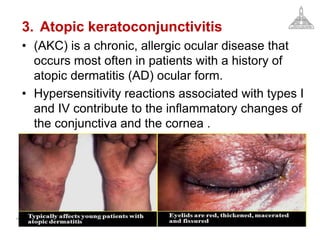
3. Atopic keratoconjunctivitis
• (AKC) is a chronic, allergic ocular disease that
occurs most often in patients with a history of
atopic dermatitis (AD) ocular form.
• Hypersensitivity reactions associated with types I
and IV contribute to the inflammatory changes of
the conjunctiva and the cornea .
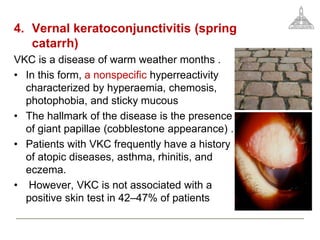
4. Vernal keratoconjunctivitis (spring
catarrh)
VKC is a disease of warm weather months .
• In this form, a nonspecific hyperreactivity
characterized by hyperaemia, chemosis,
photophobia, and sticky mucous
• The hallmark of the disease is the presence
of giant papillae (cobblestone appearance) .
• Patients with VKC frequently have a history
of atopic diseases, asthma, rhinitis, and
eczema.
• However, VKC is not associated with a
positive skin test in 42–47% of patients
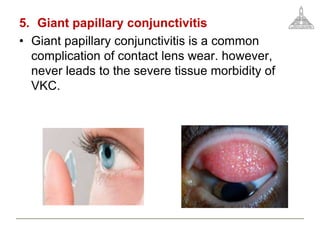
5. Giant papillary conjunctivitis
• Giant papillary conjunctivitis is a common
complication of contact lens wear. however,
never leads to the severe tissue morbidity of
VKC.
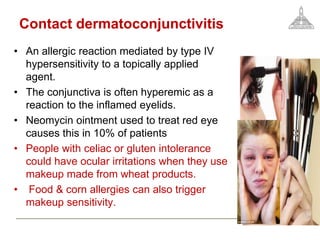
Contact dermatoconjunctivitis
• An allergic reaction mediated by type IV
hypersensitivity to a topically applied
agent.
• The conjunctiva is often hyperemic as a
reaction to the inflamed eyelids.
• Neomycin ointment used to treat red eye
causes this in 10% of patients
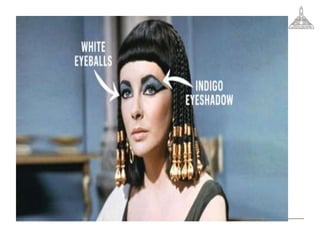
• People with celiac or gluten intolerance
could have ocular irritations when they use
makeup made from wheat products.
• Food & corn allergies can also trigger
makeup sensitivity.
Management of allergic
conjunctivitis
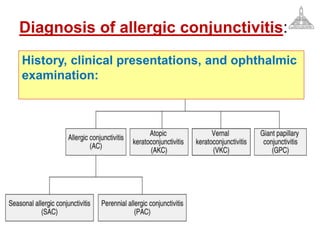
Diagnosis of allergic conjunctivitis:
History, clinical presentations, and ophthalmic
examination:
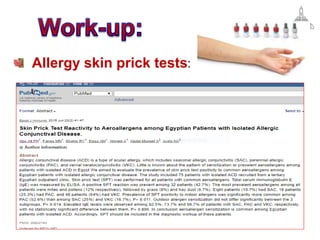
Allergy skin prick tests:
Allergen specific IgE antibody.
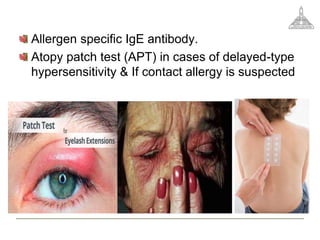
Atopy patch test (APT) in cases of delayed-type
hypersensitivity & If contact allergy is suspected
Tear fluid IgE can be measured.
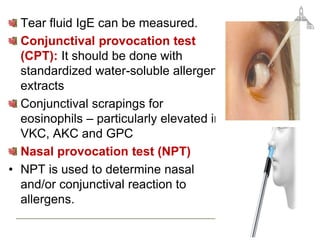
Conjunctival provocation test
(CPT): It should be done with
standardized water-soluble allergen
extracts
Conjunctival scrapings for
eosinophils – particularly elevated in
VKC, AKC and GPC
Nasal provocation test (NPT)
• NPT is used to determine nasal
and/or conjunctival reaction to
allergens.
Treatment of allergic conjunctivitis:
General measures
o Allergen avoidance:
1. House dust mites, Replace carpets with linoleum
or wooden floors, Remove curtains, pets and
stuffed toys from bedroom
o AVOID ALLERGENS IN BEAUTY PRODUCTS;
• Perform a patch test
• Keep the ingredient list short and simple
• Check the expiration date
o Cold compresses
o Stop contact lens wear
o Artificial tears
Pharmacotherapy
1. Vasoconstrictors/antihistamines
2. Mast cell stabilisers
3. Non-steroidal anti-inflammatory drugs
4. Corticosteroids
5. Severe cases :
o short-term treatment with systemic corticosteroids
o calcineurin (Cn) inhibitors, to avoid the serious ocular
side effects of long-term corticosteroid treatment.
o Cn inhibitors are capable of inducing local
immunosuppression. Cn is the target of the
immunosuppressive drugs cyclosporine A (CsA) and,
tacrolimus (Trl),
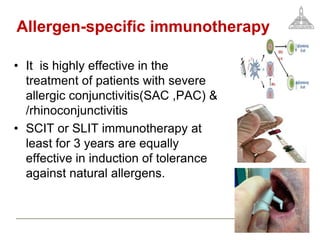
Allergen-specific immunotherapy
• It is highly effective in the
treatment of patients with severe
allergic conjunctivitis(SAC ,PAC) &
/rhinoconjunctivitis
• SCIT or SLIT immunotherapy at
least for 3 years are equally
effective in induction of tolerance
against natural allergens.
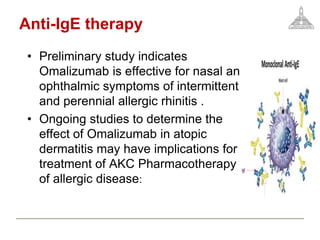
Anti-IgE therapy
• Preliminary study indicates
Omalizumab is effective for nasal and
ophthalmic symptoms of intermittent
and perennial allergic rhinitis .
• Ongoing studies to determine the
effect of Omalizumab in atopic
dermatitis may have implications for
treatment of AKC Pharmacotherapy
of allergic disease:
• Ocular allergy is one of the most common
conditions encountered by allergists and
ophthalmologists.
• Forms of ocular allergy are: seasonal allergic
conjunctivitis, perennial allergic conjunctivitis, vernal
keratoconjunctivitis, atopic keratocongiuntivitis, giant
papillary conjunctivitis and contact allergy,.
• they are mediated by Type I and type 4 hypersensitivity
mechanism .
• An understanding of the immunologic mechanisms, and
clinical features may be useful to both allergist and
ophthalmologists to recognize the proper integrated
management for such patients.
Take home message:
• References
• Ono SJ, Abelson MB. Allergic conjunctivitis update on pathophysiology and prospects for future
treatment. J Allergy Clin Immunol. 2005 Jan;115(1):118-22.
• Rosario N, Bielory L. Epidemiology of allergic conjunctivitis. Curr Opin Allergy Clin Immunol. 2011
Oct;11(5):471-6.
• 3. Kabat A, Sowka J. New blepharitis treatments: a decade ago, we looked at the latest treatment
options for blepharitis. It’s high time we eye them up again. Rev Optom 2014;152(10):80-1Pitt AD,
Smith AF, Lindsell L, et al. Economic and quality of-life impact of seasonal allergic conjunctivitis in
Oxfordshire. Ophthalmic Epidemiol. 2004 Feb;11(1):17-33.
• Abo-Ali FH1, Farres MN1, Shahin RY1, Eissa AM1, Ahmed A1, Abdel-Monsef A2, Arafa NA3. Skin
Prick Test Reactivity to Aeroallergens among Egyptian Patients with Isolated Allergic Conjunctival
Disease.Egypt J Immunol. 2015 Jun;22(2):41-47.
• Leonardi A, Motterle L, Bortolotti M. Allergy and the eye. Clin Exp Immunol. 2008 Sep;153(s1):17-
21.
• Rubenstein JB, Tannan A. Allergic conjunctivitis. In: Yanoff M, Duker JS, eds. Ophthalmology. 4th
ed. Philadelphia, PA: Elsevier Saunders; 2014:chap 4.7.
• Stock EL, Meisler DM. Vernal keratoconjunctivitis. In: Tasman W, Jaeger EA, eds. Duane's
Ophthalmology. Philadelphia, PA: Lippincott Williams & Wilkins; 2013:vol 4;chap 9.
• Mishra GP, Tamboli V, Jwala J, Mitra AK. Recent patents and emerging therapeutics in the
treatment of allergic conjunctivitis. Recent Pat Inflamm Allergey Drug Discov. 2011 Jan;5(1):26-
36.
• Reyes NJ, Mayhew E, Chen PW, Niederkorn JY. T cells are required for the maximal expression
of allergic conjunctivi tis. Invest Ophthalmol Vis Sci. 2011 Apr 6;52(5):2211-16.
• Mantelli F, Lambiase A, Bonini S. A simple and rapid diagnostic algorithm for the detection of
ocular allergic diseases. Curr Opin Allergy Clin Immunol. 2009 Oct;9(5):471-6.
Ocular allergy

Ocular allergy

  • 1.
    Fawzia Abo ali Prof.of Medicine, Allergy &Immunology Ain Shams Faculty of Medicine Allergic conjunctivitis
  • 2.
    • Approximately one-thirdof the population is affected by some form of allergic disease, about 40% of them report ocular symptoms. • Allergic eye diseases affect the ocular surface, including the cornea, conjunctiva (>80%), and eyelid. • IgE- and/or T-cell-mediated .
  • 3.
    1- seasonal allergic conjunctivitis (SAC) 2-Perennialallergic conjunctivitis (PAC 3-atopic keratoconjunctivitis (AKC) 4-giant papillary conjunctivitis (GPC) 5-vernal keratoconjunc tivitis (VKC) 5 types of allergic conjunctivitis immediate (IgE mediated) delayed (cell mediated
  • 4.
    Percentage of patientswith a specific ocular allergy : Kabat A and Sowka J. Rev Optom 2014;152(10):80-1
  • 5.
    1. Seasonal and2.perennial allergic conjunctivitis acute simple conjunctivitis Typical symptoms include: Itching, redness, burning,& watery discharge • symptoms in spring, or summer • Seasonal allergens as plant pollens • (hay fever ). • occurs all year round (PAC) • perennial allergens as house dust mite, animal dander and moulds
  • 6.
    3. Atopic keratoconjunctivitis •(AKC) is a chronic, allergic ocular disease that occurs most often in patients with a history of atopic dermatitis (AD) ocular form. • Hypersensitivity reactions associated with types I and IV contribute to the inflammatory changes of the conjunctiva and the cornea .
  • 7.
    4. Vernal keratoconjunctivitis(spring catarrh) VKC is a disease of warm weather months . • In this form, a nonspecific hyperreactivity characterized by hyperaemia, chemosis, photophobia, and sticky mucous • The hallmark of the disease is the presence of giant papillae (cobblestone appearance) . • Patients with VKC frequently have a history of atopic diseases, asthma, rhinitis, and eczema. • However, VKC is not associated with a positive skin test in 42–47% of patients
  • 8.
    5. Giant papillaryconjunctivitis • Giant papillary conjunctivitis is a common complication of contact lens wear. however, never leads to the severe tissue morbidity of VKC.
  • 9.
    Contact dermatoconjunctivitis • Anallergic reaction mediated by type IV hypersensitivity to a topically applied agent. • The conjunctiva is often hyperemic as a reaction to the inflamed eyelids. • Neomycin ointment used to treat red eye causes this in 10% of patients • People with celiac or gluten intolerance could have ocular irritations when they use makeup made from wheat products. • Food & corn allergies can also trigger makeup sensitivity.
  • 11.
  • 12.
    Diagnosis of allergicconjunctivitis: History, clinical presentations, and ophthalmic examination:
  • 13.
  • 14.
    Allergen specific IgEantibody. Atopy patch test (APT) in cases of delayed-type hypersensitivity & If contact allergy is suspected
  • 15.
    Tear fluid IgEcan be measured. Conjunctival provocation test (CPT): It should be done with standardized water-soluble allergen extracts Conjunctival scrapings for eosinophils – particularly elevated in VKC, AKC and GPC Nasal provocation test (NPT) • NPT is used to determine nasal and/or conjunctival reaction to allergens.
  • 16.
    Treatment of allergicconjunctivitis: General measures o Allergen avoidance: 1. House dust mites, Replace carpets with linoleum or wooden floors, Remove curtains, pets and stuffed toys from bedroom o AVOID ALLERGENS IN BEAUTY PRODUCTS; • Perform a patch test • Keep the ingredient list short and simple • Check the expiration date o Cold compresses o Stop contact lens wear o Artificial tears
  • 17.
    Pharmacotherapy 1. Vasoconstrictors/antihistamines 2. Mastcell stabilisers 3. Non-steroidal anti-inflammatory drugs 4. Corticosteroids 5. Severe cases : o short-term treatment with systemic corticosteroids o calcineurin (Cn) inhibitors, to avoid the serious ocular side effects of long-term corticosteroid treatment. o Cn inhibitors are capable of inducing local immunosuppression. Cn is the target of the immunosuppressive drugs cyclosporine A (CsA) and, tacrolimus (Trl),
  • 18.
    Allergen-specific immunotherapy • Itis highly effective in the treatment of patients with severe allergic conjunctivitis(SAC ,PAC) & /rhinoconjunctivitis • SCIT or SLIT immunotherapy at least for 3 years are equally effective in induction of tolerance against natural allergens.
  • 19.
    Anti-IgE therapy • Preliminarystudy indicates Omalizumab is effective for nasal and ophthalmic symptoms of intermittent and perennial allergic rhinitis . • Ongoing studies to determine the effect of Omalizumab in atopic dermatitis may have implications for treatment of AKC Pharmacotherapy of allergic disease:
  • 21.
    • Ocular allergyis one of the most common conditions encountered by allergists and ophthalmologists. • Forms of ocular allergy are: seasonal allergic conjunctivitis, perennial allergic conjunctivitis, vernal keratoconjunctivitis, atopic keratocongiuntivitis, giant papillary conjunctivitis and contact allergy,. • they are mediated by Type I and type 4 hypersensitivity mechanism . • An understanding of the immunologic mechanisms, and clinical features may be useful to both allergist and ophthalmologists to recognize the proper integrated management for such patients. Take home message:
  • 22.
    • References • OnoSJ, Abelson MB. Allergic conjunctivitis update on pathophysiology and prospects for future treatment. J Allergy Clin Immunol. 2005 Jan;115(1):118-22. • Rosario N, Bielory L. Epidemiology of allergic conjunctivitis. Curr Opin Allergy Clin Immunol. 2011 Oct;11(5):471-6. • 3. Kabat A, Sowka J. New blepharitis treatments: a decade ago, we looked at the latest treatment options for blepharitis. It’s high time we eye them up again. Rev Optom 2014;152(10):80-1Pitt AD, Smith AF, Lindsell L, et al. Economic and quality of-life impact of seasonal allergic conjunctivitis in Oxfordshire. Ophthalmic Epidemiol. 2004 Feb;11(1):17-33. • Abo-Ali FH1, Farres MN1, Shahin RY1, Eissa AM1, Ahmed A1, Abdel-Monsef A2, Arafa NA3. Skin Prick Test Reactivity to Aeroallergens among Egyptian Patients with Isolated Allergic Conjunctival Disease.Egypt J Immunol. 2015 Jun;22(2):41-47. • Leonardi A, Motterle L, Bortolotti M. Allergy and the eye. Clin Exp Immunol. 2008 Sep;153(s1):17- 21. • Rubenstein JB, Tannan A. Allergic conjunctivitis. In: Yanoff M, Duker JS, eds. Ophthalmology. 4th ed. Philadelphia, PA: Elsevier Saunders; 2014:chap 4.7. • Stock EL, Meisler DM. Vernal keratoconjunctivitis. In: Tasman W, Jaeger EA, eds. Duane's Ophthalmology. Philadelphia, PA: Lippincott Williams & Wilkins; 2013:vol 4;chap 9. • Mishra GP, Tamboli V, Jwala J, Mitra AK. Recent patents and emerging therapeutics in the treatment of allergic conjunctivitis. Recent Pat Inflamm Allergey Drug Discov. 2011 Jan;5(1):26- 36. • Reyes NJ, Mayhew E, Chen PW, Niederkorn JY. T cells are required for the maximal expression of allergic conjunctivi tis. Invest Ophthalmol Vis Sci. 2011 Apr 6;52(5):2211-16. • Mantelli F, Lambiase A, Bonini S. A simple and rapid diagnostic algorithm for the detection of ocular allergic diseases. Curr Opin Allergy Clin Immunol. 2009 Oct;9(5):471-6.