
Asthma & diabetesAsthma & diabetes
Fawzia Abo Ali
Prof. of allergy and immunology
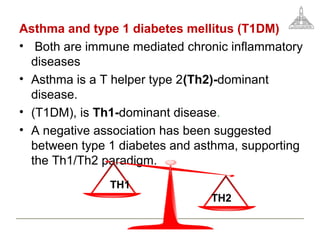
Asthma and type 1 diabetes mellitus (T1DM)
• Both are immune mediated chronic inflammatory
diseases
• Asthma is a T helper type 2(Th2)-dominant
disease.
• (T1DM), is Th1-dominant disease.
• A negative association has been suggested
between type 1 diabetes and asthma, supporting
the Th1/Th2 paradigm.
TH1
TH2
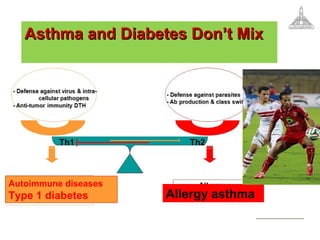
Autoimmune diseases
Type 1 diabetes Allergy asthma
Asthma and Diabetes Don’t MixAsthma and Diabetes Don’t Mix
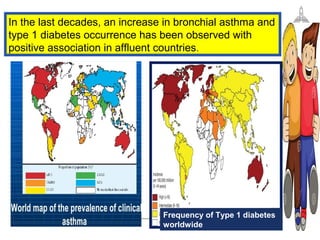
Frequency of Type 1 diabetes
worldwide
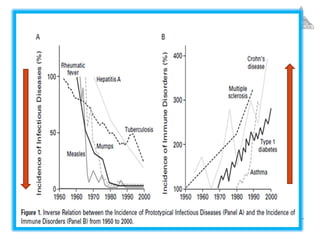
In the last decades, an increase in bronchial asthma and
type 1 diabetes occurrence has been observed with
positive association in affluent countries.
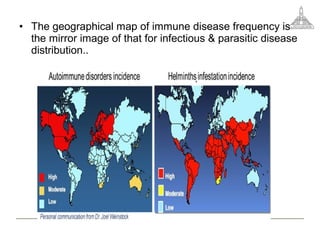
• The geographical map of immune disease frequency is
the mirror image of that for infectious & parasitic disease
distribution..
,
,
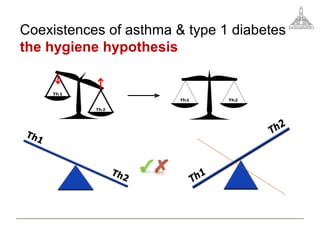
Coexistences of asthma & type 1 diabetes
the hygiene hypothesis
• when environmental stimulation is
reduced, and where genetic
predisposition exists, a dysfunctional
Th2 bias will persist and predispose
to atopic disorders.
• A failure of immune regulation
associated with loss of the traditional
educators of the immune system
could thus result in a parallel
increase in immune deviation at both
ends of the Th1/Th2 spectrum .
• The development of strong immune responses
against antigens from infectious agents could
inhibit responses to ‘weak’ antigens such as
autoantigens and allergens.
• Antigen competion for cytokines necessary for
immune balance
• Some of the molecules known to play an important
role are IL-2, IL-7, and IL-15.
• development of non-Th2 asthma due to infection-
related elements, genetics and oxidative stress, and
the development of neutrophilic inflammation.
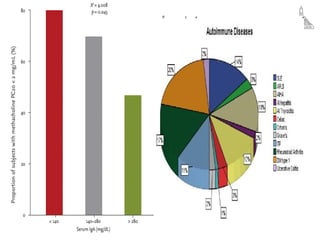
2. Selective IgA deficiency (sIgAD)
• It has been postulated that secretory IgA plays a
protective role against allergic disorders as well
by eliminating allergens at the mucosal level.
• Autoimmune disorders including type 1 diabetes
mellitus (T1DM) occur more frequently in
patients with sIgAD, with an estimated
prevalence of 7%– 36% .
• Loss of protective iga allow external and internal
antigen to invade the host
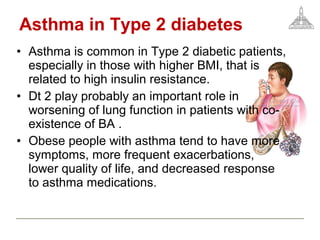
Asthma in Type 2 diabetes
• Asthma is common in Type 2 diabetic patients,
especially in those with higher BMI, that is
related to high insulin resistance.
• Dt 2 play probably an important role in
worsening of lung function in patients with co-
existence of BA .
• Obese people with asthma tend to have more
symptoms, more frequent exacerbations,
lower quality of life, and decreased response
to asthma medications.
• Independent of obesity, subjects with
diabetes may be at higher risk of asthma.
Similarly, insulin resistance and the
metabolic syndrome have been associated
to lower lung function
• insulin resistance may be involved in the
airway smooth muscle hypercontractility .
• Patients with type 2 diabetes had
significantly lower spirometric
values for the same patients .
Type 2 diabetes in asthma
• Patients with pre-existing asthma have a higher risk of
developing subsequent type 2 diabetes than those
without.
• Possible mechanisms include:
• genetic pleiotropy
• lung-related inflammatory cytokines and their effects on
insulin sensitivity,
• direct effects of hypoxia on glucose metabolism.
• Obesity is a major risk factor for diabetes, and it is also
associated with higher risk of asthma.
• Steroids and antiasthma drugs
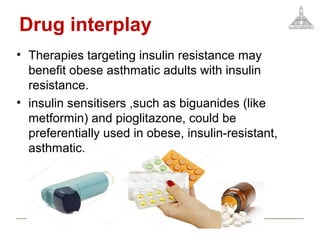
Drug interplay
• Therapies targeting insulin resistance may
benefit obese asthmatic adults with insulin
resistance.
• insulin sensitisers ,such as biguanides (like
metformin) and pioglitazone, could be
preferentially used in obese, insulin-resistant,
asthmatic.
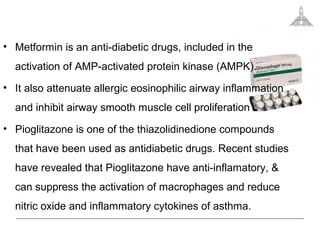
• Metformin is an anti-diabetic drugs, included in the
activation of AMP-activated protein kinase (AMPK).
• It also attenuate allergic eosinophilic airway inflammation
and inhibit airway smooth muscle cell proliferation .
• Pioglitazone is one of the thiazolidinedione compounds
that have been used as antidiabetic drugs. Recent studies
have revealed that Pioglitazone have anti-inflamatory, &
can suppress the activation of macrophages and reduce
nitric oxide and inflammatory cytokines of asthma.
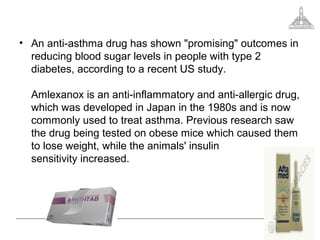
• An anti-asthma drug has shown "promising" outcomes in
reducing blood sugar levels in people with type 2
diabetes, according to a recent US study.
Amlexanox is an anti-inflammatory and anti-allergic drug,
which was developed in Japan in the 1980s and is now
commonly used to treat asthma. Previous research saw
the drug being tested on obese mice which caused them
to lose weight, while the animals' insulin
sensitivity increased.
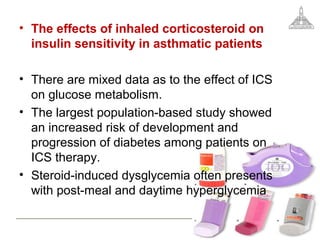
• The effects of inhaled corticosteroid on
insulin sensitivity in asthmatic patients
• There are mixed data as to the effect of ICS
on glucose metabolism.
• The largest population-based study showed
an increased risk of development and
progression of diabetes among patients on
ICS therapy.
• Steroid-induced dysglycemia often presents
with post-meal and daytime hyperglycemia
Take home message
Asthma and type 1 diabetes mellitus are common
immune mediated chronic inflammatory diseases,
believed for long to be divergent due to th1 & th2
contrary.
Altered ecological factors is associated with fast growing
conjoint prevalence of both diseases.
Loss of traditional immune educators is responsible for
alteration of TH paradigm resulting in growing
prevalence of both allergy and autoimmune diseases.
Immune deficiency is a major cause of coexistence of
allergy and autoimmunity.
Type 2 diabetes and asthma are common association
due to mutual risk factors,they may share some drugs in
the near future.
An unanswered question remains about is it wise to
eradicate infections & keep the earth clean????? To
suffer allergy & autoimmunity.
• References
1. Metsala J, Lundqvist A, Virta LJ, et al. The association between asthma and type 1 diabetes: a
paediatric case-cohort study in Finland, years 1981-2009 [published online December 2,
2017]. Int J Epidemiol.
2. Cardwell CR, Shields MD, Carson DJ, et al. A meta-analysis of the association between
childhood type 1 diabetes and atopic disease. Diabetes Care 2003; 26:2568–2574.
3. Cakir M, Akcay S, Karakas T, et al. Prevalence of atopy in children with type 1 diabetes mellitus,
hepatitis B virus carriers, and healthy children: role of T helper 1 (Th1)-type immune
response. Allergy Asthma Proc 2008; 29:166–170. 7.
4. Tzeng ST, Hsu SG, Fu LS, et al. Prevalence of atopy in children with type 1 diabetes mellitus in
central Taiwan. J Microbiol Immunol Infect 2007; 40:74–78.
5. Stene LC, Nafstad P. Relation between occurrence of type I diabetes and asthma. Lancet 2001;
357:607–608.
6. Alves C, Diniz AB, Souza MB, et al. Controversies in the association between type 1 diabetes
and asthma. Arq Bras Endocrinol Metabol 2007; 51:930–937.
7. Tedeschi A, Airaghi L. Common risk factors in type 1 diabetes and asthma. Lancet 2001;
357:1622.
8. Marianna R, Olga B, Tzvi B, et al. TH1/TH2 cytokine balance in patient with both type 1 diabetes
mellitus and asthma. Cytokine 2006; 34:170–176.
9. Stanescu DE, Lord K, Lipman TH. The epidemiology of type 1 diabetes in children. Endocrinol
Metab Clin North Am 2012; 41:679–694.
10. Maahs DM, West NA, Lawrence JM, et al. Epidemiology of type 1 diabetes. Endocrinol Metab
Clin North Am 2010; 39:481–497
11. Black MH, Anderson A, Bell RA, et al. Prevalence of asthma and its association with glycemic
control among youth with diabetes. Pediatrics 2011; 128:e839–e847.
12. Walter RE, Beiser A, Givelber RJ, et al. Association between glycemic state and lung function:
the Framingham Heart Study. Am J Respir Crit Care Med 2003; 167:911–916.
Asthma and diabetes

Asthma and diabetes

  • 1.
    Asthma & diabetesAsthma& diabetes Fawzia Abo Ali Prof. of allergy and immunology
  • 2.
    Asthma and type1 diabetes mellitus (T1DM) • Both are immune mediated chronic inflammatory diseases • Asthma is a T helper type 2(Th2)-dominant disease. • (T1DM), is Th1-dominant disease. • A negative association has been suggested between type 1 diabetes and asthma, supporting the Th1/Th2 paradigm. TH1 TH2
  • 3.
    Autoimmune diseases Type 1diabetes Allergy asthma Asthma and Diabetes Don’t MixAsthma and Diabetes Don’t Mix
  • 4.
    Frequency of Type1 diabetes worldwide In the last decades, an increase in bronchial asthma and type 1 diabetes occurrence has been observed with positive association in affluent countries.
  • 5.
    • The geographicalmap of immune disease frequency is the mirror image of that for infectious & parasitic disease distribution.. , ,
  • 7.
    Coexistences of asthma& type 1 diabetes the hygiene hypothesis
  • 8.
    • when environmentalstimulation is reduced, and where genetic predisposition exists, a dysfunctional Th2 bias will persist and predispose to atopic disorders. • A failure of immune regulation associated with loss of the traditional educators of the immune system could thus result in a parallel increase in immune deviation at both ends of the Th1/Th2 spectrum .
  • 9.
    • The developmentof strong immune responses against antigens from infectious agents could inhibit responses to ‘weak’ antigens such as autoantigens and allergens. • Antigen competion for cytokines necessary for immune balance • Some of the molecules known to play an important role are IL-2, IL-7, and IL-15. • development of non-Th2 asthma due to infection- related elements, genetics and oxidative stress, and the development of neutrophilic inflammation.
  • 10.
    2. Selective IgAdeficiency (sIgAD) • It has been postulated that secretory IgA plays a protective role against allergic disorders as well by eliminating allergens at the mucosal level. • Autoimmune disorders including type 1 diabetes mellitus (T1DM) occur more frequently in patients with sIgAD, with an estimated prevalence of 7%– 36% . • Loss of protective iga allow external and internal antigen to invade the host
  • 12.
    Asthma in Type2 diabetes • Asthma is common in Type 2 diabetic patients, especially in those with higher BMI, that is related to high insulin resistance. • Dt 2 play probably an important role in worsening of lung function in patients with co- existence of BA . • Obese people with asthma tend to have more symptoms, more frequent exacerbations, lower quality of life, and decreased response to asthma medications.
  • 13.
    • Independent ofobesity, subjects with diabetes may be at higher risk of asthma. Similarly, insulin resistance and the metabolic syndrome have been associated to lower lung function • insulin resistance may be involved in the airway smooth muscle hypercontractility . • Patients with type 2 diabetes had significantly lower spirometric values for the same patients .
  • 14.
    Type 2 diabetesin asthma • Patients with pre-existing asthma have a higher risk of developing subsequent type 2 diabetes than those without. • Possible mechanisms include: • genetic pleiotropy • lung-related inflammatory cytokines and their effects on insulin sensitivity, • direct effects of hypoxia on glucose metabolism. • Obesity is a major risk factor for diabetes, and it is also associated with higher risk of asthma. • Steroids and antiasthma drugs
  • 15.
    Drug interplay • Therapiestargeting insulin resistance may benefit obese asthmatic adults with insulin resistance. • insulin sensitisers ,such as biguanides (like metformin) and pioglitazone, could be preferentially used in obese, insulin-resistant, asthmatic.
  • 16.
    • Metformin isan anti-diabetic drugs, included in the activation of AMP-activated protein kinase (AMPK). • It also attenuate allergic eosinophilic airway inflammation and inhibit airway smooth muscle cell proliferation . • Pioglitazone is one of the thiazolidinedione compounds that have been used as antidiabetic drugs. Recent studies have revealed that Pioglitazone have anti-inflamatory, & can suppress the activation of macrophages and reduce nitric oxide and inflammatory cytokines of asthma.
  • 17.
    • An anti-asthmadrug has shown "promising" outcomes in reducing blood sugar levels in people with type 2 diabetes, according to a recent US study. Amlexanox is an anti-inflammatory and anti-allergic drug, which was developed in Japan in the 1980s and is now commonly used to treat asthma. Previous research saw the drug being tested on obese mice which caused them to lose weight, while the animals' insulin sensitivity increased.
  • 18.
    • The effectsof inhaled corticosteroid on insulin sensitivity in asthmatic patients • There are mixed data as to the effect of ICS on glucose metabolism. • The largest population-based study showed an increased risk of development and progression of diabetes among patients on ICS therapy. • Steroid-induced dysglycemia often presents with post-meal and daytime hyperglycemia
  • 19.
    Take home message Asthmaand type 1 diabetes mellitus are common immune mediated chronic inflammatory diseases, believed for long to be divergent due to th1 & th2 contrary. Altered ecological factors is associated with fast growing conjoint prevalence of both diseases. Loss of traditional immune educators is responsible for alteration of TH paradigm resulting in growing prevalence of both allergy and autoimmune diseases.
  • 20.
    Immune deficiency isa major cause of coexistence of allergy and autoimmunity. Type 2 diabetes and asthma are common association due to mutual risk factors,they may share some drugs in the near future. An unanswered question remains about is it wise to eradicate infections & keep the earth clean????? To suffer allergy & autoimmunity.
  • 21.
    • References 1. MetsalaJ, Lundqvist A, Virta LJ, et al. The association between asthma and type 1 diabetes: a paediatric case-cohort study in Finland, years 1981-2009 [published online December 2, 2017]. Int J Epidemiol. 2. Cardwell CR, Shields MD, Carson DJ, et al. A meta-analysis of the association between childhood type 1 diabetes and atopic disease. Diabetes Care 2003; 26:2568–2574. 3. Cakir M, Akcay S, Karakas T, et al. Prevalence of atopy in children with type 1 diabetes mellitus, hepatitis B virus carriers, and healthy children: role of T helper 1 (Th1)-type immune response. Allergy Asthma Proc 2008; 29:166–170. 7. 4. Tzeng ST, Hsu SG, Fu LS, et al. Prevalence of atopy in children with type 1 diabetes mellitus in central Taiwan. J Microbiol Immunol Infect 2007; 40:74–78. 5. Stene LC, Nafstad P. Relation between occurrence of type I diabetes and asthma. Lancet 2001; 357:607–608. 6. Alves C, Diniz AB, Souza MB, et al. Controversies in the association between type 1 diabetes and asthma. Arq Bras Endocrinol Metabol 2007; 51:930–937. 7. Tedeschi A, Airaghi L. Common risk factors in type 1 diabetes and asthma. Lancet 2001; 357:1622. 8. Marianna R, Olga B, Tzvi B, et al. TH1/TH2 cytokine balance in patient with both type 1 diabetes mellitus and asthma. Cytokine 2006; 34:170–176. 9. Stanescu DE, Lord K, Lipman TH. The epidemiology of type 1 diabetes in children. Endocrinol Metab Clin North Am 2012; 41:679–694. 10. Maahs DM, West NA, Lawrence JM, et al. Epidemiology of type 1 diabetes. Endocrinol Metab Clin North Am 2010; 39:481–497 11. Black MH, Anderson A, Bell RA, et al. Prevalence of asthma and its association with glycemic control among youth with diabetes. Pediatrics 2011; 128:e839–e847. 12. Walter RE, Beiser A, Givelber RJ, et al. Association between glycemic state and lung function: the Framingham Heart Study. Am J Respir Crit Care Med 2003; 167:911–916.