MYOPIA
Presenter : Dr. Gajanan kondawar
1
MYOPIA
• Short sightedness
• Myopia is a greek word meaning *close the
eye*
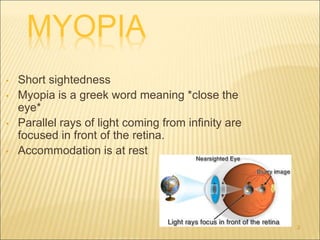
• Parallel rays of light coming from infinity are
focused in front of the retina.
• Accommodation is at rest
2
 Mechanism of production
 Axial – increase anteroposterior length
 Curvatural – increase corneal curvature
 Positional – anterior placement of lens
 Index – increase nuclear sclerosis
 Myopia due to excessive accommodation
3
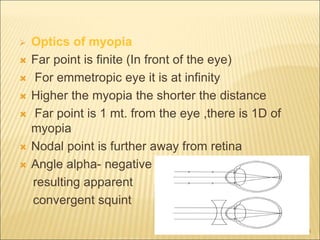
 Optics of myopia
 Far point is finite (In front of the eye)
 For emmetropic eye it is at infinity
 Higher the myopia the shorter the distance
 Far point is 1 mt. from the eye ,there is 1D of
myopia
 Nodal point is further away from retina
 Angle alpha- negative
resulting apparent
convergent squint
4
TYPES OF CLASSIFICATION
 Clinical Classification
 Degree of Myopia
 Age of Onset
5
CLINICAL CLASSIFICATION
 Congenital Myopia
 Simple Myopia
 Degenerative Myopia
 Nocturnal Myopia- insufficient contrast for an adequate
accommodative stimulus, the eye assumes the
intermediate dark focus accommodative position rather
than focusing for infinity.
 Pseudo Myopia- overstimulation of the eye's
accommodative mechanism or ciliary spasm
 Induced Myopia- exposure to various pharmaceutical
agents, variation in blood sugar levels, nuclear sclerosis
6
DEGREE OF MYOPIA
 Low Myopia(<3D)
 Medium Myopia(3-6D)
 High Myopia(>6D)
7
AGE OF ONSET
 Congenital Myopia (present at birth an
persisting through infancy)
 Youth-Onset Myopia(<20 yrs of age)
 Early Adult-Onset Myopia(20-40 yrs of age)
 Late Adult-Onset Myopia(>40 yrs of age)
8
Congenital myopia
Frequently seen in
-Premature babies
-Marfan’s syndrome
-Homocystinuria
 Increase in axial length
 Increase in Overall globe size
 Since birth, diagnosed at age 2-3 years
 If unilateral, as anisometropia, may develop
amblyopia, strabismus
 Usually 8-10 D, remain constant
 Bilateral- difficulty in distant vision, hold things very
close
9
 Associated conditions
 Convergent squint
 Cataract
 Microphthalmos
 Aniridia
 Megalocornea
Management
 Early Correction is desirable
 Retinoscopy under full cycloplegia
 Early full correction desirable
 Poor prognosis
10
 Simple / developmental myopia
 Physiological error not associated with any disease
of the eye
 Etiology :
 Normal biological variation in development of eye
 Inherited –
 Studies have shown a
 33-60 percent prevalence of myopia both parent have
myopia.
 the prevalence was 23-40 percent- one parent
 neither parent has myopia, only 6-15 percent of the
children were myopic.
11
 Associated factors
 Role of diet- (without any conclusive result)
 excessive near work- Some studies have
found the prevalence of myopia increases
with income level and educational attainment,
and it is higher among persons who work in
occupations requiring a great deal of near
work.
 A slightly higher prevalence of myopia in
females than in males.
12
 Clinical picture
 Rarely present at birth
 Rather born hypermetropic, become myopic
 Begins at 7-10 years, stabilizing around mid
teens
 Usually around 5D, never exceeds 8D
13
 Symptoms
 Poor vision for distance, stenopaeic vision.
 Asthenopic symptoms develop due to dissociation
between accommodation and convergence
 Convergence weakness, exophoria, suppression
 Excessive accommodation inducing ciliary spasm
and artificially increasing the amount of myopia
14
 Signs
 Large and prominent globe
 Deep AC
 Large, sluggishly reacting pupils
 Normal fundus, rarely crescent
 Usually doesn't exceed 6-8D
 Retinoscopy under full cycloplegia
15
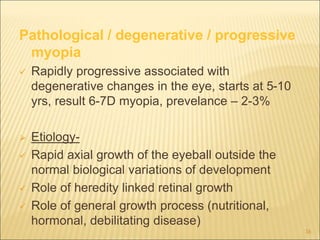
Pathological / degenerative / progressive
myopia
 Rapidly progressive associated with
degenerative changes in the eye, starts at 5-10
yrs, result 6-7D myopia, prevelance – 2-3%
 Etiology-
 Rapid axial growth of the eyeball outside the
normal biological variations of development
 Role of heredity linked retinal growth
 Role of general growth process (nutritional,
hormonal, debilitating disease)
16
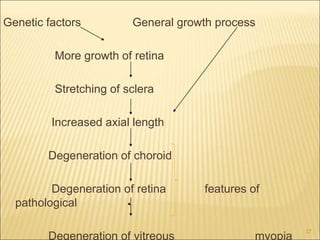
Genetic factors General growth process
More growth of retina
Stretching of sclera
Increased axial length
Degeneration of choroid
Degeneration of retina features of
pathological
Degeneration of vitreous myopia
17
 Symptoms
 Defective vision
 Muscae volitantes / floating black opacities
 Night blindness – marked chorioretinal
changes
18
 Signs
 Eye large, prominent eyes simulating
exophthalmos
 Cornea large
 AC deep
 Lens show opacities at the posterior pole due to
aberration of lenticular metabolism and due to
overstretching.
19
 Vitreous degeneration,viterous
liquefication,vitreous detachment present as
Weiss reflux
 Sclera thinning resulting in formation of post.
staphyloma
 Visual field defects show Contraction and ring
scotomas are present
20
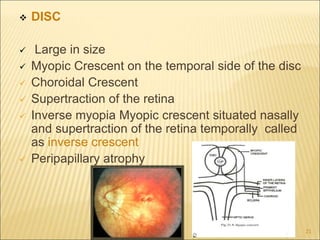
 DISC
 Large in size
 Myopic Crescent on the temporal side of the disc
 Choroidal Crescent
 Supertraction of the retina
 Inverse myopia Myopic crescent situated nasally
and supertraction of the retina temporally called
as inverse crescent
 Peripapillary atrophy
21
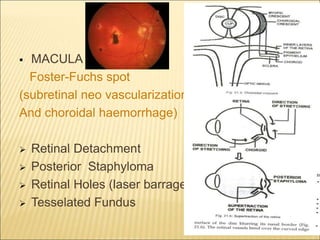
 MACULA
Foster-Fuchs spot
(subretinal neo vascularization,
And choroidal haemorrhage)
 Retinal Detachment
 Posterior Staphyloma
 Retinal Holes (laser barrage)
 Tesselated Fundus
22
23
Complications-
Retinal tear and detachment
Complicated cataract
Vitreous haemorrhage
Choroidal haemorrhage
POAG
Treatment
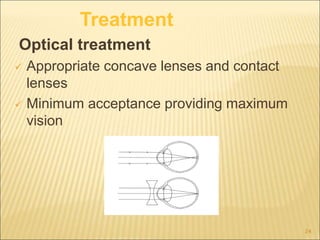
Optical treatment
 Appropriate concave lenses and contact
lenses
 Minimum acceptance providing maximum
vision
24
GUIDELINES
LOW TO MODERATE DEGREES OF MYOPIA (UP TO -6D)
 IN YOUNG SUBJECTS
Defect should never be overcorrected and advised for
constant use to avoid squinting and develop a normal
accommodation-convergence reflex
 IN ADULTS
Receiving spectacle for the first time,have the ciliary
muscle that are unaccostomed to accommodate
efficiently so that lens of slightly lower power is
prescribed with which the patient has comfortable near
vision.
25
FOR HIGH MYOPIA
DISPENSING SPECTACLES IN HIGH
MYOPIA
 High index lens materials
 Lighter lens materials
 Reduced eyesize of selected frames
26
• Full correction is given irrespective of age
along with duochrom balanced.
27
Atropine— Recent well-designed studies using topical atropine
(myopin 0.01%), a non-selective muscarinic antagonist, have
demonstrated statistically and clinically significant reductions in the
progression of myopia. Although atropine is used in many countries in
Asia for slowing the progression of myopia, it is rarely used in the
United States for this purpose.
The side effects associated with atropine (e.g. photophobia,
cycloplegia) are considered by many clinicians to be unacceptable for
long-term therapy.
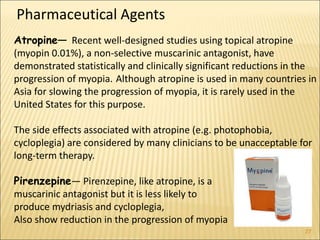
Pirenzepine— Pirenzepine, like atropine, is a
muscarinic antagonist but it is less likely to
produce mydriasis and cycloplegia,
Also show reduction in the progression of myopia
Pharmaceutical Agents
28
Several large studies conducted in different parts of the
world have reported that the prevalence of myopia in
children with more outdoor activity hours is lower than in
children with fewer hours.
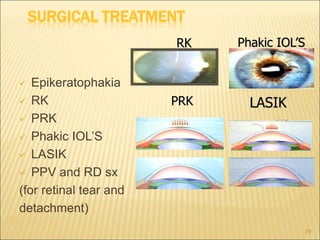
SURGICAL TREATMENT
 Epikeratophakia
 RK
 PRK
 Phakic IOL’S
 LASIK
 PPV and RD sx
(for retinal tear and
detachment)
29
LASIK
PRK
RK Phakic IOL’S
PHOTOREFRACTIVE KERATECTOMY (PRK)
 Involves direct laser ablation of corneal stroma after
removal of corneal epithelium mechanically or
using a laser beam.
 Done using Excimer laser
 MUNNERLYN EQN: depth of ablation
(micrometer)=[diameter of optical zone(mm)]² ×
1/3power(Diopter)
 For myopic a large amount of ablation is done in
central cornea than in the periphery.
 Give good results for -2D to -6D of myopia
30
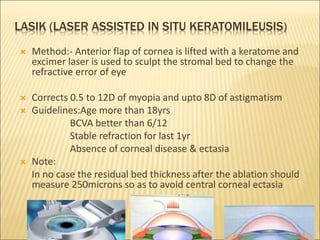
LASIK (LASER ASSISTED IN SITU KERATOMILEUSIS)
 Method:- Anterior flap of cornea is lifted with a keratome and
excimer laser is used to sculpt the stromal bed to change the
refractive error of eye
 Corrects 0.5 to 12D of myopia and upto 8D of astigmatism
 Guidelines:Age more than 18yrs
BCVA better than 6/12
Stable refraction for last 1yr
Absence of corneal disease & ectasia
 Note:
In no case the residual bed thickness after the ablation should
measure 250microns so as to avoid central corneal ectasia
31
LASEK (LASER SUBEPITHELIAL KERATOMILEUSIS)
 Indications:
 Low myopia
 Irregular astigmatism
 LASIK complications in contralateral eye
 Thin corneal pachymetry
 Predisposition to trauma
 Glaucoma suspect
32
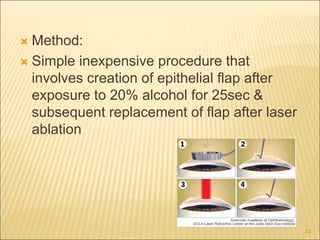
 Method:
 Simple inexpensive procedure that
involves creation of epithelial flap after
exposure to 20% alcohol for 25sec &
subsequent replacement of flap after laser
ablation
33
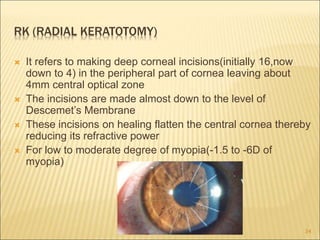
RK (RADIAL KERATOTOMY)
 It refers to making deep corneal incisions(initially 16,now
down to 4) in the peripheral part of cornea leaving about
4mm central optical zone
 The incisions are made almost down to the level of
Descemet’s Membrane
 These incisions on healing flatten the central cornea thereby
reducing its refractive power
 For low to moderate degree of myopia(-1.5 to -6D of
myopia)
34
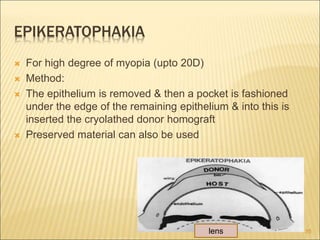
EPIKERATOPHAKIA
 For high degree of myopia (upto 20D)
 Method:
 The epithelium is removed & then a pocket is fashioned
under the edge of the remaining epithelium & into this is
inserted the cryolathed donor homograft
 Preserved material can also be used
35
lens
NON CORNEAL INTERVENTIONS
(A) REMOVAL OF CLEAR LENS
 We know that an aphakic eye is strongly hypermetropic
 If an eye with an axial myopia of -24D is deprived of its lens
it will become emmetropic without any correcting lens.
36
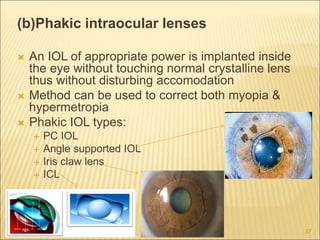
(b)Phakic intraocular lenses
 An IOL of appropriate power is implanted inside
the eye without touching normal crystalline lens
thus without disturbing accomodation
 Method can be used to correct both myopia &
hypermetropia
 Phakic IOL types:
 PC IOL
 Angle supported IOL
 Iris claw lens
 ICL
37
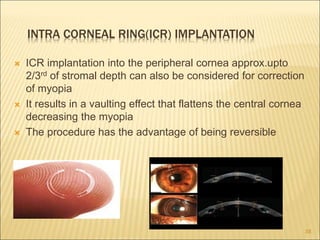
INTRA CORNEAL RING(ICR) IMPLANTATION
 ICR implantation into the peripheral cornea approx.upto
2/3rd of stromal depth can also be considered for correction
of myopia
 It results in a vaulting effect that flattens the central cornea
decreasing the myopia
 The procedure has the advantage of being reversible
38
39
General measures-
Balanced diet
Early control of debilitating disease
Proper posture and illumination
Low vision aid
Screening of children at school
THANK YOU
40

myopia.ppt

  • 1.
    MYOPIA Presenter : Dr.Gajanan kondawar 1
  • 2.
    MYOPIA • Short sightedness •Myopia is a greek word meaning *close the eye* • Parallel rays of light coming from infinity are focused in front of the retina. • Accommodation is at rest 2
  • 3.
     Mechanism ofproduction  Axial – increase anteroposterior length  Curvatural – increase corneal curvature  Positional – anterior placement of lens  Index – increase nuclear sclerosis  Myopia due to excessive accommodation 3
  • 4.
     Optics ofmyopia  Far point is finite (In front of the eye)  For emmetropic eye it is at infinity  Higher the myopia the shorter the distance  Far point is 1 mt. from the eye ,there is 1D of myopia  Nodal point is further away from retina  Angle alpha- negative resulting apparent convergent squint 4
  • 5.
    TYPES OF CLASSIFICATION Clinical Classification  Degree of Myopia  Age of Onset 5
  • 6.
    CLINICAL CLASSIFICATION  CongenitalMyopia  Simple Myopia  Degenerative Myopia  Nocturnal Myopia- insufficient contrast for an adequate accommodative stimulus, the eye assumes the intermediate dark focus accommodative position rather than focusing for infinity.  Pseudo Myopia- overstimulation of the eye's accommodative mechanism or ciliary spasm  Induced Myopia- exposure to various pharmaceutical agents, variation in blood sugar levels, nuclear sclerosis 6
  • 7.
    DEGREE OF MYOPIA Low Myopia(<3D)  Medium Myopia(3-6D)  High Myopia(>6D) 7
  • 8.
    AGE OF ONSET Congenital Myopia (present at birth an persisting through infancy)  Youth-Onset Myopia(<20 yrs of age)  Early Adult-Onset Myopia(20-40 yrs of age)  Late Adult-Onset Myopia(>40 yrs of age) 8
  • 9.
    Congenital myopia Frequently seenin -Premature babies -Marfan’s syndrome -Homocystinuria  Increase in axial length  Increase in Overall globe size  Since birth, diagnosed at age 2-3 years  If unilateral, as anisometropia, may develop amblyopia, strabismus  Usually 8-10 D, remain constant  Bilateral- difficulty in distant vision, hold things very close 9
  • 10.
     Associated conditions Convergent squint  Cataract  Microphthalmos  Aniridia  Megalocornea Management  Early Correction is desirable  Retinoscopy under full cycloplegia  Early full correction desirable  Poor prognosis 10
  • 11.
     Simple /developmental myopia  Physiological error not associated with any disease of the eye  Etiology :  Normal biological variation in development of eye  Inherited –  Studies have shown a  33-60 percent prevalence of myopia both parent have myopia.  the prevalence was 23-40 percent- one parent  neither parent has myopia, only 6-15 percent of the children were myopic. 11
  • 12.
     Associated factors Role of diet- (without any conclusive result)  excessive near work- Some studies have found the prevalence of myopia increases with income level and educational attainment, and it is higher among persons who work in occupations requiring a great deal of near work.  A slightly higher prevalence of myopia in females than in males. 12
  • 13.
     Clinical picture Rarely present at birth  Rather born hypermetropic, become myopic  Begins at 7-10 years, stabilizing around mid teens  Usually around 5D, never exceeds 8D 13
  • 14.
     Symptoms  Poorvision for distance, stenopaeic vision.  Asthenopic symptoms develop due to dissociation between accommodation and convergence  Convergence weakness, exophoria, suppression  Excessive accommodation inducing ciliary spasm and artificially increasing the amount of myopia 14
  • 15.
     Signs  Largeand prominent globe  Deep AC  Large, sluggishly reacting pupils  Normal fundus, rarely crescent  Usually doesn't exceed 6-8D  Retinoscopy under full cycloplegia 15
  • 16.
    Pathological / degenerative/ progressive myopia  Rapidly progressive associated with degenerative changes in the eye, starts at 5-10 yrs, result 6-7D myopia, prevelance – 2-3%  Etiology-  Rapid axial growth of the eyeball outside the normal biological variations of development  Role of heredity linked retinal growth  Role of general growth process (nutritional, hormonal, debilitating disease) 16
  • 17.
    Genetic factors Generalgrowth process More growth of retina Stretching of sclera Increased axial length Degeneration of choroid Degeneration of retina features of pathological Degeneration of vitreous myopia 17
  • 18.
     Symptoms  Defectivevision  Muscae volitantes / floating black opacities  Night blindness – marked chorioretinal changes 18
  • 19.
     Signs  Eyelarge, prominent eyes simulating exophthalmos  Cornea large  AC deep  Lens show opacities at the posterior pole due to aberration of lenticular metabolism and due to overstretching. 19
  • 20.
     Vitreous degeneration,viterous liquefication,vitreousdetachment present as Weiss reflux  Sclera thinning resulting in formation of post. staphyloma  Visual field defects show Contraction and ring scotomas are present 20
  • 21.
     DISC  Largein size  Myopic Crescent on the temporal side of the disc  Choroidal Crescent  Supertraction of the retina  Inverse myopia Myopic crescent situated nasally and supertraction of the retina temporally called as inverse crescent  Peripapillary atrophy 21
  • 22.
     MACULA Foster-Fuchs spot (subretinalneo vascularization, And choroidal haemorrhage)  Retinal Detachment  Posterior Staphyloma  Retinal Holes (laser barrage)  Tesselated Fundus 22
  • 23.
    23 Complications- Retinal tear anddetachment Complicated cataract Vitreous haemorrhage Choroidal haemorrhage POAG
  • 24.
    Treatment Optical treatment  Appropriateconcave lenses and contact lenses  Minimum acceptance providing maximum vision 24
  • 25.
    GUIDELINES LOW TO MODERATEDEGREES OF MYOPIA (UP TO -6D)  IN YOUNG SUBJECTS Defect should never be overcorrected and advised for constant use to avoid squinting and develop a normal accommodation-convergence reflex  IN ADULTS Receiving spectacle for the first time,have the ciliary muscle that are unaccostomed to accommodate efficiently so that lens of slightly lower power is prescribed with which the patient has comfortable near vision. 25
  • 26.
    FOR HIGH MYOPIA DISPENSINGSPECTACLES IN HIGH MYOPIA  High index lens materials  Lighter lens materials  Reduced eyesize of selected frames 26 • Full correction is given irrespective of age along with duochrom balanced.
  • 27.
    27 Atropine— Recent well-designedstudies using topical atropine (myopin 0.01%), a non-selective muscarinic antagonist, have demonstrated statistically and clinically significant reductions in the progression of myopia. Although atropine is used in many countries in Asia for slowing the progression of myopia, it is rarely used in the United States for this purpose. The side effects associated with atropine (e.g. photophobia, cycloplegia) are considered by many clinicians to be unacceptable for long-term therapy. Pirenzepine— Pirenzepine, like atropine, is a muscarinic antagonist but it is less likely to produce mydriasis and cycloplegia, Also show reduction in the progression of myopia Pharmaceutical Agents
  • 28.
    28 Several large studiesconducted in different parts of the world have reported that the prevalence of myopia in children with more outdoor activity hours is lower than in children with fewer hours.
  • 29.
    SURGICAL TREATMENT  Epikeratophakia RK  PRK  Phakic IOL’S  LASIK  PPV and RD sx (for retinal tear and detachment) 29 LASIK PRK RK Phakic IOL’S
  • 30.
    PHOTOREFRACTIVE KERATECTOMY (PRK) Involves direct laser ablation of corneal stroma after removal of corneal epithelium mechanically or using a laser beam.  Done using Excimer laser  MUNNERLYN EQN: depth of ablation (micrometer)=[diameter of optical zone(mm)]² × 1/3power(Diopter)  For myopic a large amount of ablation is done in central cornea than in the periphery.  Give good results for -2D to -6D of myopia 30
  • 31.
    LASIK (LASER ASSISTEDIN SITU KERATOMILEUSIS)  Method:- Anterior flap of cornea is lifted with a keratome and excimer laser is used to sculpt the stromal bed to change the refractive error of eye  Corrects 0.5 to 12D of myopia and upto 8D of astigmatism  Guidelines:Age more than 18yrs BCVA better than 6/12 Stable refraction for last 1yr Absence of corneal disease & ectasia  Note: In no case the residual bed thickness after the ablation should measure 250microns so as to avoid central corneal ectasia 31
  • 32.
    LASEK (LASER SUBEPITHELIALKERATOMILEUSIS)  Indications:  Low myopia  Irregular astigmatism  LASIK complications in contralateral eye  Thin corneal pachymetry  Predisposition to trauma  Glaucoma suspect 32
  • 33.
     Method:  Simpleinexpensive procedure that involves creation of epithelial flap after exposure to 20% alcohol for 25sec & subsequent replacement of flap after laser ablation 33
  • 34.
    RK (RADIAL KERATOTOMY) It refers to making deep corneal incisions(initially 16,now down to 4) in the peripheral part of cornea leaving about 4mm central optical zone  The incisions are made almost down to the level of Descemet’s Membrane  These incisions on healing flatten the central cornea thereby reducing its refractive power  For low to moderate degree of myopia(-1.5 to -6D of myopia) 34
  • 35.
    EPIKERATOPHAKIA  For highdegree of myopia (upto 20D)  Method:  The epithelium is removed & then a pocket is fashioned under the edge of the remaining epithelium & into this is inserted the cryolathed donor homograft  Preserved material can also be used 35 lens
  • 36.
    NON CORNEAL INTERVENTIONS (A)REMOVAL OF CLEAR LENS  We know that an aphakic eye is strongly hypermetropic  If an eye with an axial myopia of -24D is deprived of its lens it will become emmetropic without any correcting lens. 36
  • 37.
    (b)Phakic intraocular lenses An IOL of appropriate power is implanted inside the eye without touching normal crystalline lens thus without disturbing accomodation  Method can be used to correct both myopia & hypermetropia  Phakic IOL types:  PC IOL  Angle supported IOL  Iris claw lens  ICL 37
  • 38.
    INTRA CORNEAL RING(ICR)IMPLANTATION  ICR implantation into the peripheral cornea approx.upto 2/3rd of stromal depth can also be considered for correction of myopia  It results in a vaulting effect that flattens the central cornea decreasing the myopia  The procedure has the advantage of being reversible 38
  • 39.
    39 General measures- Balanced diet Earlycontrol of debilitating disease Proper posture and illumination Low vision aid Screening of children at school
  • 40.