Allergic Conjunctivitis
-Ashirwad Neupane
Intern, KUSMS
Case:
A 32 year lady from Pachkhal presented with:
Itching of b/l eyes for 2 weeks along with
redness and ropy discharge from both the
eyes. There was no any associated pain.
She complains of seasonal recurrance of the
above symptoms.
On Examination
• VA 6/9 No improvement on pinhole
6/9
There is presence of circumcorneal hyperaemia.
The cornea is clear.
No restriction of EOM movement.
The Pupils are Round, Regular and Reactive.
Both pupil have brisk response on Dir./Indirect light reflex.
RAPD absent. No any gross Squint.
On Slit lamp Examination:
Small papilla present on the palpebral conjunctiva in B/L eye.
Hyperaemia and chemosis in the conjunctiva.
AC clear.
Management
• She was diagnosed as Acute Allergic conjunctivitis
and managed on the following medications.
1. Gtt. Winolap [ Olopatidine 0.1%(w/v) – Dual action
antihistamines and mast cell stabilizers] BD 1 drop
B/E for 2 weeks.
2. Gtt. RefeshTear [Carboxymethyl cellulose
0.5%(w/v)] QID 1drop B/E for 1 month
3. Advice:
Avoid direct sunlight, dust and any other allergens.
Maintain ocular hygiene.
F/U after 2 weeks / SOS
Allergic conjunctivitis
Inflammation of conjunctiva due to allergic or
hypersensitive reaction which may be
immediate (humoral ) or delayed (cellular) to
specific antigens.
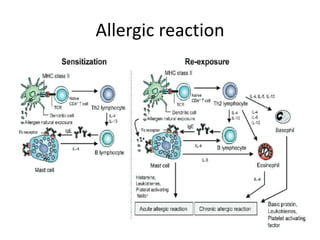
Allergic reaction
Types
1. Simple allergic conjunctivitis
-seasonal allergic conjunctivitis (SAC)
-perennial allergic conjunctivitis(PAC)
2. Vernal keratoconjunctivitis (VKC)
3. Atopic keratoconjunctivitis (AKC)
4. Giant papillary conjunctivitis (GPC)
5. Phlyctenular keratoconjunctivitis (PKC)
6. Contact Dermoconjunctivitis
Simple Allergic Conjunctivitis
Mild ,non specific IgE mediated Type I
hypersensitivity reaction
Etiology :
Hay fever conjunctivitis : associated with
allergic rhinitis
Allergens : pollens , grass , animal dandruffs
SAC: common , d/t: grass pollens
PAC: not common , d/t: house dust and mites
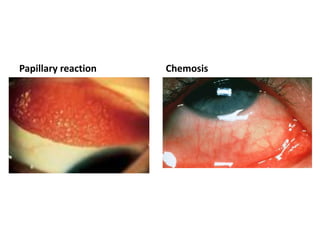
Papillary reaction Chemosis
Symptoms:
- itching
-Redness
-burning sensation
- watery discharge and
-mild photophobia
Signs :
-hyperemia and chemosis
-mild papillary reaction
-oedema of eyelids
Treatment
Elimination of allergens if possible
Cold compresses
Antihistamines oral/ topical (epinistine ,
fexofenadrine)
Mast cell stabilizers (sodium cromoglycate ,
lodaximide)
Combination( olopatidine,patalon,azelastine)
Topical corticosteroids
Immunosuppressant's (cyclosporin) for steroid
resistant cases
Vernal keratoconjunctivitis or spring catarrh
Recurrent, Bilateral , self limiting allergic inflammation
of the conjunctiva having a periodic seasonal
incidence.
More common in males
Type 1 IgE mediated.
More common in warm, dry climates especially in
summer.
Clinical features :
– 98% bilateral, can be asymmetric.
– Intense ocular itching, Lacrimation, Photophobia,
blepharospasm, blurred vision, FB sensation , burning
and difficulty opening eyes in the morning.
– Thick mucous ropy discharge , Pseudoptosis due to large
papillae.
– Giant papillae on the superior Palpebral conjunctiva are
the clinical hallmark.
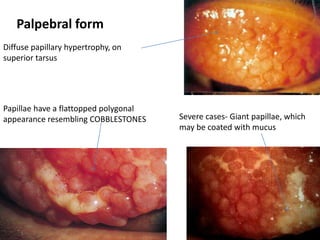
Diffuse papillary hypertrophy, on
superior tarsus
Papillae have a flattopped polygonal
appearance resembling COBBLESTONES
Palpebral form
Severe cases- Giant papillae, which
may be coated with mucus
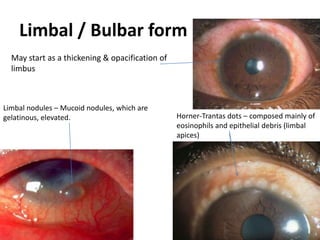
Limbal / Bulbar form
May start as a thickening & opacification of
limbus
Limbal nodules – Mucoid nodules, which are
gelatinous, elevated. Horner-Trantas dots – composed mainly of
eosinophils and epithelial debris (limbal
apices)
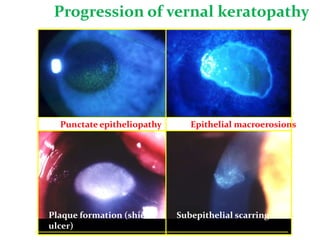
Progression of vernal keratopathy
Punctate epitheliopathy Epithelial macroerosions
Plaque formation (shield
ulcer)
Subepithelial scarring
Treatment
1.Topical Steroid:
Fluorometholone, Dexamethason, Prednisolone.
2. Mast cell stabilizers:
Nedocromil 0.1%, Lodoxamide, Sodium Cromoglycate.
3. Dual action antihiatamines and mast cell stabilizers : Olopatidine, ketotifen
4. Topical Cyclosporin 2%.
5. Topical lubricating and mucolytics : Carboxymethyl cellulose and Acetyl
cysteine (0.5%)
6. Lamellar keratectomy of densely adherent plaques.
7. Excimer laser phototherapeutic keratectomy.
8. Amniotic membrane transplantation.
9. Supratarsal inj. of steroid: Betamethasone or triamcinolone.
10. Desensitizing immunotherapy.
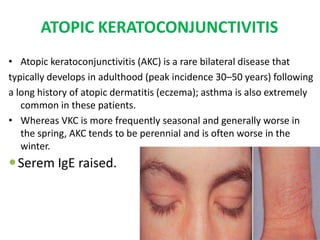
ATOPIC KERATOCONJUNCTIVITIS
• Atopic keratoconjunctivitis (AKC) is a rare bilateral disease that
typically develops in adulthood (peak incidence 30–50 years) following
a long history of atopic dermatitis (eczema); asthma is also extremely
common in these patients.
• Whereas VKC is more frequently seasonal and generally worse in
the spring, AKC tends to be perennial and is often worse in the
winter.
Serem IgE raised.
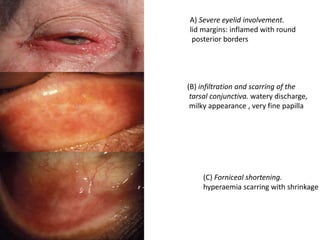
A) Severe eyelid involvement.
lid margins: inflamed with round
posterior borders
(B) infiltration and scarring of the
tarsal conjunctiva. watery discharge,
milky appearance , very fine papilla
(C) Forniceal shortening.
hyperaemia scarring with shrinkage
Symptoms :
itching , soreness , dry sensation , mucoid
discharge, Hardening Eyelid, phtophobia or
blurred vision
Signs :
Eye lids
lid margins: inflamed with round posterior borders
Extra lid fold – Dennie Morgan fold
Loss of lateral eyebrow – Hortoghe’s sign
conjunctiva :
Tarsal : watery discharge, milky appearance , very
fine papilla , hyperaemia scarring with shrinkage
Limbal: Limbal spots and Trantas dots (as in VKC)
Treatment
On same line as VKC except that it is generally
less responsive and requires more intensive
and prolonged therapy.
Lid margin inflammation and facial eczema
should be treated with oral NSAIDs, oral
antibiotics (Doxycycline or azithromycin) and
local application of steroid and antibiotic eye
ointment.
Giant (mechanically induced) papillary conjunctivitis
Mechanically induced papillary conjunctivitis occur secondary to
mechanical stimuli of the tarsal conjunctiva.
It is most frequently encountered with contact lens (CL) wear ie
papillary conjunctivitis (CLPC).
Proteinaceous deposits and cellular debris on the contact lens
surface may occur.
Symptoms consist of a foreign body sensation, redness, itching,
increased mucus production, blurring and loss of CL tolerance
Signs
Variable mucous discharge. Substantial CL protein deposits
Excessive CL mobility due to upper lid capture.
Superior tarsal hyperaemia and papillae.
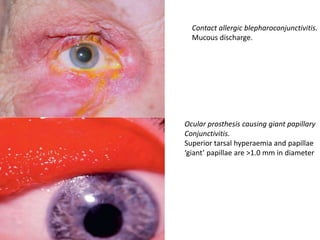
Contact allergic blepharoconjunctivitis.
Mucous discharge.
Ocular prosthesis causing giant papillary
Conjunctivitis.
Superior tarsal hyperaemia and papillae
‘giant’ papillae are >1.0 mm in diameter
Treatment
1. Removal of the stimulus
2. Ensure effective cleaning of CL or prosthesis
3. Topical
• Mast cell stabilizers.
• Antihistamines, non-steroidal anti-inflammatory
agents and combined antihistamines/mast cell
stabilizers may each be of benefit.
• Topical steroids can be used for the acute phase
of resistant cases.
Phlyctenular keratoconjunctivitis (PKC)
Nodular affection occurring as an allergic
response by conjunctiva and corneal
epithelium to some endogenous allergens
Delayed hypersensitivity ( type IV) response to
endogenous microbial proteins : Tuberculous
protein, Staphylococcal protein , parasitic
protein .
1. Stage of nodule formation : exudation and
infiltration of lymphocytes into deeper layers.
2. Stage of ulceration : Necrosis of apex of
nodule leading to ulcer formation ,
3. Stage of granulation
4. Stage of healing
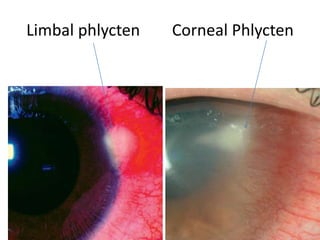
Limbal phlycten Corneal Phlycten
Treatment
• A short course of topical steroid accelerates
healing and is often given with a topical
antibiotic.
• Atropine 1 % if cornea involved.
• Recurrent troublesome disease may require
an oral tetracycline.
• It is important to treat associated blepharitis.
Contact Dermatoconjunctivitis
• It is an allergic disorder, involving conjunctiva and skin of
lids along with surrounding area of face.
• It is in a delayed hypersensitivity (type IV)
response to prolonged contact with chemicals and drugs.
Drugs that produce contact dermoconjunctivitis are
atropine, penicillin, neomycin, soframycin and gentamycin.
Treatment consists of:
1. Discontinuation of the causative medication.
2. Topical steroid eye drops to relieve symptoms.
3. Application of steroid ointment on the involved
skin.
References
• Comprehensive Ophthalmology-A.K.Khurana
• Clinical ophthalmology-Jack.J.Kanski
Thank you!!

Allergic conjunctivitis

  • 1.
  • 2.
    Case: A 32 yearlady from Pachkhal presented with: Itching of b/l eyes for 2 weeks along with redness and ropy discharge from both the eyes. There was no any associated pain. She complains of seasonal recurrance of the above symptoms.
  • 3.
    On Examination • VA6/9 No improvement on pinhole 6/9 There is presence of circumcorneal hyperaemia. The cornea is clear. No restriction of EOM movement. The Pupils are Round, Regular and Reactive. Both pupil have brisk response on Dir./Indirect light reflex. RAPD absent. No any gross Squint. On Slit lamp Examination: Small papilla present on the palpebral conjunctiva in B/L eye. Hyperaemia and chemosis in the conjunctiva. AC clear.
  • 4.
    Management • She wasdiagnosed as Acute Allergic conjunctivitis and managed on the following medications. 1. Gtt. Winolap [ Olopatidine 0.1%(w/v) – Dual action antihistamines and mast cell stabilizers] BD 1 drop B/E for 2 weeks. 2. Gtt. RefeshTear [Carboxymethyl cellulose 0.5%(w/v)] QID 1drop B/E for 1 month 3. Advice: Avoid direct sunlight, dust and any other allergens. Maintain ocular hygiene. F/U after 2 weeks / SOS
  • 5.
    Allergic conjunctivitis Inflammation ofconjunctiva due to allergic or hypersensitive reaction which may be immediate (humoral ) or delayed (cellular) to specific antigens.
  • 6.
  • 7.
    Types 1. Simple allergicconjunctivitis -seasonal allergic conjunctivitis (SAC) -perennial allergic conjunctivitis(PAC) 2. Vernal keratoconjunctivitis (VKC) 3. Atopic keratoconjunctivitis (AKC) 4. Giant papillary conjunctivitis (GPC) 5. Phlyctenular keratoconjunctivitis (PKC) 6. Contact Dermoconjunctivitis
  • 8.
    Simple Allergic Conjunctivitis Mild,non specific IgE mediated Type I hypersensitivity reaction Etiology : Hay fever conjunctivitis : associated with allergic rhinitis Allergens : pollens , grass , animal dandruffs SAC: common , d/t: grass pollens PAC: not common , d/t: house dust and mites
  • 9.
  • 10.
    Symptoms: - itching -Redness -burning sensation -watery discharge and -mild photophobia Signs : -hyperemia and chemosis -mild papillary reaction -oedema of eyelids
  • 11.
    Treatment Elimination of allergensif possible Cold compresses Antihistamines oral/ topical (epinistine , fexofenadrine) Mast cell stabilizers (sodium cromoglycate , lodaximide) Combination( olopatidine,patalon,azelastine) Topical corticosteroids Immunosuppressant's (cyclosporin) for steroid resistant cases
  • 12.
    Vernal keratoconjunctivitis orspring catarrh Recurrent, Bilateral , self limiting allergic inflammation of the conjunctiva having a periodic seasonal incidence. More common in males Type 1 IgE mediated. More common in warm, dry climates especially in summer.
  • 13.
    Clinical features : –98% bilateral, can be asymmetric. – Intense ocular itching, Lacrimation, Photophobia, blepharospasm, blurred vision, FB sensation , burning and difficulty opening eyes in the morning. – Thick mucous ropy discharge , Pseudoptosis due to large papillae. – Giant papillae on the superior Palpebral conjunctiva are the clinical hallmark.
  • 14.
    Diffuse papillary hypertrophy,on superior tarsus Papillae have a flattopped polygonal appearance resembling COBBLESTONES Palpebral form Severe cases- Giant papillae, which may be coated with mucus
  • 15.
    Limbal / Bulbarform May start as a thickening & opacification of limbus Limbal nodules – Mucoid nodules, which are gelatinous, elevated. Horner-Trantas dots – composed mainly of eosinophils and epithelial debris (limbal apices)
  • 16.
    Progression of vernalkeratopathy Punctate epitheliopathy Epithelial macroerosions Plaque formation (shield ulcer) Subepithelial scarring
  • 17.
    Treatment 1.Topical Steroid: Fluorometholone, Dexamethason,Prednisolone. 2. Mast cell stabilizers: Nedocromil 0.1%, Lodoxamide, Sodium Cromoglycate. 3. Dual action antihiatamines and mast cell stabilizers : Olopatidine, ketotifen 4. Topical Cyclosporin 2%. 5. Topical lubricating and mucolytics : Carboxymethyl cellulose and Acetyl cysteine (0.5%) 6. Lamellar keratectomy of densely adherent plaques. 7. Excimer laser phototherapeutic keratectomy. 8. Amniotic membrane transplantation. 9. Supratarsal inj. of steroid: Betamethasone or triamcinolone. 10. Desensitizing immunotherapy.
  • 18.
    ATOPIC KERATOCONJUNCTIVITIS • Atopickeratoconjunctivitis (AKC) is a rare bilateral disease that typically develops in adulthood (peak incidence 30–50 years) following a long history of atopic dermatitis (eczema); asthma is also extremely common in these patients. • Whereas VKC is more frequently seasonal and generally worse in the spring, AKC tends to be perennial and is often worse in the winter. Serem IgE raised.
  • 19.
    A) Severe eyelidinvolvement. lid margins: inflamed with round posterior borders (B) infiltration and scarring of the tarsal conjunctiva. watery discharge, milky appearance , very fine papilla (C) Forniceal shortening. hyperaemia scarring with shrinkage
  • 20.
    Symptoms : itching ,soreness , dry sensation , mucoid discharge, Hardening Eyelid, phtophobia or blurred vision Signs : Eye lids lid margins: inflamed with round posterior borders Extra lid fold – Dennie Morgan fold Loss of lateral eyebrow – Hortoghe’s sign conjunctiva : Tarsal : watery discharge, milky appearance , very fine papilla , hyperaemia scarring with shrinkage Limbal: Limbal spots and Trantas dots (as in VKC)
  • 21.
    Treatment On same lineas VKC except that it is generally less responsive and requires more intensive and prolonged therapy. Lid margin inflammation and facial eczema should be treated with oral NSAIDs, oral antibiotics (Doxycycline or azithromycin) and local application of steroid and antibiotic eye ointment.
  • 22.
    Giant (mechanically induced)papillary conjunctivitis Mechanically induced papillary conjunctivitis occur secondary to mechanical stimuli of the tarsal conjunctiva. It is most frequently encountered with contact lens (CL) wear ie papillary conjunctivitis (CLPC). Proteinaceous deposits and cellular debris on the contact lens surface may occur. Symptoms consist of a foreign body sensation, redness, itching, increased mucus production, blurring and loss of CL tolerance Signs Variable mucous discharge. Substantial CL protein deposits Excessive CL mobility due to upper lid capture. Superior tarsal hyperaemia and papillae.
  • 23.
    Contact allergic blepharoconjunctivitis. Mucousdischarge. Ocular prosthesis causing giant papillary Conjunctivitis. Superior tarsal hyperaemia and papillae ‘giant’ papillae are >1.0 mm in diameter
  • 24.
    Treatment 1. Removal ofthe stimulus 2. Ensure effective cleaning of CL or prosthesis 3. Topical • Mast cell stabilizers. • Antihistamines, non-steroidal anti-inflammatory agents and combined antihistamines/mast cell stabilizers may each be of benefit. • Topical steroids can be used for the acute phase of resistant cases.
  • 25.
    Phlyctenular keratoconjunctivitis (PKC) Nodularaffection occurring as an allergic response by conjunctiva and corneal epithelium to some endogenous allergens Delayed hypersensitivity ( type IV) response to endogenous microbial proteins : Tuberculous protein, Staphylococcal protein , parasitic protein .
  • 26.
    1. Stage ofnodule formation : exudation and infiltration of lymphocytes into deeper layers. 2. Stage of ulceration : Necrosis of apex of nodule leading to ulcer formation , 3. Stage of granulation 4. Stage of healing
  • 27.
  • 28.
    Treatment • A shortcourse of topical steroid accelerates healing and is often given with a topical antibiotic. • Atropine 1 % if cornea involved. • Recurrent troublesome disease may require an oral tetracycline. • It is important to treat associated blepharitis.
  • 29.
    Contact Dermatoconjunctivitis • Itis an allergic disorder, involving conjunctiva and skin of lids along with surrounding area of face. • It is in a delayed hypersensitivity (type IV) response to prolonged contact with chemicals and drugs. Drugs that produce contact dermoconjunctivitis are atropine, penicillin, neomycin, soframycin and gentamycin. Treatment consists of: 1. Discontinuation of the causative medication. 2. Topical steroid eye drops to relieve symptoms. 3. Application of steroid ointment on the involved skin.
  • 30.
  • 31.