VERNAL KERATO
CONJUNCTIVITIS OR
SPRING CATARRH
By
Dr.S.ANURADHA MS.,
ALLERGIC CONJUNCTIVITIS
It is defined as the inflammation of
the conjunctiva due to allergic or
hypersensitivity reactions which may
be immediate(humoral) or
delayed(cellular)
TYPES
• Simple Allergic Conjunctivitis
- Seasonal allergic conjunctivitis
-Perennial allergic conjunctivitis
• Vernal keratoconjunctivitis
• Atopic keratoconjunctivitis
• Giant papillary conjunctivitis
• Phlyctenular keratoconjunctivitis
• Contact dermatoconjunctivitis
INTRODUCTION
VKC is one of the type of ALLERGIC
CONJUCTIVITIS.
ALLERGY is an abnormally high sensitivity to
certain substances such as pollen,foods,micro
organisms.
In greek vernal mean spring.it is commonly
occurred in spring season .certain type of pollen
is released in the sping season which cause
allergy. so it is called SPRING CATARRAH.
Allergic Conjunctivitis : Causes
POLLEN
PET DANDER
POLLUTION
DUST MITES
MOLDS
DEFINITION
VKC is a
chronic,recurrent,interstitial,bilateral,
self limiting,external ocular allergic
disease having periodic seasonal
occurence.
ETIOLOGY
1.Exogenous allergen like pollen.
2.family H/O allergic diseases &
personal h/o one of the major atopic
diseases like ASTHMA,HAY
FEVER,ECZEMA may be present. It is
consider to be an type 1 IgE
mediated hypersensitivity reaction.
Conti,,,,
3.Age incidence is about 4 to 20 yrs.
4.Males are affected more than
females.
5.disease affects primarly children &
young adults.
PATHOGENESIS
Mainly involved cell is MAST CELL which is
present in conjuctiva.
Oter sites __ resp.mucosa & connective tissue.
1 cub mm of conjuctiva consits about 5000 mast
cells.
The surface of mast cell is coated with igE
antibody.each mast cell contains about 10000 to
50000 igE ab.
Cont,,,
The main stimulus for allergic
response is exposure of appropriate
sensitised igE coated mast cell to air
born allergen
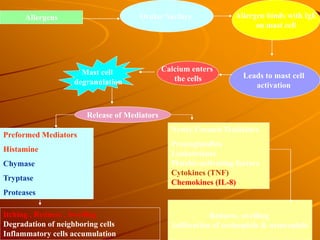
Allergens Ocular Surface Allergen binds with IgE
on mast cell
Leads to mast cell
activation
Preformed Mediators
Histamine
Chymase
Tryptase
Proteases
Itching , Redness , Swelling
Degradation of neighboring cells
Inflammatory cells accumulation
Newly Formed Mediators
Prostaglandins
Leukotrienes
Platelet-activating factors
Cytokines (TNF)
Chemokines (IL-8)
Redness, swelling
Infiltration of eosinophils & neutrophils
Calcium enters
the cells
Mast cell
degranulation
Release of Mediators
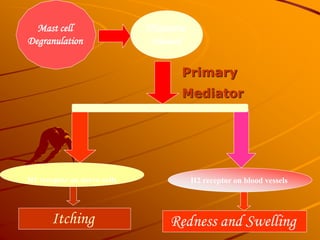
Primary
Mediator
H1 receptor on nerve cells H2 receptor on blood vessels
Mast cell
Degranulation
Histamine
released
Itching Redness and Swelling
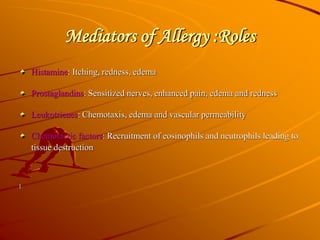
Mediators of Allergy :Roles
Histamine: Itching, redness, edema
Prostaglandins: Sensitized nerves, enhanced pain, edema and redness
Leukotrienes: Chemotaxis, edema and vascular permeability
Chemotactic factors: Recruitment of eosinophils and neutrophils leading to
tissue destruction
l
Signs & SYMPTOMS
1. Intense itching,watering,photophobia,
FB sensation.
2. one of the dignostic sign is mucous
discharge __ ropy in nature – thick
lardacious,yellowish discharge.it consists
of epitheleal cells,eosinophils ,
neutrophils.
Discharge may be found to collected in
lower conjuctiva up to medial
canthus.patient gets relief after removal of
discharge.
Cont,,,
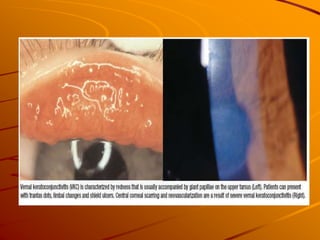
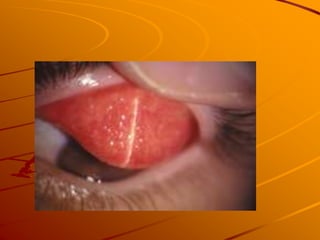
3. another diagnostic sign is macro
papillae in the upper tarsal conjuctiva.
Depending up on the site of formation of
papillae it is divided in to
1. palpebral form
2. limbal form
3. mixed ,,
PALPEBRAL FORM
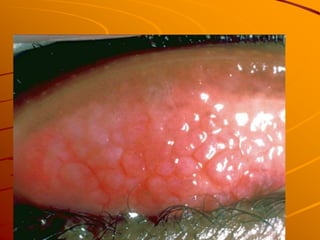
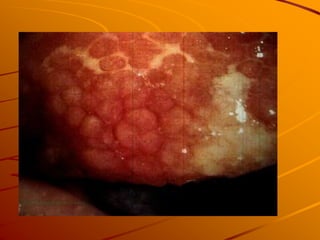
It is mainly manifested by large papillae
on the upper part of conjuctiva.
Size vary from 2 mm to 8 mm.
Papillae is bluish white , flat topped
nodules which are hard.
Papillae are arranged in a cobble stone or
pavement stone fashion.
Cont,,,
Papillae consist of dence fibrous tissue,
leucocytes, plasma cells,lymphocytes,
macrophages.
This type is common in males.
Allergic madiators which are produced in
hypersensitivity reaction play a major role
for proliferation of fibroblasts.mainly due
to benign hyperplasia of substansia
propria of conjuctiva.
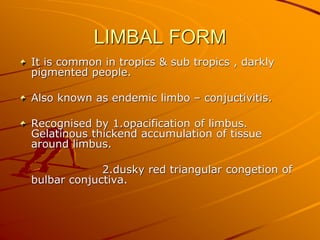
LIMBAL FORM
It is common in tropics & sub tropics , darkly
pigmented people.
Also known as endemic limbo – conjuctivitis.
Recognised by 1.opacification of limbus.
Gelatinous thickend accumulation of tissue
around limbus.
2.dusky red triangular congetion of
bulbar conjuctiva.
CONT,,
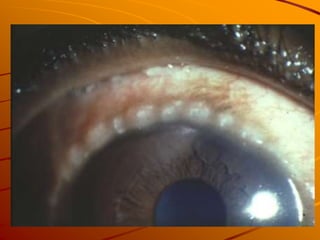
3. Main characteristic feature is
HORNER – TRANTAS dots which are
chalcky white, raised superficial dots
over the corneo scleral limbus.
These are composed of eosinophills &
epithelial debris.
VERNAL KERATOPATHY
Corneal involvement is seen in 50%
of pts.
It is due to primary or secondary to
extention of limbal lesions.
Vernal keratopathy includes 5 types.
TYPES OF V.KERATOPATHY
1.SUPERFICIAL PUNCTATE EPITHEAL
KERATITS – involves upper cornea with
palpebral form. Lesion always stains with
rose bengal & invariably fluorescein stain.
2.ULCERATIVE KERATITIS – RARE –
horizontal ,oval , shallow ulcers –
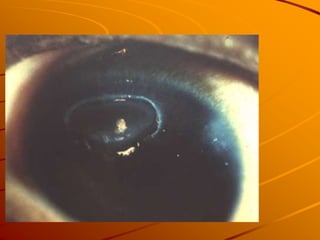
SHIELDS ULCER – in the upper half of
cornea at limbus. It is due to constant
rubbing of papillae on cornea.
TYPES
3.VERNAL CORNEAL PLAQUES – due to
coating of bare area of epitheal macro
erotion with a layer of altered exudates.
4.SUBEPITHELIAL SCARRING – ring scar .
5. PSEUDOGERONTOXON – clasical cupids
bow out line. Prone for keratoconus.
COMPLICATIONS
1.Sheild’s ulcer.
2.opacification of bowmans membrane.
3.peripharal corneal degeneration – rarely
– leads to astigmatism.
 4.keratoconus & keratoglobus– rare.
 5.Severe dry eyes
D/D
1.TRACHOMA
2.GIANT PAPILLARY CONJUCTIVITIS
3.PHYCTENULAR CONJUCTIVITIS
TREATMENT
Medical treatment – most effective.
Surgical treament
Medical Management
Vasoconstrictors/Decongestant
Antihistaminic agents
Mast Cell Stabilizers
Steroids
Immuno supressants
Artificial tear drops
NSAIDS
General measures
Vasoconstrictors
Acts by constricting the inflamed , dilated vessels.
Act on the alpha adrenergic receptors in the arterioles of the
conjunctiva resulting in decreased conjunctival congestion
Eg : naphazoline
ANTI HISTAMANICS
Block histamine receptors on nerve endings and
blood-vessel walls .
2 types of histamine receptors are important
H1 receptors mediate itching
H2 receptor mediate redness.
E.g Levocabastine , Emedastine ( not
available in India)
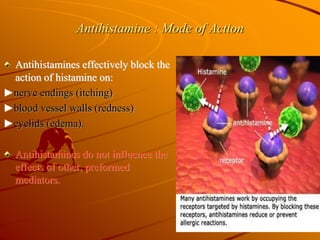
Antihistamine : Mode of Action
Antihistamines effectively block the
action of histamine on:
►nerve endings (itching)
►blood vessel walls (redness)
►eyelids (edema).
Antihistamines do not influence the
effects of other, preformed
mediators.
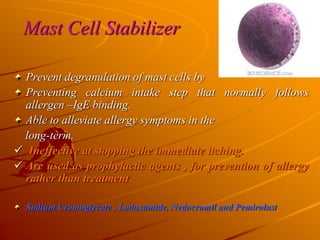
Mast Cell Stabilizer
Prevent degranulation of mast cells by
Preventing calcium intake step that normally follows
allergen –IgE binding.
Able to alleviate allergy symptoms in the
long-term.
 Ineffective at stopping the immediate itching.
 Are used as prophylactic agents , for prevention of allergy
rather than treatment
Sodium Cromoglycate , Lodoxamide, Nedocromil and Pemirolast
Mast Cell Stabilizer
Prevent degranulation of mast cells by
Preventing calcium intake step that normally follows
allergen –IgE binding.
Able to alleviate allergy symptoms in the
long-term.
 Ineffective at stopping the immediate itching.
 Are used as prophylactic agents , for prevention of allergy
rather than treatment
Sodium Cromoglycate , Lodoxamide, Nedocromil and Pemirolast
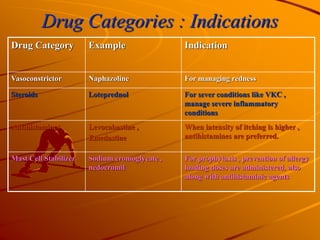
Drug Categories : Indications
Drug Category Example Indication
Vasoconstrictor Naphazoline For managing redness
Steroids Loteprednol For sever conditions like VKC ,
manage severe inflammatory
conditions
Antihistamines Levocabastine ,
Emedastine
When intensity of itching is higher ,
antihistamines are preferred.
Mast Cell Stabilizer Sodium cromoglycate ,
nedocromil
For prophylaxis , prevention of allergy
loading doses are administered, also
along with antihistaminic agents
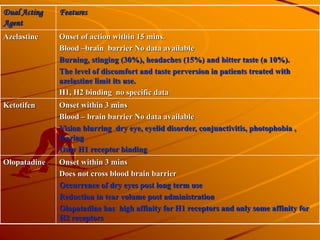
Dual Acting Agents : Rationale
Dual Acting
Agent
Features
Azelastine Onset of action within 15 mins.
Blood –brain barrier No data available
Burning, stinging (30%), headaches (15%) and bitter taste (a 10%).
The level of discomfort and taste perversion in patients treated with
azelastine limit its use.
H1, H2 binding no specific data
Ketotifen Onset within 3 mins
Blood – brain barrier No data available
Vision blurring dry eye, eyelid disorder, conjunctivitis, photophobia ,
tearing
Only H1 receptor binding
Olopatadine Onset within 3 mins
Does not cross blood brain barrier
Occurrence of dry eyes post long term use
Reduction in tear volume post administration
Olopatadine has high affinity for H1 receptors and only some affinity for
H2 receptors
Epinastine: Multiple mechanism of
Action
Antihistaminic blockade of the histamine
H1 and H2 receptors,
Mast cell stabilization,
Other anti-inflammatory activities
Epinastine :Onset and Duration Of Action
Steroids
Preferred in severe conditions like VKC.
When the inflammation is not controlled by
other therapeutic agents .
Have serious adverse effect profile
E.g Prednisolone , Loteprednol etabonate *,
Fluorometholone *.
* - Safer compared with prednisolone
IMMUNO SUPRRESENTS
Cyclosporin A is apotent immunosuppresent.
It control cell mediated immunity by inhibiting
activated T- LYMPHOCYTES.
Uncontrolled cases even after tt with sodium
cromoglycate, steroids, it is indicated.
Improvement occur with in 3 days ,complete
improvement achieved in 60% of pt after 6
weeks.
LUBRICANTS
Artificial tear drops – this agents will
wash off the allergens which are
present in the conjuctival sac.
Also reduce the dryness which is
produced by other drugs.
GENERAL TREATMENT
General tt –1. dark goggles to
prevent photophobia.
2. avoidence of allergen
3. cold compresses
SURGICAL TREATMENT
Superficial keretectomy – to remove
plaques.the epithelium is removed to
the edge of the calcified
region.medical tt is maintained until
cornea has reepithelialised to
prevent recurrence.
Eximer laser phototherapatic
keretectomy is alternative.
Contt,,
Amniotic membrane graft – with
tarsorraphy or lamellar keratoplasty
– required in severe persistant
epithelial defects with ulceration.
Large papillae is removed by cryo
application or beta irradiation.
PROGNOSIS
Good prognosis as the disease is self
limiting in most of the children

SPRING CATARRACH OR VERNAL KERATO CONJUNCTIVITIS

  • 1.
    VERNAL KERATO CONJUNCTIVITIS OR SPRINGCATARRH By Dr.S.ANURADHA MS.,
  • 2.
    ALLERGIC CONJUNCTIVITIS It isdefined as the inflammation of the conjunctiva due to allergic or hypersensitivity reactions which may be immediate(humoral) or delayed(cellular)
  • 3.
    TYPES • Simple AllergicConjunctivitis - Seasonal allergic conjunctivitis -Perennial allergic conjunctivitis • Vernal keratoconjunctivitis • Atopic keratoconjunctivitis • Giant papillary conjunctivitis • Phlyctenular keratoconjunctivitis • Contact dermatoconjunctivitis
  • 4.
    INTRODUCTION VKC is oneof the type of ALLERGIC CONJUCTIVITIS. ALLERGY is an abnormally high sensitivity to certain substances such as pollen,foods,micro organisms. In greek vernal mean spring.it is commonly occurred in spring season .certain type of pollen is released in the sping season which cause allergy. so it is called SPRING CATARRAH.
  • 5.
    Allergic Conjunctivitis :Causes POLLEN PET DANDER POLLUTION DUST MITES MOLDS
  • 6.
    DEFINITION VKC is a chronic,recurrent,interstitial,bilateral, selflimiting,external ocular allergic disease having periodic seasonal occurence.
  • 7.
    ETIOLOGY 1.Exogenous allergen likepollen. 2.family H/O allergic diseases & personal h/o one of the major atopic diseases like ASTHMA,HAY FEVER,ECZEMA may be present. It is consider to be an type 1 IgE mediated hypersensitivity reaction.
  • 8.
    Conti,,,, 3.Age incidence isabout 4 to 20 yrs. 4.Males are affected more than females. 5.disease affects primarly children & young adults.
  • 9.
    PATHOGENESIS Mainly involved cellis MAST CELL which is present in conjuctiva. Oter sites __ resp.mucosa & connective tissue. 1 cub mm of conjuctiva consits about 5000 mast cells. The surface of mast cell is coated with igE antibody.each mast cell contains about 10000 to 50000 igE ab.
  • 10.
    Cont,,, The main stimulusfor allergic response is exposure of appropriate sensitised igE coated mast cell to air born allergen
  • 11.
    Allergens Ocular SurfaceAllergen binds with IgE on mast cell Leads to mast cell activation Preformed Mediators Histamine Chymase Tryptase Proteases Itching , Redness , Swelling Degradation of neighboring cells Inflammatory cells accumulation Newly Formed Mediators Prostaglandins Leukotrienes Platelet-activating factors Cytokines (TNF) Chemokines (IL-8) Redness, swelling Infiltration of eosinophils & neutrophils Calcium enters the cells Mast cell degranulation Release of Mediators
  • 12.
    Primary Mediator H1 receptor onnerve cells H2 receptor on blood vessels Mast cell Degranulation Histamine released Itching Redness and Swelling
  • 13.
    Mediators of Allergy:Roles Histamine: Itching, redness, edema Prostaglandins: Sensitized nerves, enhanced pain, edema and redness Leukotrienes: Chemotaxis, edema and vascular permeability Chemotactic factors: Recruitment of eosinophils and neutrophils leading to tissue destruction l
  • 14.
    Signs & SYMPTOMS 1.Intense itching,watering,photophobia, FB sensation. 2. one of the dignostic sign is mucous discharge __ ropy in nature – thick lardacious,yellowish discharge.it consists of epitheleal cells,eosinophils , neutrophils. Discharge may be found to collected in lower conjuctiva up to medial canthus.patient gets relief after removal of discharge.
  • 15.
    Cont,,, 3. another diagnosticsign is macro papillae in the upper tarsal conjuctiva. Depending up on the site of formation of papillae it is divided in to 1. palpebral form 2. limbal form 3. mixed ,,
  • 17.
    PALPEBRAL FORM It ismainly manifested by large papillae on the upper part of conjuctiva. Size vary from 2 mm to 8 mm. Papillae is bluish white , flat topped nodules which are hard. Papillae are arranged in a cobble stone or pavement stone fashion.
  • 19.
    Cont,,, Papillae consist ofdence fibrous tissue, leucocytes, plasma cells,lymphocytes, macrophages. This type is common in males. Allergic madiators which are produced in hypersensitivity reaction play a major role for proliferation of fibroblasts.mainly due to benign hyperplasia of substansia propria of conjuctiva.
  • 22.
    LIMBAL FORM It iscommon in tropics & sub tropics , darkly pigmented people. Also known as endemic limbo – conjuctivitis. Recognised by 1.opacification of limbus. Gelatinous thickend accumulation of tissue around limbus. 2.dusky red triangular congetion of bulbar conjuctiva.
  • 24.
    CONT,, 3. Main characteristicfeature is HORNER – TRANTAS dots which are chalcky white, raised superficial dots over the corneo scleral limbus. These are composed of eosinophills & epithelial debris.
  • 25.
    VERNAL KERATOPATHY Corneal involvementis seen in 50% of pts. It is due to primary or secondary to extention of limbal lesions. Vernal keratopathy includes 5 types.
  • 26.
    TYPES OF V.KERATOPATHY 1.SUPERFICIALPUNCTATE EPITHEAL KERATITS – involves upper cornea with palpebral form. Lesion always stains with rose bengal & invariably fluorescein stain. 2.ULCERATIVE KERATITIS – RARE – horizontal ,oval , shallow ulcers – SHIELDS ULCER – in the upper half of cornea at limbus. It is due to constant rubbing of papillae on cornea.
  • 28.
    TYPES 3.VERNAL CORNEAL PLAQUES– due to coating of bare area of epitheal macro erotion with a layer of altered exudates. 4.SUBEPITHELIAL SCARRING – ring scar . 5. PSEUDOGERONTOXON – clasical cupids bow out line. Prone for keratoconus.
  • 29.
    COMPLICATIONS 1.Sheild’s ulcer. 2.opacification ofbowmans membrane. 3.peripharal corneal degeneration – rarely – leads to astigmatism.  4.keratoconus & keratoglobus– rare.  5.Severe dry eyes
  • 30.
  • 31.
    TREATMENT Medical treatment –most effective. Surgical treament
  • 32.
    Medical Management Vasoconstrictors/Decongestant Antihistaminic agents MastCell Stabilizers Steroids Immuno supressants Artificial tear drops NSAIDS General measures
  • 33.
    Vasoconstrictors Acts by constrictingthe inflamed , dilated vessels. Act on the alpha adrenergic receptors in the arterioles of the conjunctiva resulting in decreased conjunctival congestion Eg : naphazoline
  • 34.
    ANTI HISTAMANICS Block histaminereceptors on nerve endings and blood-vessel walls . 2 types of histamine receptors are important H1 receptors mediate itching H2 receptor mediate redness. E.g Levocabastine , Emedastine ( not available in India)
  • 35.
    Antihistamine : Modeof Action Antihistamines effectively block the action of histamine on: ►nerve endings (itching) ►blood vessel walls (redness) ►eyelids (edema). Antihistamines do not influence the effects of other, preformed mediators.
  • 36.
    Mast Cell Stabilizer Preventdegranulation of mast cells by Preventing calcium intake step that normally follows allergen –IgE binding. Able to alleviate allergy symptoms in the long-term.  Ineffective at stopping the immediate itching.  Are used as prophylactic agents , for prevention of allergy rather than treatment Sodium Cromoglycate , Lodoxamide, Nedocromil and Pemirolast
  • 37.
    Mast Cell Stabilizer Preventdegranulation of mast cells by Preventing calcium intake step that normally follows allergen –IgE binding. Able to alleviate allergy symptoms in the long-term.  Ineffective at stopping the immediate itching.  Are used as prophylactic agents , for prevention of allergy rather than treatment Sodium Cromoglycate , Lodoxamide, Nedocromil and Pemirolast
  • 38.
    Drug Categories :Indications Drug Category Example Indication Vasoconstrictor Naphazoline For managing redness Steroids Loteprednol For sever conditions like VKC , manage severe inflammatory conditions Antihistamines Levocabastine , Emedastine When intensity of itching is higher , antihistamines are preferred. Mast Cell Stabilizer Sodium cromoglycate , nedocromil For prophylaxis , prevention of allergy loading doses are administered, also along with antihistaminic agents
  • 39.
    Dual Acting Agents: Rationale
  • 40.
    Dual Acting Agent Features Azelastine Onsetof action within 15 mins. Blood –brain barrier No data available Burning, stinging (30%), headaches (15%) and bitter taste (a 10%). The level of discomfort and taste perversion in patients treated with azelastine limit its use. H1, H2 binding no specific data Ketotifen Onset within 3 mins Blood – brain barrier No data available Vision blurring dry eye, eyelid disorder, conjunctivitis, photophobia , tearing Only H1 receptor binding Olopatadine Onset within 3 mins Does not cross blood brain barrier Occurrence of dry eyes post long term use Reduction in tear volume post administration Olopatadine has high affinity for H1 receptors and only some affinity for H2 receptors
  • 41.
    Epinastine: Multiple mechanismof Action Antihistaminic blockade of the histamine H1 and H2 receptors, Mast cell stabilization, Other anti-inflammatory activities
  • 42.
    Epinastine :Onset andDuration Of Action
  • 43.
    Steroids Preferred in severeconditions like VKC. When the inflammation is not controlled by other therapeutic agents . Have serious adverse effect profile E.g Prednisolone , Loteprednol etabonate *, Fluorometholone *. * - Safer compared with prednisolone
  • 44.
    IMMUNO SUPRRESENTS Cyclosporin Ais apotent immunosuppresent. It control cell mediated immunity by inhibiting activated T- LYMPHOCYTES. Uncontrolled cases even after tt with sodium cromoglycate, steroids, it is indicated. Improvement occur with in 3 days ,complete improvement achieved in 60% of pt after 6 weeks.
  • 45.
    LUBRICANTS Artificial tear drops– this agents will wash off the allergens which are present in the conjuctival sac. Also reduce the dryness which is produced by other drugs.
  • 46.
    GENERAL TREATMENT General tt–1. dark goggles to prevent photophobia. 2. avoidence of allergen 3. cold compresses
  • 47.
    SURGICAL TREATMENT Superficial keretectomy– to remove plaques.the epithelium is removed to the edge of the calcified region.medical tt is maintained until cornea has reepithelialised to prevent recurrence. Eximer laser phototherapatic keretectomy is alternative.
  • 48.
    Contt,, Amniotic membrane graft– with tarsorraphy or lamellar keratoplasty – required in severe persistant epithelial defects with ulceration. Large papillae is removed by cryo application or beta irradiation.
  • 49.
    PROGNOSIS Good prognosis asthe disease is self limiting in most of the children