Conjunctivitis
Viral, Bacterial & Allergic
dr. Frenky R. de Jesus
National Eye Centre
Postgraduate diploma in Ophthalmology
Definition
The conjunctiva is a thin membrane that
covers the inner surface of the eyelid and
sclera
The conjunctivitis is an inflammation of
the conjunctiva, which eye appear red
with or without discharges.
Infectious Non-Infectious
Classification of Conjunctivitis
Infectious
ViralBacterial
ToxinAllergic
Neoplasm
Foreign
Body
Trauma
Non-Infectious
• Hyperacute

• Acute

• Chronic

• Angular
• Epidemic keratoconjunctivitis

• Non specific acute follicular Conj.

• Pharingoconjunctival fever.

• Chronic/relapsing adenoviral.
1. Allergic Conjunctivitis 2. Viral Conjunctivitis
3. Bacterial Conjunctivitis
1. Bacterial Conjunctivitis
Predisposing
Factors
Mode of
Infection
Causative
Organisms
• Flies

• Poor hygienic conditions

• Hot dry climate 

• Poor sanitation

• Dirty habits
• Exogenous infections:
directly, vector
transmission, 

material transfer. 

• Local spread: infected
lacrimal sac, lids and
nasopharynx.

• Endogenous infections:
blood.
• Staphylococcus aureus-
(most common)

• Staphylococcus
epidermidis 

• Streptococcus
pneumoniae 

• Streptococcus pyogenes 

• Haemophilus influenzae 

• Moraxella lacunata 

• Pseudomonas pyocyanea 

• Neisseria gonorrhoeae 

• Neisseria meningitidis
Corynebacterium
diptheriae
Characterised by a violent inflammatory response. 

It occurs in two forms:
• Adult purulent conjunctivitis (Gonococcus, staph.aureus, pneumococcus)

• Ophthalmia neonatorum in newborn
a. Hyperacute bacterial conjunctivitis
Symptoms 

• Pain

• Purulent discharge

• Swelling of eyelids
Signs
• Tenderness

• Purulent, copius thick discharge

• Bright red velvety chemosed conjunctiva 

• Pre-auricular LN enlarged

• Tense and swollen lids
Treatment
• Systemic therapy

• Topical antibiotics therapy
(moxifloxacin,
ciprofloxacin or
tobramycin)

• Bacitracin ointment

• Cycloplegics
General measures
• Frequently irrigation.
• Fluoroquinolones:

• 2nd generation: Ciprofloxacin 0.3% drops or ointment, or Ofloxacin 0.3% drops

• 3rd generation: Levofloxacin 0.5% drops

• 4th generation: Moxifloxacin 0.5% drops, Gatifloxacin 0.5% drops, or
Besifloxacin 0.6% drops

• Aminoglycosides:

• Tobramycin 0.3% drops

• Gentamicin 0.3% drops

• Macrolides:

• Erythromycin 0.5% ointment

• Azithromycin 1% solution

• Other
• Bacitracin ointment

• Bacitracin/Polymixin B ointment

• Neomycin/Polymixin B/Bacitracin

• Neomycin/Polymixin B/gramicidin

• Polymixin B/Trimethoprim

• Sulfacetamide

• Chloramphenicol

• Fusidic Acid (Common treatment in the UK; not used in the US)
Medical Therapy
• Characterized by marked conjunctival hyperaemia and mucopurulent
discharge. 

• Most common
b. Acute bacterial conjunctivitis
Symptoms 

• Discomfort & F.B sensation 

• Mucopurulent discharge 

• Mild photophobia

• Slight blurring of vision 

• Sticking of lid margins
Signs
• Conjunctival congestion 

• Chemosis

• Petechial haemorrhages 

• Flakes of mucopus 

• Matting of eyelashes
Clinical Course
• Peak in 3-4 days 

• Cured in 10-15 days

• Pass it to chronic catarrhal
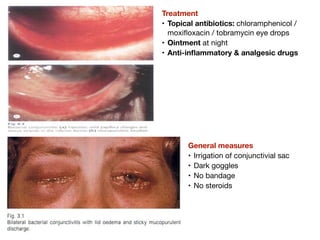
Treatment
• Topical antibiotics: chloramphenicol /
moxifloxacin / tobramycin eye drops

• Ointment at night

• Anti-inflammatory & analgesic drugs
General measures
• Irrigation of conjunctivial sac 

• Dark goggles

• No bandage

• No steroids
c. Chronic bacterial conjunctivitis
Predisposing
Factors
Mode of
Infection
Causative
Organisms
• Chronic exposure to
smoke, dust, chemical
irritants

• Local irritant as trichiasis,
concretions, FB 

• Eye-strain due to Ref
error, convergence
insufficiency

• Alcohol abuse
• As continuation of acute
mucopurulent
conjunctivitis

• As chronic infection from
chronic dacryocystitis or
chronic URI

• As a mild exogenous
infection from direct
contact or air-borne
• Staphylococcus aureus-
(most common)

• Gram - (Entrobacilli)
Symptoms 

• Burning & grittiness of eyes, specially in
evening

• Mild chronic redness

• Feeling of heat & dryness on lid margins

• Difficulty in keeping eyes open 

• Mild mucoid disharge

• On & off lacrimation

• Feeling of sleeping & tiredness in the eyes
Signs
• Congestion of posterior conjunctival
vessels 

• Mild papillary hypertrophy

• Surface of conjunctiva look sticky,
congested lid margins
Treatment
• Topical antibiotics : chloramphenicol, moxifloxacin / tobramycin eye drops.

• Astringent eye drops : zinc boric acid for symptomatic relief
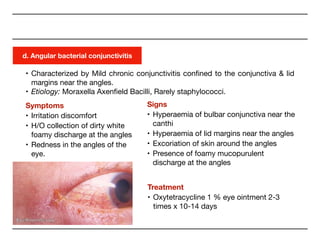
• Characterized by Mild chronic conjunctivitis confined to the conjunctiva & lid
margins near the angles.

• Etiology: Moraxella Axenfield Bacilli, Rarely staphylococci.
d. Angular bacterial conjunctivitis
Symptoms 

• Irritation discomfort

• H/O collection of dirty white
foamy discharge at the angles

• Redness in the angles of the
eye.
Signs
• Hyperaemia of bulbar conjunctiva near the
canthi

• Hyperaemia of lid margins near the angles 

• Excoriation of skin around the angles

• Presence of foamy mucopurulent
discharge at the angles
Treatment
• Oxytetracycline 1 % eye ointment 2-3
times x 10-14 days
2. Viral Conjunctivitis
• Usually benign and self-limited, (longer course approximately 2-4 weeks)
• Is highly contagious.
• Avoid touching their eyes, shaking hands, and sharing towels, among other
activities.
• Transmission; accidental inoculation of viral particles from the patient's hands
or by contact with infected upper respiratory droplets, fomites, or contaminated
swimming pools.
• Common External Ocular infection.
• In 90% cases, Adenovirus is the causative agent.
• May be Sporadic, or occur in epidemics.
• Adenovirus conjunctivitis(>90% cases).
• Herpes simplex keratoconjunctivitis.
• Herpes zoster conjunctivitis.
• Picorna viruses(Enterovirus and coxsackie virus). 

• Poxvirus conjunctivitis. 

• Myxovirus conjunctivitis.
• Parammyxovirus conjunctivitis.
• ARBOR virus conjunctivitis
Causative agents
Spread of infection
Facilitated by
• Virus can survive on dry surfaces for weeks. 

• Viral shedding may occur for many days before clinical features are apparent. 

Transmission by
• Contact with Respiratory or ocular secretions. 

• Via Contaminated Fomites such as Towels.

• Route of transmission is usually Eye-Hands-Eyes. 

• In Clinical setting,Eye-Instruments-Eye.
Presentation
Epidemic Keratoconjunctivitis
• Most severe presentation.

• Caused by adenoviruses type 8,19 and 37.

• Markedly contagious. 

• incubation period after infection (8 days) & virus shed from the inflamed eye for
2-3 weeks. 

• Keratitis occurs in 80% cases.
Non-specific acute follicular Conj.
• Most common form of acute follicular conjunctivitis 

• Caused by adenovirus serotypes 1 to 11 & 19 

• Milder form of acute follicular conjunctivitis. 

• Unilateral symptoms, Other eye involved 1-2 days later, but less severely. 

• Patient may have systemic symptoms such as sore throat or common cold.
Pharyngoconjunctival fever
• Adenoviral infection commonly associated with subtypes 3,4 & 7. 

• Acute follicular conjunctivitis, associated with pharyngitis. 

• Fever & pre-auricular lymphadenopathy.

• Cornea : superficial punctate keratitis. (30%)
Chronic/relapsing adenoviral conj. 

• Rare

• Gives a clinical picture of chronic non-specific 

• Follicles/papillas.

• Can persist over years, but eventually self limiting.
Clinical features
Symptoms 

• Watering

• Redness

• Irritation.

• Itching.

• Photophobia (When Cornea is involved).
Signs
• Eyelids Edema, Ranging from mild to Severe. 

• Lymphadenopathy Tender Pre-auricular nodes (common).

• Conjunctiva Hyperemia, Follicles. May be Papillae (Particularly superior tarsal
conjunctiva). 

• Severe Inflammation: may be associated with conjunctiva Hamorrhages,
chemosis, membranes (Rare) and pseudomembranes. Sometimes conjunctiva
Scarring.

• Keratitis (Adenoviral): PEK Usually occur in 7-10 days of onset of symptoms.
Resolving in 2 weeks. 

• Anterior Stromal infiltrates/SEI: may persist for months or years. 

• Anterior uveitis: Usually mild.
Herpes simplex Virus
• Causes Follicular conjunctivitis particularly in primary disease. 

• Usually unilateral. 

• Often Associated skin lesions. 

• Micro dendrites may be mistaken for punctate epithelial keratitis, But Corneal
sensation is reduced in HSV
Acute hemorrhagic conjunctivitis
• Usually occurs in tropical areas.

• Caused by Enterovirus and coxsackie virus (Picornavirus family).

• Rapid onset, resolves within 1-2 weeks.
Treatment
Approach Considerations
Treatment of adenoviral conjunctivitis is supportive.
Symptomatic Treatment
Cold compresses and lubricants, such as artificial tears, for comfort.
Topical vasoconstrictors and antihistamines.
Antibiotic and Topical Steroid Treatment
3. Allergic Conjunctivitis
Inflammation of conjunctiva due to allergic or hypersensitive reaction which may
be immediate (humoral ) or delayed (cellular) to specific antigens
Types
1.Simple allergic conjunctivitis 

• Hay fever conjunctivitis 

• Seasonal allergic conjunctivitis (SAC) 

• Perennial allergic conjunctivitis(PAC) 

2.Vernal keratoconjunctivitis (VKC)

3.Atopic keratoconjunctivitis (AKC)

4.Giant papillary conjunctivitis (GPC)

5.Phlyctenular keratoconjunctivitis (PKC)

6.Contact dermoconjunctivitis (CDC)
• Mild, non specific IgE mediated Type I hypersensitivity reaction.

Etiology:
• Hay fever conjunctivitis: associated with allergic rhinitis.

• Allergens: pollens, grass, animal dandruffs.

• SAC: common, grass pollens 

• PAC: not common, house dust and mites
1. Simple allergic conjunctivitis
Symptoms 

• Itching 

• Redness

• Burning sensation

• Watery discharge 

• Mild photophobia
Signs
• Hyperemia and chemosis 

• Mild papillary reaction 

• Oedema of eyelids
Treatment
• Elimination of allergens if possible 

• Cold compresses 

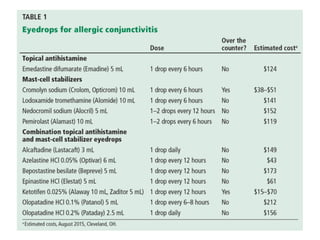
• Antihistamines oral/ topical (epinistine, fexofenadrine) 

• Mast cell stabilizers (sodium cromoglycate, lodaximide) 

• Combination( ketotifen, patalon, azelastine) 

• Topical corticosteroids 

• Immunosuppressant's (cyclosporin) for steroid resistant cases
• Recurrent, Bilateral, self limiting allergic inflammation of the conjunctiva
affecting children and young adults 

• More common in males.

• Allergic disorder in which IgE and cell mediated immune mechanism play an
important role
2. Vernal Keratoconjunctivitis (VKC)
Symptoms 

• 98% bilateral, can be asymmetric 

• Intense ocular itching, Lacrimation,
Photophobia, blepharospasm, blurred vision, FB
sensation, burning and difficulty opening eyes in
the morning. 

• Thick mucous discharge, Pseudoptosis due to
large papillae. 

• Giant papillae on the superior Palpebral
conjunctiva are the clinical hallmark.
VKC types
VKC types
VKC types
Treatment
• Topical antihistamine 

• Mast cell stabilizers: sodium chromoglycate 2 % drops 4-5 times/day 

• Topical steroid: Every 4 hrs. for 2 days followed by 3-4 times a day for 2
weeks . 

MONITOR IOP TO PREVENT STEROID INDUCED GLAUCOMA 

• Acetyl cysteine (0.5%) 

• Systemic :
I. Oral antihistamine : for itching 

II.Oral steroid : short course for very severe non responsive case 

• Treatment of large papilla supratarsal injection of long acting steroid or
surgical removal 

• General measures: dark goggles, cold compress, change of place from hot
to cold
3. Atopic Keratoconjunctivitis (AKC)
Symptoms 

• Itching 

• Soreness

• Dry sensation

• Mucoid discharge 

• Photophobia
Signs
• Lid margins: inflamed with round posterior borders

• Conjunctiva : inferiorly involve, watery discharge, milky appearance, very fine
papilla, hyperaemia scarring with shrinkage 

• Limbal: limbal involvement similar to limbal VKC 

• Cornea; punctate epithelial keratitis in lower half, vascularization , plaque
Treatment
• Topical antihistamine 

• Mast cell stabilizers: sodium chromoglycate 2 % drops 4-5 times/day 

• Topical steroiD
• Supratarsal steriod injection in severe

• Others:

!treat facial eczema and lid margin disease 

!Immunosuppressive agents( cyclosporine, tacrolimus)
4. Giant Papillary Conjunctivitis
SYMPTOMS AND SIGNS

Thick mucous discharge, inflamed superior papillae and blurry vision, FB
sensation, redness – GPC staging 

• Stage 1: itching and decreased lens tolerance 

• Stage 2: blurred vision, superior tarsal papillae ( >0.3mm) 

• Stage 3: excessive contact lens movement because tarsal papillae don’t allow
smooth movement of lid .

• Stage 4: similar appearance to mild VKC
THANK YOU

Conjunctivitis

  • 1.
    Conjunctivitis Viral, Bacterial &Allergic dr. Frenky R. de Jesus National Eye Centre Postgraduate diploma in Ophthalmology
  • 2.
    Definition The conjunctiva isa thin membrane that covers the inner surface of the eyelid and sclera The conjunctivitis is an inflammation of the conjunctiva, which eye appear red with or without discharges. Infectious Non-Infectious
  • 3.
    Classification of Conjunctivitis Infectious ViralBacterial ToxinAllergic Neoplasm Foreign Body Trauma Non-Infectious •Hyperacute • Acute • Chronic • Angular • Epidemic keratoconjunctivitis • Non specific acute follicular Conj. • Pharingoconjunctival fever. • Chronic/relapsing adenoviral.
  • 4.
    1. Allergic Conjunctivitis2. Viral Conjunctivitis 3. Bacterial Conjunctivitis
  • 5.
    1. Bacterial Conjunctivitis Predisposing Factors Modeof Infection Causative Organisms • Flies • Poor hygienic conditions • Hot dry climate • Poor sanitation • Dirty habits • Exogenous infections: directly, vector transmission, 
 material transfer. • Local spread: infected lacrimal sac, lids and nasopharynx. • Endogenous infections: blood. • Staphylococcus aureus- (most common) • Staphylococcus epidermidis • Streptococcus pneumoniae • Streptococcus pyogenes • Haemophilus influenzae • Moraxella lacunata • Pseudomonas pyocyanea • Neisseria gonorrhoeae • Neisseria meningitidis Corynebacterium diptheriae
  • 6.
    Characterised by aviolent inflammatory response. It occurs in two forms: • Adult purulent conjunctivitis (Gonococcus, staph.aureus, pneumococcus) • Ophthalmia neonatorum in newborn a. Hyperacute bacterial conjunctivitis Symptoms • Pain • Purulent discharge • Swelling of eyelids Signs • Tenderness • Purulent, copius thick discharge • Bright red velvety chemosed conjunctiva • Pre-auricular LN enlarged • Tense and swollen lids
  • 7.
    Treatment • Systemic therapy •Topical antibiotics therapy (moxifloxacin, ciprofloxacin or tobramycin) • Bacitracin ointment • Cycloplegics General measures • Frequently irrigation.
  • 8.
    • Fluoroquinolones: • 2ndgeneration: Ciprofloxacin 0.3% drops or ointment, or Ofloxacin 0.3% drops • 3rd generation: Levofloxacin 0.5% drops • 4th generation: Moxifloxacin 0.5% drops, Gatifloxacin 0.5% drops, or Besifloxacin 0.6% drops • Aminoglycosides: • Tobramycin 0.3% drops • Gentamicin 0.3% drops • Macrolides: • Erythromycin 0.5% ointment • Azithromycin 1% solution • Other • Bacitracin ointment • Bacitracin/Polymixin B ointment • Neomycin/Polymixin B/Bacitracin • Neomycin/Polymixin B/gramicidin • Polymixin B/Trimethoprim • Sulfacetamide • Chloramphenicol • Fusidic Acid (Common treatment in the UK; not used in the US) Medical Therapy
  • 9.
    • Characterized bymarked conjunctival hyperaemia and mucopurulent discharge. • Most common b. Acute bacterial conjunctivitis Symptoms • Discomfort & F.B sensation • Mucopurulent discharge • Mild photophobia • Slight blurring of vision • Sticking of lid margins Signs • Conjunctival congestion • Chemosis • Petechial haemorrhages • Flakes of mucopus • Matting of eyelashes Clinical Course • Peak in 3-4 days • Cured in 10-15 days • Pass it to chronic catarrhal
  • 10.
    Treatment • Topical antibiotics:chloramphenicol / moxifloxacin / tobramycin eye drops • Ointment at night • Anti-inflammatory & analgesic drugs General measures • Irrigation of conjunctivial sac • Dark goggles • No bandage • No steroids
  • 11.
    c. Chronic bacterialconjunctivitis Predisposing Factors Mode of Infection Causative Organisms • Chronic exposure to smoke, dust, chemical irritants • Local irritant as trichiasis, concretions, FB • Eye-strain due to Ref error, convergence insufficiency • Alcohol abuse • As continuation of acute mucopurulent conjunctivitis • As chronic infection from chronic dacryocystitis or chronic URI • As a mild exogenous infection from direct contact or air-borne • Staphylococcus aureus- (most common) • Gram - (Entrobacilli)
  • 12.
    Symptoms • Burning& grittiness of eyes, specially in evening • Mild chronic redness • Feeling of heat & dryness on lid margins • Difficulty in keeping eyes open • Mild mucoid disharge • On & off lacrimation • Feeling of sleeping & tiredness in the eyes Signs • Congestion of posterior conjunctival vessels • Mild papillary hypertrophy • Surface of conjunctiva look sticky, congested lid margins Treatment • Topical antibiotics : chloramphenicol, moxifloxacin / tobramycin eye drops. • Astringent eye drops : zinc boric acid for symptomatic relief
  • 13.
    • Characterized byMild chronic conjunctivitis confined to the conjunctiva & lid margins near the angles. • Etiology: Moraxella Axenfield Bacilli, Rarely staphylococci. d. Angular bacterial conjunctivitis Symptoms • Irritation discomfort • H/O collection of dirty white foamy discharge at the angles • Redness in the angles of the eye. Signs • Hyperaemia of bulbar conjunctiva near the canthi • Hyperaemia of lid margins near the angles • Excoriation of skin around the angles • Presence of foamy mucopurulent discharge at the angles Treatment • Oxytetracycline 1 % eye ointment 2-3 times x 10-14 days
  • 14.
    2. Viral Conjunctivitis •Usually benign and self-limited, (longer course approximately 2-4 weeks) • Is highly contagious. • Avoid touching their eyes, shaking hands, and sharing towels, among other activities. • Transmission; accidental inoculation of viral particles from the patient's hands or by contact with infected upper respiratory droplets, fomites, or contaminated swimming pools. • Common External Ocular infection. • In 90% cases, Adenovirus is the causative agent. • May be Sporadic, or occur in epidemics.
  • 15.
    • Adenovirus conjunctivitis(>90%cases). • Herpes simplex keratoconjunctivitis. • Herpes zoster conjunctivitis. • Picorna viruses(Enterovirus and coxsackie virus). • Poxvirus conjunctivitis. • Myxovirus conjunctivitis. • Parammyxovirus conjunctivitis. • ARBOR virus conjunctivitis Causative agents
  • 16.
    Spread of infection Facilitatedby • Virus can survive on dry surfaces for weeks. • Viral shedding may occur for many days before clinical features are apparent. Transmission by • Contact with Respiratory or ocular secretions. • Via Contaminated Fomites such as Towels. • Route of transmission is usually Eye-Hands-Eyes. • In Clinical setting,Eye-Instruments-Eye.
  • 17.
    Presentation Epidemic Keratoconjunctivitis • Mostsevere presentation. • Caused by adenoviruses type 8,19 and 37. • Markedly contagious. • incubation period after infection (8 days) & virus shed from the inflamed eye for 2-3 weeks. • Keratitis occurs in 80% cases. Non-specific acute follicular Conj. • Most common form of acute follicular conjunctivitis • Caused by adenovirus serotypes 1 to 11 & 19 • Milder form of acute follicular conjunctivitis. • Unilateral symptoms, Other eye involved 1-2 days later, but less severely. • Patient may have systemic symptoms such as sore throat or common cold.
  • 18.
    Pharyngoconjunctival fever • Adenoviralinfection commonly associated with subtypes 3,4 & 7. • Acute follicular conjunctivitis, associated with pharyngitis. • Fever & pre-auricular lymphadenopathy. • Cornea : superficial punctate keratitis. (30%) Chronic/relapsing adenoviral conj. • Rare • Gives a clinical picture of chronic non-specific • Follicles/papillas. • Can persist over years, but eventually self limiting.
  • 19.
    Clinical features Symptoms •Watering • Redness • Irritation. • Itching. • Photophobia (When Cornea is involved). Signs • Eyelids Edema, Ranging from mild to Severe. • Lymphadenopathy Tender Pre-auricular nodes (common). • Conjunctiva Hyperemia, Follicles. May be Papillae (Particularly superior tarsal conjunctiva). • Severe Inflammation: may be associated with conjunctiva Hamorrhages, chemosis, membranes (Rare) and pseudomembranes. Sometimes conjunctiva Scarring. • Keratitis (Adenoviral): PEK Usually occur in 7-10 days of onset of symptoms. Resolving in 2 weeks. • Anterior Stromal infiltrates/SEI: may persist for months or years. • Anterior uveitis: Usually mild.
  • 21.
    Herpes simplex Virus •Causes Follicular conjunctivitis particularly in primary disease. • Usually unilateral. • Often Associated skin lesions. • Micro dendrites may be mistaken for punctate epithelial keratitis, But Corneal sensation is reduced in HSV Acute hemorrhagic conjunctivitis • Usually occurs in tropical areas. • Caused by Enterovirus and coxsackie virus (Picornavirus family). • Rapid onset, resolves within 1-2 weeks.
  • 22.
    Treatment Approach Considerations Treatment ofadenoviral conjunctivitis is supportive. Symptomatic Treatment Cold compresses and lubricants, such as artificial tears, for comfort. Topical vasoconstrictors and antihistamines. Antibiotic and Topical Steroid Treatment
  • 23.
    3. Allergic Conjunctivitis Inflammationof conjunctiva due to allergic or hypersensitive reaction which may be immediate (humoral ) or delayed (cellular) to specific antigens
  • 24.
    Types 1.Simple allergic conjunctivitis • Hay fever conjunctivitis • Seasonal allergic conjunctivitis (SAC) • Perennial allergic conjunctivitis(PAC) 2.Vernal keratoconjunctivitis (VKC) 3.Atopic keratoconjunctivitis (AKC) 4.Giant papillary conjunctivitis (GPC) 5.Phlyctenular keratoconjunctivitis (PKC) 6.Contact dermoconjunctivitis (CDC)
  • 25.
    • Mild, nonspecific IgE mediated Type I hypersensitivity reaction. Etiology: • Hay fever conjunctivitis: associated with allergic rhinitis. • Allergens: pollens, grass, animal dandruffs. • SAC: common, grass pollens • PAC: not common, house dust and mites 1. Simple allergic conjunctivitis Symptoms • Itching • Redness • Burning sensation • Watery discharge • Mild photophobia Signs • Hyperemia and chemosis • Mild papillary reaction • Oedema of eyelids
  • 26.
    Treatment • Elimination ofallergens if possible • Cold compresses • Antihistamines oral/ topical (epinistine, fexofenadrine) • Mast cell stabilizers (sodium cromoglycate, lodaximide) • Combination( ketotifen, patalon, azelastine) • Topical corticosteroids • Immunosuppressant's (cyclosporin) for steroid resistant cases
  • 27.
    • Recurrent, Bilateral,self limiting allergic inflammation of the conjunctiva affecting children and young adults • More common in males. • Allergic disorder in which IgE and cell mediated immune mechanism play an important role 2. Vernal Keratoconjunctivitis (VKC) Symptoms • 98% bilateral, can be asymmetric • Intense ocular itching, Lacrimation, Photophobia, blepharospasm, blurred vision, FB sensation, burning and difficulty opening eyes in the morning. • Thick mucous discharge, Pseudoptosis due to large papillae. • Giant papillae on the superior Palpebral conjunctiva are the clinical hallmark.
  • 28.
  • 29.
  • 30.
  • 31.
    Treatment • Topical antihistamine • Mast cell stabilizers: sodium chromoglycate 2 % drops 4-5 times/day • Topical steroid: Every 4 hrs. for 2 days followed by 3-4 times a day for 2 weeks . 
 MONITOR IOP TO PREVENT STEROID INDUCED GLAUCOMA • Acetyl cysteine (0.5%) • Systemic : I. Oral antihistamine : for itching II.Oral steroid : short course for very severe non responsive case • Treatment of large papilla supratarsal injection of long acting steroid or surgical removal • General measures: dark goggles, cold compress, change of place from hot to cold
  • 32.
  • 33.
    Symptoms • Itching • Soreness • Dry sensation • Mucoid discharge • Photophobia Signs • Lid margins: inflamed with round posterior borders • Conjunctiva : inferiorly involve, watery discharge, milky appearance, very fine papilla, hyperaemia scarring with shrinkage • Limbal: limbal involvement similar to limbal VKC • Cornea; punctate epithelial keratitis in lower half, vascularization , plaque
  • 35.
    Treatment • Topical antihistamine • Mast cell stabilizers: sodium chromoglycate 2 % drops 4-5 times/day • Topical steroiD • Supratarsal steriod injection in severe • Others:
 !treat facial eczema and lid margin disease !Immunosuppressive agents( cyclosporine, tacrolimus)
  • 36.
    4. Giant PapillaryConjunctivitis
  • 37.
    SYMPTOMS AND SIGNS
 Thickmucous discharge, inflamed superior papillae and blurry vision, FB sensation, redness – GPC staging • Stage 1: itching and decreased lens tolerance • Stage 2: blurred vision, superior tarsal papillae ( >0.3mm) • Stage 3: excessive contact lens movement because tarsal papillae don’t allow smooth movement of lid . • Stage 4: similar appearance to mild VKC
  • 40.