Acquired ImmunodeficiencyAcquired Immunodeficiency
states & AIDSstates & AIDS
Fawzia aboaliFawzia aboali
Prof of internal medicine &clinical immunologyProf of internal medicine &clinical immunology
Ain shams faculty of medicineAin shams faculty of medicine
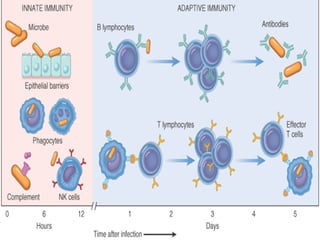
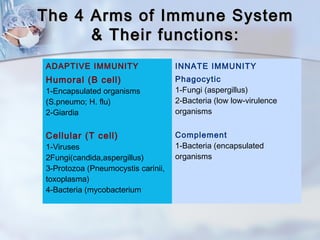
The 4 Arms of Immune SystemThe 4 Arms of Immune System
& Their functions:& Their functions:
ADAPTIVE IMMUNITY INNATE IMMUNITY
Humoral (B cell)
1-Encapsulated organisms
(S.pneumo; H. flu)
2-Giardia
Phagocytic
1-Fungi (aspergillus)
2-Bacteria (low low-virulence
organisms
Cellular (T cell)
1-Viruses
2Fungi(candida,aspergillus)
3-Protozoa (Pneumocystis carinii,
toxoplasma)
4-Bacteria (mycobacterium
Complement
1-Bacteria (encapsulated
organisms
ImmunodeficiencyImmunodeficiency
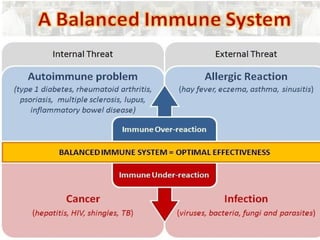
Definition
Immunodeficiency (or immune deficiency) is a
state in which the immune systemimmune system 's ability to
fight infectious disease is compromised or
entirely absent. Immunodeficiency may also
decrease cancer immunosurveillance.
 INFECTIONS
 MALIGNANCY
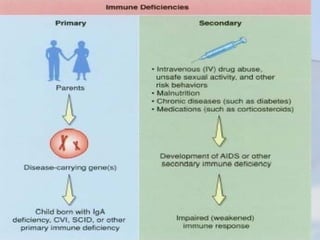
SECONDARY IMMUNE
DEFICIENCY
1.1. Acquired Immune Deficiency SyndromeAcquired Immune Deficiency Syndrome
(AIDS)(AIDS)
2.2. Cancer / Chemotherapy:Cancer / Chemotherapy:
3.3. Immunosuppression In DiabetesImmunosuppression In Diabetes
4.4. Immunosuppression In Transplant PtsImmunosuppression In Transplant Pts
5.5. Autoimmune diseaseAutoimmune disease
6.6. Immunosuppression Related to Steroid UseImmunosuppression Related to Steroid Use
7.7. Immunosuppression In Asplenic PtsImmunosuppression In Asplenic Pts
8.8. Effect of Aging On Immune CompetenceEffect of Aging On Immune Competence
9.9. pregnancypregnancy
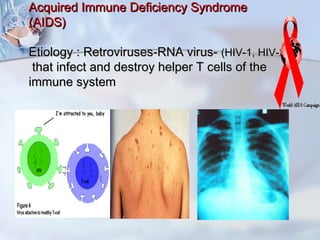
Acquired Immune Deficiency SyndromeAcquired Immune Deficiency Syndrome
(AIDS)(AIDS)
Etiology : Retroviruses-RNA virus-Etiology : Retroviruses-RNA virus- (HIV-1, HIV-2(HIV-1, HIV-2
that infect and destroy helper T cells of thethat infect and destroy helper T cells of the
immune systemimmune system
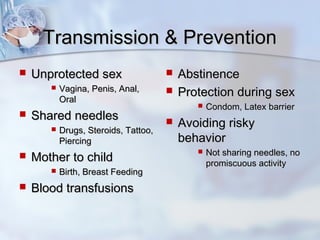
Transmission & PreventionTransmission & Prevention
 Unprotected sexUnprotected sex
 Vagina, Penis, Anal,Vagina, Penis, Anal,
OralOral
 Shared needlesShared needles
 Drugs, Steroids, Tattoo,Drugs, Steroids, Tattoo,
PiercingPiercing
 Mother to childMother to child
 Birth, Breast FeedingBirth, Breast Feeding
 Blood transfusionsBlood transfusions
 AbstinenceAbstinence
 Protection during sexProtection during sex
 Condom, Latex barrierCondom, Latex barrier
 Avoiding riskyAvoiding risky
behaviorbehavior
 Not sharing needles, noNot sharing needles, no
promiscuous activitypromiscuous activity
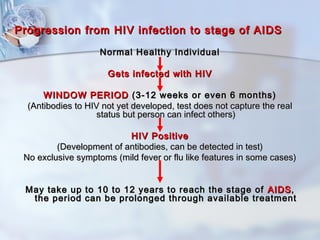
Normal Healthy IndividualNormal Healthy Individual
Gets infected with HIVGets infected with HIV
WINDOW PERIODWINDOW PERIOD (3-12 weeks or even 6 months)(3-12 weeks or even 6 months)
(Antibodies to HIV not yet developed, test does not capture the real(Antibodies to HIV not yet developed, test does not capture the real
status but person can infect others)status but person can infect others)
HIV PositiveHIV Positive
(Development of antibodies, can be detected in test)(Development of antibodies, can be detected in test)
No exclusive symptoms (mild fever or flu like features in some cases)No exclusive symptoms (mild fever or flu like features in some cases)
May take up to 10 to 12 years to reach the stage ofMay take up to 10 to 12 years to reach the stage of AIDSAIDS,,
the period can be prolonged through available treatmentthe period can be prolonged through available treatment
Progression from HIV infection to stage of AIDSProgression from HIV infection to stage of AIDS
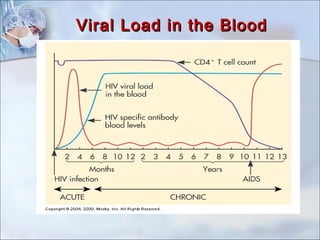
Viral Load in the BloodViral Load in the Blood
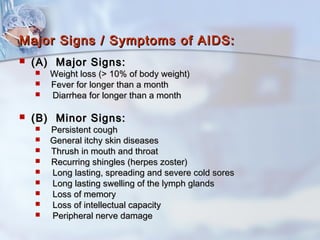
Major Signs / Symptoms of AIDS:Major Signs / Symptoms of AIDS:
 (A) Major Signs:(A) Major Signs:
 Weight loss (> 10% of body weight)Weight loss (> 10% of body weight)
 Fever for longer than a monthFever for longer than a month
 Diarrhea for longer than a monthDiarrhea for longer than a month
 (B) Minor Signs:(B) Minor Signs:
 Persistent coughPersistent cough
 General itchy skin diseasesGeneral itchy skin diseases
 Thrush in mouth and throatThrush in mouth and throat
 Recurring shingles (herpes zoster)Recurring shingles (herpes zoster)
 Long lasting, spreading and severe cold soresLong lasting, spreading and severe cold sores
 Long lasting swelling of the lymph glandsLong lasting swelling of the lymph glands
 Loss of memoryLoss of memory
 Loss of intellectual capacityLoss of intellectual capacity
 Peripheral nerve damagePeripheral nerve damage
Effect on immuneEffect on immune
systemsystem
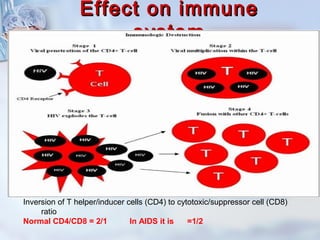
Inversion of T helper/inducer cells (CD4) to cytotoxic/suppressor cell (CD8)
ratio
Normal CD4/CD8 = 2/1 In AIDS it is =1/2
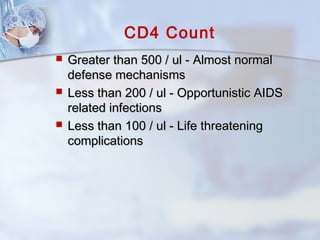
CD4 Count
 Greater than 500 / ul - Almost normalGreater than 500 / ul - Almost normal
defense mechanismsdefense mechanisms
 Less than 200 / ul - Opportunistic AIDSLess than 200 / ul - Opportunistic AIDS
related infectionsrelated infections
 Less than 100 / ul - Life threateningLess than 100 / ul - Life threatening
complicationscomplications
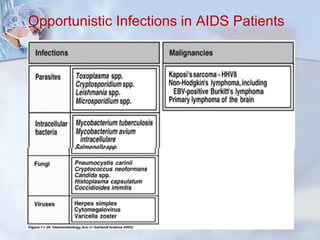
Opportunistic Infections in AIDS Patients
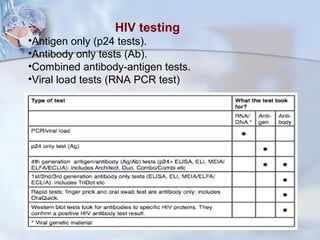
HIV testing
•Antigen only (p24 tests).
•Antibody only tests (Ab).
•Combined antibody-antigen tests.
•Viral load tests (RNA PCR test)
2.2. Cancer / Chemotherapy:Cancer / Chemotherapy:
Unfortunately in cancer, both the diseaseUnfortunately in cancer, both the disease
and the treatment can causeand the treatment can cause
immunosuppression :immunosuppression :
 NeutropeniaNeutropenia
 Cell Mediated ImmunityCell Mediated Immunity
 Humoral factorsHumoral factors
Neutropenia
 Occurs approximately two weeks after the lastOccurs approximately two weeks after the last
dose of chemotherapydose of chemotherapy
 an absolute neutrophil count of less than 1,000an absolute neutrophil count of less than 1,000
cells/mm3 on the way down are at increased riskcells/mm3 on the way down are at increased risk
for a serious bacterial infection.for a serious bacterial infection.
Management strategy:
1. All patients with anticipated severe neutropenia1. All patients with anticipated severe neutropenia
(ANC < 0.5 x 10⁹/l), should receive prophylaxis(ANC < 0.5 x 10⁹/l), should receive prophylaxis
against bacteria, fungi,viruses&against bacteria, fungi,viruses&G-CSFG-CSF
2. Neutropenic patients who present with fever2. Neutropenic patients who present with fever
require a prompt switch to an appropriate treatmentrequire a prompt switch to an appropriate treatment
regimeregime
3. Immunosuppression In Diabetes
 Humoral Immunity:Humoral Immunity:
normalnormal Ab levels & vaccination responses.Ab levels & vaccination responses.
 Impaired Cellular Immunity:Impaired Cellular Immunity:
 Impaired( innate) neotrophil functionsImpaired( innate) neotrophil functions
Infections In Diabetics
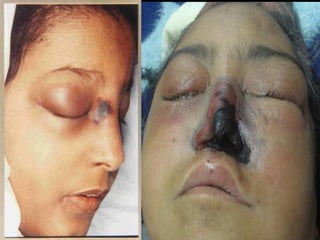
 rhinocerebral mucormycosisrhinocerebral mucormycosis
 oral &esophageal candidiasisoral &esophageal candidiasis
 T.BT.B
 surgical / wound infectionsurgical / wound infection
GSACEP © 2005
4. Immunosuppression In Transplant Pts
 Infection 2nd most impt problem posttransplantationInfection 2nd most impt problem posttransplantation
Pre-transplant Host Factors:Pre-transplant Host Factors:
 ongoing medical conditions (HBV, HCV, diabetes)ongoing medical conditions (HBV, HCV, diabetes)
 prior MO colonization (prior MO colonization ( Candida, staph)Candida, staph)
 prior latent infection (TB, CMV)prior latent infection (TB, CMV)
 prior medications (i.e. immunosuppressives,prior medications (i.e. immunosuppressives,
antibiotics)antibiotics)
Common Microbial Etiologies Post-TransplantationCommon Microbial Etiologies Post-Transplantation
 BacteriaBacteria: common gm+ & gm- flora: common gm+ & gm- flora
 Fungi:Fungi: Candida sp.; Aspergillus spCandida sp.; Aspergillus sp
5. Immunosuppression in autoimmune
Diseases:
Multiple infection risk factorsMultiple infection risk factors::
1. functional defect in phagocytic cells.1. functional defect in phagocytic cells.
2. CMI defects: lymphopenia, CD4 - cell2. CMI defects: lymphopenia, CD4 - cell
3. reduced Ab levels & low complement levels.3. reduced Ab levels & low complement levels.
4. functional asplenia.4. functional asplenia.
5. also, corticosteroids & immunosuppressives5. also, corticosteroids & immunosuppressives
increase infection risks.increase infection risks.
6.6. Immunosuppression Related to Steroid UseImmunosuppression Related to Steroid Use
 Glucocorticoids (corticosteroids) have inhibitoryGlucocorticoids (corticosteroids) have inhibitory
effects on T cells and B cells, as well aseffects on T cells and B cells, as well as
phagocytes.phagocytes.
 Infections depend on route of administration,Infections depend on route of administration,
dose, & duration of therapy.dose, & duration of therapy.
Infections Related to Steroid UseInfections Related to Steroid Use
 increased susceptibility to all types ofincreased susceptibility to all types of
infection.infection.
 Prolonged CMI suppression important forProlonged CMI suppression important for
opportunistic infection to occur.opportunistic infection to occur.
 Fever may be absentFever may be absent
 delayed wound healing & wound infections:delayed wound healing & wound infections:
steroids interfere with fibroblast proliferation &steroids interfere with fibroblast proliferation &
collagen synthesis.collagen synthesis.
7.7. Immunosuppression In Asplenic PtsImmunosuppression In Asplenic Pts
• lower C3 levels & defective responses to encapsulatedlower C3 levels & defective responses to encapsulated
bacterial pathogensbacterial pathogens
• decreased phagocytosisdecreased phagocytosis
• failure to recognize polysaccharide Ag’s.failure to recognize polysaccharide Ag’s.
• impaired IgM synthesis early in infection.impaired IgM synthesis early in infection.
Pathogen:Pathogen:
-S. pneumoniae ,H influenzae ,-S. pneumoniae ,H influenzae ,N. meningitidisN. meningitidis
 Sickle CellSickle Cell
Functionally aspenic (ask about immunizations!)Functionally aspenic (ask about immunizations!)
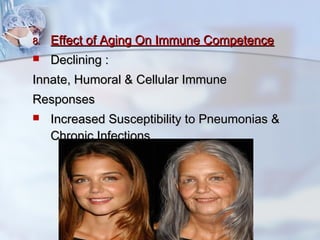
8.8. Effect of Aging On Immune CompetenceEffect of Aging On Immune Competence
 Declining :Declining :
Innate, Humoral & Cellular ImmuneInnate, Humoral & Cellular Immune
ResponsesResponses
 Increased Susceptibility to Pneumonias &Increased Susceptibility to Pneumonias &
Chronic InfectionsChronic Infections
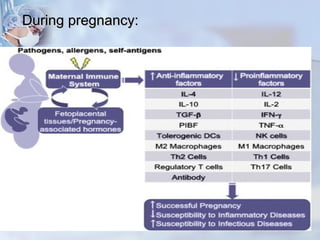
During pregnancy:During pregnancy:
Initial Evaluation of Possible
Immunodeficiency
 Make sure that what seems to be infections are notMake sure that what seems to be infections are not
really:really: ATOPY, ALLERGY, ASTHMAATOPY, ALLERGY, ASTHMA
 Hold off on any live vaccines.Hold off on any live vaccines.
 Document that there have been multiple infectionsDocument that there have been multiple infections
 Exclude secondary causes of immune deficiencyExclude secondary causes of immune deficiency
 Look for other, non-immune features ofLook for other, non-immune features of
immunodeficiency:immunodeficiency: rash, hypocalcemia, facialrash, hypocalcemia, facial
characteristicscharacteristics
 Family historyFamily history
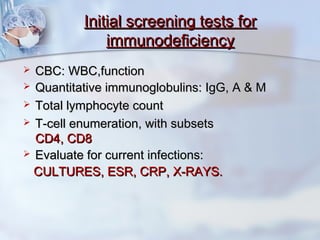
Initial screening tests forInitial screening tests for
immunodeficiencyimmunodeficiency
 CBC: WBC,functionCBC: WBC,function
 Quantitative immunoglobulins: IgG, A & MQuantitative immunoglobulins: IgG, A & M
 Total lymphocyte countTotal lymphocyte count
 T-cell enumeration, with subsetsT-cell enumeration, with subsets
CD4, CD8CD4, CD8
 Evaluate for current infections:Evaluate for current infections:
CULTURES, ESR, CRP, X-RAYS.CULTURES, ESR, CRP, X-RAYS.
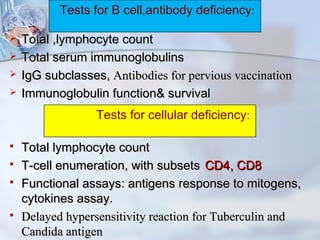
 Total ,lymphocyte countTotal ,lymphocyte count
 Total serum immunoglobulinsTotal serum immunoglobulins
 IgG subclasses,IgG subclasses, Antibodies for pervious vaccinationAntibodies for pervious vaccination
 Immunoglobulin function& survivalImmunoglobulin function& survival
 Total lymphocyte countTotal lymphocyte count
 T-cell enumeration, with subsetsT-cell enumeration, with subsets CD4, CD8CD4, CD8
 Functional assays: antigens response to mitogens,Functional assays: antigens response to mitogens,
cytokines assay.cytokines assay.
 Delayed hypersensitivity reaction for Tuberculin andDelayed hypersensitivity reaction for Tuberculin and
Candida antigenCandida antigen
Tests for B cell,antibody deficiency:
Tests for cellular deficiency:
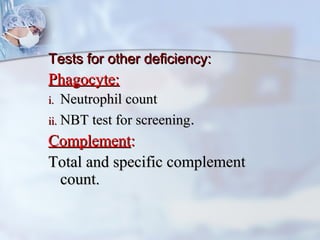
Tests for other deficiency:Tests for other deficiency:
Phagocyte:Phagocyte:
i.i. Neutrophil countNeutrophil count
ii.ii. NBT test for screeningNBT test for screening..
ComplementComplement::
Total and specific complementTotal and specific complement
count.count.
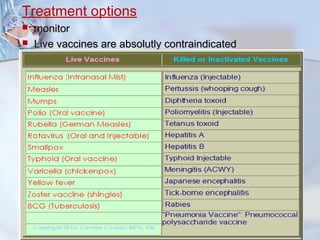
Treatment options
 monitormonitor
 Live vaccines are absolutly contraindicatedLive vaccines are absolutly contraindicated
1.1. Treatment of the cause (secondary causes)Treatment of the cause (secondary causes)
2.2. Other Treatment: for special cases:Other Treatment: for special cases:
• IVIG .( IV infusion of immunoglobulin.)IVIG .( IV infusion of immunoglobulin.)
• Periodic antibiotic treatment.Periodic antibiotic treatment.
• Bone marrow transplantation .Bone marrow transplantation .
• CSF.(colony stimulating factor ) For : neutropeniaCSF.(colony stimulating factor ) For : neutropenia
• Thymus transplantation .Thymus transplantation .
• IFN – gamma . For : CGD.IFN – gamma . For : CGD.
• gene therapygene therapy
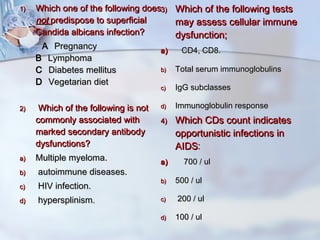
1)1) Which one of the following doesWhich one of the following does
notnot predispose to superficialpredispose to superficial
Candida albicans infection?Candida albicans infection?
A A  Pregnancy Pregnancy
B B  Lymphoma Lymphoma
C C  Diabetes mellitus Diabetes mellitus
D D  Vegetarian diet Vegetarian diet
2)2)   Which of the following is notWhich of the following is not
commonly associated withcommonly associated with
marked secondary antibodymarked secondary antibody
dysfunctions?dysfunctions?
a)a) Multiple myeloma.Multiple myeloma.
b)b)   autoimmune diseases.autoimmune diseases.
c)c)   HIV infection.HIV infection.
d)d)   hypersplinism.hypersplinism.
3)3) Which of the following testsWhich of the following tests
may assess cellular immunemay assess cellular immune
dysfunction;dysfunction;
a)a)     CD4, CD8.CD4, CD8.
b)b) Total serum immunoglobulinsTotal serum immunoglobulins
c)c) IgG subclassesIgG subclasses
d)d) Immunoglobulin responseImmunoglobulin response
4)4) Which CDs count indicatesWhich CDs count indicates
opportunistic infections inopportunistic infections in
AIDSAIDS::
a)a)      700 / ul700 / ul
b)b) 500 / ul500 / ul
c)c) 200 / ul200 / ul
d)d) 100 / ul100 / ul
Acquired id states&amp;aids

Acquired id states&amp;aids

  • 1.
    Acquired ImmunodeficiencyAcquired Immunodeficiency states& AIDSstates & AIDS Fawzia aboaliFawzia aboali Prof of internal medicine &clinical immunologyProf of internal medicine &clinical immunology Ain shams faculty of medicineAin shams faculty of medicine
  • 4.
    The 4 Armsof Immune SystemThe 4 Arms of Immune System & Their functions:& Their functions: ADAPTIVE IMMUNITY INNATE IMMUNITY Humoral (B cell) 1-Encapsulated organisms (S.pneumo; H. flu) 2-Giardia Phagocytic 1-Fungi (aspergillus) 2-Bacteria (low low-virulence organisms Cellular (T cell) 1-Viruses 2Fungi(candida,aspergillus) 3-Protozoa (Pneumocystis carinii, toxoplasma) 4-Bacteria (mycobacterium Complement 1-Bacteria (encapsulated organisms
  • 5.
    ImmunodeficiencyImmunodeficiency Definition Immunodeficiency (or immunedeficiency) is a state in which the immune systemimmune system 's ability to fight infectious disease is compromised or entirely absent. Immunodeficiency may also decrease cancer immunosurveillance.  INFECTIONS  MALIGNANCY
  • 7.
    SECONDARY IMMUNE DEFICIENCY 1.1. AcquiredImmune Deficiency SyndromeAcquired Immune Deficiency Syndrome (AIDS)(AIDS) 2.2. Cancer / Chemotherapy:Cancer / Chemotherapy: 3.3. Immunosuppression In DiabetesImmunosuppression In Diabetes 4.4. Immunosuppression In Transplant PtsImmunosuppression In Transplant Pts 5.5. Autoimmune diseaseAutoimmune disease 6.6. Immunosuppression Related to Steroid UseImmunosuppression Related to Steroid Use 7.7. Immunosuppression In Asplenic PtsImmunosuppression In Asplenic Pts 8.8. Effect of Aging On Immune CompetenceEffect of Aging On Immune Competence 9.9. pregnancypregnancy
  • 8.
    Acquired Immune DeficiencySyndromeAcquired Immune Deficiency Syndrome (AIDS)(AIDS) Etiology : Retroviruses-RNA virus-Etiology : Retroviruses-RNA virus- (HIV-1, HIV-2(HIV-1, HIV-2 that infect and destroy helper T cells of thethat infect and destroy helper T cells of the immune systemimmune system
  • 9.
    Transmission & PreventionTransmission& Prevention  Unprotected sexUnprotected sex  Vagina, Penis, Anal,Vagina, Penis, Anal, OralOral  Shared needlesShared needles  Drugs, Steroids, Tattoo,Drugs, Steroids, Tattoo, PiercingPiercing  Mother to childMother to child  Birth, Breast FeedingBirth, Breast Feeding  Blood transfusionsBlood transfusions  AbstinenceAbstinence  Protection during sexProtection during sex  Condom, Latex barrierCondom, Latex barrier  Avoiding riskyAvoiding risky behaviorbehavior  Not sharing needles, noNot sharing needles, no promiscuous activitypromiscuous activity
  • 10.
    Normal Healthy IndividualNormalHealthy Individual Gets infected with HIVGets infected with HIV WINDOW PERIODWINDOW PERIOD (3-12 weeks or even 6 months)(3-12 weeks or even 6 months) (Antibodies to HIV not yet developed, test does not capture the real(Antibodies to HIV not yet developed, test does not capture the real status but person can infect others)status but person can infect others) HIV PositiveHIV Positive (Development of antibodies, can be detected in test)(Development of antibodies, can be detected in test) No exclusive symptoms (mild fever or flu like features in some cases)No exclusive symptoms (mild fever or flu like features in some cases) May take up to 10 to 12 years to reach the stage ofMay take up to 10 to 12 years to reach the stage of AIDSAIDS,, the period can be prolonged through available treatmentthe period can be prolonged through available treatment Progression from HIV infection to stage of AIDSProgression from HIV infection to stage of AIDS
  • 11.
    Viral Load inthe BloodViral Load in the Blood
  • 12.
    Major Signs /Symptoms of AIDS:Major Signs / Symptoms of AIDS:  (A) Major Signs:(A) Major Signs:  Weight loss (> 10% of body weight)Weight loss (> 10% of body weight)  Fever for longer than a monthFever for longer than a month  Diarrhea for longer than a monthDiarrhea for longer than a month  (B) Minor Signs:(B) Minor Signs:  Persistent coughPersistent cough  General itchy skin diseasesGeneral itchy skin diseases  Thrush in mouth and throatThrush in mouth and throat  Recurring shingles (herpes zoster)Recurring shingles (herpes zoster)  Long lasting, spreading and severe cold soresLong lasting, spreading and severe cold sores  Long lasting swelling of the lymph glandsLong lasting swelling of the lymph glands  Loss of memoryLoss of memory  Loss of intellectual capacityLoss of intellectual capacity  Peripheral nerve damagePeripheral nerve damage
  • 13.
    Effect on immuneEffecton immune systemsystem Inversion of T helper/inducer cells (CD4) to cytotoxic/suppressor cell (CD8) ratio Normal CD4/CD8 = 2/1 In AIDS it is =1/2
  • 14.
    CD4 Count  Greaterthan 500 / ul - Almost normalGreater than 500 / ul - Almost normal defense mechanismsdefense mechanisms  Less than 200 / ul - Opportunistic AIDSLess than 200 / ul - Opportunistic AIDS related infectionsrelated infections  Less than 100 / ul - Life threateningLess than 100 / ul - Life threatening complicationscomplications
  • 15.
  • 16.
    HIV testing •Antigen only(p24 tests). •Antibody only tests (Ab). •Combined antibody-antigen tests. •Viral load tests (RNA PCR test)
  • 17.
    2.2. Cancer /Chemotherapy:Cancer / Chemotherapy: Unfortunately in cancer, both the diseaseUnfortunately in cancer, both the disease and the treatment can causeand the treatment can cause immunosuppression :immunosuppression :  NeutropeniaNeutropenia  Cell Mediated ImmunityCell Mediated Immunity  Humoral factorsHumoral factors
  • 18.
    Neutropenia  Occurs approximatelytwo weeks after the lastOccurs approximately two weeks after the last dose of chemotherapydose of chemotherapy  an absolute neutrophil count of less than 1,000an absolute neutrophil count of less than 1,000 cells/mm3 on the way down are at increased riskcells/mm3 on the way down are at increased risk for a serious bacterial infection.for a serious bacterial infection. Management strategy: 1. All patients with anticipated severe neutropenia1. All patients with anticipated severe neutropenia (ANC < 0.5 x 10⁹/l), should receive prophylaxis(ANC < 0.5 x 10⁹/l), should receive prophylaxis against bacteria, fungi,viruses&against bacteria, fungi,viruses&G-CSFG-CSF 2. Neutropenic patients who present with fever2. Neutropenic patients who present with fever require a prompt switch to an appropriate treatmentrequire a prompt switch to an appropriate treatment regimeregime
  • 19.
    3. Immunosuppression InDiabetes  Humoral Immunity:Humoral Immunity: normalnormal Ab levels & vaccination responses.Ab levels & vaccination responses.  Impaired Cellular Immunity:Impaired Cellular Immunity:  Impaired( innate) neotrophil functionsImpaired( innate) neotrophil functions Infections In Diabetics  rhinocerebral mucormycosisrhinocerebral mucormycosis  oral &esophageal candidiasisoral &esophageal candidiasis  T.BT.B  surgical / wound infectionsurgical / wound infection
  • 20.
  • 21.
    4. Immunosuppression InTransplant Pts  Infection 2nd most impt problem posttransplantationInfection 2nd most impt problem posttransplantation Pre-transplant Host Factors:Pre-transplant Host Factors:  ongoing medical conditions (HBV, HCV, diabetes)ongoing medical conditions (HBV, HCV, diabetes)  prior MO colonization (prior MO colonization ( Candida, staph)Candida, staph)  prior latent infection (TB, CMV)prior latent infection (TB, CMV)  prior medications (i.e. immunosuppressives,prior medications (i.e. immunosuppressives, antibiotics)antibiotics) Common Microbial Etiologies Post-TransplantationCommon Microbial Etiologies Post-Transplantation  BacteriaBacteria: common gm+ & gm- flora: common gm+ & gm- flora  Fungi:Fungi: Candida sp.; Aspergillus spCandida sp.; Aspergillus sp
  • 22.
    5. Immunosuppression inautoimmune Diseases: Multiple infection risk factorsMultiple infection risk factors:: 1. functional defect in phagocytic cells.1. functional defect in phagocytic cells. 2. CMI defects: lymphopenia, CD4 - cell2. CMI defects: lymphopenia, CD4 - cell 3. reduced Ab levels & low complement levels.3. reduced Ab levels & low complement levels. 4. functional asplenia.4. functional asplenia. 5. also, corticosteroids & immunosuppressives5. also, corticosteroids & immunosuppressives increase infection risks.increase infection risks.
  • 23.
    6.6. Immunosuppression Relatedto Steroid UseImmunosuppression Related to Steroid Use  Glucocorticoids (corticosteroids) have inhibitoryGlucocorticoids (corticosteroids) have inhibitory effects on T cells and B cells, as well aseffects on T cells and B cells, as well as phagocytes.phagocytes.  Infections depend on route of administration,Infections depend on route of administration, dose, & duration of therapy.dose, & duration of therapy.
  • 24.
    Infections Related toSteroid UseInfections Related to Steroid Use  increased susceptibility to all types ofincreased susceptibility to all types of infection.infection.  Prolonged CMI suppression important forProlonged CMI suppression important for opportunistic infection to occur.opportunistic infection to occur.  Fever may be absentFever may be absent  delayed wound healing & wound infections:delayed wound healing & wound infections: steroids interfere with fibroblast proliferation &steroids interfere with fibroblast proliferation & collagen synthesis.collagen synthesis.
  • 25.
    7.7. Immunosuppression InAsplenic PtsImmunosuppression In Asplenic Pts • lower C3 levels & defective responses to encapsulatedlower C3 levels & defective responses to encapsulated bacterial pathogensbacterial pathogens • decreased phagocytosisdecreased phagocytosis • failure to recognize polysaccharide Ag’s.failure to recognize polysaccharide Ag’s. • impaired IgM synthesis early in infection.impaired IgM synthesis early in infection. Pathogen:Pathogen: -S. pneumoniae ,H influenzae ,-S. pneumoniae ,H influenzae ,N. meningitidisN. meningitidis  Sickle CellSickle Cell Functionally aspenic (ask about immunizations!)Functionally aspenic (ask about immunizations!)
  • 26.
    8.8. Effect ofAging On Immune CompetenceEffect of Aging On Immune Competence  Declining :Declining : Innate, Humoral & Cellular ImmuneInnate, Humoral & Cellular Immune ResponsesResponses  Increased Susceptibility to Pneumonias &Increased Susceptibility to Pneumonias & Chronic InfectionsChronic Infections
  • 27.
  • 28.
    Initial Evaluation ofPossible Immunodeficiency  Make sure that what seems to be infections are notMake sure that what seems to be infections are not really:really: ATOPY, ALLERGY, ASTHMAATOPY, ALLERGY, ASTHMA  Hold off on any live vaccines.Hold off on any live vaccines.  Document that there have been multiple infectionsDocument that there have been multiple infections  Exclude secondary causes of immune deficiencyExclude secondary causes of immune deficiency  Look for other, non-immune features ofLook for other, non-immune features of immunodeficiency:immunodeficiency: rash, hypocalcemia, facialrash, hypocalcemia, facial characteristicscharacteristics  Family historyFamily history
  • 29.
    Initial screening testsforInitial screening tests for immunodeficiencyimmunodeficiency  CBC: WBC,functionCBC: WBC,function  Quantitative immunoglobulins: IgG, A & MQuantitative immunoglobulins: IgG, A & M  Total lymphocyte countTotal lymphocyte count  T-cell enumeration, with subsetsT-cell enumeration, with subsets CD4, CD8CD4, CD8  Evaluate for current infections:Evaluate for current infections: CULTURES, ESR, CRP, X-RAYS.CULTURES, ESR, CRP, X-RAYS.
  • 30.
     Total ,lymphocytecountTotal ,lymphocyte count  Total serum immunoglobulinsTotal serum immunoglobulins  IgG subclasses,IgG subclasses, Antibodies for pervious vaccinationAntibodies for pervious vaccination  Immunoglobulin function& survivalImmunoglobulin function& survival  Total lymphocyte countTotal lymphocyte count  T-cell enumeration, with subsetsT-cell enumeration, with subsets CD4, CD8CD4, CD8  Functional assays: antigens response to mitogens,Functional assays: antigens response to mitogens, cytokines assay.cytokines assay.  Delayed hypersensitivity reaction for Tuberculin andDelayed hypersensitivity reaction for Tuberculin and Candida antigenCandida antigen Tests for B cell,antibody deficiency: Tests for cellular deficiency:
  • 31.
    Tests for otherdeficiency:Tests for other deficiency: Phagocyte:Phagocyte: i.i. Neutrophil countNeutrophil count ii.ii. NBT test for screeningNBT test for screening.. ComplementComplement:: Total and specific complementTotal and specific complement count.count.
  • 32.
    Treatment options  monitormonitor Live vaccines are absolutly contraindicatedLive vaccines are absolutly contraindicated
  • 33.
    1.1. Treatment ofthe cause (secondary causes)Treatment of the cause (secondary causes) 2.2. Other Treatment: for special cases:Other Treatment: for special cases: • IVIG .( IV infusion of immunoglobulin.)IVIG .( IV infusion of immunoglobulin.) • Periodic antibiotic treatment.Periodic antibiotic treatment. • Bone marrow transplantation .Bone marrow transplantation . • CSF.(colony stimulating factor ) For : neutropeniaCSF.(colony stimulating factor ) For : neutropenia • Thymus transplantation .Thymus transplantation . • IFN – gamma . For : CGD.IFN – gamma . For : CGD. • gene therapygene therapy
  • 34.
    1)1) Which oneof the following doesWhich one of the following does notnot predispose to superficialpredispose to superficial Candida albicans infection?Candida albicans infection? A A  Pregnancy Pregnancy B B  Lymphoma Lymphoma C C  Diabetes mellitus Diabetes mellitus D D  Vegetarian diet Vegetarian diet 2)2)   Which of the following is notWhich of the following is not commonly associated withcommonly associated with marked secondary antibodymarked secondary antibody dysfunctions?dysfunctions? a)a) Multiple myeloma.Multiple myeloma. b)b)   autoimmune diseases.autoimmune diseases. c)c)   HIV infection.HIV infection. d)d)   hypersplinism.hypersplinism. 3)3) Which of the following testsWhich of the following tests may assess cellular immunemay assess cellular immune dysfunction;dysfunction; a)a)     CD4, CD8.CD4, CD8. b)b) Total serum immunoglobulinsTotal serum immunoglobulins c)c) IgG subclassesIgG subclasses d)d) Immunoglobulin responseImmunoglobulin response 4)4) Which CDs count indicatesWhich CDs count indicates opportunistic infections inopportunistic infections in AIDSAIDS:: a)a)      700 / ul700 / ul b)b) 500 / ul500 / ul c)c) 200 / ul200 / ul d)d) 100 / ul100 / ul

Editor's Notes

  • #6 In this series of slides, we will focus our discussions upon deficiencies of the major components of the immune system. The general theme of the immunodeficient individual for recurrent infections. Immunodeficiency can be separated into primary and secondary states and the type of infection suggests the particular component of the system involved. In this series of slides we will deal only with primary immunodeficiency states. Secondary immunodeficiency states result when the immune defect observed clearly results from infection, drugs (e.g. cytotoxic agents, steroids) protein losing states, or lymphoreticular malignancy.
  • #15 CD4 counts are important in these patients as they help define who is at risk for serious infections. Patients with a CD4 count greater than 500/ul show almost normal defense mechanisms. A CD4 count less than 200/ul puts the patient at risk for the opportunistic AIDS related infections. A CD4 count less than 100/ul are at significant risk for life threatening complications.
  • #18 Unfortunately in cancer, both the disease and the treatment can cause immunosuppression. Cancer and the subsequent chemotherapy causes immune defects in granulocytes (Absolute neutrophil count), cell mediated immunity (bone marrow depression), and other humoral factors. The presence of fever in these patients is secondary to a bacterial infection approximately 55% of the time. Other causes of fever include tumor fever, chemotherapy, drug, inflammation, and fungal infection. Granulocytopenia lasting greater then 10 days increases the risk of developing critical infections.
  • #19 In the evaluation of these patients, one of the most important pieces of information to illicit is the timing of the last dose of chemotherapy and/or radiation therapy to determine the approximate time of the nadir of the patient’s absolute neutrophil count. This usually occurs approximately two weeks after the last dose of chemotherapy. Calculate the absolute neutrophil count by multiplying the total WBC count by the percentage of neutrophils. Keep in mind that patients with an absolute neutrophil count of less than 1,000 cells/mm3 on the way down are at increased risk for a serious bacterial infection. Many do not consider patients to be neutropenic unless the ANC is less than 500 cells/mm3.