PROPERTIES OF SEAWATER
Aminul Islam
CHEMICAL COMPOSITION OF SEAWATER
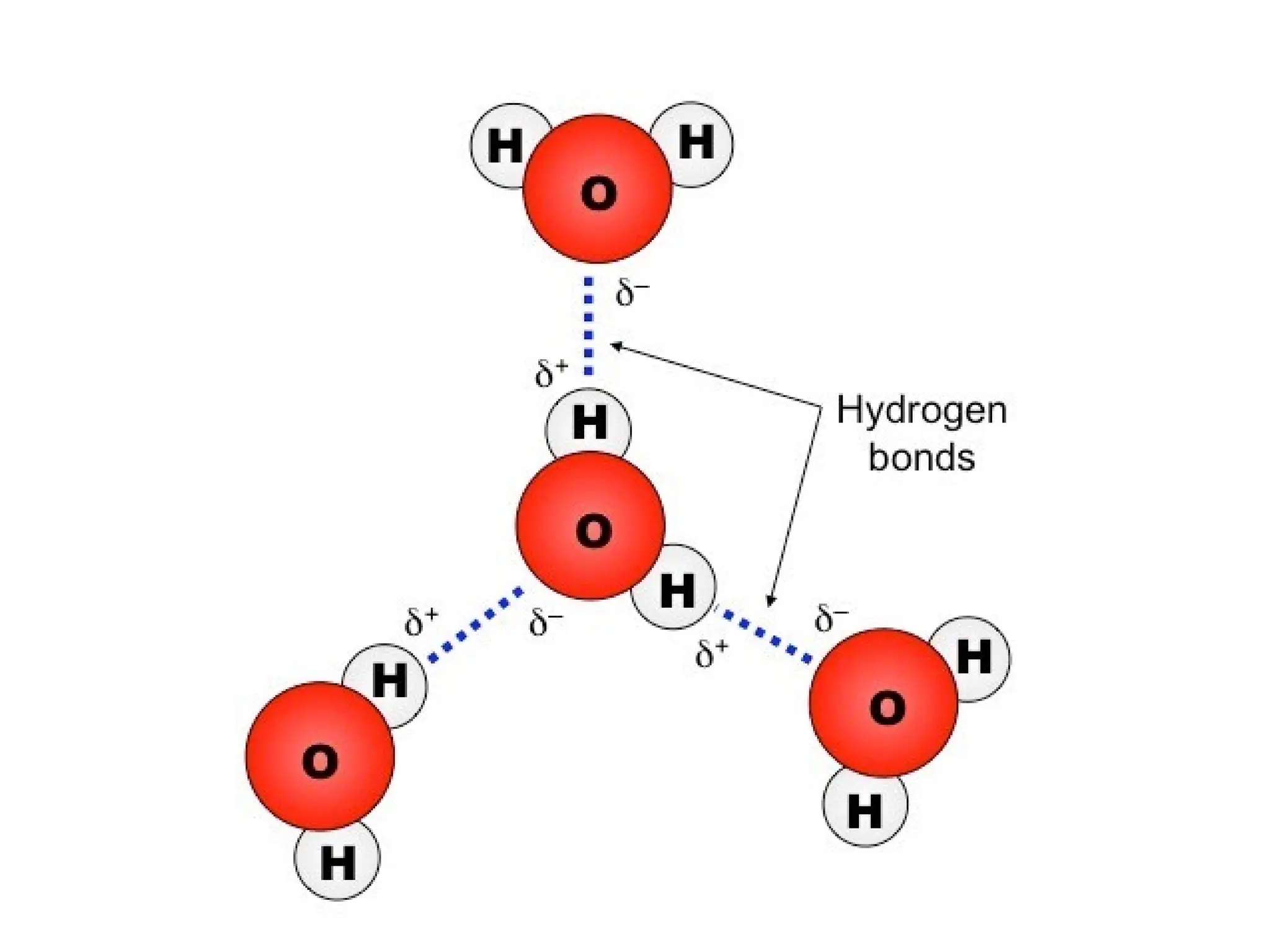
MOLECULAR STRUCTURE OF WATER
PROPERTIES OF WATER
Properties Meaning
Polar
molecule
A neutral, or uncharged molecule that has an
asymmetric internal distribution of charge, leading
to partially positive and partially negative regions
Cohesion
The attraction of molecules for other molecules of
the same kind
Adhesion
The attraction of molecules for other molecules of
a different kind
Density The mass per unit volume of a substance
PROPERTIES OF WATER
Properties Meaning
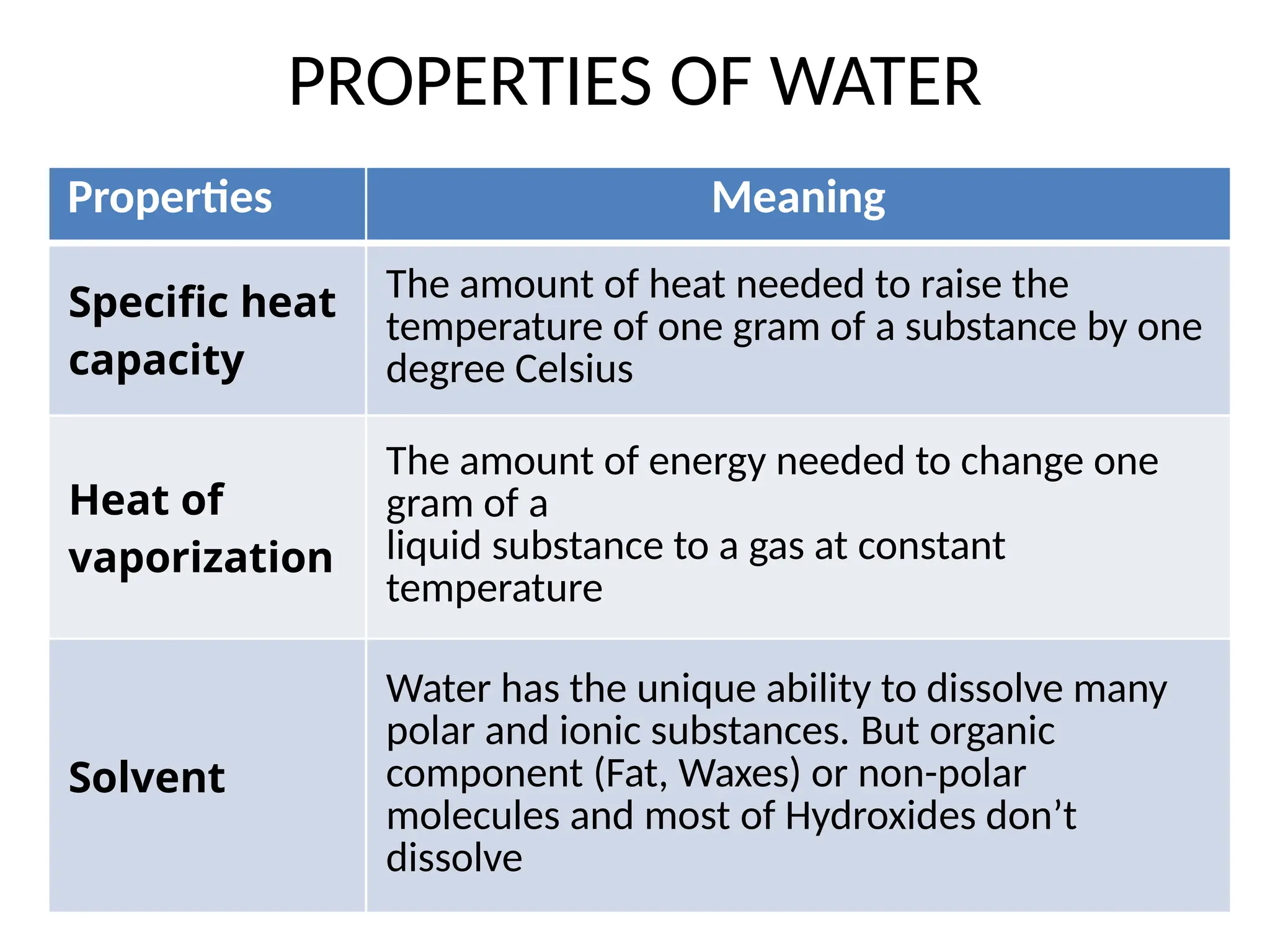
Specific heat
capacity
The amount of heat needed to raise the
temperature of one gram of a substance by one
degree Celsius
Heat of
vaporization
The amount of energy needed to change one
gram of a
liquid substance to a gas at constant
temperature
Solvent
Water has the unique ability to dissolve many
polar and ionic substances. But organic
component (Fat, Waxes) or non-polar
molecules and most of Hydroxides don’t
dissolve
WATER IS THE UNIVERSAL SOLVENT
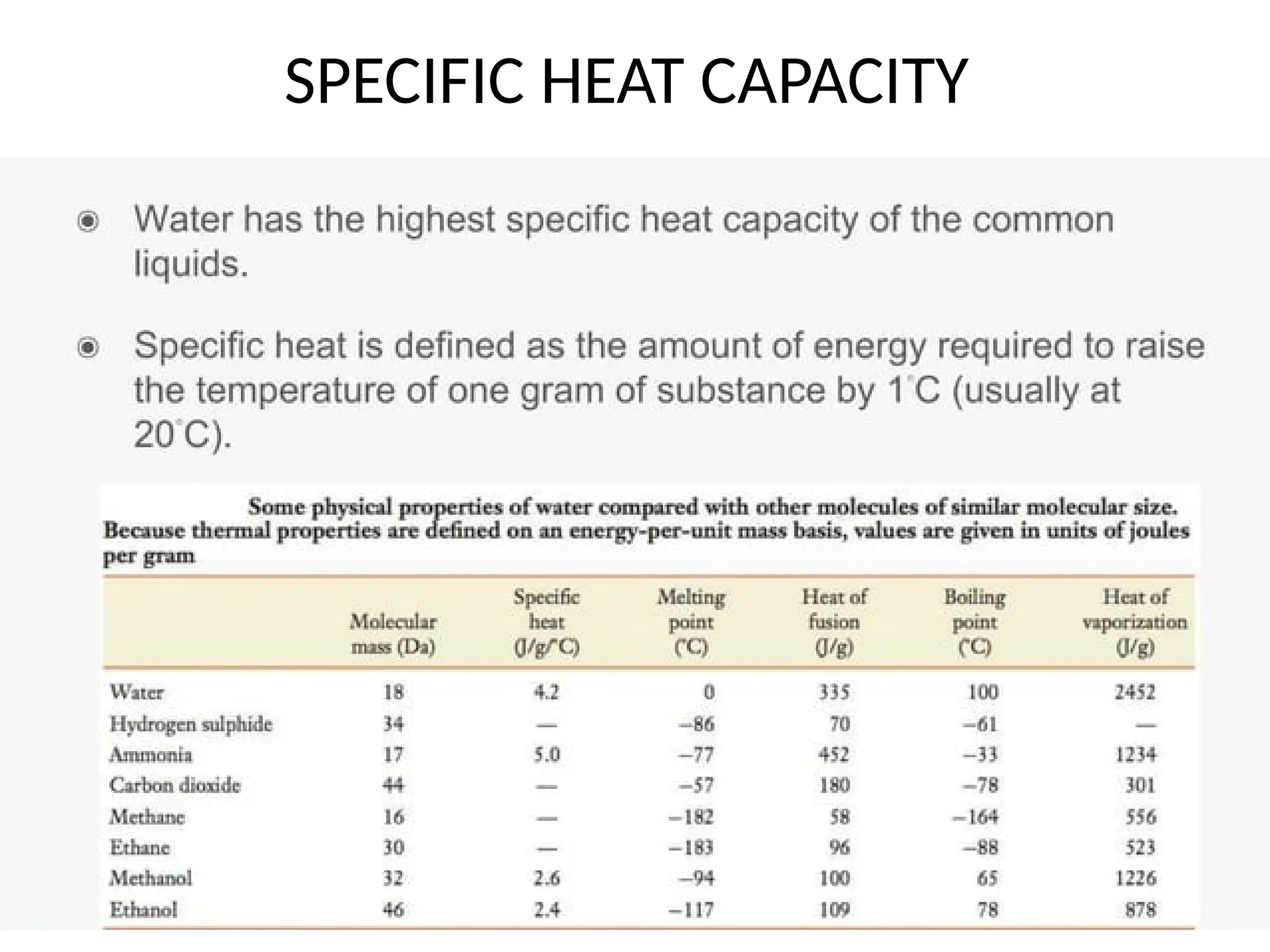
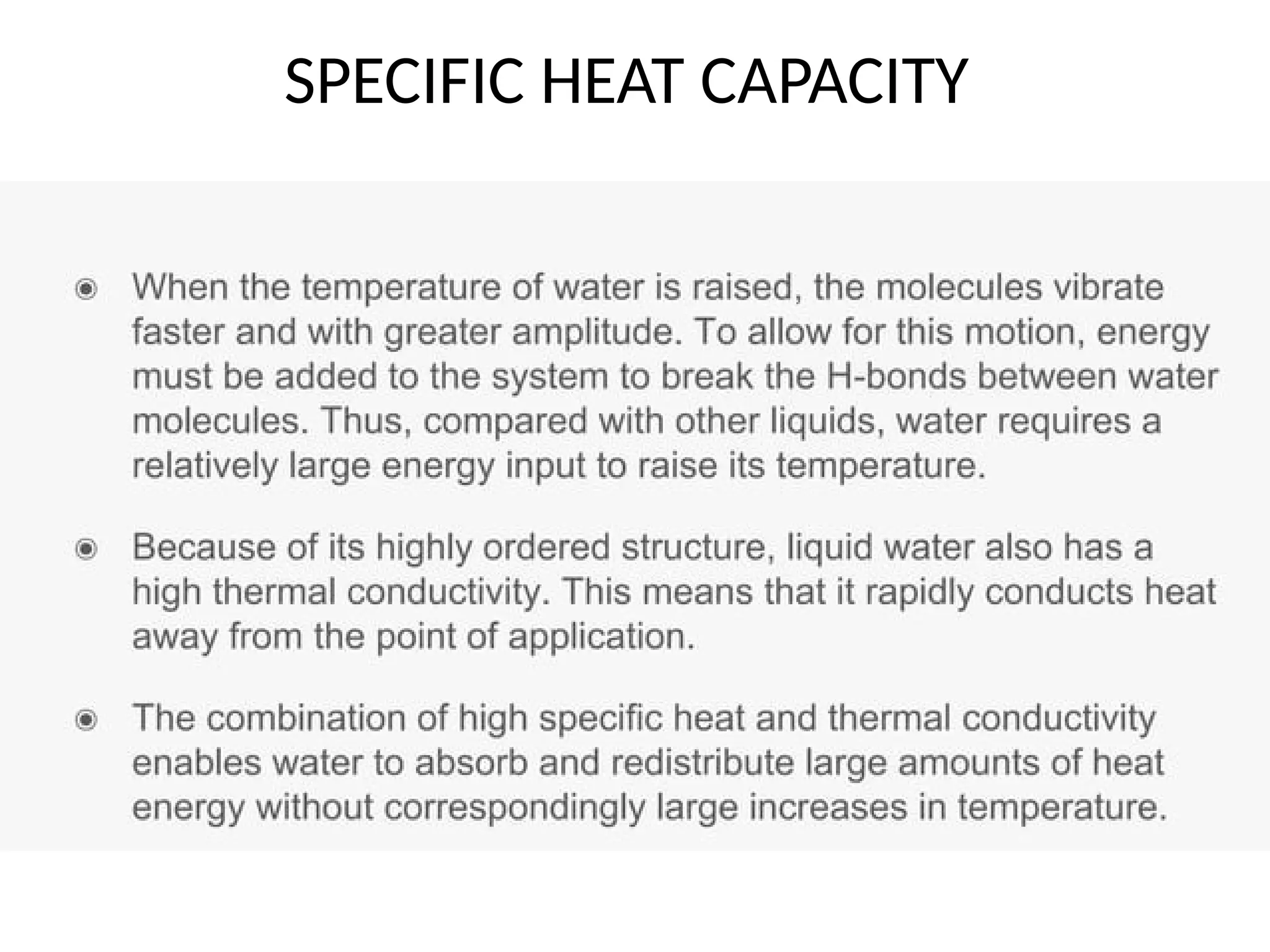
SPECIFIC HEAT CAPACITY
HEAT OF VAPORIZATION
HEAT OF FUSION
CHEMICAL COMPOSITION OF SEAWATER
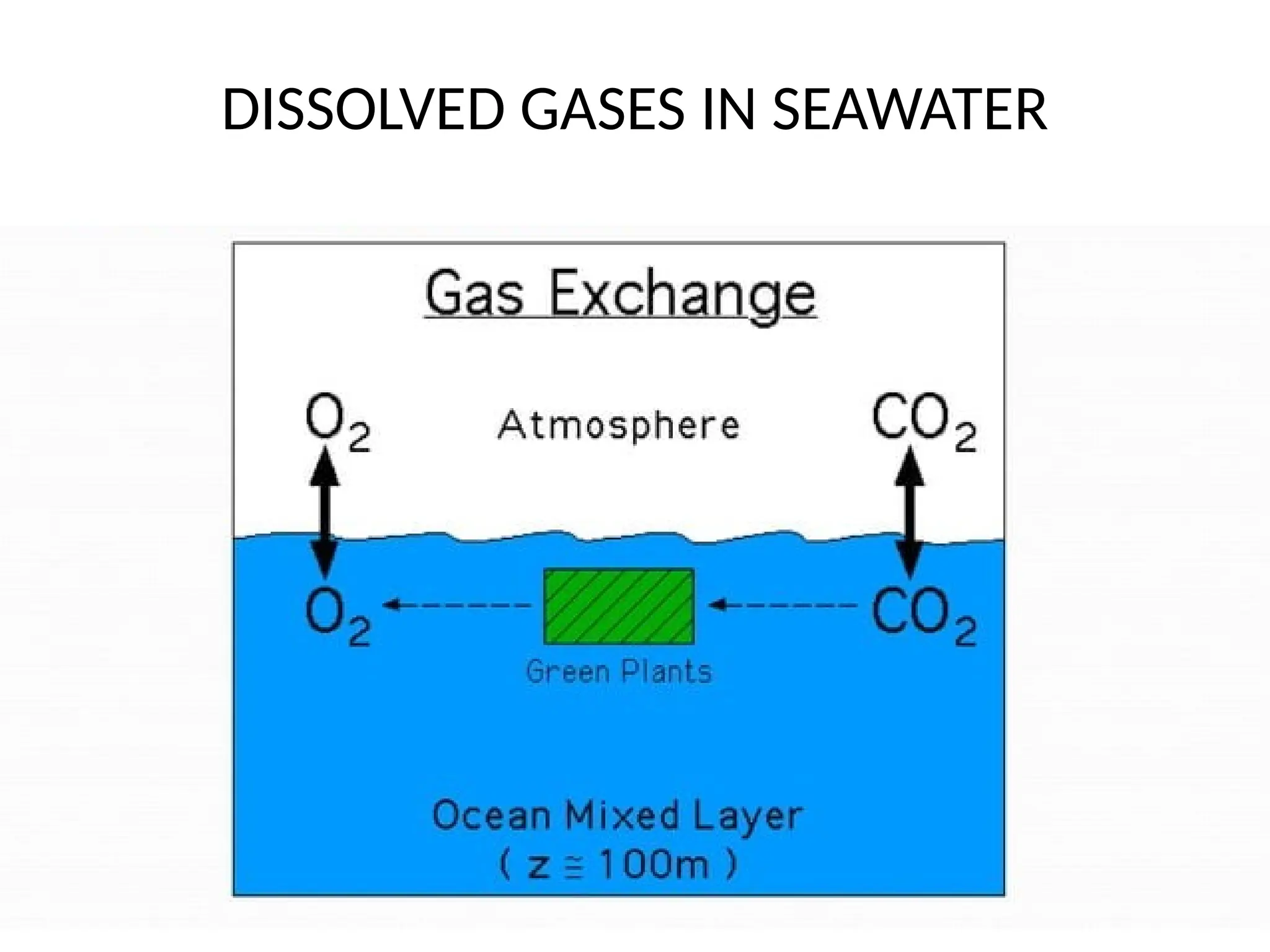
DISSOLVED GASES IN SEAWATER
GAS Present in
atmosphere
Present in
seawater
N2 78.08 48
O2 20.95 36
CO2 0.038 15
SALINITY
• Salinity – “Total amount of dissolved material in
grams in one kilogram of sea water”.
- Impossible to measure.
- Example: Volatile materials like gases or
Chlorides are lost in the last stage of drying.
• ICES defines – “Total amount of solid materials in
grams dissolved in one kg of sea water when
- All the Carbonate converted to Oxide,
- Bromide and Iodide chloride and all organic
matter completely Oxidized.
- denoted as parts per thousand(‰) or ppt.
SOURCE OF SALTS
• Volcanism: H2O, HCl and CO2
- original ocean were acidic
• Chemical Weathering: Ca, Na, K, Mg
- Rivers are alkaline (base)
• Billions of years ago … Base reacted with Acid
in a neutralization reaction to form Salt and
Water
• Salinity is currently Constant and that is 34.60-
34.80 parts per thousand
FACTORS AFFECTING SALINITY
 Salinity of surface water depend mainly depends on
Evaporation and Precipitation
 In coastal regions, it influenced by fresh water
flow from rivers & in polar regions by the processes
of freezing and thawing of ice
 Wind, also influences salinity of an area by
transferring water (Ocean Currents) to other areas
 Ocean currents contribute to the salinity variations.
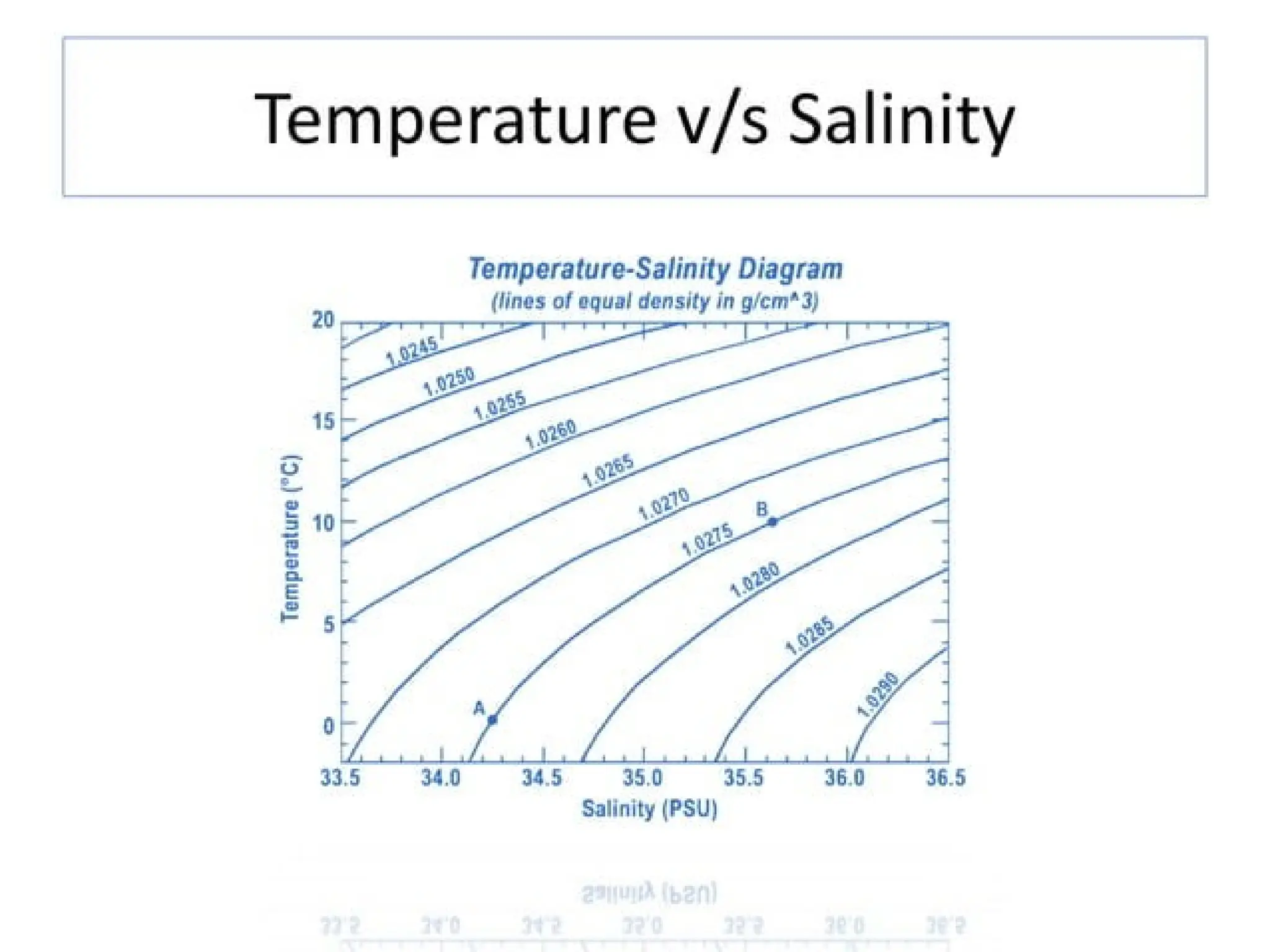
 Salinity, temperature and density of water are
interrelated. Hence, any change in the temperature
or density influences the salinity of an area.
DISTRIBUTION OF OCEAN SALINITY
Ocean salinity distribution can be studied in two
ways-
• Horizontal Distribution
o Latitudinal distribution
o Regional distribution of salinity
• Vertical Distribution of Salinity
DISTRIBUTION OF OCEAN SALINITY
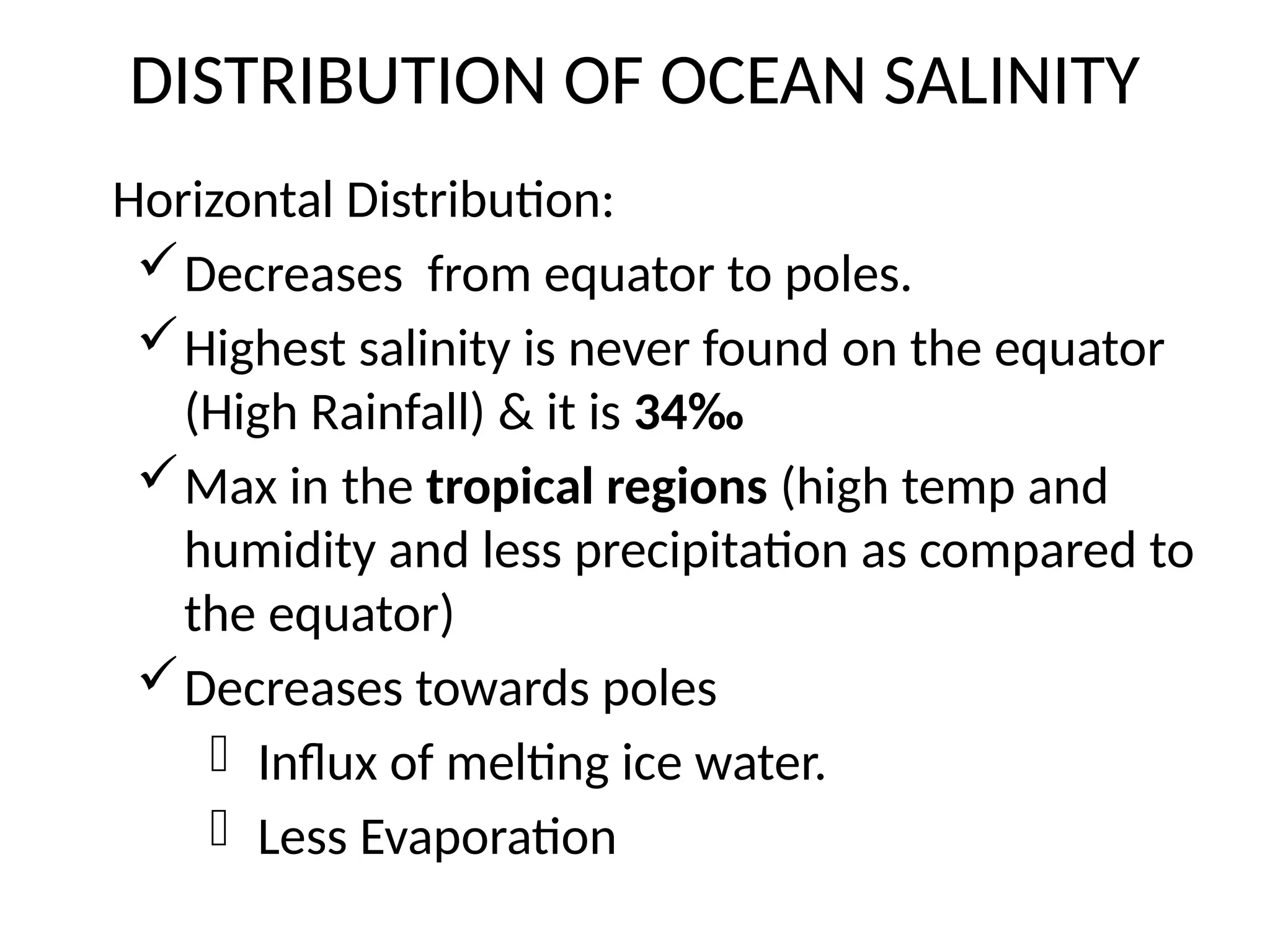
Horizontal Distribution:
Decreases from equator to poles.
Highest salinity is never found on the equator
(High Rainfall) & it is 34‰
Max in the tropical regions (high temp and
humidity and less precipitation as compared to
the equator)
Decreases towards poles
- Influx of melting ice water.
- Less Evaporation
DISTRIBUTION OF OCEAN SALINITY
Regional Distribution of Salinity:
Oceans are divided three categories based on salinity
variation. These are:
Seas having higher salinity: Theses are the Red Sea,
Mediterranean sea, and other enclosed seas.
Seas having normal salinity: Theses are Caribbean
sea, Gulf of California, Gulf of Mexico, etc.
Seas having below normal salinity: The Arctic
Ocean, Antarctica ocean, Bering sea, Andaman sea,
Baltic sea, etc.
DISTRIBUTION OF OCEAN SALINITY
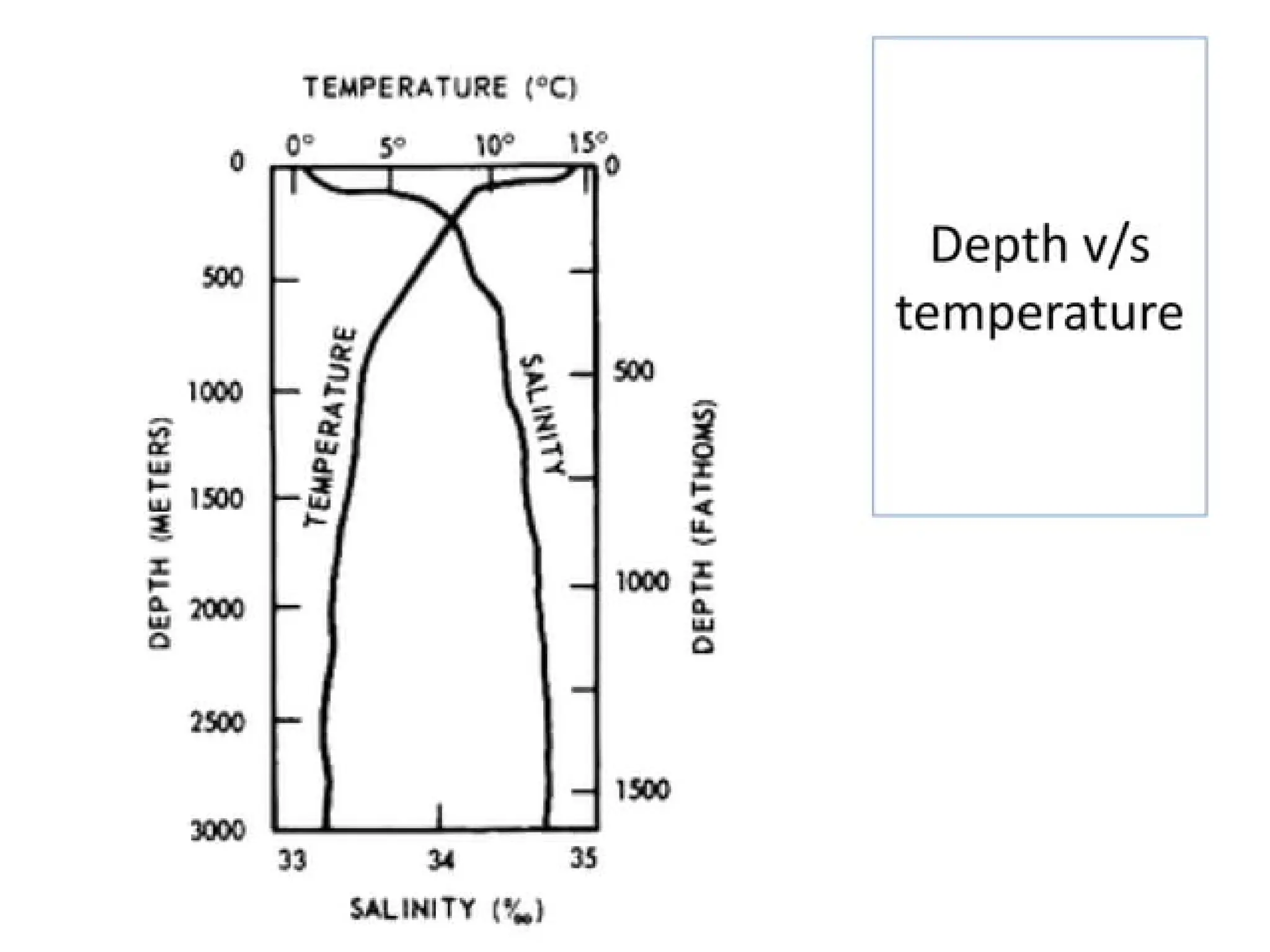
Vertical Distribution of Salinity:
 There are three zones…
1. Mixed Layer
2. Halocline
3. Deep Ocean
 The low surface
salinity at high
latitudes, and higher
surface salinity at low
latitudes
DISTRIBUTION OF TEMPERATURE
Horizontal distribution:
• It gradually decreases from the equator towards the
poles.
• The rate of decrease of temperature with increasing
latitude is generally 0.5°C per latitude.
• The horizontal temperature distribution is shown
by isothermal lines
DISTRIBUTION OF TEMPERATURE
• Mixed Layer: it is about
500m thick with
temperatures ranging
between 20° and 25° C.
• Extend: 100-400m
• Tropical region -Throughout
the year, it is present.
• Mid-latitudes - Summer.
DISTRIBUTION OF TEMPERATURE
• Thermocline Layer:
Temperatures decreases
rapidly with depth &
extended fm 500-1000m.
• It is semi-permanent in the
tropics varies with season,
latitude, Temperature and
turbulent mixing by wind.
 Winter – It to drop to
further depths
 Summer – Bring back to
the upper layer.
Properties and Various Distribution of Seawater

Properties and Various Distribution of Seawater

  • 1.
  • 2.
  • 3.
  • 4.
  • 6.
    PROPERTIES OF WATER PropertiesMeaning Polar molecule A neutral, or uncharged molecule that has an asymmetric internal distribution of charge, leading to partially positive and partially negative regions Cohesion The attraction of molecules for other molecules of the same kind Adhesion The attraction of molecules for other molecules of a different kind Density The mass per unit volume of a substance
  • 7.
    PROPERTIES OF WATER PropertiesMeaning Specific heat capacity The amount of heat needed to raise the temperature of one gram of a substance by one degree Celsius Heat of vaporization The amount of energy needed to change one gram of a liquid substance to a gas at constant temperature Solvent Water has the unique ability to dissolve many polar and ionic substances. But organic component (Fat, Waxes) or non-polar molecules and most of Hydroxides don’t dissolve
  • 8.
    WATER IS THEUNIVERSAL SOLVENT
  • 9.
  • 10.
  • 11.
  • 12.
  • 13.
  • 14.
  • 15.
  • 16.
  • 17.
  • 18.
  • 19.
  • 20.
    DISSOLVED GASES INSEAWATER GAS Present in atmosphere Present in seawater N2 78.08 48 O2 20.95 36 CO2 0.038 15
  • 21.
    SALINITY • Salinity –“Total amount of dissolved material in grams in one kilogram of sea water”. - Impossible to measure. - Example: Volatile materials like gases or Chlorides are lost in the last stage of drying. • ICES defines – “Total amount of solid materials in grams dissolved in one kg of sea water when - All the Carbonate converted to Oxide, - Bromide and Iodide chloride and all organic matter completely Oxidized. - denoted as parts per thousand(‰) or ppt.
  • 22.
    SOURCE OF SALTS •Volcanism: H2O, HCl and CO2 - original ocean were acidic • Chemical Weathering: Ca, Na, K, Mg - Rivers are alkaline (base) • Billions of years ago … Base reacted with Acid in a neutralization reaction to form Salt and Water • Salinity is currently Constant and that is 34.60- 34.80 parts per thousand
  • 23.
    FACTORS AFFECTING SALINITY Salinity of surface water depend mainly depends on Evaporation and Precipitation  In coastal regions, it influenced by fresh water flow from rivers & in polar regions by the processes of freezing and thawing of ice  Wind, also influences salinity of an area by transferring water (Ocean Currents) to other areas  Ocean currents contribute to the salinity variations.  Salinity, temperature and density of water are interrelated. Hence, any change in the temperature or density influences the salinity of an area.
  • 24.
    DISTRIBUTION OF OCEANSALINITY Ocean salinity distribution can be studied in two ways- • Horizontal Distribution o Latitudinal distribution o Regional distribution of salinity • Vertical Distribution of Salinity
  • 25.
    DISTRIBUTION OF OCEANSALINITY Horizontal Distribution: Decreases from equator to poles. Highest salinity is never found on the equator (High Rainfall) & it is 34‰ Max in the tropical regions (high temp and humidity and less precipitation as compared to the equator) Decreases towards poles - Influx of melting ice water. - Less Evaporation
  • 26.
  • 27.
    DISTRIBUTION OF OCEANSALINITY Regional Distribution of Salinity: Oceans are divided three categories based on salinity variation. These are: Seas having higher salinity: Theses are the Red Sea, Mediterranean sea, and other enclosed seas. Seas having normal salinity: Theses are Caribbean sea, Gulf of California, Gulf of Mexico, etc. Seas having below normal salinity: The Arctic Ocean, Antarctica ocean, Bering sea, Andaman sea, Baltic sea, etc.
  • 29.
    DISTRIBUTION OF OCEANSALINITY Vertical Distribution of Salinity:  There are three zones… 1. Mixed Layer 2. Halocline 3. Deep Ocean  The low surface salinity at high latitudes, and higher surface salinity at low latitudes
  • 33.
  • 34.
    • It graduallydecreases from the equator towards the poles. • The rate of decrease of temperature with increasing latitude is generally 0.5°C per latitude. • The horizontal temperature distribution is shown by isothermal lines DISTRIBUTION OF TEMPERATURE
  • 36.
    DISTRIBUTION OF TEMPERATURE •Mixed Layer: it is about 500m thick with temperatures ranging between 20° and 25° C. • Extend: 100-400m • Tropical region -Throughout the year, it is present. • Mid-latitudes - Summer.
  • 37.
    DISTRIBUTION OF TEMPERATURE •Thermocline Layer: Temperatures decreases rapidly with depth & extended fm 500-1000m. • It is semi-permanent in the tropics varies with season, latitude, Temperature and turbulent mixing by wind.  Winter – It to drop to further depths  Summer – Bring back to the upper layer.

Editor's Notes

  • #23 Factors Affecting the Salinity of the Seawater: There are many affecting factors such as the weather including evaporation, precipitation; rivers, winds, ocean currents, sea waves, and global warming. Evaporation: The rate of evaporation and salinity are positively related. It is observed that with higher the evaporation rate, the higher the salinity. With high temperature and low humidity, more evaporation takes place and salt concentration increases and total salinity increases too. It is found that salinity is higher in the tropics than at the equator. Precipitation: It is inversely proportional to salinity. Higher precipitation results in lower salinity and vice versa. Hence, the regions of high precipitation record lesser salinity than the regions of low precipitation. The melting water of ice from polar areas in the temperate regions increases the volume of ocean water and results in lower salinity. Basically, high precipitation raises the amount of ocean water and reduces the salt-to-water ratio. The Influx of River Water: Rivers reduce the salinity by diluting the salt concentration of the sea and ocean. If a number of rivers are flowing into a specific location of the ocean, then there is a high chance for low salinity. As big rivers contain a large amount of fresh water, which is enough to decline the salinity of the ocean. For example, lower levels of salinity are found near the mouths of the Ganga-Brahmaputra, the Amazon, the Congo, etc. and the effect of river water is more when it discharges in the enclosed sea. Such as in the Gulf of Bothnia situated in the Baltic Sea, salinity reduces by five parts per thousand as river water adds in it. Ocean Currents: They affect the spatial distribution of ocean salinity. Oceanic currents affect the salinity by increasing and decreasing it. Oceanic currents have less impact on the enclosed sea’s salinity however the impact on the salinity of marginal seas with open sea ducts is significant. Atmospheric Pressure and Wind Direction: Anticyclonic conditions generally raise the salinity of the oceanic surface water when it has stable air and a higher temperature. At the high-pressure zone of subtropics, higher salinity can be observed. Winds and currents provide assistance in the redistribution of oceanic salinity. Global Warming: Global warming threatens the overall stability of ecological balance, not only salinity. It affects many factors such as temperature, ice melting, and many more, which directly and indirectly impact the salinity of seawater.
  • #25 Latitudinal Distribution:   The basic principle of salinity distribution is that it decreases from the equator to the poles. Though the highest salinity is never found on the equator due to high rainfall, it is found maximum in the tropical regions. These regions have high temperatures and humidity and less precipitation as compared to the equator. The Equator has 34‰ salinity whereas the highest salinity is found between 20 degrees to 40 degrees north. Salinity decreases towards polar zones due to the influx of melting ice water. Thus on the basis of the latitudinal distribution, salinity is divided into 4 zones: equatorial zones have comparatively low salinity, tropical zones have maximum salinity, temperate zones have low salinity and sub-polar and polar zone have minimum salinity.
  • #29 In addition to geographical variation in salinity, there are also changes in salinity with depth. As we have seen, most differences in salinity are due to variations in evaporation, precipitation, runoff, and ice cover. All of these process occur at the ocean surface, not at depth, so the most pronounced differences in salinity should be found in surface waters. Salinity in deeper water remains relatively uniform, as it is unaffected by these surface processes. Some representative salinity profiles are shown in Figure 11.2.411.2.4. At the surface, the top 200 m or so show relatively uniform salinity in what is called the mixed layer. Winds, waves, and surface currents stir up the surface water, causing a great deal of mixing in this layer and fairly uniform salinity conditions. Below the mixed layer is an area of rapid salinity change over a small change in depth. This zone of rapid change is called the halocline, and it represents a transition between the mixed layer and the deep ocean. Below the halocline, salinity may show little variation down to the seafloor, as this region is far removed from the surface processes that impact salinity. In the figure below, note the low surface salinity at high latitudes, and higher surface salinity at low latitudes as discussed above. Yet despite the surface differences, salinity at depth in both locations may be very similar.