Estimation of reducing and
non-reducing sugar
Jasmine Juliet .R
Biochemistry
Agricultural College
&
Research Institute,
Madurai.
Reducing and non-reducing sugar -
Introduction
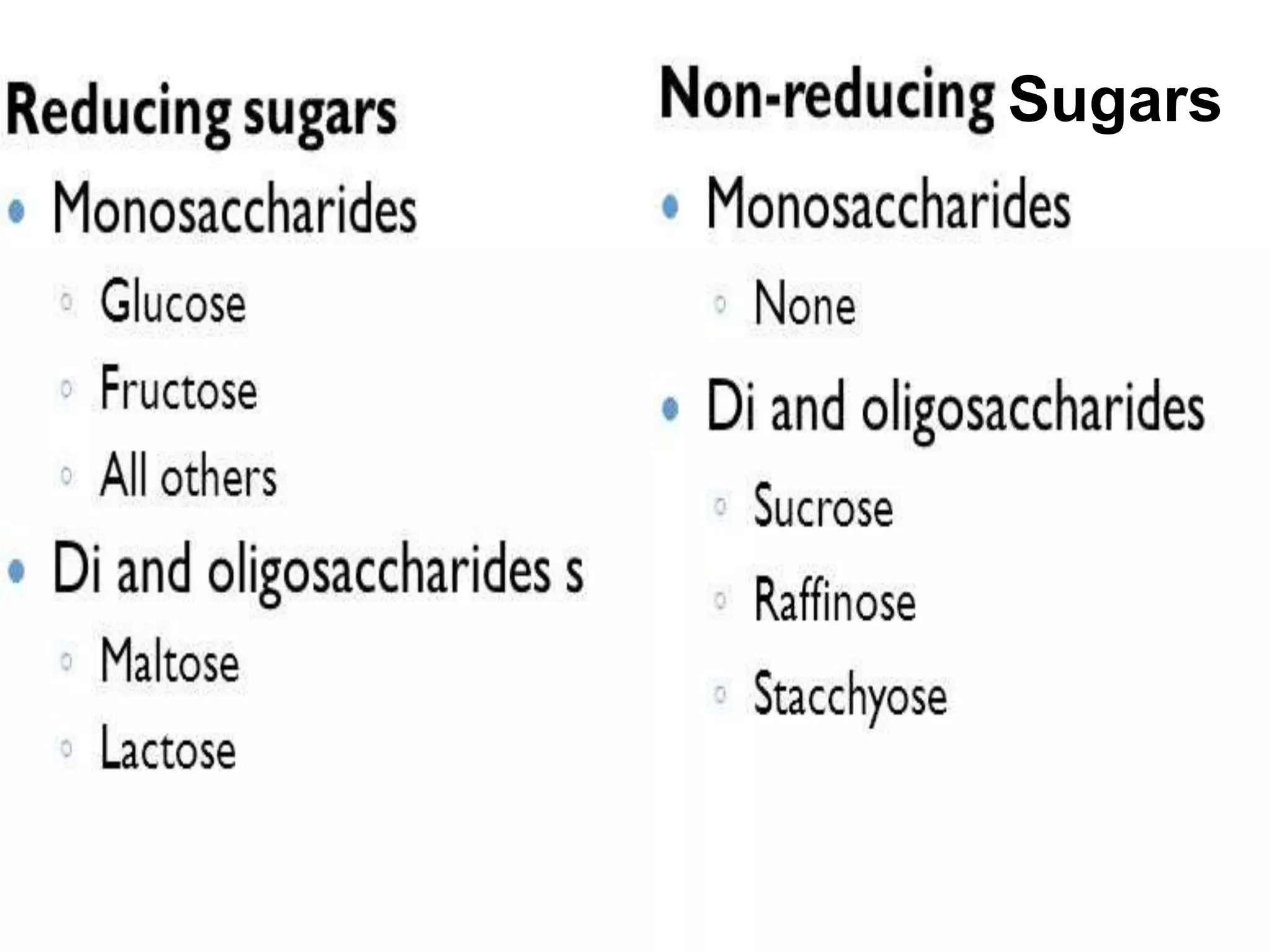
o Reducing sugar: Sugar that can act as a reducing agent
due to the presence of free aldehyde or ketone groups
o Non-Reducing Sugar: Sugar which does not have
free aldehyde or ketone functional group is the non-
reducing sugar. Also, they do not get oxidized. Sucrose
is their most common source. They give a negative
reaction for Fehling’s as well as Benedict’s test. All
polysaccharides are non-reducing sugars.
Sugars
https://youtu.be/lZ_0MkUzdbo
Estimation of reducing and non-reducing
sugar
Estimation of reducing and non-reducing
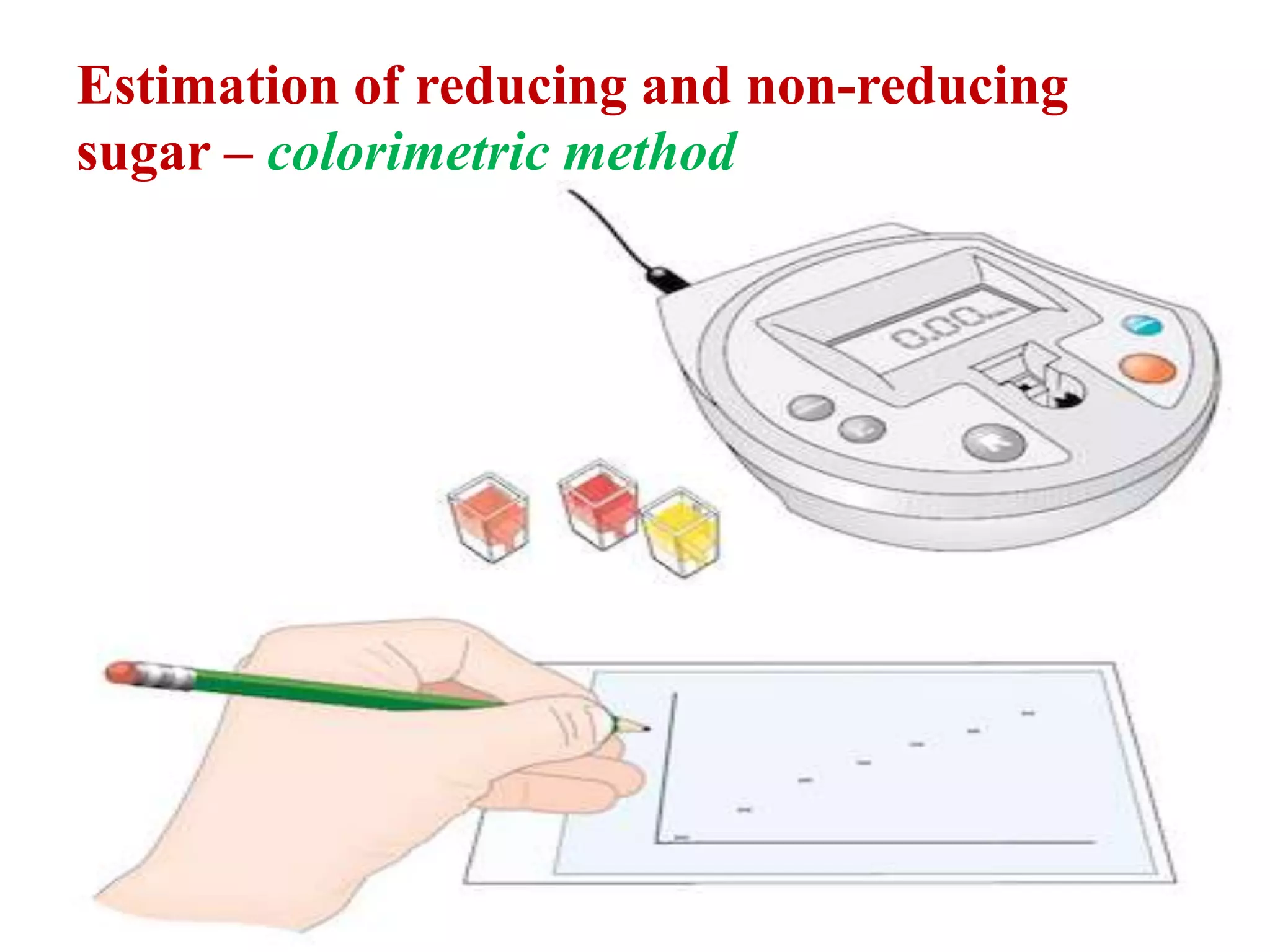
sugar – colorimetric method
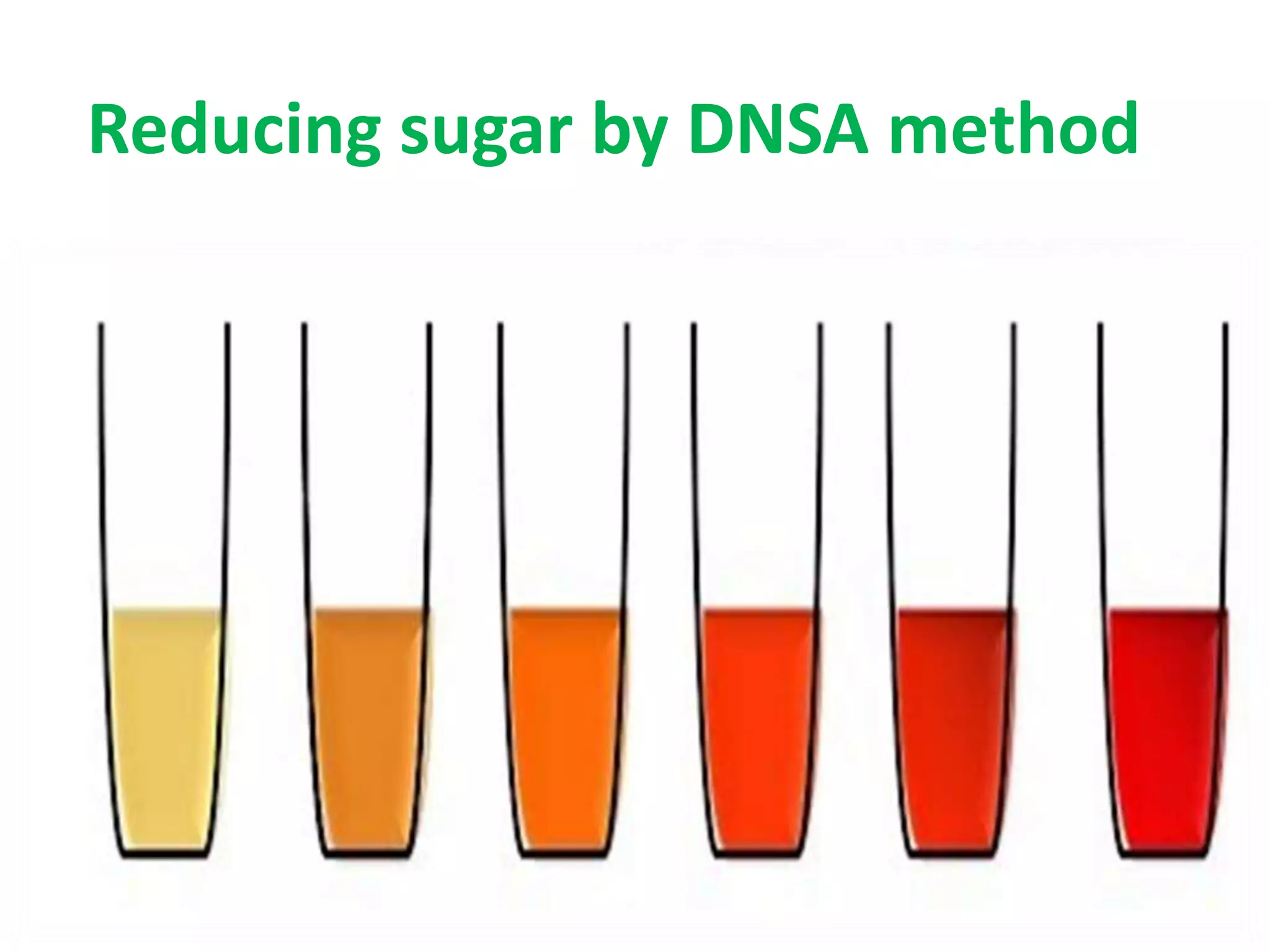
Reducing sugar by DNSA method
Estimation of reducing sugar by DNSA method
o Estimation of reducing sugar by dinitro salicylic acid
method is:
 very simple,
 sensitive and
 adoptable during handling of a large number of
samples at a time.
Estimation of reducing sugar - Principle
o 3, 5-Dinitrosalicylic acid (DNSA) is used extensively in
biochemistry for the estimation of reducing sugars.
o It detects the presence of free carbonyl group (C=O) of reducing
sugars.
o This involves the oxidation of the aldehyde functional group (in
glucose) and the ketone functional group (in fructose).
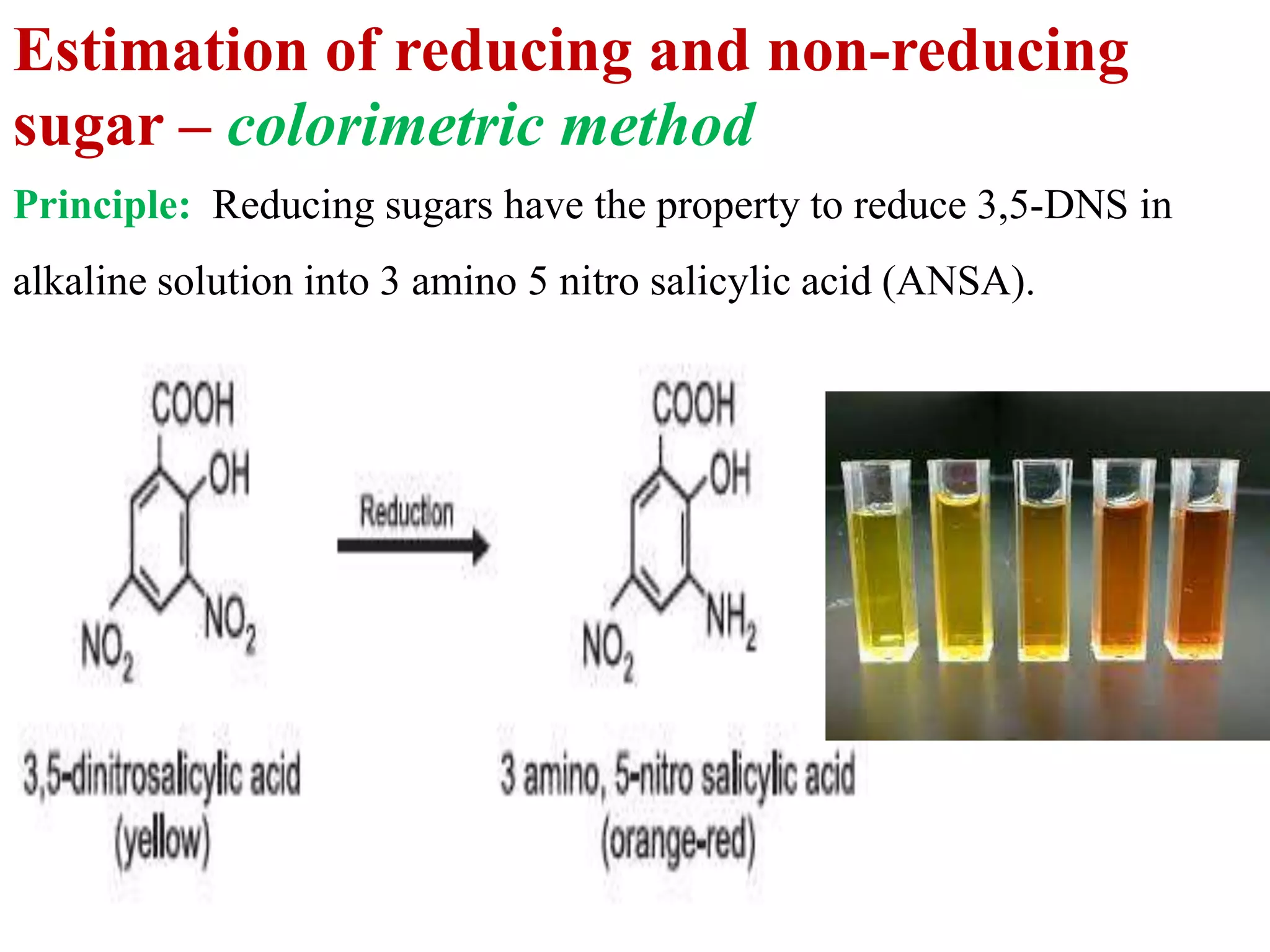
o During this reaction DNSA is reduced to 3- amino5-nitrosalicylic
acid (ANSA) which under alkaline conditions is converted to a
reddish brown coloured complex which has an absorbance
maximum of 510 nm.
Estimation of reducing and non-reducing
sugar – colorimetric method
Principle: Reducing sugars have the property to reduce 3,5-DNS in
alkaline solution into 3 amino 5 nitro salicylic acid (ANSA).
Estimation of reducing sugar – Reagents
required
o Sodium potassium tartrate: Dissolve 40 gms of sodium potassium
tartrate in 60 mL of distilled H2O.
o DNS reagent: Dissolve by stirring 1 g dinitrosalicylic acid, 200 mg
crystalline phenol and 50 mg sodium sulphite in 100 ml 1%NaOH. Store
at 4ºC.
o Standard sugar solution:
(i) Stock standard : 250 mg of glucose in water and make up the
volume to 100 mL.
(ii) Working standard : Take 10 mL from this stock solution and make
up the volume to 100 mL.
Estimation of reducing sugar -
Procedure
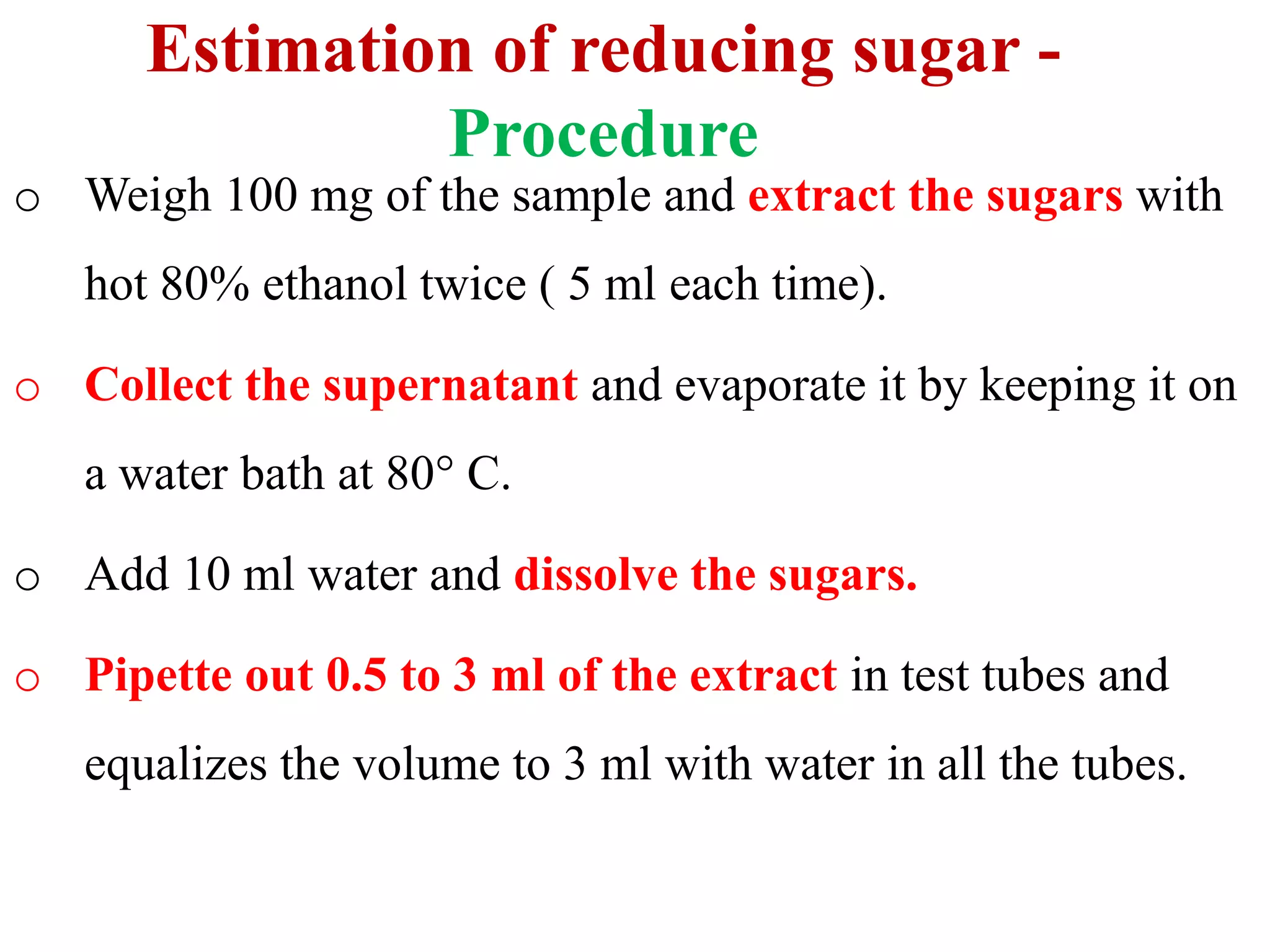
o Weigh 100 mg of the sample and extract the sugars with
hot 80% ethanol twice ( 5 ml each time).
o Collect the supernatant and evaporate it by keeping it on
a water bath at 80° C.
o Add 10 ml water and dissolve the sugars.
o Pipette out 0.5 to 3 ml of the extract in test tubes and
equalizes the volume to 3 ml with water in all the tubes.
Estimation of reducing sugar - Procedure
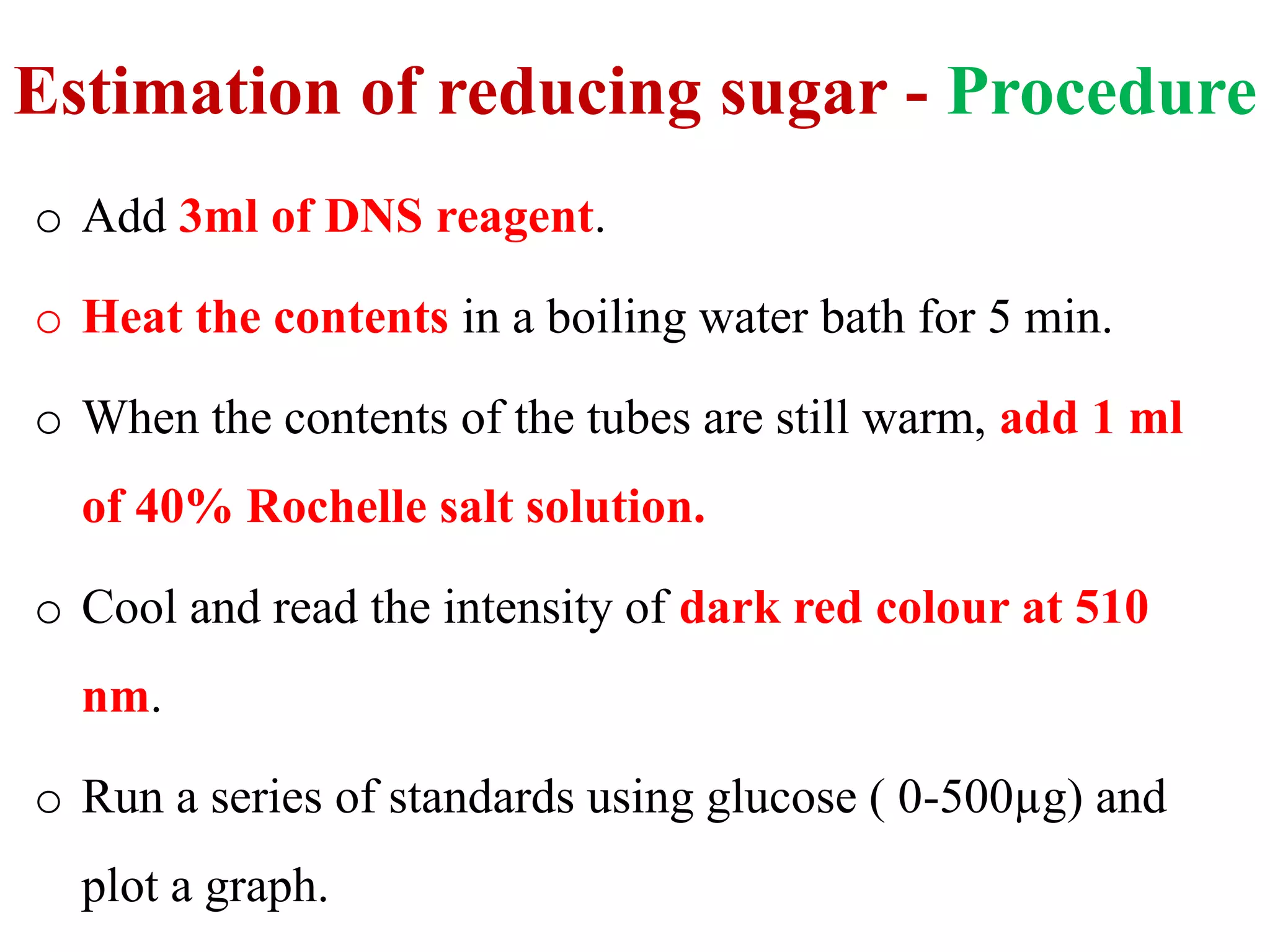
o Add 3ml of DNS reagent.
o Heat the contents in a boiling water bath for 5 min.
o When the contents of the tubes are still warm, add 1 ml
of 40% Rochelle salt solution.
o Cool and read the intensity of dark red colour at 510
nm.
o Run a series of standards using glucose ( 0-500µg) and
plot a graph.
Estimation of reducing sugar -
Calculation
o Calculate the amount of reducing sugars
present in the sample using the standard
graph.
https://www.youtube.com/watch?v=NtqsWKRW7N8
Estimation of reducing sugar by DNSA method
Estimation of total sugar -
Introduction
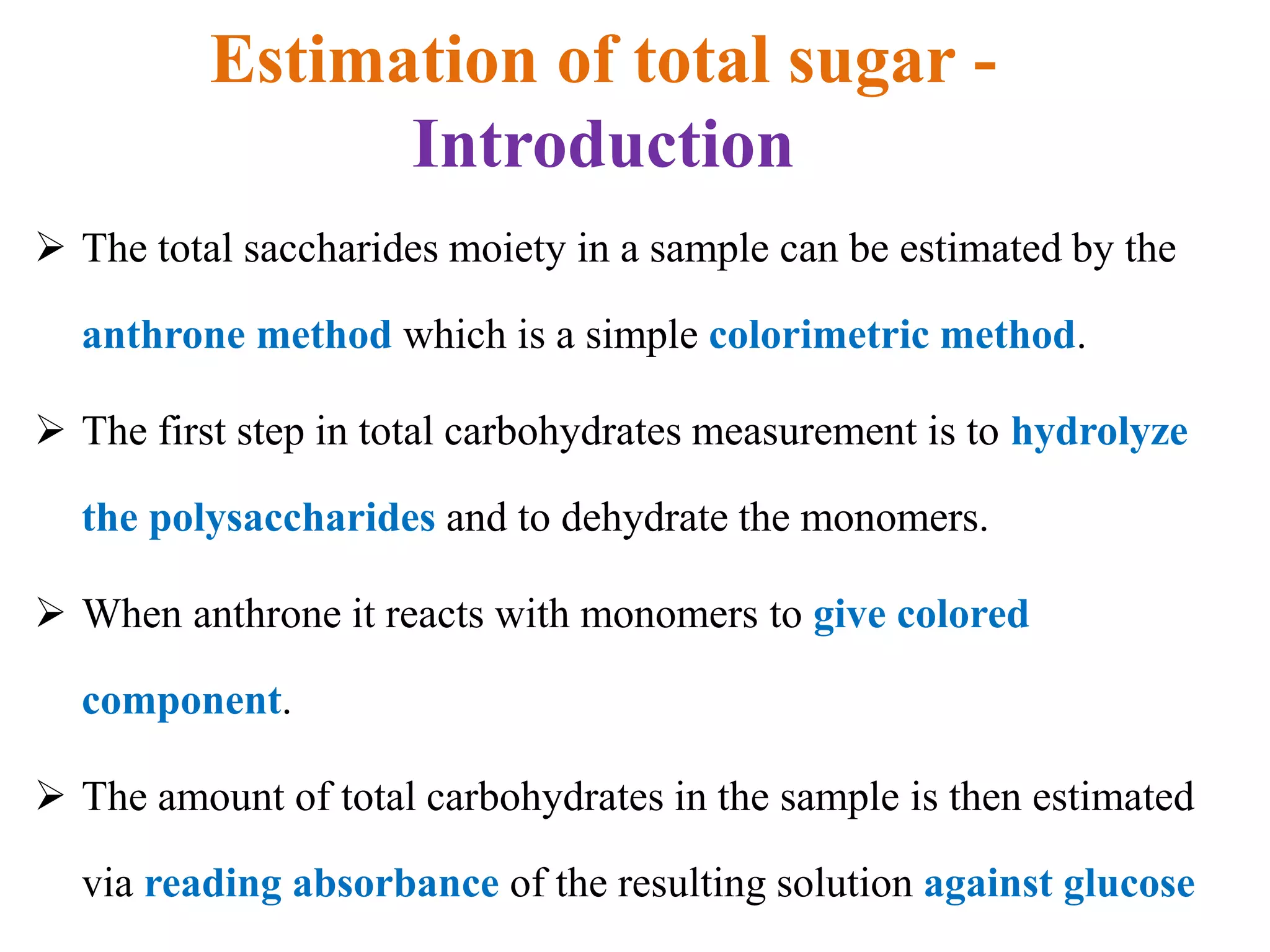
 The total saccharides moiety in a sample can be estimated by the
anthrone method which is a simple colorimetric method.
 The first step in total carbohydrates measurement is to hydrolyze
the polysaccharides and to dehydrate the monomers.
 When anthrone it reacts with monomers to give colored
component.
 The amount of total carbohydrates in the sample is then estimated
via reading absorbance of the resulting solution against glucose
Estimation of total sugar -
Principle
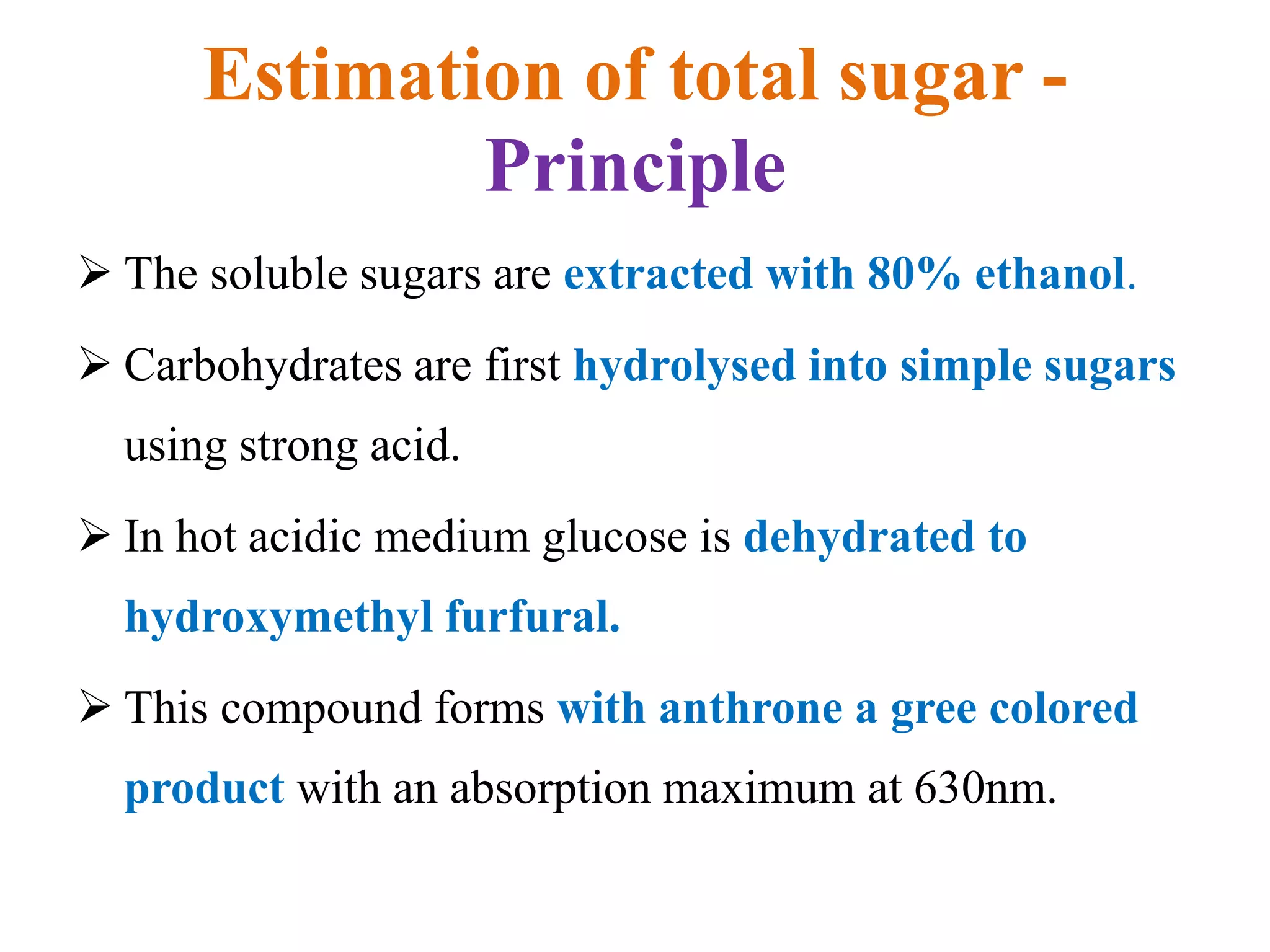
 The soluble sugars are extracted with 80% ethanol.
 Carbohydrates are first hydrolysed into simple sugars
using strong acid.
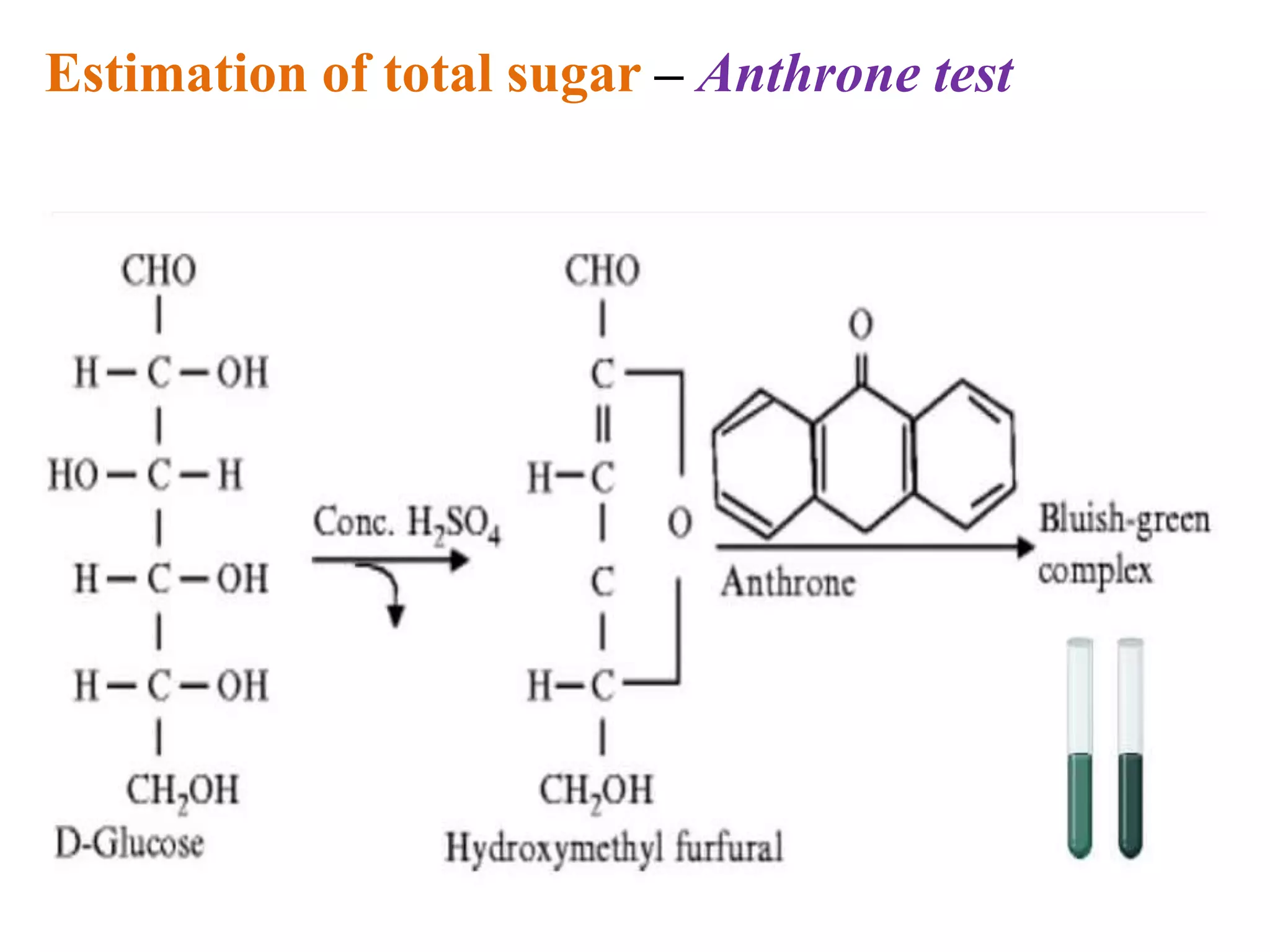
 In hot acidic medium glucose is dehydrated to
hydroxymethyl furfural.
 This compound forms with anthrone a gree colored
product with an absorption maximum at 630nm.
Estimation of total sugar – Anthrone test
Estimation of total sugar -
Material
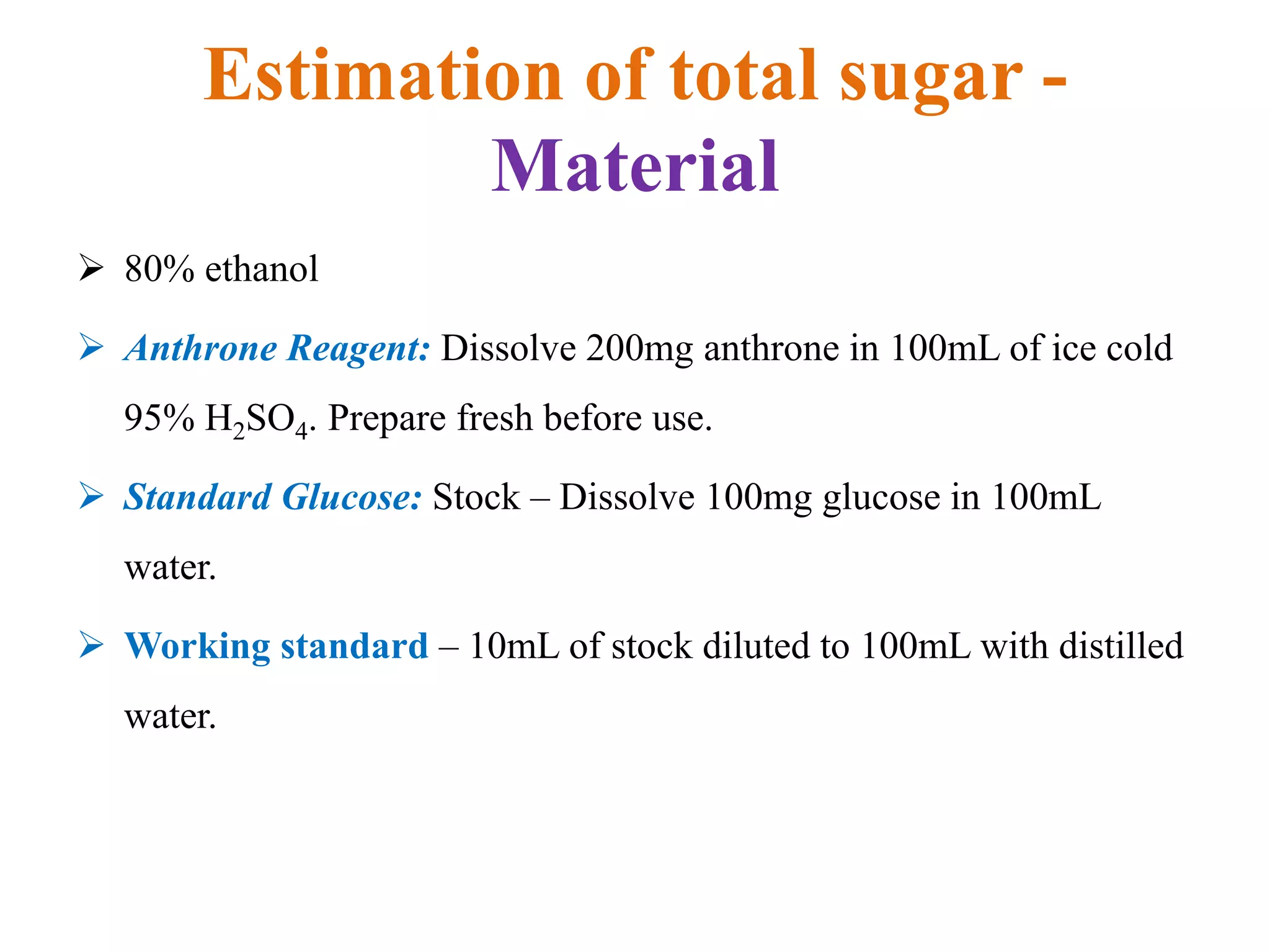
 80% ethanol
 Anthrone Reagent: Dissolve 200mg anthrone in 100mL of ice cold
95% H2SO4. Prepare fresh before use.
 Standard Glucose: Stock – Dissolve 100mg glucose in 100mL
water.
 Working standard – 10mL of stock diluted to 100mL with distilled
water.
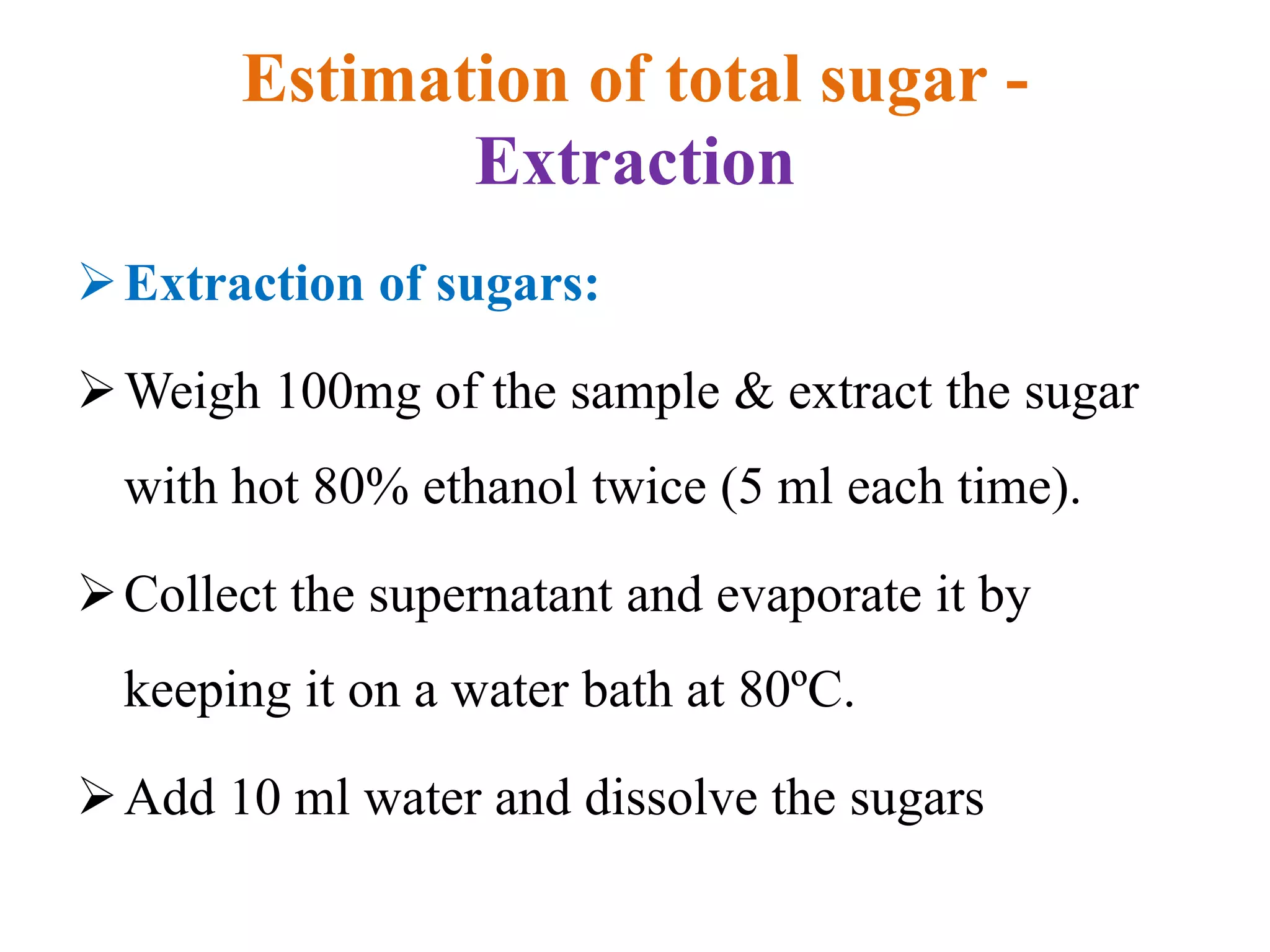
Estimation of total sugar -
Extraction
Extraction of sugars:
Weigh 100mg of the sample & extract the sugar
with hot 80% ethanol twice (5 ml each time).
Collect the supernatant and evaporate it by
keeping it on a water bath at 80ºC.
Add 10 ml water and dissolve the sugars
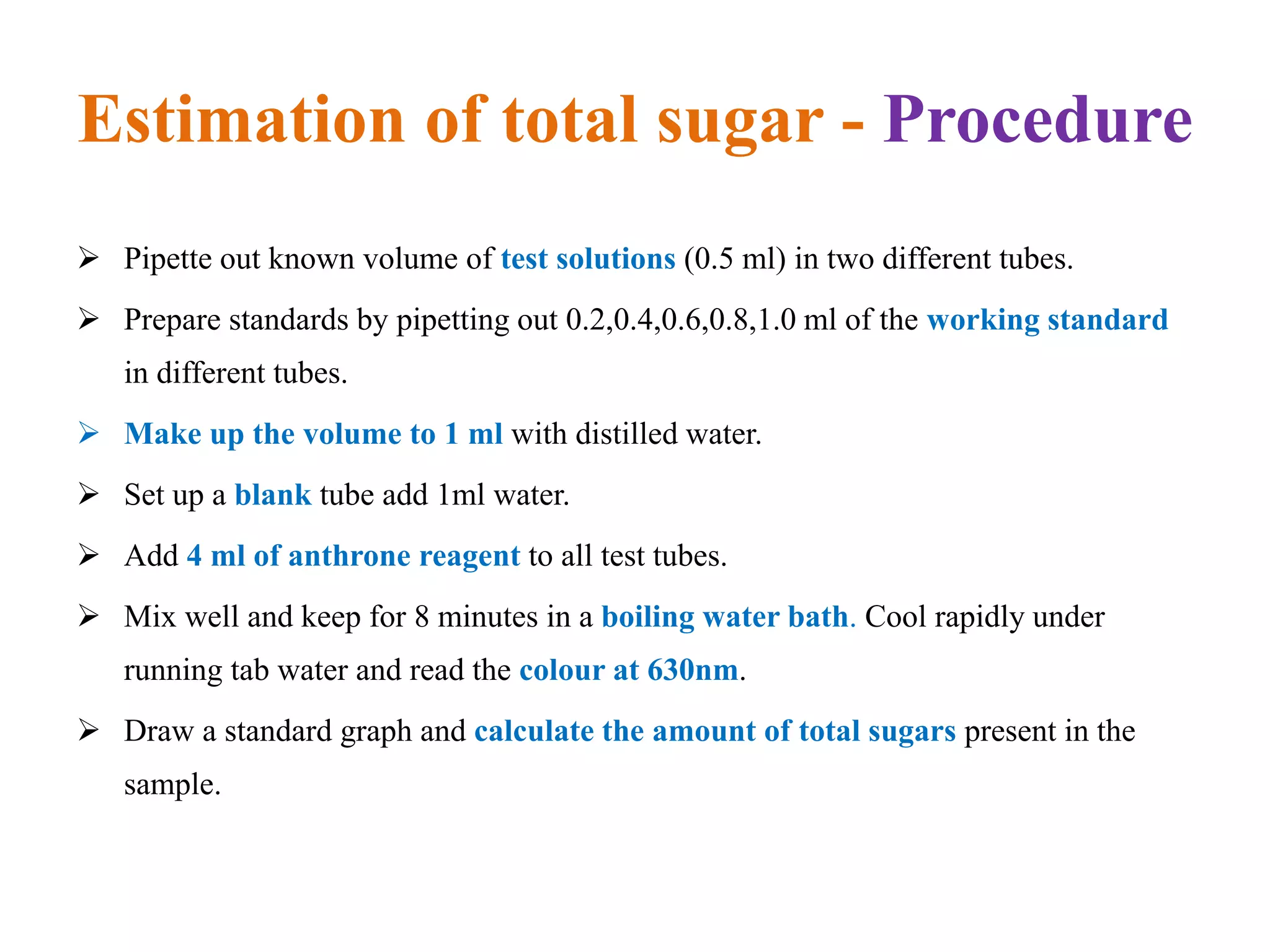
Estimation of total sugar - Procedure
 Pipette out known volume of test solutions (0.5 ml) in two different tubes.
 Prepare standards by pipetting out 0.2,0.4,0.6,0.8,1.0 ml of the working standard
in different tubes.
 Make up the volume to 1 ml with distilled water.
 Set up a blank tube add 1ml water.
 Add 4 ml of anthrone reagent to all test tubes.
 Mix well and keep for 8 minutes in a boiling water bath. Cool rapidly under
running tab water and read the colour at 630nm.
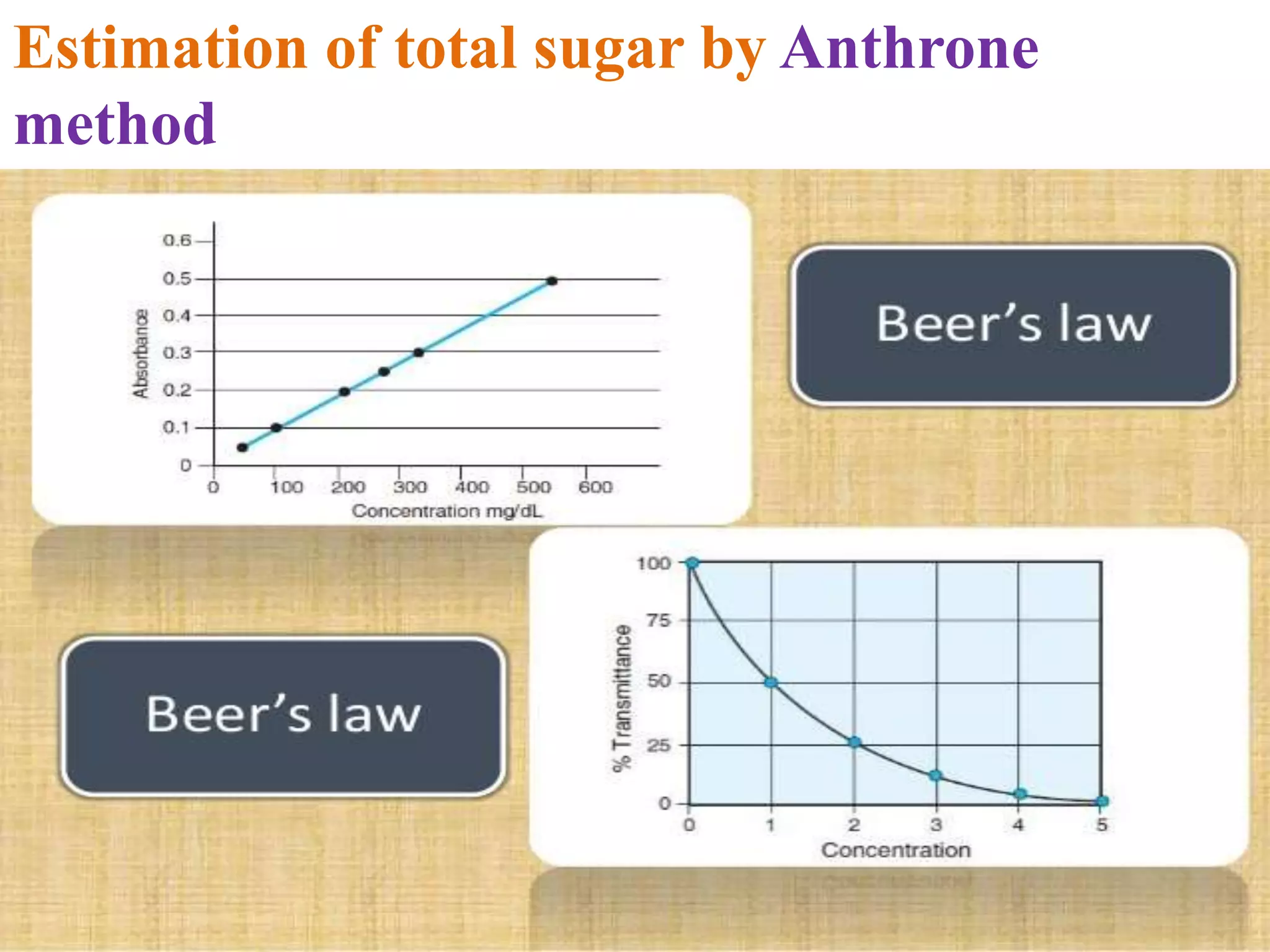
 Draw a standard graph and calculate the amount of total sugars present in the
sample.
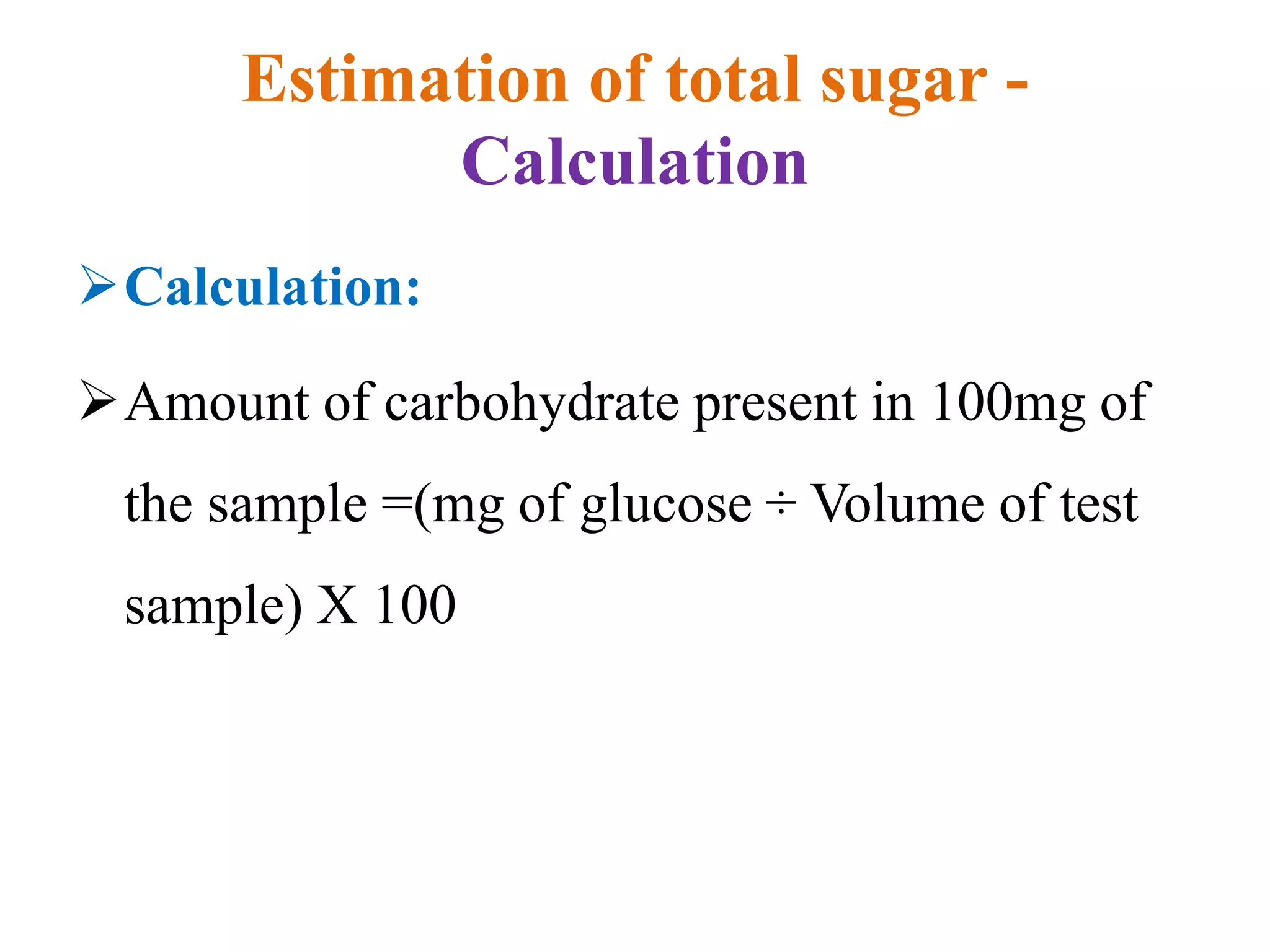
Estimation of total sugar -
Calculation
Calculation:
Amount of carbohydrate present in 100mg of
the sample =(mg of glucose ÷ Volume of test
sample) X 100
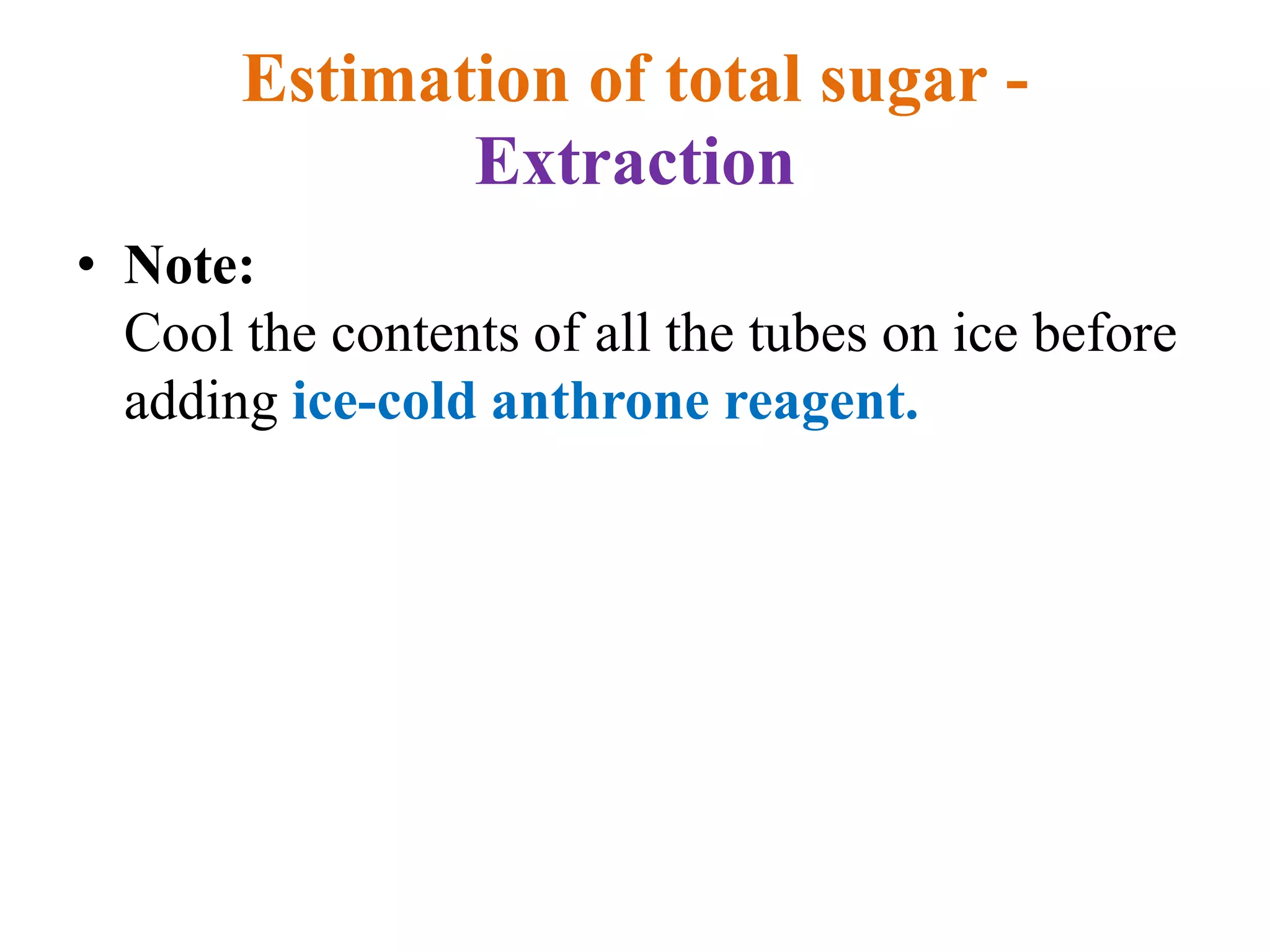
Estimation of total sugar -
Extraction
• Note:
Cool the contents of all the tubes on ice before
adding ice-cold anthrone reagent.
Estimation of total sugar by Anthrone
method
Estimation of Non- reducing
sugar
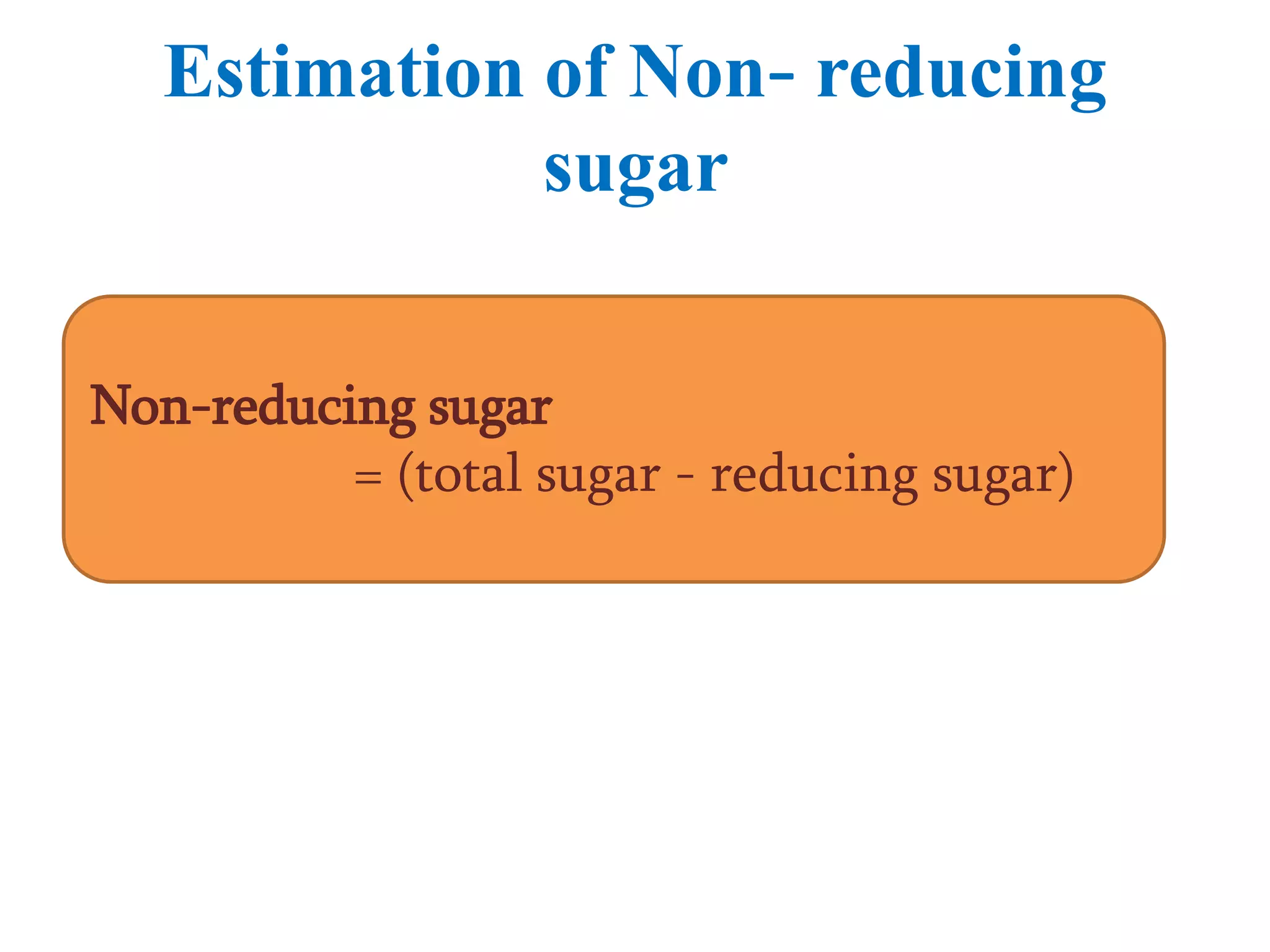
Non-reducing sugar
= (total sugar - reducing sugar)
Estimation of total sugar by Anthrone
method
• https://youtu.be/VzYDk4t97Ok
Estimation of reducing and non reducing sugar

Estimation of reducing and non reducing sugar

  • 1.
    Estimation of reducingand non-reducing sugar Jasmine Juliet .R Biochemistry Agricultural College & Research Institute, Madurai.
  • 2.
    Reducing and non-reducingsugar - Introduction o Reducing sugar: Sugar that can act as a reducing agent due to the presence of free aldehyde or ketone groups o Non-Reducing Sugar: Sugar which does not have free aldehyde or ketone functional group is the non- reducing sugar. Also, they do not get oxidized. Sucrose is their most common source. They give a negative reaction for Fehling’s as well as Benedict’s test. All polysaccharides are non-reducing sugars.
  • 3.
  • 4.
  • 5.
    Estimation of reducingand non-reducing sugar – colorimetric method
  • 6.
    Reducing sugar byDNSA method
  • 7.
    Estimation of reducingsugar by DNSA method o Estimation of reducing sugar by dinitro salicylic acid method is:  very simple,  sensitive and  adoptable during handling of a large number of samples at a time.
  • 8.
    Estimation of reducingsugar - Principle o 3, 5-Dinitrosalicylic acid (DNSA) is used extensively in biochemistry for the estimation of reducing sugars. o It detects the presence of free carbonyl group (C=O) of reducing sugars. o This involves the oxidation of the aldehyde functional group (in glucose) and the ketone functional group (in fructose). o During this reaction DNSA is reduced to 3- amino5-nitrosalicylic acid (ANSA) which under alkaline conditions is converted to a reddish brown coloured complex which has an absorbance maximum of 510 nm.
  • 9.
    Estimation of reducingand non-reducing sugar – colorimetric method Principle: Reducing sugars have the property to reduce 3,5-DNS in alkaline solution into 3 amino 5 nitro salicylic acid (ANSA).
  • 10.
    Estimation of reducingsugar – Reagents required o Sodium potassium tartrate: Dissolve 40 gms of sodium potassium tartrate in 60 mL of distilled H2O. o DNS reagent: Dissolve by stirring 1 g dinitrosalicylic acid, 200 mg crystalline phenol and 50 mg sodium sulphite in 100 ml 1%NaOH. Store at 4ºC. o Standard sugar solution: (i) Stock standard : 250 mg of glucose in water and make up the volume to 100 mL. (ii) Working standard : Take 10 mL from this stock solution and make up the volume to 100 mL.
  • 11.
    Estimation of reducingsugar - Procedure o Weigh 100 mg of the sample and extract the sugars with hot 80% ethanol twice ( 5 ml each time). o Collect the supernatant and evaporate it by keeping it on a water bath at 80° C. o Add 10 ml water and dissolve the sugars. o Pipette out 0.5 to 3 ml of the extract in test tubes and equalizes the volume to 3 ml with water in all the tubes.
  • 12.
    Estimation of reducingsugar - Procedure o Add 3ml of DNS reagent. o Heat the contents in a boiling water bath for 5 min. o When the contents of the tubes are still warm, add 1 ml of 40% Rochelle salt solution. o Cool and read the intensity of dark red colour at 510 nm. o Run a series of standards using glucose ( 0-500µg) and plot a graph.
  • 13.
    Estimation of reducingsugar - Calculation o Calculate the amount of reducing sugars present in the sample using the standard graph.
  • 14.
  • 15.
    Estimation of totalsugar - Introduction  The total saccharides moiety in a sample can be estimated by the anthrone method which is a simple colorimetric method.  The first step in total carbohydrates measurement is to hydrolyze the polysaccharides and to dehydrate the monomers.  When anthrone it reacts with monomers to give colored component.  The amount of total carbohydrates in the sample is then estimated via reading absorbance of the resulting solution against glucose
  • 16.
    Estimation of totalsugar - Principle  The soluble sugars are extracted with 80% ethanol.  Carbohydrates are first hydrolysed into simple sugars using strong acid.  In hot acidic medium glucose is dehydrated to hydroxymethyl furfural.  This compound forms with anthrone a gree colored product with an absorption maximum at 630nm.
  • 17.
    Estimation of totalsugar – Anthrone test
  • 18.
    Estimation of totalsugar - Material  80% ethanol  Anthrone Reagent: Dissolve 200mg anthrone in 100mL of ice cold 95% H2SO4. Prepare fresh before use.  Standard Glucose: Stock – Dissolve 100mg glucose in 100mL water.  Working standard – 10mL of stock diluted to 100mL with distilled water.
  • 20.
    Estimation of totalsugar - Extraction Extraction of sugars: Weigh 100mg of the sample & extract the sugar with hot 80% ethanol twice (5 ml each time). Collect the supernatant and evaporate it by keeping it on a water bath at 80ºC. Add 10 ml water and dissolve the sugars
  • 21.
    Estimation of totalsugar - Procedure  Pipette out known volume of test solutions (0.5 ml) in two different tubes.  Prepare standards by pipetting out 0.2,0.4,0.6,0.8,1.0 ml of the working standard in different tubes.  Make up the volume to 1 ml with distilled water.  Set up a blank tube add 1ml water.  Add 4 ml of anthrone reagent to all test tubes.  Mix well and keep for 8 minutes in a boiling water bath. Cool rapidly under running tab water and read the colour at 630nm.  Draw a standard graph and calculate the amount of total sugars present in the sample.
  • 22.
    Estimation of totalsugar - Calculation Calculation: Amount of carbohydrate present in 100mg of the sample =(mg of glucose ÷ Volume of test sample) X 100
  • 23.
    Estimation of totalsugar - Extraction • Note: Cool the contents of all the tubes on ice before adding ice-cold anthrone reagent.
  • 24.
    Estimation of totalsugar by Anthrone method
  • 25.
    Estimation of Non-reducing sugar Non-reducing sugar = (total sugar - reducing sugar)
  • 26.
    Estimation of totalsugar by Anthrone method • https://youtu.be/VzYDk4t97Ok