ALKALOIDS
CONTENTS
• Introduction
• History
• Classification
• Properties
• Functions
• Uses
• Effects of alkaloids on humans
• Extraction of alkaloids
• Biosynthesis of alkaloids
• Conclusions
• References
Introduction
• The name alkaloids was introduced in1819 by the German chemist
Friedrich Wilhelm Meibner, and is derived from Latin , root alkali which
inturn, comes from the Arabic- meaning ashes of plant
• The term alkaloids are used to designate basic nitrogenous compounds of
plant origin that are physiologically active
• Alkaloids are produced by a large variety of organisms including bacteria,
fungi, plants and animals
• The first individual alkaloid, morphine was isolated in 1804 from the
opium poppy
• Friedrich serturner, the German chemist to isolate morphine from opium
poppy
• Alkaloids have a wide range of pharmacological activities including
antimalarial (e.g: quinine)
• Antiasthma(e g: ephedrine)
• Cholinometric(e.g: galantamine)
• Vasodilatory(e.g: vincamine)
• Antiarrhythmic (e.g : quinidine)
• Analgesic (e.g: morphine)
• Antibacterial (e.g : Chelerythrine)
• Antihyperglycemic activities (e.g : piperine)
• Other alkaloids posses psychotropic ( e.g : psilocin) and other
stimulant activities (E.g : Cocaine, caffeine, nicotine, theobromine)
• Toxic alkaloids like adropine, tubocurarine
History
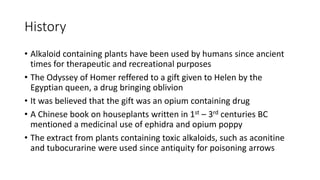
• Alkaloid containing plants have been used by humans since ancient
times for therapeutic and recreational purposes
• The Odyssey of Homer reffered to a gift given to Helen by the
Egyptian queen, a drug bringing oblivion
• It was believed that the gift was an opium containing drug
• A Chinese book on houseplants written in 1st – 3rd centuries BC
mentioned a medicinal use of ephidra and opium poppy
• The extract from plants containing toxic alkaloids, such as aconitine
and tubocurarine were used since antiquity for poisoning arrows
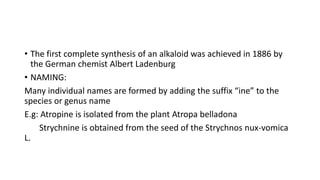
• The first complete synthesis of an alkaloid was achieved in 1886 by
the German chemist Albert Ladenburg
• NAMING:
Many individual names are formed by adding the suffix “ine” to the
species or genus name
E.g: Atropine is isolated from the plant Atropa belladona
Strychnine is obtained from the seed of the Strychnos nux-vomica
L.
Classification
1. Biosynthetic classification:
• . In this particular instance the significance solely, lies to the
precursor from which the alkaloids are produced in the plant
biosynthetic ally
• Example: indole alkaloids derived from tryptophan
• Piperidine alkaloids derived from lysine
• Pyrrolidine alkaloids derived from ornithine
• Phenylethylamine alkaloids derived from tyrosine
• Imidazole alkaloids derived from histidine
• Chemical classification:
• The main criterion is the presence of the basic heterocyclic
nucleus
• Examples:-
• Pyrrolidine alkaloids ( Hygrine )
• Piperidine alkoloids( Lobeline)
• Pyrrolizidine alkaloids ( Senecionine)
• Tropane alkaloids (Atropine)
• Quinoline alkaloids (quinine)
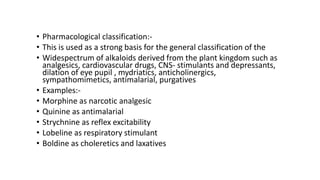
• Pharmacological classification:-
• This is used as a strong basis for the general classification of the
• Widespectrum of alkaloids derived from the plant kingdom such as
analgesics, cardiovascular drugs, CNS- stimulants and depressants,
dilation of eye pupil , mydriatics, anticholinergics,
sympathomimetics, antimalarial, purgatives
• Examples:-
• Morphine as narcotic analgesic
• Quinine as antimalarial
• Strychnine as reflex excitability
• Lobeline as respiratory stimulant
• Boldine as choleretics and laxatives
• Taxonomic classification:-
• This particular classification essentially deals with the 'taxon’ i.e.,
taxonomic category
• The most common taxa are the genus, subgenus, species,
subspecies and variety
• Cannabinaceous alkaloids:- e.g- Cannabis sativa (Hemp)
• Rubiaceous alkaloids:- e.g:- Cinchona (quinine)
• Solanaceous alkaloids:- eg:- Atropa belladona L. , Capsicum annum
L. ( Sweet potato,paprika)
• Non-heterogenous alkaloids
• Heterogeneous alkaloids
PROPERTIES OF ALKALOIDS
• PHYSICAL PROPERTIES
• Condition:-
• Most alkaloids are crystalline solids
• Few alkaloids are amorphous solids
• E.g: emetine
• Some are liquids that are either:-
• Volatile e.g:- Nicotine and coniine or non- volatile – e.g:- Pilocarpine and
hyoacine
• Colour:
• The majority of alkaloids are colourless but some are coloured
• E g: Colchicine and berberine are yellow
• Canadians is orange
• The salts of sanguinarine are copper-red
Solubility:
• Both alkaloidal bases and their salts are soluble in alcohol
• Generally the bases are soluble in organic solvents and insoluble in water
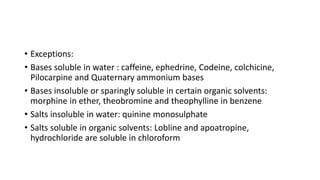
• Exceptions:
• Bases soluble in water : caffeine, ephedrine, Codeine, colchicine,
Pilocarpine and Quaternary ammonium bases
• Bases insoluble or sparingly soluble in certain organic solvents:
morphine in ether, theobromine and theophylline in benzene
• Salts insoluble in water: quinine monosulphate
• Salts soluble in organic solvents: Lobline and apoatropine,
hydrochloride are soluble in chloroform
• CHEMICAL PROPERTIES
• Most of the alkaloids are basic in nature, due to the availability of lone pair
electrons on the nitrogen
• The basic character of the alkaloid compound is enhanced if the adjacent
functional groups are electron releasing
• The alkaloids turn to be neutral or acidic when the adjacent functional
groups are electron withdrawing like amide group which reduces the
availability of lone pair of electrons
• Their salt formation with an inorganic acid prevents many a time their
decomposition
• In the natural form, the alkaloids exists either in free State as amine or as
salt with acid or alkaloid N- oxides
Functions of alkaloids in plants
• They may act as the reservoirs of protein synthesis
• They may act as protective substances against the insect or animal attacks
• Like hormones, they may function as plant stimulants or regulators in
activities like growth, metabolism and reproduction
• They may function as detoxicating agents by methylating, condensing and
cyclizing the compounds whose accumulation might cause damage to the
plant
• They may be utilised as the source of energy in case of deficiency in carbon
dioxide assimilation
• Source of nitrogen in case of nitrogen deficiency
Uses of alkaloids
• Alkaloids showed strong biological effects on animal and human organisms in very small
doses
• Alkaloids are present not only in human daily life in food and drinks but also as stimulant
drugs
• They showed anti-inflammatory, anticancer, analgesics, local anaesthetic and pain relief,
neuropharmacologic, antimicrobial, antifungal and many other activities
• Alkaloids are useful as diet ingredients, supplements and pharmaceuticals in medicine
and in other applications in human life
• Alkaloids are also important compounds in organic synthesis for searching new
semisynthetic and synthetic compounds with possibly better biological activity than
parent compounds
Effects of alkaloids on humans
• Alkaloids are produced by many plants as defense chemicals not only
mainly against herbivores but also against microbial pathogens
• Many alkaloids exhibit a pronounced toxicity in animal models and
humans
• A major target in animals is the nervous system and many alkaloids
structurally resemble neurotransmitters
• Because of structure similarity, they can interfere with
neurotransmitter receptors or ion channels and thus modulates
neuronal signal transduction
• Also other organs can be affected by toxic alkaloids such as the liver,
kidney, heart and circulation, gatrointestinal tract and reproductive
organs
• At a molecular level, alkaloids can interfere with membrane
permeability, membrane proteins (ion channels and receptors),
enzymes and other proteins, DNA, RNA and corresponding proteins,
electron chain and the cytoskeleton
• Because of these pharmacological properties, some alkaloids can be
used in medicine to treat infections, health disorders and even cancer
Extraction of alkaloids
• STAS- OTTO METHOD:
• The technique involve the distribution of alkaloidal bases between
acid or aqueous solution and immiscible organic solvents
• Stage 1 :- The powdered material is moistened with water and mixed
with alkali like sodium and potassium carbonate, ammonia, lime.
Make a paste with water, dry, repowder
• Stage 2 :- Extract the free alkaloids by hot continuous percolation
with chloroform or any other organic solvents
• Stage 3:- agitate the chloroform solution witb successive portion of
dilute sulphuric acid separating the aqueous layer before adding the
next portion of acid
• Stage 4 :- make the mixed aqueous liquid alkaline with ammonia,
collect the precipitate that forms, wash with water and dry
Biosynthesis of alkaloids
• Biological precursor of most alkaloids are amino acids such as,
ornithine, lysine, phenylalanine, tyrosine, tryptophan, histidine,
aspartic acid,etc.
• SYNTHESIS OF SCHIFF’S BASES
• Schiff’s bases can be obtained by reacting amines with ketones or
aldehydes
• These are common method of producing C=N bonds
• In the biosynthesis of alkaloids such reactions may take place within
a molecule. Such as in the synthesis of piperidine
Mannich reaction
• An integral component of the Mannich reaction in addition to an
amine and carbonyl compound is a carbanion which plays the role of
the nucleophile in the nucleophilic addition to the ions formed by the
reaction of amine and carbonyl
• The Mannich reaction can produce both intermolecularly and
intramolecularly
Dimer alkaloids
• In addition to the described monomeric alkaloids, there are dimeric
and even trimeric and tetrameric alkaloids formed upon condensation
of two, three and four monomeric alkaloids
• Dimeric alkaloids are usually formed from monomers of same type
• Mannich reaction resulting in e.g: Vocamine
• Condensation of aldehydes with amines resulting in toxiferine
Conclusions
• Alkaloids are basic nitrogenous compounds which are of great
medicinal properties
• It becomes toxic when given in high quantity
• And it acts as medicine when given in small quantity
References
• Andreas Luch(2009), Molecular, clinical, environmental toxicology,
Springer,p20
• R.H.F Manske(1965).,The alkaloid chemistry and physiology,vol VIII ,
Newyork, Academic press, p-673
• www.pharmacology.in/alkaloidsclassification
•Thank you...

alkaloids.pptx

  • 1.
  • 2.
    CONTENTS • Introduction • History •Classification • Properties • Functions • Uses • Effects of alkaloids on humans • Extraction of alkaloids • Biosynthesis of alkaloids • Conclusions • References
  • 3.
    Introduction • The namealkaloids was introduced in1819 by the German chemist Friedrich Wilhelm Meibner, and is derived from Latin , root alkali which inturn, comes from the Arabic- meaning ashes of plant • The term alkaloids are used to designate basic nitrogenous compounds of plant origin that are physiologically active • Alkaloids are produced by a large variety of organisms including bacteria, fungi, plants and animals • The first individual alkaloid, morphine was isolated in 1804 from the opium poppy • Friedrich serturner, the German chemist to isolate morphine from opium poppy
  • 4.
    • Alkaloids havea wide range of pharmacological activities including antimalarial (e.g: quinine) • Antiasthma(e g: ephedrine) • Cholinometric(e.g: galantamine) • Vasodilatory(e.g: vincamine) • Antiarrhythmic (e.g : quinidine) • Analgesic (e.g: morphine) • Antibacterial (e.g : Chelerythrine) • Antihyperglycemic activities (e.g : piperine) • Other alkaloids posses psychotropic ( e.g : psilocin) and other stimulant activities (E.g : Cocaine, caffeine, nicotine, theobromine) • Toxic alkaloids like adropine, tubocurarine
  • 5.
    History • Alkaloid containingplants have been used by humans since ancient times for therapeutic and recreational purposes • The Odyssey of Homer reffered to a gift given to Helen by the Egyptian queen, a drug bringing oblivion • It was believed that the gift was an opium containing drug • A Chinese book on houseplants written in 1st – 3rd centuries BC mentioned a medicinal use of ephidra and opium poppy • The extract from plants containing toxic alkaloids, such as aconitine and tubocurarine were used since antiquity for poisoning arrows
  • 6.
    • The firstcomplete synthesis of an alkaloid was achieved in 1886 by the German chemist Albert Ladenburg • NAMING: Many individual names are formed by adding the suffix “ine” to the species or genus name E.g: Atropine is isolated from the plant Atropa belladona Strychnine is obtained from the seed of the Strychnos nux-vomica L.
  • 7.
    Classification 1. Biosynthetic classification: •. In this particular instance the significance solely, lies to the precursor from which the alkaloids are produced in the plant biosynthetic ally • Example: indole alkaloids derived from tryptophan • Piperidine alkaloids derived from lysine • Pyrrolidine alkaloids derived from ornithine • Phenylethylamine alkaloids derived from tyrosine • Imidazole alkaloids derived from histidine
  • 8.
    • Chemical classification: •The main criterion is the presence of the basic heterocyclic nucleus • Examples:- • Pyrrolidine alkaloids ( Hygrine ) • Piperidine alkoloids( Lobeline) • Pyrrolizidine alkaloids ( Senecionine) • Tropane alkaloids (Atropine) • Quinoline alkaloids (quinine)
  • 9.
    • Pharmacological classification:- •This is used as a strong basis for the general classification of the • Widespectrum of alkaloids derived from the plant kingdom such as analgesics, cardiovascular drugs, CNS- stimulants and depressants, dilation of eye pupil , mydriatics, anticholinergics, sympathomimetics, antimalarial, purgatives • Examples:- • Morphine as narcotic analgesic • Quinine as antimalarial • Strychnine as reflex excitability • Lobeline as respiratory stimulant • Boldine as choleretics and laxatives
  • 10.
    • Taxonomic classification:- •This particular classification essentially deals with the 'taxon’ i.e., taxonomic category • The most common taxa are the genus, subgenus, species, subspecies and variety • Cannabinaceous alkaloids:- e.g- Cannabis sativa (Hemp) • Rubiaceous alkaloids:- e.g:- Cinchona (quinine) • Solanaceous alkaloids:- eg:- Atropa belladona L. , Capsicum annum L. ( Sweet potato,paprika)
  • 11.
  • 12.
  • 14.
    PROPERTIES OF ALKALOIDS •PHYSICAL PROPERTIES • Condition:- • Most alkaloids are crystalline solids • Few alkaloids are amorphous solids • E.g: emetine • Some are liquids that are either:- • Volatile e.g:- Nicotine and coniine or non- volatile – e.g:- Pilocarpine and hyoacine
  • 15.
    • Colour: • Themajority of alkaloids are colourless but some are coloured • E g: Colchicine and berberine are yellow • Canadians is orange • The salts of sanguinarine are copper-red Solubility: • Both alkaloidal bases and their salts are soluble in alcohol • Generally the bases are soluble in organic solvents and insoluble in water
  • 17.
    • Exceptions: • Basessoluble in water : caffeine, ephedrine, Codeine, colchicine, Pilocarpine and Quaternary ammonium bases • Bases insoluble or sparingly soluble in certain organic solvents: morphine in ether, theobromine and theophylline in benzene • Salts insoluble in water: quinine monosulphate • Salts soluble in organic solvents: Lobline and apoatropine, hydrochloride are soluble in chloroform
  • 18.
    • CHEMICAL PROPERTIES •Most of the alkaloids are basic in nature, due to the availability of lone pair electrons on the nitrogen • The basic character of the alkaloid compound is enhanced if the adjacent functional groups are electron releasing • The alkaloids turn to be neutral or acidic when the adjacent functional groups are electron withdrawing like amide group which reduces the availability of lone pair of electrons • Their salt formation with an inorganic acid prevents many a time their decomposition • In the natural form, the alkaloids exists either in free State as amine or as salt with acid or alkaloid N- oxides
  • 19.
    Functions of alkaloidsin plants • They may act as the reservoirs of protein synthesis • They may act as protective substances against the insect or animal attacks • Like hormones, they may function as plant stimulants or regulators in activities like growth, metabolism and reproduction • They may function as detoxicating agents by methylating, condensing and cyclizing the compounds whose accumulation might cause damage to the plant • They may be utilised as the source of energy in case of deficiency in carbon dioxide assimilation • Source of nitrogen in case of nitrogen deficiency
  • 20.
    Uses of alkaloids •Alkaloids showed strong biological effects on animal and human organisms in very small doses • Alkaloids are present not only in human daily life in food and drinks but also as stimulant drugs • They showed anti-inflammatory, anticancer, analgesics, local anaesthetic and pain relief, neuropharmacologic, antimicrobial, antifungal and many other activities • Alkaloids are useful as diet ingredients, supplements and pharmaceuticals in medicine and in other applications in human life • Alkaloids are also important compounds in organic synthesis for searching new semisynthetic and synthetic compounds with possibly better biological activity than parent compounds
  • 21.
    Effects of alkaloidson humans • Alkaloids are produced by many plants as defense chemicals not only mainly against herbivores but also against microbial pathogens • Many alkaloids exhibit a pronounced toxicity in animal models and humans • A major target in animals is the nervous system and many alkaloids structurally resemble neurotransmitters • Because of structure similarity, they can interfere with neurotransmitter receptors or ion channels and thus modulates neuronal signal transduction
  • 22.
    • Also otherorgans can be affected by toxic alkaloids such as the liver, kidney, heart and circulation, gatrointestinal tract and reproductive organs • At a molecular level, alkaloids can interfere with membrane permeability, membrane proteins (ion channels and receptors), enzymes and other proteins, DNA, RNA and corresponding proteins, electron chain and the cytoskeleton • Because of these pharmacological properties, some alkaloids can be used in medicine to treat infections, health disorders and even cancer
  • 23.
    Extraction of alkaloids •STAS- OTTO METHOD: • The technique involve the distribution of alkaloidal bases between acid or aqueous solution and immiscible organic solvents • Stage 1 :- The powdered material is moistened with water and mixed with alkali like sodium and potassium carbonate, ammonia, lime. Make a paste with water, dry, repowder • Stage 2 :- Extract the free alkaloids by hot continuous percolation with chloroform or any other organic solvents
  • 24.
    • Stage 3:-agitate the chloroform solution witb successive portion of dilute sulphuric acid separating the aqueous layer before adding the next portion of acid • Stage 4 :- make the mixed aqueous liquid alkaline with ammonia, collect the precipitate that forms, wash with water and dry
  • 26.
    Biosynthesis of alkaloids •Biological precursor of most alkaloids are amino acids such as, ornithine, lysine, phenylalanine, tyrosine, tryptophan, histidine, aspartic acid,etc. • SYNTHESIS OF SCHIFF’S BASES • Schiff’s bases can be obtained by reacting amines with ketones or aldehydes • These are common method of producing C=N bonds
  • 27.
    • In thebiosynthesis of alkaloids such reactions may take place within a molecule. Such as in the synthesis of piperidine
  • 28.
    Mannich reaction • Anintegral component of the Mannich reaction in addition to an amine and carbonyl compound is a carbanion which plays the role of the nucleophile in the nucleophilic addition to the ions formed by the reaction of amine and carbonyl
  • 29.
    • The Mannichreaction can produce both intermolecularly and intramolecularly
  • 30.
    Dimer alkaloids • Inaddition to the described monomeric alkaloids, there are dimeric and even trimeric and tetrameric alkaloids formed upon condensation of two, three and four monomeric alkaloids • Dimeric alkaloids are usually formed from monomers of same type • Mannich reaction resulting in e.g: Vocamine • Condensation of aldehydes with amines resulting in toxiferine
  • 32.
    Conclusions • Alkaloids arebasic nitrogenous compounds which are of great medicinal properties • It becomes toxic when given in high quantity • And it acts as medicine when given in small quantity
  • 33.
    References • Andreas Luch(2009),Molecular, clinical, environmental toxicology, Springer,p20 • R.H.F Manske(1965).,The alkaloid chemistry and physiology,vol VIII , Newyork, Academic press, p-673 • www.pharmacology.in/alkaloidsclassification
  • 34.